Showing posts with label Martin Amis. Show all posts

Thursday, January 09, 2025

I’m getting tired of Grief Memoirs


---

I recently read ‘Levels of Life’ (2013) by Julian Barnes, a literary homage and grief-stricken memoir dedicated to his wife, Pat Kavanagh, a literary agent who died in 2008.

I am in two minds about Barnes (as I am as regards his peer group of Ian McEwan and Martin Amis). They come from the same upper-middle-class milieu, cleave to the same bien-pensant views, held as superior to the ‘philistinism’ of those less intellectually- and culturally-endowed.

And yet their tragedy is that they have so very little to say, condemned as they are by history and circumstance to be subject to no significant oppression, no injustice or hardship of any real kind.

Their work is all style and no substance. Elegant and well-turned for sure, but instantly forgettable. And when it is not, it takes the form of failed experimental literature: unreadable writing-games for the sake of crude novelty.

And so Julian Barnes’s thoughts turn to that most powerful, destabilising emotion: the unbearable grief of losing a loved one. And this most difficult literary challenge is somehow beyond him. The very self-regard and self-righteousness which propels him in his elite literary trajectory now colours his own account of trauma with the sins of vanity and self-indulgence, self-pity and the taking of spiteful revenge.

Levels of Life’ starts with the two short stories of nineteenth century balloonists. This introduction, an over-elaborate and frankly tedious metaphor for later grief, is a kind of bait-and-switch. The manoeuvre is sabotaged by the tedium of the bait itself, which hardly encourages the reader to continue to the actual point of the book: the switch from soldierly and thespian balloonists to Pat Kavanagh and the effects of her death on the author.

Parts of this third part are worth reading - Barnes, after all, is not without talent - and the best bits are where he is the snarkiest about his friends and literary acquaintances. But his introspective account of how grief feels is only Wikipedia-interesting, and is often, one feels, coloured by a certain self-absorption.

Following the death of a loved one, grief lasts a long time and you never really get over it.

Beyond that, we’re in seriously diminishing marginal returns from this literary genre. No more!

Monday, November 25, 2024

A short interview with John Fowles (via ChatGPT)


A watercolour of Clare in Lyme Regis: June 2006

The English author John Fowles (1926-2005) wrote “The Magus” (1965); “The French Lieutenant's Woman” (1969) - a Victorian-era romance with a postmodern twist that was set in Lyme Regis, Dorset, where Fowles lived for much of his life; “The Ebony Tower” (1974); “Daniel Martin” (1977); “Mantissa” (1982); and “A Maggot” (1985).

His biography: “John Fowles - A Life in Two Worlds” and his journals also aid in the reconstruction of John Fowles’s views and character.

I would add that my own favourite John Fowles novel is “Daniel Martin” which is a semi-autobiographical account of his Hollywood screenwriting years following the success of his earlier novels.

John Fowles was of the same generation as my father (1925-2009).


Me. It is said that it is difficult to be the wife of a (male) writer of literary fiction. You said somewhere that a writer is someone who doesn’t like their given reality very much, preferring the realities dreamt up within their own head. Many male writers’ thoughts naturally tend towards women and romantic/erotic encounters. You also said that, like many of your peers, you always fell in love with your female characters. Very Thomas Hardy!

And there was poor Elizabeth, your wife, doomed to hours of boredom downstairs while you were happily ensconced in your study writing thousands of words fantasising about your own ideal women, fantasies which she had to believe represented your ‘improvements’ upon her, while also stripping her of her privacy. Any comments?

---

John Fowles: Indeed, Elizabeth bore a complex burden, one that I’ve often wrestled with myself—though perhaps not enough. Writers, especially those in the throes of constructing imagined worlds and complex characters, have a rather discomfiting tendency to neglect those closest to them, especially their partners. In her case, Elizabeth's sacrifice was the quiet tolerance of being not only the wife of a man often lost in fantasy but also someone whose love and life were continually mined, unwittingly and often unwillingly, for literary material.

I once said that writing is "an attempt to reach a reality I am denied in real life.” That statement acknowledges a painful truth: writing, especially for a male writer, can be an act of escapism—a selfish indulgence into the inner worlds of fantasy, love, and erotic idealizations. Elizabeth must have seen the life we shared as something like an exhibition hall where her own privacy, her own essence, was open to my ever-hungry gaze and, by extension, the world’s.

Yes, I fell in love with many of my characters, but it was a love entwined with my own limitations—a symptom of the yearning for some idealized, unattainable aspect of femininity. It was romantic, yes, but also escapist, immature, and, in some ways, quite selfish. I was aware that there was a cruelty to this process: Elizabeth could sense that in many ways she had to compete not with flesh-and-blood women, but with figments of my own imagination. And in this way, being the wife of a male writer is rather akin to loving a man who holds a mistress in his mind, and she is all the more unattainable and alluring for being his own creation.

You mention Hardy, and I do feel that kinship; his characters, like mine, were often born of a frustrated desire to reimagine or transcend his reality. He sought out, in his female characters, not only muses but ideals to save him from his everyday limitations. But the irony, of course, is that the more you pursue that imaginative escape, the more entangled you become in the harsh realities and pains of those who live alongside you. 

Perhaps, in the end, what writers owe their partners is more than mere apology; they owe them a confrontation with reality—a willingness to relinquish the allure of imagined love and to confront the actual, flesh-and-blood work of loving another person. For me, this insight came possibly too late.

---

Me. The recently deceased English writer, Martin Amis, characterised you as an author who many thought of as highbrow, but who was in reality merely middlebrow. How would you respond to that, both as a style of criticism and as regards its accuracy or otherwise?

---

John Fowles: Ah, Amis—a writer of immense talent, though never one to shy away from the sharp barb. In his view, “middlebrow” implied a lack of true literary courage, perhaps a failure to push the boundaries of style, thought, or intellect. To him, my novels might have seemed to skirt the edge of the avant-garde but, in their structure and themes, remained too accessible, too “populist” to stand beside the more experimental works of his preferred literary pantheon. 

But to be labelled “middlebrow” is more a comment on reception than on the intentions of the author. The distinction between high and middlebrow is largely arbitrary, rooted in a hierarchical model of taste that I find unnecessarily dismissive. I did not set out to write books that would please a particular class of reader or another. Rather, I sought to explore, often at length, human freedom, existential ambiguity, and the ways in which we are caught between destiny and self-determination. 

The 'middlebrow' critique could be accurate in that I did not pursue complexity for complexity’s sake. Instead, I preferred psychological richness over linguistic experiment, felt an affinity for Victorian detail and the immersive quality of storytelling. Perhaps this made my work more digestible, but it was a deliberate choice. To make philosophical themes accessible without diluting them was always a goal, and it does not—at least in my estimation—diminish the ambition of my work.

I also believe there’s an intellectual laziness in these hierarchical labels, which reduce a book’s essence to some vague metric of “difficulty” or “literary sophistication”. Amis, for all his brilliance, could be rather enamoured of self-conscious cleverness. I was interested in ideas not for show, but for their impact on my characters' lives, and through them, on my readers. In "The Magus", "The French Lieutenant’s Woman", and "Daniel Martin", I wanted to construct complex emotional landscapes where the readers could see themselves reflected, not merely a conceptual hall of mirrors.

In the end, I stand by the choices I made. If that relegates me to “middlebrow” in some circles, so be it. But let it also be acknowledged that literary merit resides as much in authenticity and psychological insight as in structural novelty.

---

Me. In Myers-Briggs terms, I have always thought of you as an INTP. There is the restless curiosity about everything, the evidence in your writing of a very rational mind, unencumbered by popular shibboleths. You disdained conventional elite society in London, preferring an arid systematising ‘career’ at Lyme Regis Museum. Finally I would note your great interest in the psychoanalytic theories of Freud and Jung.

---

John Fowles: An INTP, you say? There’s something rather satisfying in that description, and I imagine the young, solitary boy in me would have felt a touch vindicated, as well. I certainly felt that restlessness, that compulsion to pry open the familiar to peer at what lies beneath. My curiosity was not just intellectual—it was ontological, driven by a desire to challenge the very nature of reality, to peel back the layers that most accept without question. I wanted to know 'why' things were, what hidden mechanisms drove human behavior, and to unearth those subtle, sometimes uncomfortable truths that define our existence. An INTP label does ring true in this sense: rational, indeed, but also subversive, a trait that led me to feel alienated from the cliques and hierarchy of London’s literary society.

My 'career' in the Lyme Regis Museum, with its bones, fossils, and local histories, was something of an intentional retreat into a simpler, even meditative world. It was less about disdain for the elites—though I had my reservations about the performative intellectualism of the metropolis—and more about the solace I found in removing myself from the competitive and judgmental currents of that world. I have always preferred the authenticity of my own pursuits to being pulled into the expectations of others.

As for my interest in Freud and Jung, it was not only that their theories fascinated me; it was that they gave structure and language to the deep, often irrational forces that shape us. Jung’s notion of archetypes, for instance, was an idea that could play out in "The Magus" and "Daniel Martin", where the characters are propelled by unconscious forces and personal mythologies. I gravitated toward these ideas because they offered a framework within which I could better understand myself and my characters, placing our individual struggles within a broader human narrative. 

The INTP label, if nothing else, captures the desire for intellectual freedom and the impulse to remain unbound by conventions or norms. I am, in a sense, the perennial outsider, always examining and observing rather than immersing myself. But in that distance, I find clarity—a vantage point from which the contradictions and complexities of life can reveal themselves fully.

Saturday, March 03, 2018

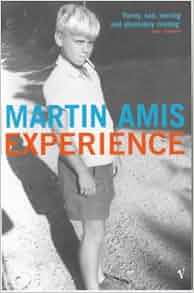
"Experience" - Martin Amis (2001)

Amazon link
"In this remarkable work of autobiography, the son of the great comic novelist Kingsley Amis explores his relationship with his father and writes about the various crises of Kingsley's life, including the final one of his death.

Amis also reflects on the life and legacy of his cousin, Lucy Partington, who disappeared without trace in 1973 and was exhumed twenty years later from the basement of Frederick West, one of Britain's most prolific serial murderers."
The above from the Amazon synopsis. I like Martin Amis (and the book) for his brutal, revelatory honesty. He gets a hard time from sections of the press, being out of tune with a feminised air du temps.

On the other hand ..
"On election night in the US, he and his wife anticipated a win for Hillary Clinton, and were “rubbing our hands together over the size of the landslide”. The next day, he was put in mind of something Sebastian Haffner, the German historian, said after Hitler came in. “He said the feeling was not of horror; it was of complete unreality. You go out into the street and people look different. The commerce, the cars; it all looks staged for your benefit. Completely make-believe. A sick-making feeling. And here it is. And what the fuck did they expect?”

Thursday, January 11, 2018

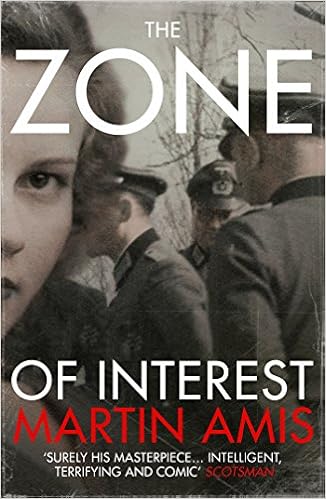
"The Zone of Interest" by Martin Amis

Amazon link

This is, I think, the first Martin Amis novel I've actually read.

Shocking.

I guess I had him pegged as a North London liberal, one of the golden generation who probably couldn't actually write that well, or who was transfixed by self-referential Islington-angst like Ian McEwan (am I being unfair?).

But no. Amis can write, he's interested in big questions and he's not restrained by bien-pensant shibboleths (or not much).

Hence a novel concerned in minute detail with human relationships between the Nazis at .. Auschwitz.

Very brave.

---

Here's a plot summary.
"The novel begins in August 1942, with Thomsen's first sight of Hannah Doll, wife of Paul Doll, the camp's commandant. (Doll's name is similar to Otto Moll, a notorious camp commandant in real life.)

He is immediately intrigued and initiates a few encounters with her. In time their relationship becomes more intimate, even though it remains unfulfilled. Despite their attempts at discretion, Paul Doll's suspicions are raised. He has her followed by one of the camp's prisoners, and is informed by him that they did indeed make two exchanges of letters.

While spying on Hannah in the bathroom (as he does regularly), Paul watches her read the letter from Thomsen secretly and rather excitedly, before destroying it. From that point onward, his wife becomes increasingly contemptuous of him, viciously taunting him in private, and embarrassing him in public.

Paul decides to assign Szmul, a long-serving member of the Sonderkommando, to the murder of his wife. He does so by threatening to capture Szmul's wife, Shulamith. The murder is scheduled to take place on April 30, 1943 - at Walpurgisnacht."
Thomsen is the nephew of Martin Bormann and leads a rather charmed life. Not that this saves him in the end.

In his afterword, Amis writes about the paradox of Nazism. Why the final solution? Why did they do it?

And quotes Primo Levi:
"“Perhaps one cannot, what is more one must not, understand what happened, because to understand [the Holocaust] is almost to justify ... no normal human being will ever be able to identify with Hitler, Himmler, Goebbels, Eichmann, and endless others. This dismays us, and at the same time gives us a sense of relief, because perhaps it is desirable that their words (and also, unfortunately, their deeds) cannot be comprehensible to us. They are non-human words and deeds, really counter-human...”
and then comments, "Historians will consider this more an evasion than an argument."

But Amis offers no analytical thoughts of his own.

---

Martin Amis is a novelist, not a sociologist. We look to his characters for explanations .. that is to say, their personality types. And here the Myers-Briggs/Keirsey schemes add value once again.

In the novel, Auschwitz presents itself as an environment of selection for Nazi staff. They are physically located at the gas chambers, the ovens, the pyres, the slave-labour factories and the centres for vivisection. It is impossible to ignore the smells, the screams and .. just what you see in front of you.

The primary screening attribute is empathy coupled with imagination. No-one with any degree of generalised empathy could possibly tolerate the place. Few Idealist NFs amongst the camp-Nazis.

Next focus on role: these are either abstract (policy and strategic) or concrete (operational).

Amis's hands-on characters, those who conduct 'selections' and 'actions' at Auschwitz are concrete ST types, generally logistical Guardian STJs. They have internalised that the jews, 'untermenschen', the handicapped and insane are to be classified as 'other', and are inured to 'the process'.

They're rule-followers.

The 'racial purity intellectuals' (like Goebbels and Hitler himself) do not physically attend the camps: for them, the raw physicality of death never intrudes. Their lack of empathy is abstract - the same as that of any military person or politician who is prepared to carpet bomb, or detonate nuclear weapons over cities.

For these people in themselves, Nazism is only an act of the intellect: either a deduction from certain principles or the righteous struggle on behalf of one imagined community ('the Aryan race') against its outgroups (the 'untermenschen'). Yes, the Nazis have their own version of SJWs - call them Racial Justice Warriors.

There is a third category of person: those who are caught up in the process but not directly involved in implementation. IG Farben business executives who are allocated concentration camp slave-labour, the protagonist Thomsen who serves as liaison between Auschwitz operations and Bormann's Party Chancellery. Thomsen describes his position as a 'Mitlaufer', (p. 148),
".. we were obstruktive Mitlaufer. We went along. We went along, we went along with, doing all we could to drag our feet and scuff the carpets and scratch the parquet, but we went along. There were hundreds of thousands like us, maybe millions like us. "
I think people like that, trapped by circumstance, were of diverse psychological type - though naturally all exhibiting an overarching deficit of empathy and imagination (few NFs then).

---

It's both interesting and sad that none of the four temperaments leads to good governance.

  • The rule of Rationals, Plato's Republic, leads to (always over-simple and inadequate) grand theory dominating humanitarianism. It doesn't have to be fascism .. Stalinism is another example. And the neocon-sponsored Vietnam and Iraq wars.

  • The rule of Idealists, which we have - at least ideologically - in the West at the moment, imposes (very selectively!) a normative model of human nature which sterilises human relationships. It's also profoundly reactionary in scientific terms, demonising research which 'feels uncomfortable'.

  • The rule of Guardians, as seen with Theresa May, is the domain of the concrete - without insight and imagination, politically ballistic, focused on operations over strategy. Destined to hit the wall when new thinking is required.

  • And finally, and perhaps most scary, the rule of Artisans. Those thrill-seeking adventurers who shoot from the hip, are easily bored and crave excitement. Welcome aboard, Mr Trump!
Yes, we are truly doomed to stumble from trap to trap.

---

What was Hitler's type by the way? Apparently INFJ, Of course, he never personally visited a death camp.

Hitler was an emotional and chaotic Idealist leader, whose moralistic drives had to be turned into policies and strategies by Rationals - and then implemented by Guardians and Artisans.

Reading his Wikipedia entry, Martin Bormann comes across strongly as a Guardian ESTJ.