Showing posts with label Roger Penrose. Show all posts

Monday, December 09, 2024

That Roger Penrose biography


Amazon link

I have just read this biography of Roger Penrose ("The Impossible Man" by Patchen Barss) and I am conflicted. The author has spent years researching the book, visiting key locations, interviewing most of the people who were central to Penrose's life and spending a large amount of time befriending Roger Penrose himself. 

There is a great deal of personal detail about the minutiae of Penrose's life and relationships: with parents, siblings, friends and ex-partners.

In the old days this could have been an interesting and insightful picture of an intriguing man and his truly transformational ideas in mathematics and physics. Yet, we no longer live in those days: to get published today one has to adopt a moralising, self-righteous and judgemental tone. 

Victims must be found and Roger Penrose must be found to be at fault.

It's not quite a hit-job, but it's in that paradigm. The author's hard work has given us a voyeuristic picture to be sure but it's not super-surprising: most lives are like that in kind if not degree. 

Such prurience might be forgiven if it led to deeper understanding but it does not. The author seems to think it's Penrose's fault that he turned out - in terms of emotional distance and intense intellectual focus - much like his father, but that doesn't surprise the majority of humanity who have heard the saying that 'the apple does not fall far from the tree'.

Peter Woit has a similar distaste for the patronising tone of this biography and its lack of interest in Penrose's specific accomplishments - although saying that Penrose's manner of relationships was typical of upper-class Englishmen of his generation (born in the 1930s) understates just how specifically detached from intimate emotional competence Roger Penrose actually was and is.

The comments on Woit's blog are interesting too. Someone said that Penrose's naivety led to him being taken advantage of by the author who kind of set him up - and that too sounds plausible.

There is room for a better book which does what Penrose himself failed to do in several of his own publications: explain what is unique and valuable in Roger Penrose's work in terms ordinary mortals can sort of understand.


Trivia note: I spoke once to Professor Penrose on the telephone in the 1980s, when I led a team at the STL research lab in artificial intelligence: we were considering hiring from his post-doc team. Penrose was helpful but reserved, as I recall, as if talking to business people about non-science topics only necessitated the loan of a few neurons for the duration of the call...

Sunday, September 25, 2016

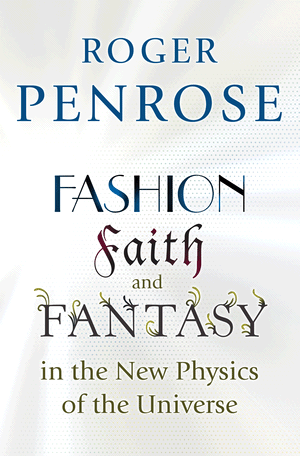
Fashion, Faith and Fantasy: a kind of review

Amazon link

I have just "finished" this book and put my hands up in dismay at the thought of reviewing it.

Roger Penrose is now 85 and this book may be the final presentation of his worldview. Although he talks about the 'layman' as his audience, potential readers should recall "The Road to Reality". In Amazon reviews of that tome, retired maths professors and physics PhDs lined up to recount at which chapter they hit the limits of their knowledge and had to give up.

This volume is not so different.

In a nutshell:

1. Penrose dislikes String Theory because its extra dimensions admit too many functional degrees of freedom (basically the number of possible field configurations).  It is not explained clearly why the super-explosion in the functional freedom space size is problematic, although he does make a related point that he believes that the six 'curled-up' dimensions are actually unstable and should collapse.

Perhaps it's obvious.

2. Quantum Theory is seen as a partial or incomplete theory - in particular, Penrose thinks that its linearity will be violated in an improved theory. He believes that the reason we don't observe 'Schrödinger's cat' spatial superpositions is due to the gravitational effects of superposition (he takes spatial delocalisation to have a real gravitational effect, aligning with his ontological realism for the quantum state). Specifically, the gravitational self-energy due to the superposition generates energy uncertainty, equivalent to time-uncertainty, hence superposed stationary states collapse into a position eigenstate very quickly. As he explains it, the maths behind this is pretty advanced, requiring general relativity.

3. Cosmologically, Penrose is not a fan of inflation, basing his criticisms on the 2nd Law and entropy. His criticisms have force suggesting that inflation retains support faute de mieux.

What does Penrose himself suggest as alternatives? He thinks twistor theory (a framework featuring emergent space-time) continues to have promise, and believes that a particular kind of bouncing, recurrent universe traversing through repeated big-bangs can explain the extraordinarily low entropy 13.8 billion years ago.

I think it's good for physics that he wrote this book, but absent a huge background in general relativity, complex analysis, twistor theory, quantum field theory and tensor analysis it's difficult to assess the merits of his arguments.

Wednesday, September 14, 2016

Fashion, Faith, and Fantasy

Amazon link

My hard copy has just arrived, a respite from reading Gareth Stedman Jones' theory-and-history-dense biographical tome, "Karl Marx: Greatness and Illusion".


Here is how Peter Woit describes Penrose's book.
"Besides a mathematical appendix, the book is divided up into four parts:

"Fashion

"This is the section that deals with string theory, and Penrose’s central objection is to the use of extra spatial dimensions as a crucial part of the theory. When trying to use string theory as a unified theory, an assumption is made that one can take four space-time dimensions very large, and the rest very small, decoupling the large and small dimensions. Penrose argues that there is no reason to believe one can consistently do this, that there should be couplings between these degrees of freedom that cannot be ignored, leading to instability of the theory, rather than a stable ground state with large dimensions.
...

"Faith

"In this section Penrose addresses the measurement problem of quantum mechanics, pointing out correctly that our standard story about quantum mechanics introduces an “ontological shift”, indicating that something more is going on than a well-understood consistent framework. He favors the idea that perhaps the introduction of gravity into the usual framework could resolve this problem, backing this up a dimensional analysis argument that a relevant effect could come from gravity, while being too small to be observable so far.
...

"Fantasy

"Here Penrose describes in detail some basic problems in the theory of cosmology, and how they are supposedly resolved by the theory of inflation. He explains that characterizing this as “fantasy” is not meant to be purely critical, that “fantasizing” about the moment of the big bang is what theorists do in the absence of compelling evidence, and that he just has other fantasies he thinks worthwhile.
...

"A new physics for the universe?

"In a final section, Penrose describes some of his more positive ideas addressing the problems pointed out in the earlier sections. This begins with a wonderful summary of the theory of twistors, and I strongly suspect that he’s right that this very different way of thinking about space-time geometry will ultimately be part of any successful integration of our understanding of quantization and geometry. That this geometry is very specific to four space-time dimensions provides yet another reason for skepticism about the fashion of theories with more spatial dimensions."
Update: I have just been reading the mathematical appendices and - just as with The Road to Reality - Penrose's concept of 'lay person' essentially equates to: reader trained in mathematics and physics to at least graduate level, but not a practising post-doctoral physicist!

---

You might also be interested in John Baez's blog, Azimuth, where he has four pieces published so far under the general title, "Struggles with the Continuum". Part one is here, and each part links to the next.
"Is spacetime really a continuum? That is, can points of spacetime really be described—at least locally—by lists of four real numbers (t,x,y,z)? Or is this description, though immensely successful so far, just an approximation that breaks down at short distances?

"Rather than trying to answer this hard question, let’s look back at the struggles with the continuum that mathematicians and physicists have had so far."
Part one is devoted to Newtonian mechanics and considers point particles moving under gravity. Is this well-understood and well-behaved?

No!
"Xia proved in 1992 that with 5 or more particles, there are solutions where particles shoot off to infinity in a finite amount of time!"
The second part introduces the quantum mechanics of charged point-particles (deploying the uncertainty principle). This makes a difference, but things break down with more than three spatial dimensions.

Part three brings in special relativity, and part four quantum field theory.

There is at least one more part promised, and the level of analysis is not beyond that of a maths/physics graduate - at least to get the general idea.

--

Today, another one of "the last days of summer", found us at Lytes Cary Manor in the 28 degrees sunshine.

Lytes Cary Manor, Somerset

We had a picnic, swished off a wasp or two, took a walk around the woodland trail then sat in the gardens for a while, watching the Yeovilton helicopters training overhead. Then we came home.