Showing posts with label Interstellar travel. Show all posts

Thursday, January 31, 2019

Interstellar AI: a new paper from Hein and Baxter


Centauri Dreams has a series of posts: "Artificial Intelligence and the Starship" which review "an absorbing new paper called “Artificial Intelligence for Interstellar Travel, now submitted to the Journal of the British Interplanetary Society" by Andreas Hein and Stephen Baxter. Baxter is the well-known science-fiction writer.

I checked out their paper on the arxiv. It's disappointing.

Here's the abstract.
"The large distances involved in interstellar travel require a high degree of spacecraft autonomy, realized by artificial intelligence. The breadth of tasks artificial intelligence could perform on such spacecraft involves maintenance, data collection, designing and constructing an infrastructure using in-situ resources.

Despite its importance, existing publications on artificial intelligence and interstellar travel are limited to cursory descriptions where little detail is given about the nature of the artificial intelligence. This article explores the role of artificial intelligence for interstellar travel by compiling use cases, exploring capabilities, and proposing typologies, system and mission architectures.

Estimations for the required intelligence level for specific types of interstellar probes are given, along with potential system and mission architectures, covering those proposed in the literature but also presenting novel ones.

Finally, a generic design for interstellar probes with an AI payload is proposed. Given current levels of increase in computational power, a spacecraft with a similar computational power as the human brain would have a mass from dozens to hundreds of tons in a 2050-2060 time-frame.

Given that the advent of the first interstellar missions and artificial general intelligence are estimated to be by the mid-21st century, a more in-depth exploration of the relationship between the two should be attempted, focusing on neglected areas such as protecting the artificial intelligence payload from radiation in interstellar space and the role of artificial intelligence in self-replication."
They use some formalisation and present a taxonomy of four different kinds of AI:
"We distinguish between four types of AI probes:

Explorer
  • capable of implementing a previously defined science mission in a system with known properties (for instance after remote observation);

  • capable of manufacturing predefined spare parts and components; Examples: the Icarus and Daedalus studies.
Philosopher
  • capable of devising and implementing a science program in unexplored circumstances; capable of original science: observing unexpected phenomena, drawing up hypotheses and testing them;

  • capable of doing this within philosophical parameters such as planetary protection;

  • capable of using local resources to a limited extent, e.g. manufacturing sub-probes, or replicas for further exploration at other stars.
Founder
  • capable of using local resources on a significant scale, such as for establishing a human-ready habitat;

  • capable of setting up a human-ready habitat on a target object such as part of an embryo space colonization programme;

  • perhaps modifying conditions on a global scale (terraforming).
Ambassador
  • equipped to handle the first contact with extraterrestrial intelligence on behalf of mankind, within philosophical and other parameters: e.g. obeying a Prime Directive and ensuring the safety of humanity."
These are engineering classifications and don't correspond to any sensible theoretical taxonomy of agent types. Perhaps that wasn't the intention but in terms of defining a research program which can dovetail with an interstellar vehicle programme, we do actually need a sensible roadmap for AI in the appropriate terms. Referencing AGI doesn't cut it, because today that term labels the problem only.

I didn't find their mathematical transliteration of their verbal points useful. How can I convey my problem?

∃x.question(me, unspecified-audience, conversation-procedure(x, describes(problem(me, non-utility-of-their-maths), unspecified-audience))).

I trust you are now enlightened in all senses.

I plan to write some more here about a more ecological way of thinking about agent taxonomies. Here's a brief preview.
Agents are discrete entities which exhibit behaviour in their environments. Agents are bound by the laws of physics, which therefore don't per se differentiate between agents which we find boring (lumps of rock) and agents we find interesting (animals, people).

Non-trivial agents are entities whose behaviour deviates from the behaviour of a similarly-sized-and-placed lump of rock - an entity whose behaviour could be predicted from the laws of physics and easily-obtained boundary conditions without too much difficulty. Non-trivial agents have complex and inaccessible internal states which produce enhanced behaviour by use of free-energy.

Agents are characterised by these four intentional parameters: beliefs + goals and perceptions + actions. These also work for rocks but it's a trivial case. An interesting problem is to link the intentional level of description to the input-output behaviourist level and then back to the laws of physics. This can always be done in principle.

Non-trivial agents are always mechanisms, whether biologically-living or fabricated. They do not in general need to be constructed so as to use explicit symbolic manipulation (theorem-provers or planners) as part of their mechanisms, although research scientists may use such concepts to describe and analyse their behaviour.

Agents get a lot more interesting when they're social, and when social objectives and individual goals are contingent, possibly contradictory and need to be dynamically negotiated. It's believed that mutual-modelling, language and conversation, and consciousness are all emergent from that scenario.

It's possible to devise a scale of intellectual competence for agents, linked to the capacity to effectively deploy abstractions to cope with complex and novel situations. It's not too clear how to model this taxonomy in the architecture space apart from such obvious points as "more processors and memory, and cranking up the clock rate" and their neuronal equivalents. Those remedies are not of course wrong but it's not enough.

Now apply this to the design of autonomous interstellar probes.

In almost every respect, the engineering domain of interstellar missions is an application area for AI rather than something which raises fundamentally new theoretical questions.

Thursday, April 13, 2017

A star drive which might work (Mach Effect)

NASA has just announced this: "Mach Effects for In Space Propulsion: Interstellar Mission".

From Centauri Dreams:
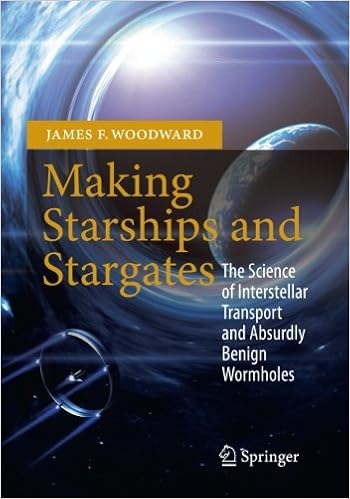
" In this case, the work goes toward a so-called Mach Effect Thruster (MET). Mach effects are transient variations in the rest masses of objects as predicted by standard physics where Mach’s principle applies. Proponents believe they offer the possibility of producing thrust without the ejection of propellant, as discussed in James Woodward’s Making Starships and Stargates: The Science of Interstellar Transport and Absurdly Benign Wormholes (Springer-Verlag, 2012).

What Fearn proposes is to investigate such thrusters by continuing the development of laboratory-scale devices while designing and developing power supply and electrical systems that will determine the efficiency of the Mach Effect Thruster. The analytical task is to improve theoretical thrust predictions and build a reliable model of the device. At the theoretical level, this team is definitely talking deep space, with part of the proposal being to:

'Predict maximum thrust achievable by one device and how large an array of thrusters would be required to send a probe, of size 1.5m diameter by 3m, of total mass 1,245 Kg including a modest 400kg of payload, a distance of 8 light years (ly) away.'"
Here's the book mentioned.

Amazon link

I downloaded the book-sample to my Kindle app and so far it's both well-written and interesting. Unlike the 'EM Drive', which was widely criticised and seems to violate conservation of momentum, the Mach Effect appears to be a valid consequence of General Relativity when combined with Mach's principle - at least, no-one so far has come forward with a convincing theoretical refutation.

Experimental effects so far appear to be small (if they exist at all) and unproven, but NASA evidently considers there could be something to it.

I'll probably read the book a little later. At least Jerry Pournelle will be pleased.

Wednesday, October 28, 2015

On colonising the observable universe quite quickly!


Stuart Armstrong and Anders Sandberg

Future of Humanity Institute, Philosophy Department, Oxford University, Suite 8, Littlegate House 16/17 St. Ebbe’s Street, Oxford, OX1 1PT UK.

---
Abstract

"The Fermi paradox is the discrepancy between the strong likelihood of alien intelligent life emerging (under a wide variety of assumptions), and the absence of any visible evidence for such emergence. In this paper, we extend the Fermi paradox to not only life in this galaxy, but to other galaxies as well.

"We do this by demonstrating that traveling between galaxies – indeed even launching a colonisation project for the entire reachable universe – is a relatively simple task for a star-spanning civilization, requiring modest amounts of energy and resources.

"We start by demonstrating that humanity itself could likely accomplish such a colonisation project in the foreseeable future, should we want to, and then demonstrate that there are millions of galaxies that could have reached us by now, using similar methods. This results in a considerable sharpening of the Fermi paradox."
The authors have in mind the launching of replicators both to other stars in our own galaxy and to other galaxies. They note that once the interstellar/intergalactic probe is up to relativistic speed it basically turns off and cruises. In cosmological time it's rather irrelevant as to whether the cruise time is hundreds, thousands or millions of years (the universe operate on a timescale of billions of years).
"However, the main difference between interstellar and intergalactic travel is merely a longer time until the destination is reached. If the contents of the colonizing probe are inert over long timescales (as they would need to be for many forms of interstellar travel) it is likely that they can be made inert over the longer flights to other galaxies." (Page 3)
We could send lots of probes without too much effort assuming a technology a few hundred years in the future.
"... we will first delineate a potential replicator probe design, and tackle how such probes could decelerate upon arrival. We will see what speeds these probes could move at, and how many duplicates need to be sent out to avoid collisions with intergalactic dust particles.

"Then we will consider the launch system – due to the great inefficiency of the rocket equation, it would be much more effective to use fixed launch systems than to count on the probes to power themselves. We will analyse these launch systems, and delve into some details as to how they could be powered (four different scenarios will be considered, from speculative antimatter drives to reasonable fission engines).

"It will turn out that only about six hours of the sun’s energy is needed to commence the colonisation of the entire universe! And this is the kind of energy that a future human civilisation could quite easily aspire to, as we shall demonstrate." (page 4).
They propose we disassemble Mercury (they describe how to do it with mass drivers, and on page 16 calculate it will take 31 years and 85 days!) and use the material to create a Dyson Swarm of solar mirrors powering propulsion devices (lasers, particle beams, coilguns ...).

The probes will be accelerated by these power-plants to relativistic speeds at which point they will coast to their targets. Thousands, millions or billions of years later they will arrive, slow down and find asteroids or planets to start terraforming. The seeds they carry will germinate .. and our descendants will walk under the light of other stars .. in other galaxies.

They're careful to stay within the envelope of feasible, or exploratory engineering,


so why didn't aliens on some of the other relatively nearby galaxies get to us first? They show that there's plenty of candidate colonisers (of the order of a million galaxies) and plenty of time for it to have happened (page 25).

The Fermi Paradox just got sharper.

All in all, a very stimulating big-concept read. Here's a links to Anders Sandberg's blog.

Thursday, May 08, 2014

An interstellar colony?

David Waltham's book "Lucky Planet" suggests we may be the only intelligence in the visible universe. This, he suggests, is because of the difficulties in stabilising a planetary climate over the multi-billion years required to evolve intelligent life.

Of course, there will be plenty of planets in our galaxy which could (perhaps with a degree of terraforming) support sustainable human colonies now we exist - if we could only get there and put the work in. We have just 500 million years before the Earth becomes uninhabitable.

The Wikipedia article on interstellar travel suggests that sending conventional massive spacecraft with loads of people and tons of equipment between the stars is really a non-starter. What is the minimal payload it makes sense to send?

Assume we can image and research target exoplanets from the solar system. We want one with oceans, land and at least carbon dioxide in an otherwise benign atmosphere. Send a small package of photosynthesising eukaryotic cells and let them propagate in the ocean. Wait a billion years for intelligent life to evolve and get around to building radio telescopes. Send them engineering schematics for our own DNA and cell structure,  artificial wombs and AI nannies. We're there folks, with the maximum of bits and the absolute minimum of atoms.

Wait, you say, it's all too slow.

In which case we have to send more atoms first. It's always better to send bits at the speed of light and reconstitute complex objects at the other end, the issue is how to bootstrap the process. The minimal remote terminal has to decode designs sent using (e.g.) modulated laser light and fabricate stuff using a 3D printer type of thing. Sadly, it takes an advanced technological civilization to build and operate those kinds of things - far too much for our first nanoprobe landing on a moon under another star.

I suggest the only way we're going to get this interstellar colonisation thing to work is by copying the only effective bootstrap process we know - life itself. Starting from a nanoprobe seed we have to design cycles of incremental development using only local resources which ends up with a fully developed remote fabricator - in effect a matter transmitter. Then let terraforming and colonisation begin!

Note: designing a suitable techno-pseudoevolutionary process is left as an exercise for the reader.