Showing posts with label Neuroscience. Show all posts

Thursday, April 26, 2018

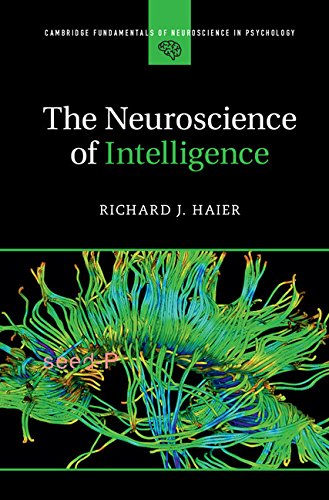
Practical review of intelligence research - Rich Haier

Amazon link

This book is "Rich" Haier, Professor Emeritus in the Pediatric Neurology Division of the School of Medicine at the University of California, Irvine, writing to his students. He wants to tell them about the three-pronged nature of contemporary research into intelligence: psychometric tests (delivering 'g'), neuro-imaging and genomics.

Leveraging all three approaches, he comprehensively demolishes blank-slate ideas that intelligence doesn't really differ between individuals, genders and/or ethnic groups, and shows that intelligence differences (as measured psychometrically or in life outcomes) have measurable correlates neuro-anatomically and genetically.

Since higher IQ correlates positively with desirable life outcomes, he is a strong proponent of research which might lead to future IQ improvements, either through some kind of  'IQ pill' or targeted allele-engineering.

Haier is plainly an experimentalist, not a theoretician. He is happiest explaining the details of studies, neuro-imaging equipment and brain images: he's almost too thorough. He is also good on the unexpected results: when men and women with identical (and high) mathematical abilities were scanned while solving advanced math problems they were equally successful - but the men used the spatial parts of their brain while the women were using verbal modules.

While we are plainly in the middle of a technology-led revolution (well-described at an introductory level) it's frustrating that the jury is still out on all the important questions. We don't know what the brain is doing which distinguishes consciousness from unconsciousness; we don't really know how the high-IQ brain differs in structure or function from the low-IQ brain although there are some suggestive ideas; we don't know how to alter/improve IQ by any well-attested intervention.

Perhaps this will change over the next few years. Given the stigma which still attaches to intelligence research in the West, perhaps we'll have to wait for the Chinese to tell us.

Thursday, April 20, 2017

Those bright, flickering webs

As a hopeless case, I was finally admitted to psychotherapy.

I lay on the couch, as relaxed as I ever get, and listened to the analyst.
"I see that your profession is neuroscientist. Now, I have your file here, but perhaps you could explain the problem to me in your own words?"
I sighed: repetition had become tedious in the extreme.
"In the streets, at work and at home, .. I am surrounded by systems. They're controlled by webs of neural tissue. They spin carefully-crafted, conformist and entirely-deceptive narratives .. purporting to explain to themselves and others just why they do what they do."
The analyst paused a moment to parse these rather abstract reflections,
"And when you see the people around you, your loved ones, what exactly do you see?"


"I see what my MRI scanner sees: heads filled with bright, flickering webs of neural activation. Enhanced glucose metabolism. I see protoplasmic circuitry doing what evolution has honed it to do. ... I see the laws of physics operating."
At this the analyst looked thoroughly alarmed. He stood up and walked across to his desk where he made a hushed and urgent call. I caught the term 'psychopath'.

Returning, he resumed speaking almost before he had sat down.
"You might have what we professionally call a framing issue. The answer is ..."
But I was no longer listening, I was focused instead on the intricate movements of his jaw, tongue and larynx, all controlled by that bright, flickering web I could almost see inside his skull.

Saturday, September 03, 2016

The Experience Room

Look at pictures of your parent's house as compared to yours. It's a bit cluttered but in essence not a lot different, is it?

Not as many electrical points.

It's tempting to assume that, like the bicycle, we've got there. We know how to make the ideal person-cave.

Not at all. We're in the interregnum while they figure out programmable matter: self-reconfiguring smart dust, computronium.

You know, like how the Terminator gets smashed up, then flows like a black fluid back into .. the Terminator.


The house of the future. It's made of smart matter - tiny programmable components which attach to each other to form chairs, tables, rugs, pictures and screens. We sometimes call computers a case-study of 'deferred design'; the future dwelling is deferred décor.

Your apartment will simulate any reality by creating smart-dust avatars (telepario) with the floor, walls and ceiling showing synthesised scenes. VR without the helmets.

You might still run into the walls, though. Much better to directly stimulate the brain. Emulate all sensory inputs and interpret all effector outputs in a totally simulated environment.

How many SF stories have we read with that theme? The slippery slope to the prospect of the brain in a vat, so unsettling at the end of Dan Simmons's spooky 'Flashback'.

We're living the transitional decades, waiting for AI, nanotech, genomics, neuroscience and materials-tech to catch up. The world will then lurch to a very different place.

Thursday, March 17, 2016

AI really is applied neurobiology

When I was researching AI back in the 1980s, we'd all heard of Geoffrey Hinton. He was the key pioneer of artificial neural nets, a field which at the time wasn't making much progress. He never turned up at the main AI conferences where we discussed logics, theorem-proving and symbolic planning programs. A different paradigm entirely.

I never set eyes on him.

Professor Hinton has had the last laugh. His work, and that of close colleagues, underpins the recent AI successes of Google (AlphaGo!), Baidu, Facebook and Microsoft. Whether it's speech recognition, automatic translation or face recognition, deep-learning neural nets are powering it along behind the scenes.

Here's Professor Hinton's recent address to the Royal Society (h/t Steve Hsu). I don't normally find time to watch other people's recommended videos, but I made an exception for this one. Hinton rather reminds me of Richard Dawkins in appearance and style. He's lucid, understated and staggeringly smart. Here he engagingly tells the story of the fall and rise again of the neural net approach to artificial intelligence.


At almost the end of the talk, he puts up this slide for almost two seconds .. and then hides it.

The "secret slide"
I'm sure he just felt it wasn't quite aligned to his audience which didn't seem packed with AI specialists.

There was always a tendency within AI which made a distinction between our language for describing agents as knowing, believing, wanting entities - using intentional, symbolic terms, and the presumed internal agent architecture which caused behaviour - and which need not involve pushing symbols around at all.

We've long been aware of the awesome computation underlying animal/human unconscious situational competences. We've long failed to replicate such abilities using 'Good Old-Fashioned AI'. Perhaps it's time to conclude, with Prof. Hinton, that the architecture which realises such capabilities really has to be that of the deep-learning neural net.

Prof. Hinton is at pains to point out that the most sophisticated current systems fall well short of human brain structure both in terms of quantity of neurons and complexity of interconnection and communication.

We should keep reminding ourselves that brains are doing important stuff at the granularity of small groups of molecules: they are the essence of nanotech.*
___

* In fact, we should probably be using our best AI neural nets to figure out what our own neurons are actually doing. The massive connectivity found in brains may implement features and structures so complex as to be beyond unaided human comprehension.

[In an interesting analogy, you may recall the 'killer app' for quantum computers is said to be the simulation of quantum systems themselves, intractable with conventional computers.]