Showing posts with label Pope Francis. Show all posts

Tuesday, December 17, 2024

The film "Conclave"


We went to see "Conclave" (the film) this afternoon. I had read Robert Harris's novel and was expecting a kind of fashionably-liberal attack on Catholicism but was pleasantly surprised. Stereotypes and cheap shots were not much in evidence and the characterisations and 'political positions' of the various papal candidates seemed plausible.

It's refreshing to see a film which is adult enough to differentiate between the mission of the Church and its all-too-fallible leadership.

We know by the ending of the film (as in the book) where its true feelings lie, and it's hard to disagree. When "Love thine Enemy" comes into conflict with "Smite thine Enemy" we surely have a suspicion where the New Testament stands.

And yet: Jesus had in mind the imminence of the arrival of the Kingdom of Heaven, facilitated by the expression of universal empathy and acceptance. However: if you will the means you have to will the ends: loving your enemy when he doesn't love you is a quick trip to martyrdom - and at a community level - extinction. Perhaps that doesn't matter if the Kingdom of Heaven is at hand but most people - most Catholics - would fight back under those circumstances.

We do now know in wonderfully vivid detail how the Conclave works.

Wednesday, August 14, 2024

"Lord of the World" - Robert Hugh Benson


From the Wikipedia article:

In March 2023, Pope Francis again mentioned that he "always recommends" Lord of the World during an interview with the Argentine newspaper La Nación. He referenced the book within the context of "ideological colonization" and in response to a question about non-binary gender options appearing on government forms, saying that such a phenomenon reminded him of the Benson's "futuristic" world, “in which differences are disappearing and everything is the same, everything is uniform, a single leader of the whole world.”

Robert Hugh Benson’s 1907 dystopian novel, "Lord of the World", parallels the Book of Revelation to a significant extent, particularly in its depiction of the Antichrist, the persecution of the faithful, and the ultimate conflict between good and evil. However, it focuses on a direct critique of modern secularism and uses a conventional narrative structure. Benson's novel can be seen as a modern reimagining of the apocalyptic themes of Revelation, tailored to the concerns and anxieties of his own time, which are not dissimilar to our own, hence its enduring popularity. It also has its moments of striking prediction, including weapons akin to thermonuclear bombs.

Its style reflects the transition between the stodgy Victorian novel and the more readable style coming into fashion in the first decade of the twentieth century. As Pope Francis remarks, it starts with a heavy data dump but improves after that, becoming quite page turning. It's plain, pedestrian writing you'll find here nonetheless.

Its catholicism is old-fashioned: robust, down-the-line, rather literalist supernaturalism. There are plenty of Latin prayers which you may need the Internet to make sense out of: I suppose Benson expected his readership to just know them.

Thursday, May 17, 2018

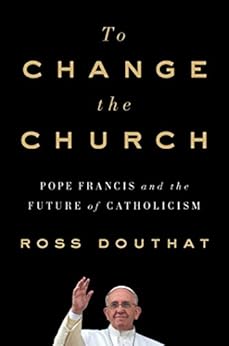
"To Change the Church" - Ross Douthat

Amazon link

Ross Douthat is not very well known here but in the States he has a profile as a conservative commentator on the NYT. He is also a Catholic convert.

Here is what his fellow New York Times writer, Paul Elie, had to say about Douthat's work:
"To Douthat [Pope] Francis is an accommodationist, and decline has reached the apex of the church. “This is a hinge moment in the history of Catholicism,” he declares, “a period of theological crisis that’s larger than just the Francis pontificate but whose particular peak under this pope will be remembered, studied and argued about for as long as the Catholic Church endures.”

What immediately follows is an adroit, perceptive, gripping account of Catholic controversializing. Douthat sets out the liberal and conservative “master narratives” about the Second Vatican Council and then offers a third narrative that deftly blends the two.

He sketches the life and times of the future pope, Jorge Mario Bergoglio, the Argentine Jesuit archbishop of Buenos Aires. There’s commentary on past controversies and a brief history of Catholic teaching on marriage, from Matthew 19 (“What God has joined, let not man put asunder”) to Humanae Vitae, the 1968 encyclical in which Pope Paul VI upheld the ban on artificial birth control. ...

And then, as Douthat reaches what he sees as the heart of the matter — the Vatican synods on marriage and the family in 2014 and 2015 — his culture-warrior tendencies stir fully to life.

He casts the synods as a battle: warring factions, attacks and frontal assaults, purges and collaborators. Francis’ openness to the German cardinal Walter Kasper’s proposal to relax the ban on divorced-and-remarried people in Germany receiving Communion at Mass is framed as a liberal pope’s “crusade to change the church.”

Although Francis has invited free discussion more than any previous pope, his efforts to shape the synod’s outcome (he is the pope, after all) are seen as “stage-managing” and “deck-stacking.” The synod fathers’ disputes are rolled down the slippery slope and deemed a “full-scale theological crisis” in which the hope that Francis would foster unity and renewal is undone by the supposed liberals’ supposed desire to accommodate “the sexual revolution and all its works.”

Douthat’s own position is traditionalist-cum-literalist: Any relaxing of the Catholic teaching on marriage — one man, one woman, one time — means that core teachings can be changed; if core teachings can be changed, the Catholic Church is no longer the Catholic Church; and if the church is not the church, all hope is lost."
I started the book somewhat sympathetic to Douthat's position - Pope Francis has not endeared himself with his vague anti-capitalism, ecological posturing and seeming inability to sort out the Vatican.

Douthat is a smart guy but he has a problem - blind faith. Once he committed to switching his critical intelligence off to accommodate a strangely-invisible super-presence, the fount of moral authority and one which extruded a portion of itself into a low-key itinerant Jewish preacher some two thousand years ago .. well, he felt he had to commit himself to Jesus's reported words as divinely-inspired axioms for life.

No matter the grievous consequences to perfectly respectable people (remarried divorcees - the case in point - enjoined to live as 'sister and brother'), the letter of the law must be served or the heavens shall fall. In the face of such egregious nonsense one can only wish more power to Francis's elbow.

As Elie observes:
"Vatican II was at once the church’s response to a crisis and the perpetuation of it. In less than five years the council fathers made changes whose number and scale dwarf the modest proposals floated in Francis’ pontificate — made them over the objections of Bill Buckley and other pundits who styled themselves as more Catholic than the pope. The biggest change had to do with the church’s relationship to Judaism, other churches and other religions.

In a few strokes, Jesus’ hard saying “No one comes to the Father except through me” and its Catholic expression (“Outside the church there is no salvation”) were softened and qualified. The change was profound and tradition-defying. Ever since, the church has affirmed the integrity of other faiths; ever since, Catholics have had to ask themselves, “Why be Catholic, when other ways are O.K., too?” Ever since, there has been no one clear answer."