Monday, January 16, 2017

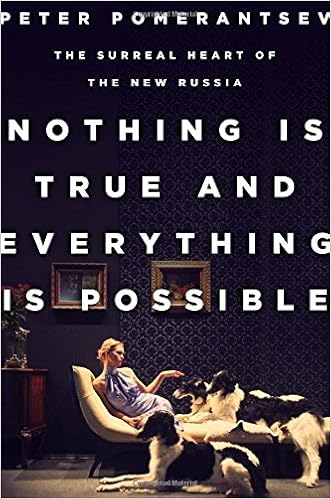
"Nothing Is True and Everything Is Possible"

Dominic Cummings said that no-one should 'pontificate on Putin’s mafia government' before reading this book.

Amazon link

Here are some excerpts from The Guardian's review.
"Pomerantsev, born in the UK to Russian émigré parents, spent almost a decade in Moscow working as a TV producer, making documentaries and reality shows for Russian audiences. He arrived in the early 2000s, in the midst of an oil boom that brought a measure of prosperity to many and huge wealth to a select few, creating a tidal wave of glitz and extravagance, especially in the capital.

Nothing Is True and Everything Is Possible is an entertaining if at times bleak chronicle of these years, depicting a world “where gangsters become artists, gold‑diggers quote Pushkin, Hells Angels hallucinate themselves as saints”.

...

"We also meet Vitali Dyomochka, a Siberian hoodlum turned cineaste. Dissatisfied with the quality of crime dramas on Russian TV – “it was all fake” – he took to making his own series, giving starring roles to several of his henchmen. There were no scripts, stuntmen or makeup: “all the blood you saw on the screen was real”, Pomerantsev writes, adding that “the guns and bullets were all real, too; when they filmed a shoot-’em-up in a bar the place was wasted”.

Djomochka allegedly got the series broadcast by getting his goons to threaten local TV stations; needless to say, it was a huge hit."

...

"Putinism itself is built on an ideology of all ideologies at once: liberalism; nationalism; conservatism; Orthodox tradition; an “anti-hegemonic” foreign policy.

As Pomerantsev points out, one key to the success of this new authoritarianism is that “instead of simply oppressing opposition, as had been the case with 20th-century strains, it climbs inside all ideologies and movements, exploiting them and rendering them absurd”.

The clearest example of this is the creation of a political system that has the appearance of democracy – regular elections, multiple parties, a free media – without any of the substance: the elections are rigged; the parties are all under the president’s control; the media do what their owners tell them, and the owners obey the Kremlin.

It’s this mismatch between form and content that has earned the Putin regime the name “virtual” or “imitation democracy”.

...

"Corruption, which affects almost every sphere of life, from major corporations to visits to the doctor, has taken root in the vast juridical twilight zone that emerged during the 1990s, and which the authorities have an active interest in maintaining.

Among the many other stories Pomerantsev follows is that of Yana Yakovleva, a businesswoman suddenly arrested for “illegally” trading in chemicals she has been selling perfectly legally for years. She’s the victim of “state raiding”, a widespread phenomenon in which government officials put the squeeze on businesses – finding owners to be in breach of fire-safety regulations, say, or in arrears with taxes they never owed; or, as in Yakovleva’s case, charging them retroactively with having broken a brand-new law.

She spends several grim months in prison before coming to trial; astoundingly, she wins and is released – but less because of her actual innocence than because her campaign has made her a useful pawn in a battle between two powerful Kremlin factions. “To make something happen in Russia,” Pomerantsev concludes, “you have to be both valiant protester and Machiavellian.”

"By the summer of 2010, when Moscow was wreathed in suffocating smoke from peat-bog fires, Pomerantsev had become increasingly frustrated by the constraints he faced in his work. His channel only wanted “positive” stories, and there were clear limits on what could be said and shown: he had to cut all the high-level politics out of Yakovleva’s story, for instance.

But on returning to the UK, he encountered the beneficiaries of the system he thought he had left behind – the oligarchs and bureaucrats turned businessmen who have siphoned wealth out of Russia and into London, the gilded post-Soviet youth who spend their time surrounded by their peers in an exclusive network of Mayfair nightclubs."
The words we use are value-loaded. In most historical societies, what we call corruption is the normal operation of 'big man' factional political economy. The Romans would have understood.

There is an economics literature on corruption, conceptualising it as rent-seeking and adding gratuitously to transaction costs. However, liberal democracies also have expensive mechanisms for arbitrating differences and setting priorities. The difference is more about stability and predictability: in a sense, liberal democracies have nationalised corruption and rebranded it.

The main thing I get from Peter Pomerantsev's book is that in today's Russia, society-wide trust does not exist and most state institutions do not work as such, being merely facades for powerful and arbitrary interest groups.

This so accords with history and natural human psychology that it jarringly reminds us again just how unlikely the relatively non-corrupt western model of bourgeois democracy actually is. The rule of law and the effectiveness of institutions requires elites to inhibit their emotions and personal drives, subordinating them to the rules.

Who knows how much of this is cultural and how much genetic? What we do know is that corrupt, clannish societies have enormous historical inertia, southern Italy being a case in point. The Russians haven't had much luck with their history in this regard, unfortunately.

As a root-and-branch picture of modern Russia, I'm with Mr Cummings. We should not be seeing Putin's state as a 'more vigorous capitalist society with more traditional values and less politically-correct nonsense'.

No, Russia is more like a capitalist version of Game of Thrones.

As a piece of writing, "Nothing Is True and Everything Is Possible" is mostly fascinating, but could have benefited from the attentions of an editor to cut out the occasional longueur.

Sunday, January 15, 2017

A natural (or green) burial

For the avoidance of doubt, Clare has always insisted on a green burial. A shroud or decomposable coffin, a small tree - a rowan would be ideal - planted on top.

We had heard that Wells Cemetery has a corner devoted to natural burials so we strolled down there yesterday. The cemetery is quite pleasant (pictured below) but there are no woodland plots, just a field adjacent to the main site reserved for 'lawn burials'. Not at all what she had in mind.


Wells cemetery

Apparently I am to be buried in an adjoining plot.

I'm good with that - it's not really my problem anyway. Perhaps I could have a yew? A service to future bowmen?

The headstones were in varied states of disrepair. You should plainly avoid anything where the stonemason drills tiny holes and then pops in different coloured stone flakes to spell out the legend. These inevitably fall out over the years. The best lettering is chiseled then painted.

The green/natural burial protocol forbids headstones. The idea is, over time, to create a new wood. There would be records in the office of course. And perhaps GPS coordinates on the Internet.

As we wandered amongst the graves, I suggested I could mark her eventual spot with a holographic projector. As the visitor approached, a projection of Clare would emerge which would greet and say a few words. It could be solar-powered for maximum greenness.


And then I thought: folk would be wandering through this graveyard assaulted by a cacophonous swarm of the long-dead springing into existence, like chuggers from hell.

My second thought was augmented reality. In the future, everyone will inhabit a reality painted with tailored virtualized overlays. This will let the dead speak only to those interested, and the dataset will live in the cloud, not on a weatherproof server under that rowan tree.

But by then, synthetic versions of ourselves will inhabit the datasphere, interacting on demand. It will seem like we had never died.

No-one will care about those spectral arboreal presences in Wells cemetery.

---

Note: these funeral arrangements are entirely speculative at time of writing.

---

Update (4th February 2017):

Clare has thought some more about the practicalities of a green burial in Somerset. Hence this video statement.


I guess we'll do what we can on the day in question.

Saturday, January 14, 2017

The long road to Go

Some people fill their dead time with shoot-'em-ups on their phones or tablets.

Boring.

I'm not interested in chess, but the game of Go has vaguely intrigued me. A brief search led me to the British Go Association and their recommended starter Android app, 'GOdroid'.


GOdroid screen shots

This app is for complete beginners, played on a 9x9 board on my Nexus 10.
I lost the first game.

I lost the second game more comprehensively.
OK, so this is not as easy as it appears. Time for some assistance. I turn to Amazon.

Amazon link

The book arrived this morning and looks promising.

---

No jokes please. I just wrote a post about building an AI system to play noughts and crosses. I am not planning to take on AlphaGo!

The long road to noughts and crosses

Clare innocently asks why, after five afternoons of programming, we still don't have a program which can play noughts and crosses.

The game seems pretty trivial. Just arrange for the program to play in the corners, then complete 'three in a row' if it can. Probably the system will never lose and will win quite often.

Yes, I could have done that.

---

I explain that in the version I'm working on, the computer starts with no information about noughts and crosses and no built-in ideas about how to play.

Faced with a blank board there are nine possible places to put its first 'X'. It has no reason to prioritise one over another, so it therefore generates nine possible board positions.

For each of these, it doesn't know where its opponent will place its first 'O', so that's eight possibilities it has to consider. It's now juggling a tree of depth two with 72 options.


The process repeats. No win or loss can occur until the fifth move (3 'X's and 2 'O's) by which time the tree has branched to 15,120 possible boards. Most positions are still in-play though.

Lacking a priori insight, the program has to apply a combination of things. Looking ahead, say, to depth 5, it can score future boards where it wins very positively, and positions where it loses very negatively. Ongoing positions it has to judge more heuristically, creating a 'how good is this for me?' score.

Then it has to somehow back-up these terminal scores which are maybe five or more moves out, bringing them back so that they give guidance for the very next move.

Effectively, the computer is asking itself: what next move maximises my chances to being on a road which ends up with a win, despite my opponent trying to thwart me on every turn?

This is the famous 'minimax' algorithm.

So plenty of apparatus to put together before the first cross gets entered in the first game.

I'm almost there.

---

Once the apparatus of tree generate-and-test has been written and debugged, it can easily be extended to interactions which are less trivial than noughts and crosses.

Automated Theorem Provers and Expert Systems also build trees and evaluate nodes against success criteria. The difference is that the trees they build are not adversarial, so no minimax.

But a conversation planning system is more like a two-player game.

My goal of a smarter chatbot with inference and conversational direction is still very firmly in my mind .. although it's a way off.

Friday, January 13, 2017

My weight training programme (video)

Here's an 8 minute video where I describe my weight training routine, which starts with an exercise bike HIT warm-up followed by floor exercises and free weights (dumbbells).

As of Saturday morning, 23 people have viewed this post .. and 3 people watched the video. What were the other 20 doing?


Some mistakes in my commentary:
  • the heaviest dumbbells are 14 kg each, not 14.5 kg 
  • the first weight routine is the 'bent over row' (not 'back over row') 
  • it's the 'bicep curl', not 'bicep crunch'.
The order I do exercises varies, there's no rule which says 'heaviest weights first' - in fact that's rather deprecated. Sometimes I start with arm flaps (not the technical term).

---

Credits to Clare for the camera work.

Thursday, January 12, 2017

Clare bought a cactus

From Lidl, actually

Proud of herself, she asked me to step into the kitchen:
"I've bought something new."
I gazed blindly around in confusion, my eyes eventually alighting on the pepper pot.
"You bought some new pepper?"
The new cactus was on the window ledge. I had been staring right at it.

It may be called 'Blindsight'.

---

She joked that if she ran away and replaced herself with another woman, it might be .. well, two weeks before I realised.

John Cook on automated theorem provers

(Source)

Mathematician and computer scientist John Cook restates the orthodoxy on automated theorem proving (ATP).
"When I first heard of automated theorem proving, I imagined computers being programmed to search for mathematical theorems interesting to a wide audience. Maybe that’s what a few of the pioneers in the area had in mind too, but that’s not how things developed.

The biggest uses for automated theorem proving have been highly specialized applications, not mathematically interesting theorems. Computer chip manufacturers use formal methods to verify that given certain inputs their chips produce certain outputs. Compiler writers use formal methods to verify that their software does the right thing. A theorem saying your product behaves correctly is very valuable to you and your customers, but nobody else. These aren’t the kinds of theorems that anyone would cite the way they might site the Pythagorean theorem. Nobody would ever say “And therefore, by the theorem showing that this particular pacemaker will not fall into certain error modes, I now prove this result unrelated to pacemakers.”

Automated theorem provers are important in these highly specialized applications in part because the results are of such limited interest. For every theorem of wide mathematical interest, there are a large number of mathematicians who are searching for a proof or who are willing to scrutinize a proposed proof. A theorem saying that a piece of electronics performs correctly appeals to only the tiniest audience, and yet is probably much easier (for a computer) to prove.

The term “automated theorem proving” is overloaded to mean a couple things. It’s used broadly to include any use of computing in proving theorems, and it’s used more narrowly to mean software that searches for proofs or even new theorems. Most theorem provers in the broad sense are not automated theorem provers in the more narrow sense but rather proof assistants. They verify proofs rather than discover them. (There’s some gray zone. They may search on a small scale, looking for a way to prove a minor narrow result, but not search for the entire proof to a big theorem.) There have been computer-verified proofs of important mathematical theorems, such as the Feit-Thompson theorem from group theory, but I’m not aware of any generally interesting discoveries that have come out of a theorem prover."
However, if you widen the discussion to automated deduction as we see in expert systems, planning systems and pretty much everything Google is trying to achieve, inference is everywhere.

Dominic Cummings on the media

"High prestige pundits and editors yield great power over the stories told (and have far more power over politicians like Cameron, unfortunately, than they realise) but the field is not based on real expertise. Fields dominated by real expertise are distinguished by two features: 1) there is enough informational structure in the environment such that reliable predictions are possible despite complexity and 2) there is effective feedback so learning is possible.

Neither condition applies generally to politics or the political media. In the most rigorous studies done, it has been shown that in general political experts are little better than the proverbial dart throwing chimp and that those most confident in their big picture views and are most often on TV  – people like Robert Peston, Jon Snow, and Evan Davis – are the least accurate political ‘experts’ (cf. HERE).

We know that cognitive diversity is vital for political accuracy yet almost all political institutions and the media – including the dominant people at Newsnight, the Economist, the FT, and Parliament – are actually remarkably homogenous, as discussed above, and they herd around very similar ideas about how the world works. Scientists and entrepreneurs in particular are almost totally excluded from political influence.

There is no structure to hold them to account either internally or externally so, like anyone when not forced to be rigorous, they fool themselves."
From Dominic Cumming's blog. It's a very long piece, but written with intelligence and a scathing disregard for bubble-think. Quite educational.

The scientists allowed on TV normally express the liberalism of academia, and are usually interviewed outside of their field of expertise, if hard science.

A further extract:
"Polls show that better educated people are less likely to have accurate views about the science of evolution and genetics (their desire to send moral signals suckers them into believing fairy tales).

The conformity of the educated is in some ways a good thing – most obviously, a basic consensus about things like not killing one’s domestic opponents that is extremely unusual historically. But it has many bad effects too.

There is a collective lack of imagination which makes the system very susceptible to disastrous shocks. They share a narrow set of ideas about how the world works which mistakes their own view as the only possible sensible approach.

They are always writing about how ‘shocking’ things are to them – things that never were as low probability events as they imagine.  They can’t imagine something like Stalin deliberately creating a famine or deliberately murdering millions.

They tell themselves that Hitler will be ‘more sensible in power’ and ‘engagement’ is the right path. Western liberals (like Clinton and many pro-euro campaigners) and conservatives (like Bush) talked of relations with Putin as if he is a normal western politician rather than an ex-KGB mafia overlord with views very far from western liberals.

They tell each other ‘I can’t imagine President Trump, it just can’t happen’. Many conservatives are now telling themselves that they should not take Trump too literally but that too is a failure of imagination – his character is clear to those unblinded by gang mentality and he will govern in character."
---

Via Steve Hsu - Mr Cummings has now been added to my blog list, to your right.

Wednesday, January 11, 2017

'Sugar Free Farm' - ITV

Clare and myself watched this last night (don't ask!):
"Forget The Jump. ITV's Sugar Free Farm might actually be the most horrendous reality show on television.

For over two weeks, seven celebrities will be completely ditching sugar from their diets.

That doesn’t just mean no chocolate, biscuits or cake – that’d be bad enough. But the rules also mean that natural sugar from fruit and syrups are also banned."
There were some real fatties on the sleb team, but the two worst offenders (from their pre-farm 'lifestyle questionnaires') were Joe Pasquale and Peter Davison (the fifth incarnation of the Doctor in Doctor Who and Tristan Farnon in All Creatures Great and Small) - we always call him 'the vet from space'.

Peter Davison

Davison presented as the complete sugar-addict, rarely passing a sweet shop without buying a large jar of fudge. In the event, he lasted less than twenty four hours before being carted off in an ambulance, anxious paramedics hovering over him.

They said that this showed how bad sugar was for you; I rather felt that it proved how bad lack of sugar was.

"March Violets" - Philip Kerr

Amazon Link

It must have seemed a good idea. Take a Philip Marlowe type 'wisecracking, hard-drinking, tough private eye' and transpose him to 1936 Nazi Berlin as Bernie Gunther.

This former seasoned, competent, tough ex-cop (forced out by the Nazis due to his socialist sympathies) is now a seasoned, competent, tough private detective with some illustrious clients including Hermann Goering and Heinrich Himmler.

With a background of Nazi stormtrooper action against communists, trades unionists and jews, Gunther gets to work. His client, Hermann Six, is a leading Ruhr industrialist. His daughter has apparently been killed with her husband, and their fashionable house burned down. A valuable diamond necklace has vanished from the safe and Six wants it back - without the authorities' knowledge. Naturally a web of corruption lies behind these events.

Philip Kerr's writing style is somewhat florid:
"I drove home feeling like a ventriloquist's mouth ulcer. I was sore at the way things had turned out. It's not every day that one of Germany's great film stars takes you to bed and then throws you out on your ear."
Mr Kerr is perfectly competent at churning the words out. Gunther travels around Berlin, interviews people in his sassy, faintly insolent style, gets beaten up, discovers corpses, meets his police contacts, talks to clients and has sex with various curvy women. In all this he remains generally calm, upbeat and without any discernible emotion.

The plot is complicated and involves keeping track of a number of different characters, few of whom stand out, yet in the end the resolution is only mildly interesting. The pacing is uniform throughout, a placid and unengrossing read.

This tedium tempted me to abandon, but I just about kept on to the end, thinking it a wasted opportunity. Someone must like it though, because he went on to write a further eleven Gunther novels.

'March Violets' was the derisive term by which long-time Nazis referred to new party converts.