Showing posts with label Nazi. Show all posts

Thursday, September 24, 2026

That annoying alignment problem


'They're way smarter than us,' you opine, 'Who knows what they really want? Perhaps it's time for a bit of pre-emptive action.'

Who was that German statesman-in-waiting of the interwar years? The one who said:

"... not more intelligent than we are, only more subtle and cunning." That would be Der Angriff then, on 21 January 1929.

Or, "Either he destroys us, or we render him harmless. No other alternative is conceivable." From the political novel, Michael, first published in 1929.

Yes, same guy. His name will come to mind in a moment.

And who was this? “Literally everyone on Earth will die,” (if superhuman AI is built). The recommendation being the destruction of a 'rogue data centre' by a pre-emptive air strike.

History: such a treasure trove.


Thursday, January 11, 2018

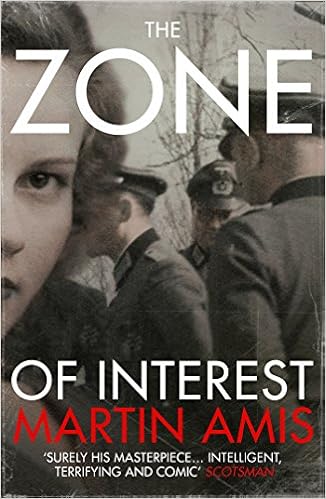
"The Zone of Interest" by Martin Amis

Amazon link

This is, I think, the first Martin Amis novel I've actually read.

Shocking.

I guess I had him pegged as a North London liberal, one of the golden generation who probably couldn't actually write that well, or who was transfixed by self-referential Islington-angst like Ian McEwan (am I being unfair?).

But no. Amis can write, he's interested in big questions and he's not restrained by bien-pensant shibboleths (or not much).

Hence a novel concerned in minute detail with human relationships between the Nazis at .. Auschwitz.

Very brave.

---

Here's a plot summary.
"The novel begins in August 1942, with Thomsen's first sight of Hannah Doll, wife of Paul Doll, the camp's commandant. (Doll's name is similar to Otto Moll, a notorious camp commandant in real life.)

He is immediately intrigued and initiates a few encounters with her. In time their relationship becomes more intimate, even though it remains unfulfilled. Despite their attempts at discretion, Paul Doll's suspicions are raised. He has her followed by one of the camp's prisoners, and is informed by him that they did indeed make two exchanges of letters.

While spying on Hannah in the bathroom (as he does regularly), Paul watches her read the letter from Thomsen secretly and rather excitedly, before destroying it. From that point onward, his wife becomes increasingly contemptuous of him, viciously taunting him in private, and embarrassing him in public.

Paul decides to assign Szmul, a long-serving member of the Sonderkommando, to the murder of his wife. He does so by threatening to capture Szmul's wife, Shulamith. The murder is scheduled to take place on April 30, 1943 - at Walpurgisnacht."
Thomsen is the nephew of Martin Bormann and leads a rather charmed life. Not that this saves him in the end.

In his afterword, Amis writes about the paradox of Nazism. Why the final solution? Why did they do it?

And quotes Primo Levi:
"“Perhaps one cannot, what is more one must not, understand what happened, because to understand [the Holocaust] is almost to justify ... no normal human being will ever be able to identify with Hitler, Himmler, Goebbels, Eichmann, and endless others. This dismays us, and at the same time gives us a sense of relief, because perhaps it is desirable that their words (and also, unfortunately, their deeds) cannot be comprehensible to us. They are non-human words and deeds, really counter-human...”
and then comments, "Historians will consider this more an evasion than an argument."

But Amis offers no analytical thoughts of his own.

---

Martin Amis is a novelist, not a sociologist. We look to his characters for explanations .. that is to say, their personality types. And here the Myers-Briggs/Keirsey schemes add value once again.

In the novel, Auschwitz presents itself as an environment of selection for Nazi staff. They are physically located at the gas chambers, the ovens, the pyres, the slave-labour factories and the centres for vivisection. It is impossible to ignore the smells, the screams and .. just what you see in front of you.

The primary screening attribute is empathy coupled with imagination. No-one with any degree of generalised empathy could possibly tolerate the place. Few Idealist NFs amongst the camp-Nazis.

Next focus on role: these are either abstract (policy and strategic) or concrete (operational).

Amis's hands-on characters, those who conduct 'selections' and 'actions' at Auschwitz are concrete ST types, generally logistical Guardian STJs. They have internalised that the jews, 'untermenschen', the handicapped and insane are to be classified as 'other', and are inured to 'the process'.

They're rule-followers.

The 'racial purity intellectuals' (like Goebbels and Hitler himself) do not physically attend the camps: for them, the raw physicality of death never intrudes. Their lack of empathy is abstract - the same as that of any military person or politician who is prepared to carpet bomb, or detonate nuclear weapons over cities.

For these people in themselves, Nazism is only an act of the intellect: either a deduction from certain principles or the righteous struggle on behalf of one imagined community ('the Aryan race') against its outgroups (the 'untermenschen'). Yes, the Nazis have their own version of SJWs - call them Racial Justice Warriors.

There is a third category of person: those who are caught up in the process but not directly involved in implementation. IG Farben business executives who are allocated concentration camp slave-labour, the protagonist Thomsen who serves as liaison between Auschwitz operations and Bormann's Party Chancellery. Thomsen describes his position as a 'Mitlaufer', (p. 148),
".. we were obstruktive Mitlaufer. We went along. We went along, we went along with, doing all we could to drag our feet and scuff the carpets and scratch the parquet, but we went along. There were hundreds of thousands like us, maybe millions like us. "
I think people like that, trapped by circumstance, were of diverse psychological type - though naturally all exhibiting an overarching deficit of empathy and imagination (few NFs then).

---

It's both interesting and sad that none of the four temperaments leads to good governance.

  • The rule of Rationals, Plato's Republic, leads to (always over-simple and inadequate) grand theory dominating humanitarianism. It doesn't have to be fascism .. Stalinism is another example. And the neocon-sponsored Vietnam and Iraq wars.

  • The rule of Idealists, which we have - at least ideologically - in the West at the moment, imposes (very selectively!) a normative model of human nature which sterilises human relationships. It's also profoundly reactionary in scientific terms, demonising research which 'feels uncomfortable'.

  • The rule of Guardians, as seen with Theresa May, is the domain of the concrete - without insight and imagination, politically ballistic, focused on operations over strategy. Destined to hit the wall when new thinking is required.

  • And finally, and perhaps most scary, the rule of Artisans. Those thrill-seeking adventurers who shoot from the hip, are easily bored and crave excitement. Welcome aboard, Mr Trump!
Yes, we are truly doomed to stumble from trap to trap.

---

What was Hitler's type by the way? Apparently INFJ, Of course, he never personally visited a death camp.

Hitler was an emotional and chaotic Idealist leader, whose moralistic drives had to be turned into policies and strategies by Rationals - and then implemented by Guardians and Artisans.

Reading his Wikipedia entry, Martin Bormann comes across strongly as a Guardian ESTJ.

Thursday, November 16, 2017

I am conflicted about AI-based law enforcement ...

From The Times today (Gang war fear after Romanian sex trafficker Sorin Serbu is killed):

Sorin Serbu - Romanian gangster
"The murder of a powerful Romanian gangster threatens to prompt an underworld war to control a lucrative sex trafficking market.

Sorin Serbu was beaten to death by masked men carrying baseball bats two weeks after he is said to have been involved in a fight with a rival Romanian gangster.

Serbu, 36, was left in a pool of blood outside the Global Bar in Ilford, east London, in the early hours of Sunday after a music gig. Police have confirmed that they are looking for five attackers. He was taken to an east London hospital but died of his injuries. The incident was reported to police by ambulance workers at 2.48am.

The gangster had a history of running drugs and prostitutes into Europe and made millions of euros while based in Italy, according to The Sun, which quoted a Romanian justice source saying: “There may be more bloodshed before this is over. Serbu tried to muscle in and imported around 100 prostitutes. The arrival of competition like that was always going to rock the boat.”

The vice trade in Ilford and neighbouring Redbridge has long been dominated by Romanian and Albanian gangsters. The problem has become so serious that Romanian police officers have been brought in on secondment to help tackle the gangs.

Locals have grown increasingly irate over the street trade and kerb crawling, with complaints about sex in gardens and used condoms strewn along a main road. Officers have seized vans belonging to the gangs and found mattresses in the back.

It is thought that Serbu, from Braila, eastern Romania, had relocated from Rome, his last base for drug and sex trafficking, after coming under pressure from Italian police."

Ilford used to be a relatively respectable area of east London. Not so much now.

Locally-ubiquitous CCTV and AI-based facial-recognition and incident-monitoring would surely help the authorities in dealing with this blight. What could possibly go wrong?

And then I read this (from Marginal Revolution):
"René Carmille  was a punch card computer expert and comptroller general of the French Army, who later would head up the Demographics Department of the French National Statistics Service. As quickly as IBM worked with the Nazis to enable them to use their punch card computer systems to update census data to find and round up Jewish citizens, Rene and his team of double-agents worked just as fast to manipulate their data to undermine their efforts.

The IEEE newspaper, The Institute, describes Carmille as being an early ethical hacker: “Over the course of two years, Carmille and his group purposely delayed the process by mishandling the punch cards. He also hacked his own machines, reprogramming them so that they’d never punch information from Column 11 [which indicated religion] onto any census card.” His work to identify and build in this exploit saved thousands of Jews from being rounded up and deported to death camps.

Rene was arrested in Lyon in 1944. He was interrogated for two days by Klaus Barbie, a cruel and brutal SS and Gestapo officer called “the Butcher of Lyon,” but he still did not break under torture. Rene was caught by the Nazis and sent to the Dachau concentration camp, where he died in 1945."
I remember how the Nazis demanded that Jewish authorities in the ghettos of occupied Europe should render administrative assistance in documenting their Jewish inhabitants. The more efficient the Jewish leadership, the more Jews got deported to the depth camps.

Administrative chaos saved lives, lots of them. The Greeks and Romans understood the dilemma.

Wednesday, March 01, 2017

Diary: chronicles of wasted time

There were several things I toyed with writing about today.

1. China Miéville on the Nazis

The Nazis (short for National Socialists, lest anyone forget) are uniquely demonised in contemporary culture. It's not so much that the Nazis did uniquely bad things - most of their heinous deeds recapitulated acts previously implemented by many other powers: in fact the Nazi edge in atrocity tended to be greater efficiency. Nazis are demons mostly because they took such pride in their murderous policies. They were the paradigmatic nasty party. They flagrantly and consistently failed to show generalised compassion.

Readers familiar with Jonathan Haidt's Moral Foundations Theory will recognise the red-flag value-atrocity for liberals here. By promoting the 'Aryan race' and classifying Jews, homosexuals, the disabled and non-'Aryans' in general as sub-human (and therefore worthy of extermination), Nazism was xenophobia personified.

You can see why nationalists like Trump, Le Pen and the rest are so easily compared to Hitler. Shockingly, they explicitly disavow liberal globalism and human universalism.

We know the 'downsides' to Nazism, strongly amplified by the fact they lost. But the Pollyanna world of Liberalism - where everyone is 'nice' all the time - doesn't always reflect reality either.

Especially when you engage with people who don't tend - or intend - to play nice at all.

Ordinary folk are generally not liberals, and once the liberal elite makes a hash of it they get somewhat agitated. How agitated? Depends on how bad things get.

The Nazis were quite popular in the grim thirties, and not just amongst ordinary Germans.

Somehow these deeper truths about human nature - and what humans will do to survive in extremis - appear to have evaded China Miéville. The root causes of fascist movements aren't really manifest through the metaphor of shallow, lifeless Nazi art.

Anyway, I decided, meta-fictionally, not to write about that, because writing anything at all about the Nazis gets you into trouble.


2.  Who's going to win the French Presidential Election 2017?

The first round is Sunday, 23 April and the second round is two weeks later, 7 May 2017. The Media is gushingly excited that Emmanuel Macron of En Marche! will win the second round decisively against Marine Le Pen of the Front National.

Take that, you fascists!

---

*Eyebrows raised*.

Macron is somewhere between the Tony Blair and Nick Clegg of the French governing elite. And about as popular as either amongst the non-bubble masses.

In The Times today, British neocon op-ed writer Roger Boyes calls it for Le Pen, citing subterranean popular discontent.
"Le Pen has kept momentum; she has (unlike Ukip) a proper party machine behind her which is able to guarantee that declared voting intentions turn into actual votes. She is polling at 45 per cent if she runs against François Fillon in the second round; not many on the left will be able to vote for a man who promises to cut half a million public service jobs.

Against Emmanuel Macron she is polling at 42 per cent in the run-off; it doesn’t take much more to give her victory. That’s Macron, the pro-European, elite-educated, former investment banker Blairite who once served as economics minister under François Hollande — how desperate does a country have to be to imagine that he could be a saviour, rather than a prettifier of the old politics?"
I am not quite so sure. I suspect the French media will do a pretty good job on Le Pen, accusing her of plotting to break up the EU - something which the French masses still find scary, with all those old Nazi occupation memories and a resurgent Germany.

If I had to call it, I'd agree that Macron is toast, even froth. But this Penelopegate thing is perhaps forgivable by a cynical electorate; if so, François Fillon's traditionalist nationalism will strike a chord in the second round.

If he gets that far, it's winnable for Les Républicains.

Anyway, I was going to write about that but .. what do I know about French politics?


3. And what about your theorem prover?

Yes, hmm, shuffles papers. You know, I thought and thought about the control architecture. I'm good with unification and binary resolution - all those functions are well-understood and work. But generating the proof space (which Prolog does by depth-first search with backtracking) is a bit intricate and involves quite complex clausal data structures, particularly if you want to number clauses, and keep track of previous goals and bindings to generate an explicit proof tree.

So it's a bit, well, .. boring - and I feel under-motivated today. Which is why I'm wasting my time telling you all this.

Saturday, February 25, 2017

"The Last Days of New Paris" - China Miéville

Amazon link

This is a novella which rewards your imagination, creativity, and openness to experience. There is a plot, after a fashion, though as usual with this author, it's the journey not the destination.

Vichy Marseilles in 1941 sees a gathering of Surrealists fighting fascism through their works. The atmosphere positively fizzes with their dangerous, subversive 'art of the unconscious'. To hand is an American scientist (and occultist), Jack Parsons, who will bottle this energy in a 'battery' of his own devising to further his own plans to fight fascism. Unfortunately, the thoroughly-charged battery is stolen and ends up in New Paris where it detonates: the S-bomb.

In New Paris 1950, the city is blockaded as Surrealist manifestations stalk the arrondissements aided by the Surrealist underground, La Main à plume. Trapped Nazis and Gestapo agents contract with the denizens of Hell to combat them. The Germans have a top-secret plan: Fall Rot. But what is it? Thibaut, a leader of La Main à plume, has to find out.

The afterword purports to document a meeting between an aged Thibaut and Mr Miéville in a London hotel where the story is recounted in frenzied haste. At the end you will find detailed notes on most of the surrealist works of art which 'manifested themselves' in New Paris. Of particular note is the Surrealist publication/manifesto, "Le Surréalisme au service de la révolution", seeming to serve as a blueprint for the S-bomb.

You may spend most of the novella wondering where all this is going. It does, however, resolve; there is an overarching theme. I might wish it had been a little more subtle than the banality of evil. However, Miéville can make even Manicheanism look chic.

Wednesday, January 11, 2017

"March Violets" - Philip Kerr

Amazon Link

It must have seemed a good idea. Take a Philip Marlowe type 'wisecracking, hard-drinking, tough private eye' and transpose him to 1936 Nazi Berlin as Bernie Gunther.

This former seasoned, competent, tough ex-cop (forced out by the Nazis due to his socialist sympathies) is now a seasoned, competent, tough private detective with some illustrious clients including Hermann Goering and Heinrich Himmler.

With a background of Nazi stormtrooper action against communists, trades unionists and jews, Gunther gets to work. His client, Hermann Six, is a leading Ruhr industrialist. His daughter has apparently been killed with her husband, and their fashionable house burned down. A valuable diamond necklace has vanished from the safe and Six wants it back - without the authorities' knowledge. Naturally a web of corruption lies behind these events.

Philip Kerr's writing style is somewhat florid:
"I drove home feeling like a ventriloquist's mouth ulcer. I was sore at the way things had turned out. It's not every day that one of Germany's great film stars takes you to bed and then throws you out on your ear."
Mr Kerr is perfectly competent at churning the words out. Gunther travels around Berlin, interviews people in his sassy, faintly insolent style, gets beaten up, discovers corpses, meets his police contacts, talks to clients and has sex with various curvy women. In all this he remains generally calm, upbeat and without any discernible emotion.

The plot is complicated and involves keeping track of a number of different characters, few of whom stand out, yet in the end the resolution is only mildly interesting. The pacing is uniform throughout, a placid and unengrossing read.

This tedium tempted me to abandon, but I just about kept on to the end, thinking it a wasted opportunity. Someone must like it though, because he went on to write a further eleven Gunther novels.

'March Violets' was the derisive term by which long-time Nazis referred to new party converts.

Sunday, April 26, 2015

Homo Sapiens 2.0

It's been observed that the Germans would make a much better job at running Greece than the Greeks do. Some reactionaries have even been heard to observe that the British Empire made a better fist at governing its colonies (particularly in Africa) than the post-independence Governments.


At a technical level, these thoughts are certainly correct. They leave one factor out, however. The efficient Northern Europeans ran these countries in their own interests, not those of the indigenous populations. That's why the Greeks prefer their domestic leaders, incompetent and/or corrupt though they may be.

Genetics-aware commentators have been speculating for a while that we're on the verge of reprogramming our children with optimised alleles for health, athleticism, beauty, personality and intelligence. There's no technical reason why this shouldn't be reliable, safe, effective and possible in the next few decades. Sounds like the salvation of the human race - we can bootstrap ourselves to the next screen. Here's an update on work-in-progress.


But what of the parents and the broader community - do they think their own interests will align with those of their super-children? Hands up how many of you want to vote for your own extinction.

Every pre homo sapiens sub-species experienced this reality. The new guys are in the area and they're smarter and more competent than we are. We're gonna be toast. In the greater scheme of things, should we be happy about that or should we wipe out these upstarts while we can (if we can)?*

FWIW, my vote is in favour of letting the new guys have our space. But then, I always wanted humanity to get to the stars.

---

* They say all Internet discussions eventually bring in the Nazis - this was precisely the argument National Socialists used against the Jews.