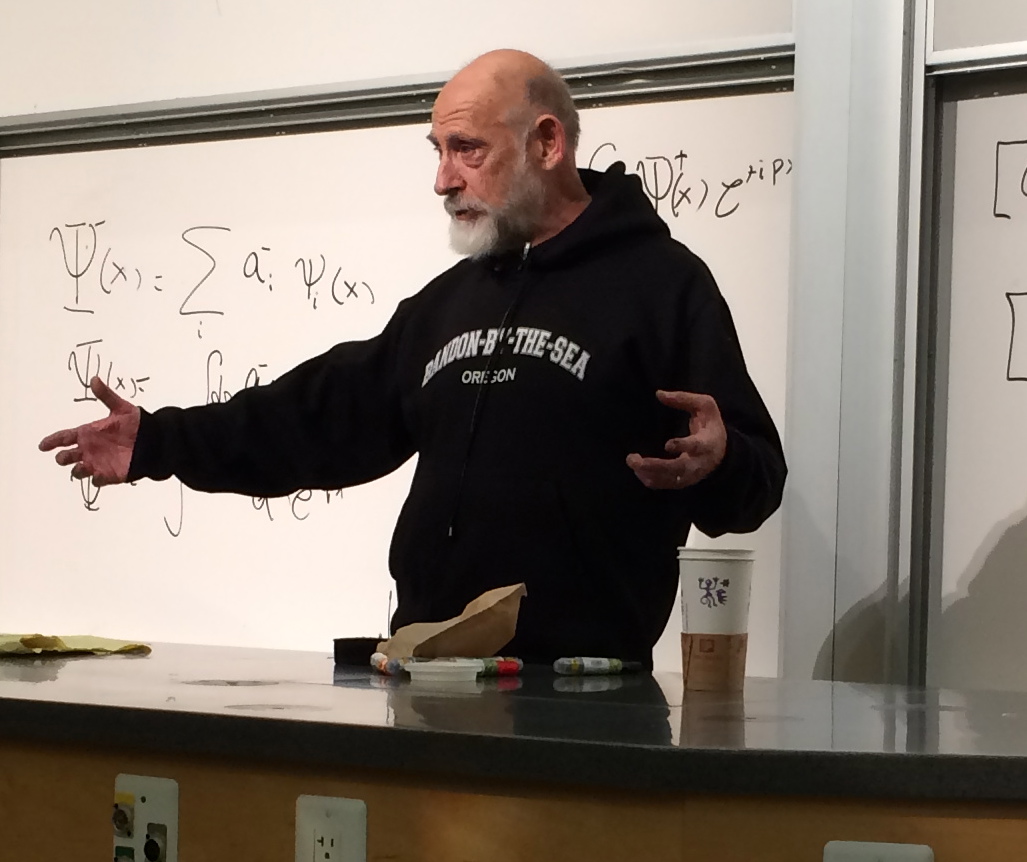
My first thought was that Professor Susskind lacked empathy. He'd be asked a question, plainly a little off the plot. It was clear to me and to half the audience what mistaken assumption the student was making but Susskind never seemed to put himself in the student's mind. He just filtered the question through his own, correct, understanding and seemed not to understand the questioner's context. It reminded me of the many stories of Paul Dirac - how autistic!
 |
| Prof. Leonard Susskind |
But as I've worked through the lectures I understand the man more. His style is immensely attractive. Very casual in sweatshirt and and cords, he ambles around behind the bench snacking on shortbreads and taking swigs of coffee from a cardboard cup. He makes 'mistakes' all the time, 'forgetting' constants and exponents. Students often pick him up on these.
I get him now. He never looks stressed during questions because he knows everything. He makes the 'mistakes' because it keeps the audience awake and involved: those little cognitive dissonances. He stresses the big picture because that's the narrative which conveys the underlying concepts.
He is the perfect complement to the textbook.
His genius is even deeper. In early lectures he covers enough
differential geometry for General Relativity. Differential geometry is hard: as I absorbed his lecture I kept thinking
Riemann was a genius. And yet he conveyed the key concepts of generalised coordinates, the metric tensor, connections, curvature and geodesics perfectly. Ditto for tensor algebra and calculus. Truly the
theoretical minimum!
Here are the ten lectures I'm referring to (
YouTube playlist).
Yesterday Susskind told me about falling into a black hole using the
Schwarzschild metric and coordinates. We started from the metric, integrated over a trajectory to get a distance, looked at the conditions under which this trajectory would be a geodesic (it's stationary) and then did some algebra to get velocity at various distances from the black hole from the viewpoint of a distant observer. We derived the well-known weird results that the object appears to stop at the event horizon and takes an infinite amount of time to get there. This is not the view of the freely-falling observer: the formal resolution of this puzzle is to come.
At the end of lecture 5, a student asks how Karl Schwarzschild was able to derive his eponymous solution to Einstein's field equations for a non-rotating black hole while serving in the hell of the first world war (he later tragically died). Susskind shakes his head in reverential awe and says only that sometimes, when things get tough, he himself finds peace just thinking through the equations.