 |
| The author - 21st November 2005 |
Thursday, November 12, 2015
Ten Years After

Tuesday, November 10, 2015
Wolves amongst the stars

About a month ago I read Liu Cixin's epic 'The Three-Body Problem' as described in this post. In volume two of the trilogy, 'The Dark Forest', the Trisolaran invasion fleet has been launched from the nearby Centaurus system and is 400 years out from Earth. Trisolaran technology appears invincible and worse, the Trisolarans can listen to everything happening on Earth and have a fifth column of human supporters for their genocidal mission.
Earth turns to the Wallfacers - and Luo Ji in particular. Here's a rather lengthy extract where Luo Ji is explaining some unpalatable truths to his burly police bodyguard, Shi Qiang.
They crossed the highway to where the embankment blocked out the lights of the residential area. Groping about in the dark that surrounded them, Luo Ji and Shi Qiang sat down on the sandy ground.Liu Cixin's science fiction is old-school and high-concept, inspired equally by Isaac Asimov's psychohistory and China's ancient history. This second volume grapples with the problem: how can you deal with an extermination force of overwhelming military superiority, almost perfect data intelligence but one which is hundreds of years away, past any planning horizon politicians, the military and the people are accustomed to?
"Let's begin," Luo Ji's voice sounded in the dark.
"Give me the easy version. At my level, I'm not going to understand anything complicated."
"Everyone can understand, Da Shi. The truth is simple. It's the kind of thing that, once you hear it, you'll wonder why you didn't come up with it yourself. Do you know about mathematical axioms?"
"I took geometry in high school. 'Only one straight line can be drawn between two points.' That kind of thing."
"Right. So now we're going to set out two axioms for cosmic civilization.
"First, survival is the primary need of civilization. Second, civilization continually grows and expands, but the total matter in the universe remains constant."
“And then?"
"That's it."
"What can you derive from those little things?"
"The same way you can figure out an entire case from a bullet or a drop of blood, cosmic sociology is able to describe a complete picture of galactic and cosmic civilization from those two axioms. That's what science is like, Da Shi. The cornerstone of every discipline is quite simple."
"So let's see you derive something."
...
"... The universe is big, but life is bigger! That's what the second axiom means. The amount of matter in the universe remains constant, but life grows exponentially. Exponentials are the devils of mathematics. If there's a microscopic bacterium in the ocean that divides once every half hour, its descendants will fill the entire ocean in the space of a few days, so long as there are sufficient nutrients. Don't let humanity and Trisolaris give you a false impression. These two civilizations are tiny, but they are only in their infancy. Once a civilization passes a certain technological threshold, the expansion of life through the universe is frightening. For instance, take humanity's present navigation speed. In a million years, Earth civilization could fill the galaxy. And a million years is a short time measured against the universe."
"So you're saying that, taking the long view, the entire universe might have that kind of... what are they calling it, a 'dead hand'?"
"No need for the long view. Right now the entire universe has been dealt that dead hand. Like Hines said, civilization may have started in the universe billions of years ago. Looking at the signs, the universe might be packed full already. Who knows how much empty space there is in the Milky Way or the universe, or how many resources are left?"
"But that's not right, is it? The universe looks empty. We haven't seen any other alien life apart from Trisolaris, right?"
"That's what we'll talk about next. Give me a cigarette."
Luo Ji groped about in the dark for a while before taking the cigarette from Shi Qiang's hand. When Luo Ji next spoke, Shi Qiang realized he had moved to a spot three or four meters away.
"We need to increase the distance to make it feel more like outer space," Luo Ji said.
Then he lit the cigarette by twisting its filter, and Shi Qiang lit one of his own. In the dark, two tiny red planets stood in distant opposition.
"Okay. To illustrate the problem, we now need to establish the most elementary model of cosmic civilization. These two balls of flame represent two civilized planets. The universe is made up of only these two planets, and apart from them there's nothing else. Erase all of our surroundings. Can you locate that feeling?"
"Yeah. That's an easy feeling to find in a dark place like this."
"Let's call these two civilized worlds your civilization and my civilization. They're separated by a great distance, say, a hundred light-years. You can detect that I exist, but you don't know any details. However, I'm completely ignorant of your presence."
"Right."
"Now we need to define two concepts, 'benevolence' and 'malice' between civilizations. These words themselves aren't very rigorous in a scientific context, so we've got to restrict their meaning. `Benevolence' means not taking the initiative to attack and eradicate other civilizations. 'Malice' is the opposite."
"That's a low bar for benevolence."
"Next, consider your options for dealing with me. Please remember that the axioms of cosmic civilization should be kept in mind throughout the process, as well as the distance scale and the environment of space."
"I could choose to communicate with you."
"If you do that, you should be aware of the price you'll pay: You'll have exposed your existence to me."
"Right. In the universe, that's no small thing."
"There are different degrees of exposure. The strongest form of exposure is when I know your precise interstellar coordinates. Next is when I know your general direction, and the weakest is when I only know of your existence. But even the weakest form of exposure makes it possible for me to search for you, because since you've detected my existence, I know that I'll be able to find you. It's only a matter of time from the standpoint of technological development."
"But my boy, I could still take the risk to talk to you. If you're malicious, then it's my bad luck. But if you're benevolent, then we could have further exchanges and ultimately be united into a benevolent civilization."
"Okay, Da Shi. Now we've come to the crux of it. Let's return to the axioms of cosmic civilization: Even if I'm a benevolent civilization, can I determine at the start of our communication whether or not you are also benevolent?"
"Of course not. That would violate the first axiom."
"So once I've received your message, what should I do?"
"Naturally, you ought to determine whether I'm benevolent or malicious. Malicious, and you eradicate me. Benevolent, and we can continue communicating."
The flame on Luo Ji's side rose up and moved back and forth. Evidently he had gotten up and was pacing.
"That's fine on Earth, but not out in the universe. So next we'll introduce an important new concept: the chain of suspicion."
"That's an odd term."
"The term is all I had at first. It wasn't explained to me. But, later, I was able to infer its meaning from the words themselves."
"Who didn't explain it?"
"... I'll tell you later. Let's continue. If you think I'm benevolent, that's not a reason to feel safe, because according to the first axiom, a benevolent civilization can't predict that any other civilization is benevolent. You don't know whether I think you're benevolent or malicious. Next, even if you know that I think you're benevolent, and I also know that you think I'm benevolent, I don't know what you think about what I think about what you're thinking about me. It's convoluted, isn't it? This is just the third level, but the logic goes on indefinitely."
"I get what you mean."
"That's the chain of suspicion. It's something that you don't see on Earth. Humanity's shared species, cultural similarities, interconnected ecosystem, and close distances means that, in this environment, the chain of suspicion will only extend a level or two before it's resolved through communication. But in space, the chain of suspicion can be very long. ...."
Shi Qiang took a drag on his cigarette, and his contemplative face emerged from the darkness for a moment.
"... In actual cosmic civilization, the biological differences between different groups might be as high as the kingdom level, and cultural differences are even further beyond our imagining. Add to this the vast distances between them, and you have chains of suspicion that are practically indestructible."
"That means that the outcome is the same, regardless of whether we're benevolent civilizations or malicious civilizations?"
"That's right. That's the most important aspect of the chain of suspicion. It's unrelated to the civilization's own morality and social structure. It's enough to think of every civilization as the points at the end of a chain. Regardless of whether civilizations are internally benevolent or malicious, when they enter the web formed by chains of suspicion, they're all identical."
"But if you're much weaker than I am, you're not a threat to me. So I could always communicate with you, right?"
"That won't work, either. Here we need to introduce a second important concept: the technological explosion. I didn't get a full explanation for this, either, but it was far easier to infer than the chain of suspicion. Human civilization has five thousand years of history, and life on Earth might be as much as a few billion years old. But modern technology was developed over the course of three hundred years. On the scale of the universe, that's not development. It's an explosion! The potential for technological leaps is the explosive buried within every civilization, and if it's lit by some internal or external factor, it goes off with a bang. On Earth it took three hundred years, but there's no reason why humanity should be the fastest of all cosmic civilizations. Maybe there are others whose technological explosions were even more sudden.
"I'm weaker than you, but once I've received your message and know of your existence, the chain of suspicion is established between us. If at any time I experience a technological explosion that suddenly puts me far ahead of you, then I'm stronger than you. On the scale of the universe, several hundred years is the snap of a finger. And it might be that my knowledge of your existence and the information I received from our communication was the perfect spark to set off that explosion. That means that even though I'm just a newborn or growing civilization, I'm still a big danger to you."
Shi Qiang watched Luo Ji's flame in the darkness as he thought for a few seconds, then looked at his own cigarette.
"So I have to keep quiet."
"Do you think that will work?"
They smoked. The balls of flame brightened and their faces emerged from the darkness like the gods of this simple universe, deep in thought. Shi Qiang said,
"No, it won't. If you're stronger than me, then since I was able to find you, one day you'll be able to find me. And then there will be a chain of suspicion between us. If you're weaker than me, you could experience a technological explosion at any time, and that would take us back to the first case. To sum up: one, letting you know I exist, and two, letting you continue to exist, are both dangerous to me and violate the first axiom."
"Da Shi, you've really got a clear mind."
"My brain can keep up with yours so far, but we're only getting started."
Luo Ji was silent in the dark for a long time. His face emerged in the weak light of the ball of flame two or three times before he said,
"Da Shi, this isn't a start. Our reasoning has already reached a conclusion."
"Conclusion? We haven't figured anything out! Where's the picture of cosmic civilization you promised?"
"If neither communication nor silence will work once you learn of my existence, you're left with just one option."
In the long silence that followed, the two flames went out. There was no wind, and the dark silence turned thick as asphalt, connecting sky and desert into a murky whole. At last Shi Qiang uttered one word in the darkness: "F***!"
"Extrapolate that option out to the billions upon billions of stars and hundreds of millions of civilizations, and there's your picture,"
Luo Ji said, nodding in the darkness.
"That's... that's really dark."
"The real universe is just that black."
Luo Ji waved a hand, feeling the darkness as if stroking velvet.
"The universe is a dark forest. Every civilization is an armed hunter stalking through the trees like a ghost, gently pushing aside branches that block the path and trying to tread without sound. Even breathing is done with care. The hunter has to be careful, because everywhere in the forest are stealthy hunters like him. If he finds other life—another hunter, an angel or a demon, a delicate infant or a tottering old man, a fairy or a demigod—there's only one thing he can do: open fire and eliminate them. In this forest, hell is other people; an eternal threat that any life that exposes its own existence will be swiftly wiped out. This is the picture of cosmic civilization. It's the explanation for the Fermi Paradox."
Shi Qiang lit another cigarette, if only to have a bit of light.
"But in this dark forest, there's a stupid child called humanity, who has built a bonfire and is standing beside it shouting, 'Here I am! Here I am!"' Luo Ji said.
"Has anyone heard it?"
"That's guaranteed. But those shouts alone can't be used to determine the child's location. Humanity has not yet transmitted information about the exact position of Earth and the Solar System into the universe. From the information that has been sent out, all that can be learned is the distance between Earth and Trisolaris, and their general heading in the Milky Way. The precise location of the two worlds is still a mystery. Since we're located in the wilderness of the periphery of the galaxy, we're a little safer."
"So what's the deal with the spell?"
...
As ever, his solutions are ingenious .. and implicit in the excerpt above.
In volume three, Death's End (April 2016), his ambitions seem to be set even higher.
Monday, November 09, 2015
SPECTRE

All the people who said this was two and a half hours of pure escapism were exactly right. The film is too long but passes the 'how many times did I check my watch' test.
The film succeeds through high production values. The plot is formulaic and dull while the action sequences are way over-familiar. But there are deeper problems.
Bond is too old and the women are infeasibly compliant. A modern audience just can't suspend disbelief when a woman Bond never met before pretty much immediately goes into a passionate clinch with him .. just because. Things move to embarrassment-central when his love interest - Dr Madeleine
Deeper again. The more they fill out his back story - unhappy orphaned childhood, adopted-brother to a major villain - the more they paint themselves into a corner for any future movies. Past Bonds were the elite of the secret service; contemporary Bond is a relic, an action man reaching those parts of hands-on lethality that higher-tech methods currently miss. Remember the Boston Consulting Group growth–share matrix? Well, Bond has moved from Star to Cash-Cow to Dog.
So I really struggle with the positioning of future-Bond.
Daniel Craig wants out and should be let out.

A charismatic Idris Elba would be a great government assassin - if that was where our foreign intelligence services were going (is it?). Otherwise Bond is going to end up as a drone-wielding Q. In that case, better we stop while we're still (marginally) ahead.
Some see Bond as a classic projection of British cultural 'soft power' - a wildly-successful global phenomenon where British Intelligence (troubled, naturally) still sits at the centre of events. In SPECTRE we Brits are setting up a global surveillance consortium called 'nine eyes', for God's sake.
You know, even in a fictional universe, there's a difference between punching above your weight and trying to peddle Lalaland.
Sunday, November 08, 2015
Le Bistrot Pierre, Bath
Lunch today at the very pleasant Le Bistrot Pierre, Bath. Food was good and bon marché while the waitresses spoke perfect English gently seasoned with "Monsieur" and "Fromage" - in accents not a million miles from authentically French.


Here are some impressionistic pictures which might convey the ambience for this family get-together. Our thanks to Jane for organising it.

We had hopes of a post-prandial Jane Austen pilgrimage around the houses she occupied in Bath but we ran out of time.
We'll try and combine it with a trip to the Bath Christmas Market (November 26th - Dec 13th).


Here are some impressionistic pictures which might convey the ambience for this family get-together. Our thanks to Jane for organising it.

We had hopes of a post-prandial Jane Austen pilgrimage around the houses she occupied in Bath but we ran out of time.
We'll try and combine it with a trip to the Bath Christmas Market (November 26th - Dec 13th).
Friday, November 06, 2015
Blown away by VR - Google Cardboard
My "EightOnes VR Kit V2 inspired by Google Cardboard V2.0 - Easy Assembly Virtual Reality Headset With Capacitive Touch Button" kit arrived yesterday and I put it together this morning.

With the help of this video, plus downloading the Google Cardboard app, it's not so hard.
Is it possible to classify an experience as simultaneously awesome and clunky? Google's app comes with a set of demos so you can (using a lot of WiFi bandwidth) ..
At these moments you know that when Virtual Reality comes of age, the world will be transformed.
Meanwhile, my hands got tired holding the viewer, and as I can't easily get my Nexus 6 out of its cover, I had to physically hold it against the back of the cardboard box.
But at £12.99 why not buy at VR 'release 0.1'? I'm now looking for other VR packages for Cardboard - more guided tours, more exotic scenery.
I already downloaded a VR planetarium and toured the solar system ...
A proper review here.
I think it would be a great Christmas present.
---
Update: since the above was written I've been intermittently looking for content. There's not much, and what there is falls into three categories:
Only the last option delivers the true promise of VR and it's the hardest to provide. I haven't tried any games - I was hoping instead to wander virtually around some exotic faraway locations and/or see strange wildlife - but there's very little content out there, either on YouTube or Google Play. Don't know if Cardboard will be enough to kickstart things.

With the help of this video, plus downloading the Google Cardboard app, it's not so hard.
Is it possible to classify an experience as simultaneously awesome and clunky? Google's app comes with a set of demos so you can (using a lot of WiFi bandwidth) ..
- wingsuit your way across American mountains, valleys and caverns
- take a flying tour of Chicago, Google Earth-style
- immerse yourself in the Palace of Versaille with a charming, french-accented guide.
At these moments you know that when Virtual Reality comes of age, the world will be transformed.
Meanwhile, my hands got tired holding the viewer, and as I can't easily get my Nexus 6 out of its cover, I had to physically hold it against the back of the cardboard box.
But at £12.99 why not buy at VR 'release 0.1'? I'm now looking for other VR packages for Cardboard - more guided tours, more exotic scenery.
I already downloaded a VR planetarium and toured the solar system ...
A proper review here.
I think it would be a great Christmas present.
---
Update: since the above was written I've been intermittently looking for content. There's not much, and what there is falls into three categories:
- Still pictures taken with 3D cameras. You can move your PoV through 360 degrees
- 3D Movies where you are passive - danger of nausea!
- Genuine 3D environments where you can look around, move and interact.
Only the last option delivers the true promise of VR and it's the hardest to provide. I haven't tried any games - I was hoping instead to wander virtually around some exotic faraway locations and/or see strange wildlife - but there's very little content out there, either on YouTube or Google Play. Don't know if Cardboard will be enough to kickstart things.
Thursday, November 05, 2015
Password Entropy
There are some things you just know.

Let's look at password entropy (from the Wikipedia article).
This would give a pretty impressive total of 26 * 4.7 = 117.5 bits of entropy.
But xkcd claims only 44; how come?
The cartoon's author, Randall Munroe, could be using the NIST heuristic analysis of 2004. After all, the phrase is not composed from random letters but words in English, which cuts out a lot of randomness*. If we use the NIST figures, I calculate we get 41 bits of entropy. But the whole area is actually rather vague.
Personally, I do the best I can. I use relatively insecure passwords for low-grade access to websites which seem to demand them, and much more cryptic (and unmemorable) passwords for stuff which is really important. By now I must have somewhere close to a hundred different username-password combinations,
Some people recommend investing in a password manager; I use Word with the 128-bit AES encryption turned on and a pretty high-entropy password which I have memorised. NIST recommends 80 bits of entropy for (non-military) high-security.
If I ever forget it, I'm toast!
---
* Bruce Schneier has some good advice (and a bit of a critique of the xkcd cartoon).
Johannes Weber has written the excellent 'Password Strength/Entropy: Characters vs. Words'.
Randall Munroe, xkcd author, explains what he was really doing (clue - count the little boxes representing bits under the symbols/words ...). Think of the words in the passphrase as quasi-symbols drawn from a huge 'alphabet' - a set with thousands or hundreds of thousands of members. This is the value we give to N (so even log2N is reasonably large). Then with two to six words in the passphrase, L = 2 to 6 ... and the entropy L * log2N does what you need. In the cartoon, Randall assumes a publically-known dictionary of 2,048 words, from which each word in the passphrase is randomly chosen. This gives 11 bits of entropy for each word.
- It was obviously a bomb on that Russian airliner
- TalkTalk has been a disaster for years
- It's never a bad time to review your passwords policy.
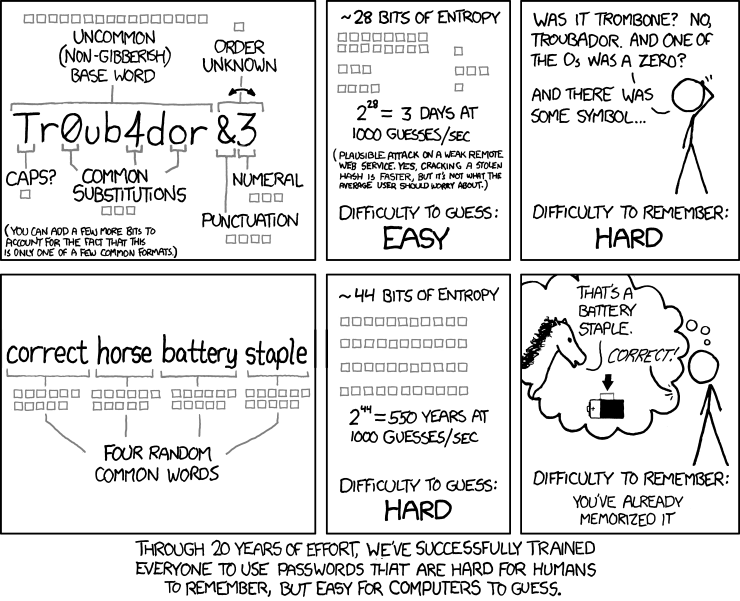
Let's look at password entropy (from the Wikipedia article).
"It is usual in the computer industry to specify password strength in terms of information entropy, measured in bits, a concept from information theory. Instead of the number of guesses needed to find the password with certainty, the base-2 logarithm of that number is given, which is the number of "entropy bits" in a password.If we take logs to base 10 and consider the word 'cat' (where the three symbols are each taken from the set of 26 lower case characters {a-z}) then the entropy is:
"A password with, say, 42 bits of strength calculated in this way would be as strong as a string of 42 bits chosen randomly, say by a fair coin toss. Put another way, a password with 42 bits of strength would require 242 attempts to exhaust all possibilities during a brute force search. Thus, adding one bit of entropy to a password doubles the number of guesses required, which makes an attacker's task twice as difficult."
...
"For passwords generated by a process that randomly selects a string of symbols of length, L, from a set of N possible symbols, the number of possible passwords can be found by raising the number of symbols to the power L, i.e. NL. Increasing either L or N will strengthen the generated password.
"The strength of a random password as measured by the information entropy is just the base-2 logarithm or log2 of the number of possible passwords, assuming each symbol in the password is produced independently. Thus a random password's information entropy, H, is given by the formula
H = log2NL = L * log2N = L * log N/log 2
where N is the number of possible symbols and L is the number of symbols in the password. H is measured in bits.In the last expression, log can be to any base."
3 * (log 26/ log 2) = 3 * (1.415/.3010) = 3 * 4.7 = 14 (approx).In the xkcd cartoon, the phrase used is: "correcthorsebatterystaple" which I make to be 25 characters. These are drawn from the 26 lc symbols {a-z} which deliver 4.7 bits of entropy per character. (Handy table for DIY calculations here).
This would give a pretty impressive total of 26 * 4.7 = 117.5 bits of entropy.
But xkcd claims only 44; how come?
The cartoon's author, Randall Munroe, could be using the NIST heuristic analysis of 2004. After all, the phrase is not composed from random letters but words in English, which cuts out a lot of randomness*. If we use the NIST figures, I calculate we get 41 bits of entropy. But the whole area is actually rather vague.
Personally, I do the best I can. I use relatively insecure passwords for low-grade access to websites which seem to demand them, and much more cryptic (and unmemorable) passwords for stuff which is really important. By now I must have somewhere close to a hundred different username-password combinations,
Some people recommend investing in a password manager; I use Word with the 128-bit AES encryption turned on and a pretty high-entropy password which I have memorised. NIST recommends 80 bits of entropy for (non-military) high-security.
If I ever forget it, I'm toast!
---
* Bruce Schneier has some good advice (and a bit of a critique of the xkcd cartoon).
Johannes Weber has written the excellent 'Password Strength/Entropy: Characters vs. Words'.
Randall Munroe, xkcd author, explains what he was really doing (clue - count the little boxes representing bits under the symbols/words ...). Think of the words in the passphrase as quasi-symbols drawn from a huge 'alphabet' - a set with thousands or hundreds of thousands of members. This is the value we give to N (so even log2N is reasonably large). Then with two to six words in the passphrase, L = 2 to 6 ... and the entropy L * log2N does what you need. In the cartoon, Randall assumes a publically-known dictionary of 2,048 words, from which each word in the passphrase is randomly chosen. This gives 11 bits of entropy for each word.
Wednesday, November 04, 2015
Our central heating redux
This has been a long saga - amazing how many hits this post has received (91 as of today).
The central heating engineer, Ian Hosegood, came this morning. It turns out the problem was indeed with the Siemens wireless base station (wall-mounted next to the boiler). It was showing the radio link to the living room thermostat as active, but the relay to the boiler/pump had not tripped. This is the bug in the device highlighted in the post I mentioned. Ian switched it out for the Honeywell CM927 wireless programmable room thermostat and upstairs relay box.
Finally, the central heating is working again.
In passing, Ian observed that I seemed to have a flat rear tyre (my car parked on the drive outside the front door). At the garage they found the screw causing a slow puncture - fixable; the other rear tyre was low-tread so had to be replaced. With the water pump failure last Friday, this has been an expensive few days.
---

Clare and myself visited my mother this afternoon - here's one I took with her while Clare was at the cafe getting us all hot drinks.
The central heating engineer, Ian Hosegood, came this morning. It turns out the problem was indeed with the Siemens wireless base station (wall-mounted next to the boiler). It was showing the radio link to the living room thermostat as active, but the relay to the boiler/pump had not tripped. This is the bug in the device highlighted in the post I mentioned. Ian switched it out for the Honeywell CM927 wireless programmable room thermostat and upstairs relay box.
Finally, the central heating is working again.
In passing, Ian observed that I seemed to have a flat rear tyre (my car parked on the drive outside the front door). At the garage they found the screw causing a slow puncture - fixable; the other rear tyre was low-tread so had to be replaced. With the water pump failure last Friday, this has been an expensive few days.
---

Clare and myself visited my mother this afternoon - here's one I took with her while Clare was at the cafe getting us all hot drinks.
Tuesday, November 03, 2015
Who died on Law Hill?
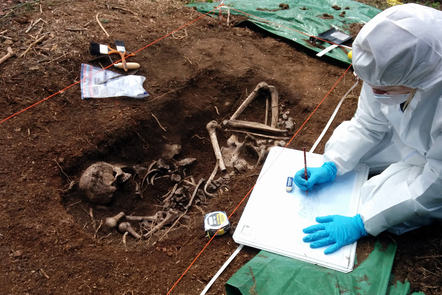
Dundee University, in collaboration with the OU, is launching a free online course (6 weeks; 4 hours per week) on 'forensic anthropology': Identifying the Dead.
---
Identifying the Dead is just one course from FutureLearn. There are so many! I was naturally interested as to how they make their money, what's the business model?
The CEO, Simon Nelson, suggests it's through charging for certificates and exams .. but it seems early days yet.
"In the shadow of Dundee’s Law Hill, a grim discovery demands the attention of forensic experts. Unidentified human remains have been found and the police need to identify the victim to move forward with their investigation.Clare and myself have signed up. The start date hasn't been announced yet but there will be more here later.
"Experts from the University of Dundee’s award-winning Centre for Anatomy and Human Identification (CAHId) will guide you through the process of human identification. They will introduce you to the fields of human identification; forensic anthropology and archaeology; craniofacial identification; and the study of the human body.
- After a meticulous recovery of the remains, it will be your job to:
- document and attempt to explain any evidence of trauma;
- identify the victim through biological profiling;
- and undertake a facial reconstruction.
"Week-by-week, the case will unfold, providing you with more information about the victim. You will be presented with theoretical material and hands-on learning opportunities, to evaluate the case information and use what you have learned, to piece together clues to the victim’s identity."
---
Identifying the Dead is just one course from FutureLearn. There are so many! I was naturally interested as to how they make their money, what's the business model?
The CEO, Simon Nelson, suggests it's through charging for certificates and exams .. but it seems early days yet.
Monday, November 02, 2015
Doves in the Church
Those kind, committee-minded ladies at the Church are apparently organising events for those poor unfortunates in the Calais Jungle. Never mind that it has been reported that:
I'm reminded of the iterated hawks vs. doves scenario in evolutionary game theory. You have this kind of payoff matrix.

If everyone is a dove, then they all cooperate in harmony and everyone gets a steady one unit of reward. If a hawk should chance along - with an angry sense of entitlement, shall we say? - the hawk takes but does not reciprocate. The hawk gets a reward of 2 units while the dove gets ripped off. The hawks steer clear of each other - when they meet, things get violent and abusive and they each reap damage of -2 units. Eventually, there are no more doves and the whole setup collapses. A metaphor for consistent Christianity, you might think.
The Old Testament is the way to go. As you will no doubt recall, in tournaments trialling different interpersonal strategies tit-for-tat tends to win out. Tit-for-tat is really an 'eye for an eye, a tooth for a tooth', as explained in the diagram below, albeit one which is quick to forgive on repentance.

It's important to recall that the specific Hawk-Dove payoff matrix (or Prisoner's Dilemma, or Chicken - they're all variants) logically comes first. It's that which determines cooperation to be good, mutual defection terrible, but defection when dealing with a cooperator best of all.
If the world presents a situation with that kind of payoff matrix, then we can discuss what strategy to adopt. Unconditional cooperation - let's be brutal - means you're a sucker. Unconditional defection is just brutal, and worse, leads to terrible outcomes when not dealing with unlimited suckers. Tit-for-tat generally and robustly comes out top: start nice, punish cheaters but be prepared to forgive.
You may have noticed that in interpersonal matters, women have an instinctive psychological knowledge of these game-theoretic truths*. And those Church women, what's that all about? Trust me, those very pleasant women will never meet a single person from the Jungle face-to-face,
---
* Men sometimes organise themselves into a hierarchical pecking order (the threat of physical aggression can play a part in this - think Mafia) where you can defect down but have to cooperate up. Short of running away, which is usually not possible, you're stuck with it: you play dove-up and hawk-down. The society of women is, arguably, often more egalitarian.
---
Here's the video tutorial for Hawk vs. Dove (just under 10 minutes). Best viewed in conjunction with reading this Wikipedia article.
"A crisis relief charity chief is set to pull the plug on aid to the Calais ‘Jungle’ camp after discovering most people there are economic migrants ‘without any reason’ to leave their home country. The Bradford-based Human Relief Foundation has been running a project to help the ‘refugees’ at the makeshift camp and previously claimed they were all ‘fleeing war and significant atrocities.’ But a visit by a team led by Kassim Tokan, the HRF deputy chief executive, discovered a totally different picture on the ground, with unwanted clothing and food being ‘dumped and burnt’ by the migrants. Instead of vulnerable families fighting for survival he found the camp – dubbed the Jungle – was ’95 to 97 per cent’ adult men.
"The discovery has prompted the charity – which sends relief aid to people in desperate need around the world – to change its aid policy in respect of the Calais camp where around 4,000 people are living. They found chaotic conditions with no organisation where aid was being distributed randomly and unwanted items later discarded in piles on the ground. Interviewed by ITV’s Calendar News, Mr Tokan admitted he was surprised by what he found. Asked if his charity would withdraw support for the camp’s inhabitants, he said: ‘Most likely, yes.’
"He said it would be better to help people in genuine need in Jordan, Lebanon and Turkey rather than ‘healthy people here.’
 |
| The 'Calais Jungle' in action |
I'm reminded of the iterated hawks vs. doves scenario in evolutionary game theory. You have this kind of payoff matrix.
If everyone is a dove, then they all cooperate in harmony and everyone gets a steady one unit of reward. If a hawk should chance along - with an angry sense of entitlement, shall we say? - the hawk takes but does not reciprocate. The hawk gets a reward of 2 units while the dove gets ripped off. The hawks steer clear of each other - when they meet, things get violent and abusive and they each reap damage of -2 units. Eventually, there are no more doves and the whole setup collapses. A metaphor for consistent Christianity, you might think.
The Old Testament is the way to go. As you will no doubt recall, in tournaments trialling different interpersonal strategies tit-for-tat tends to win out. Tit-for-tat is really an 'eye for an eye, a tooth for a tooth', as explained in the diagram below, albeit one which is quick to forgive on repentance.

It's important to recall that the specific Hawk-Dove payoff matrix (or Prisoner's Dilemma, or Chicken - they're all variants) logically comes first. It's that which determines cooperation to be good, mutual defection terrible, but defection when dealing with a cooperator best of all.
If the world presents a situation with that kind of payoff matrix, then we can discuss what strategy to adopt. Unconditional cooperation - let's be brutal - means you're a sucker. Unconditional defection is just brutal, and worse, leads to terrible outcomes when not dealing with unlimited suckers. Tit-for-tat generally and robustly comes out top: start nice, punish cheaters but be prepared to forgive.
You may have noticed that in interpersonal matters, women have an instinctive psychological knowledge of these game-theoretic truths*. And those Church women, what's that all about? Trust me, those very pleasant women will never meet a single person from the Jungle face-to-face,
---
* Men sometimes organise themselves into a hierarchical pecking order (the threat of physical aggression can play a part in this - think Mafia) where you can defect down but have to cooperate up. Short of running away, which is usually not possible, you're stuck with it: you play dove-up and hawk-down. The society of women is, arguably, often more egalitarian.
---
Here's the video tutorial for Hawk vs. Dove (just under 10 minutes). Best viewed in conjunction with reading this Wikipedia article.
Sunday, November 01, 2015
China will build the next LHC; the HBP is a disaster
From Science Alert Oct 30th 2015:
There's a book on this (below) due for release shortly (author Steve Nadis writes about the project here); Luboš Motl reviews the book here.

Jess Riedel is not so impressed,
---
I'm inclined to be impressed by China's big science. Less so on the record of the European Union.
"China has announced that it will begin construction of the world's largest particle collider in 2020. According to officials, the subterranean facility will be at least twice the size of the Large Hadron Collider (LHC) in Switzerland, and will endeavour to find out more about the mysterious Higgs boson.
"The final concept design won't be completed until the end of next year, so we don't have many details to go on, but the collider is expected to smash protons and electrons together at seven times the energy levels of the LHC, generating millions of Higgs bosons in the process. Best of all, the facility will reportedly be available to the entire global scientific community. "
 |
| The Great Collider |
There's a book on this (below) due for release shortly (author Steve Nadis writes about the project here); Luboš Motl reviews the book here.
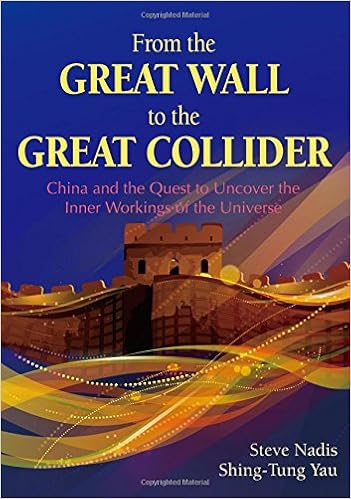
Jess Riedel is not so impressed,
"I think this is a bad development for physics because I am pessimistic about particle accelerators telling us something truly deep and novel about the universe, at least in the next century. Particle physics is a perfect-storm specialty in the sense that it can absorb unlimited amounts of money and physics talent while yielding arbitrarily slow progress on the important questions. If there are tens of billions of dollars flowing into these machines, innumerable physicists will continue to pour their youth into them for extremely incremental results."but even in terms of spin-offs (computing and communications, high-tech manufacture, magnet and superconducting technologies, general physics education and culture) this has to be a winner for China. Assuming it finally gets the OK from the Politburo.
---
I'm inclined to be impressed by China's big science. Less so on the record of the European Union.
"In 2013 the European Commission awarded neuroscientist Henry Markram $1.3 billion to pursue an audacious goal: building a simulation of the human brain. Markram's initiative, the Human Brain Project (HBP), is now in disarray. Critics blame HBP management and the project's unreasonably ambitious goals. Yet plenty of blame for the HBP's woes rests with the project's funders in Brussels, who put politics ahead of science and exercised poor oversight."So we now have this amusing, impassioned and sweary rant about the project which carries a deep ring of truth. In this area, at least, it appears that no-one knows anything.
(Scientific American article here).
Subscribe to:
Posts (Atom)