Showing posts with label Fermi problem. Show all posts

Tuesday, November 10, 2015

Wolves amongst the stars


About a month ago I read Liu Cixin's epic 'The Three-Body Problem' as described in this post. In volume two of the trilogy, 'The Dark Forest', the Trisolaran invasion fleet has been launched from the nearby Centaurus system and is 400 years out from Earth. Trisolaran technology appears invincible and worse, the Trisolarans can listen to everything happening on Earth and have a fifth column of human supporters for their genocidal mission.

Earth turns to the Wallfacers - and Luo Ji  in particular. Here's a rather lengthy extract where Luo Ji is explaining some unpalatable truths to his burly police bodyguard, Shi Qiang.
They crossed the highway to where the embankment blocked out the lights of the residential area. Groping about in the dark that surrounded them, Luo Ji and Shi Qiang sat down on the sandy ground.

"Let's begin," Luo Ji's voice sounded in the dark.

"Give me the easy version. At my level, I'm not going to understand anything complicated."

"Everyone can understand, Da Shi. The truth is simple. It's the kind of thing that, once you hear it, you'll wonder why you didn't come up with it yourself. Do you know about mathematical axioms?"

"I took geometry in high school. 'Only one straight line can be drawn between two points.' That kind of thing."

"Right. So now we're going to set out two axioms for cosmic civilization.

"First, survival is the primary need of civilization. Second, civilization continually grows and expands, but the total matter in the universe remains constant."

“And then?"

"That's it."

"What can you derive from those little things?"

"The same way you can figure out an entire case from a bullet or a drop of blood, cosmic sociology is able to describe a complete picture of galactic and cosmic civilization from those two axioms. That's what science is like, Da Shi. The cornerstone of every discipline is quite simple."

 "So let's see you derive something."

...

"... The universe is big, but life is bigger! That's what the second axiom means. The amount of matter in the universe remains constant, but life grows exponentially. Exponentials are the devils of mathematics. If there's a microscopic bacterium in the ocean that divides once every half hour, its descendants will fill the entire ocean in the space of a few days, so long as there are sufficient nutrients. Don't let humanity and Trisolaris give you a false impression. These two civilizations are tiny, but they are only in their infancy. Once a civilization passes a certain technological threshold, the expansion of life through the universe is frightening. For instance, take humanity's present navigation speed. In a million years, Earth civilization could fill the galaxy. And a million years is a short time measured against the universe."

"So you're saying that, taking the long view, the entire universe might have that kind of... what are they calling it, a 'dead hand'?"

"No need for the long view. Right now the entire universe has been dealt that dead hand. Like Hines said, civilization may have started in the universe billions of years ago. Looking at the signs, the universe might be packed full already. Who knows how much empty space there is in the Milky Way or the universe, or how many resources are left?"

"But that's not right, is it? The universe looks empty. We haven't seen any other alien life apart from Trisolaris, right?"

"That's what we'll talk about next. Give me a cigarette."

Luo Ji groped about in the dark for a while before taking the cigarette from Shi Qiang's hand. When Luo Ji next spoke, Shi Qiang realized he had moved to a spot three or four meters away.

"We need to increase the distance to make it feel more like outer space," Luo Ji said.

Then he lit the cigarette by twisting its filter, and Shi Qiang lit one of his own. In the dark, two tiny red planets stood in distant opposition.

"Okay. To illustrate the problem, we now need to establish the most elementary model of cosmic civilization. These two balls of flame represent two civilized planets. The universe is made up of only these two planets, and apart from them there's nothing else. Erase all of our surroundings. Can you locate that feeling?"

"Yeah. That's an easy feeling to find in a dark place like this."

"Let's call these two civilized worlds your civilization and my civilization. They're separated by a great distance, say, a hundred light-years. You can detect that I exist, but you don't know any details. However, I'm completely ignorant of your presence."

"Right."

"Now we need to define two concepts, 'benevolence' and 'malice' between civilizations. These words themselves aren't very rigorous in a scientific context, so we've got to restrict their meaning. `Benevolence' means not taking the initiative to attack and eradicate other civilizations. 'Malice' is the opposite."

"That's a low bar for benevolence."

"Next, consider your options for dealing with me. Please remember that the axioms of cosmic civilization should be kept in mind throughout the process, as well as the distance scale and the environment of space."

"I could choose to communicate with you."

"If you do that, you should be aware of the price you'll pay: You'll have exposed your existence to me."

"Right. In the universe, that's no small thing."

"There are different degrees of exposure. The strongest form of exposure is when I know your precise interstellar coordinates. Next is when I know your general direction, and the weakest is when I only know of your existence. But even the weakest form of exposure makes it possible for me to search for you, because since you've detected my existence, I know that I'll be able to find you. It's only a matter of time from the standpoint of technological development."

"But my boy, I could still take the risk to talk to you. If you're malicious, then it's my bad luck. But if you're benevolent, then we could have further exchanges and ultimately be united into a benevolent civilization."

"Okay, Da Shi. Now we've come to the crux of it. Let's return to the axioms of cosmic civilization: Even if I'm a benevolent civilization, can I determine at the start of our communication whether or not you are also benevolent?"

"Of course not. That would violate the first axiom."

"So once I've received your message, what should I do?"

"Naturally, you ought to determine whether I'm benevolent or malicious. Malicious, and you eradicate me. Benevolent, and we can continue communicating."

The flame on Luo Ji's side rose up and moved back and forth. Evidently he had gotten up and was pacing.

"That's fine on Earth, but not out in the universe. So next we'll introduce an important new concept: the chain of suspicion."

"That's an odd term."

"The term is all I had at first. It wasn't explained to me. But, later, I was able to infer its meaning from the words themselves."

"Who didn't explain it?"

"... I'll tell you later. Let's continue. If you think I'm benevolent, that's not a reason to feel safe, because according to the first axiom, a benevolent civilization can't predict that any other civilization is benevolent. You don't know whether I think you're benevolent or malicious. Next, even if you know that I think you're benevolent, and I also know that you think I'm benevolent, I don't know what you think about what I think about what you're thinking about me. It's convoluted, isn't it? This is just the third level, but the logic goes on indefinitely."

"I get what you mean."

"That's the chain of suspicion. It's something that you don't see on Earth. Humanity's shared species, cultural similarities, interconnected ecosystem, and close distances means that, in this environment, the chain of suspicion will only extend a level or two before it's resolved through communication. But in space, the chain of suspicion can be very long. ...."

Shi Qiang took a drag on his cigarette, and his contemplative face emerged from the darkness for a moment.

"... In actual cosmic civilization, the biological differences between different groups might be as high as the kingdom level, and cultural differences are even further beyond our imagining. Add to this the vast distances between them, and you have chains of suspicion that are practically indestructible."

"That means that the outcome is the same, regardless of whether we're benevolent civilizations or malicious civilizations?"

"That's right. That's the most important aspect of the chain of suspicion. It's unrelated to the civilization's own morality and social structure. It's enough to think of every civilization as the points at the end of a chain. Regardless of whether civilizations are internally benevolent or malicious, when they enter the web formed by chains of suspicion, they're all identical."

"But if you're much weaker than I am, you're not a threat to me. So I could always communicate with you, right?"

"That won't work, either. Here we need to introduce a second important concept: the technological explosion. I didn't get a full explanation for this, either, but it was far easier to infer than the chain of suspicion. Human civilization has five thousand years of history, and life on Earth might be as much as a few billion years old. But modern technology was developed over the course of three hundred years. On the scale of the universe, that's not development. It's an explosion! The potential for technological leaps is the explosive buried within every civilization, and if it's lit by some internal or external factor, it goes off with a bang. On Earth it took three hundred years, but there's no reason why humanity should be the fastest of all cosmic civilizations. Maybe there are others whose technological explosions were even more sudden.

"I'm weaker than you, but once I've received your message and know of your existence, the chain of suspicion is established between us. If at any time I experience a technological explosion that suddenly puts me far ahead of you, then I'm stronger than you. On the scale of the universe, several hundred years is the snap of a finger. And it might be that my knowledge of your existence and the information I received from our communication was the perfect spark to set off that explosion. That means that even though I'm just a newborn or growing civilization, I'm still a big danger to you."

Shi Qiang watched Luo Ji's flame in the darkness as he thought for a few seconds, then looked at his own cigarette.

"So I have to keep quiet."

"Do you think that will work?"

They smoked. The balls of flame brightened and their faces emerged from the darkness like the gods of this simple universe, deep in thought. Shi Qiang said,

"No, it won't. If you're stronger than me, then since I was able to find you, one day you'll be able to find me. And then there will be a chain of suspicion between us. If you're weaker than me, you could experience a technological explosion at any time, and that would take us back to the first case. To sum up: one, letting you know I exist, and two, letting you continue to exist, are both dangerous to me and violate the first axiom."

"Da Shi, you've really got a clear mind."

"My brain can keep up with yours so far, but we're only getting started."

Luo Ji was silent in the dark for a long time. His face emerged in the weak light of the ball of flame two or three times before he said,

"Da Shi, this isn't a start. Our reasoning has already reached a conclusion."

"Conclusion? We haven't figured anything out! Where's the picture of cosmic civilization you promised?"

"If neither communication nor silence will work once you learn of my existence, you're left with just one option."

In the long silence that followed, the two flames went out. There was no wind, and the dark silence turned thick as asphalt, connecting sky and desert into a murky whole. At last Shi Qiang uttered one word in the darkness: "F***!"

"Extrapolate that option out to the billions upon billions of stars and hundreds of millions of civilizations, and there's your picture,"

Luo Ji said, nodding in the darkness.

"That's... that's really dark."

"The real universe is just that black."

Luo Ji waved a hand, feeling the darkness as if stroking velvet.

"The universe is a dark forest. Every civilization is an armed hunter stalking through the trees like a ghost, gently pushing aside branches that block the path and trying to tread without sound. Even breathing is done with care. The hunter has to be careful, because everywhere in the forest are stealthy hunters like him. If he finds other life—another hunter, an angel or a demon, a delicate infant or a tottering old man, a fairy or a demigod—there's only one thing he can do: open fire and eliminate them. In this forest, hell is other people; an eternal threat that any life that exposes its own existence will be swiftly wiped out. This is the picture of cosmic civilization. It's the explanation for the Fermi Paradox."

Shi Qiang lit another cigarette, if only to have a bit of light.

"But in this dark forest, there's a stupid child called humanity, who has built a bonfire and is standing beside it shouting, 'Here I am! Here I am!"' Luo Ji said.

"Has anyone heard it?"

"That's guaranteed. But those shouts alone can't be used to determine the child's location. Humanity has not yet transmitted information about the exact position of Earth and the Solar System into the universe. From the information that has been sent out, all that can be learned is the distance between Earth and Trisolaris, and their general heading in the Milky Way. The precise location of the two worlds is still a mystery. Since we're located in the wilderness of the periphery of the galaxy, we're a little safer."

"So what's the deal with the spell?"

...
Liu Cixin's science fiction is old-school and high-concept, inspired equally by Isaac Asimov's psychohistory and China's ancient history. This second volume grapples with the problem: how can you deal with an extermination force of overwhelming military superiority, almost perfect data intelligence but one which is hundreds of years away, past any planning horizon politicians, the military and the people are accustomed to?

As ever, his solutions are ingenious .. and implicit in the excerpt above.

In volume three, Death's End (April 2016), his ambitions seem to be set even higher.

Wednesday, October 28, 2015

On colonising the observable universe quite quickly!


Stuart Armstrong and Anders Sandberg

Future of Humanity Institute, Philosophy Department, Oxford University, Suite 8, Littlegate House 16/17 St. Ebbe’s Street, Oxford, OX1 1PT UK.

---
Abstract

"The Fermi paradox is the discrepancy between the strong likelihood of alien intelligent life emerging (under a wide variety of assumptions), and the absence of any visible evidence for such emergence. In this paper, we extend the Fermi paradox to not only life in this galaxy, but to other galaxies as well.

"We do this by demonstrating that traveling between galaxies – indeed even launching a colonisation project for the entire reachable universe – is a relatively simple task for a star-spanning civilization, requiring modest amounts of energy and resources.

"We start by demonstrating that humanity itself could likely accomplish such a colonisation project in the foreseeable future, should we want to, and then demonstrate that there are millions of galaxies that could have reached us by now, using similar methods. This results in a considerable sharpening of the Fermi paradox."
The authors have in mind the launching of replicators both to other stars in our own galaxy and to other galaxies. They note that once the interstellar/intergalactic probe is up to relativistic speed it basically turns off and cruises. In cosmological time it's rather irrelevant as to whether the cruise time is hundreds, thousands or millions of years (the universe operate on a timescale of billions of years).
"However, the main difference between interstellar and intergalactic travel is merely a longer time until the destination is reached. If the contents of the colonizing probe are inert over long timescales (as they would need to be for many forms of interstellar travel) it is likely that they can be made inert over the longer flights to other galaxies." (Page 3)
We could send lots of probes without too much effort assuming a technology a few hundred years in the future.
"... we will first delineate a potential replicator probe design, and tackle how such probes could decelerate upon arrival. We will see what speeds these probes could move at, and how many duplicates need to be sent out to avoid collisions with intergalactic dust particles.

"Then we will consider the launch system – due to the great inefficiency of the rocket equation, it would be much more effective to use fixed launch systems than to count on the probes to power themselves. We will analyse these launch systems, and delve into some details as to how they could be powered (four different scenarios will be considered, from speculative antimatter drives to reasonable fission engines).

"It will turn out that only about six hours of the sun’s energy is needed to commence the colonisation of the entire universe! And this is the kind of energy that a future human civilisation could quite easily aspire to, as we shall demonstrate." (page 4).
They propose we disassemble Mercury (they describe how to do it with mass drivers, and on page 16 calculate it will take 31 years and 85 days!) and use the material to create a Dyson Swarm of solar mirrors powering propulsion devices (lasers, particle beams, coilguns ...).

The probes will be accelerated by these power-plants to relativistic speeds at which point they will coast to their targets. Thousands, millions or billions of years later they will arrive, slow down and find asteroids or planets to start terraforming. The seeds they carry will germinate .. and our descendants will walk under the light of other stars .. in other galaxies.

They're careful to stay within the envelope of feasible, or exploratory engineering,


so why didn't aliens on some of the other relatively nearby galaxies get to us first? They show that there's plenty of candidate colonisers (of the order of a million galaxies) and plenty of time for it to have happened (page 25).

The Fermi Paradox just got sharper.

All in all, a very stimulating big-concept read. Here's a links to Anders Sandberg's blog.

Thursday, July 03, 2014

1917 US Army IQ test; aliens; Cluny

1. Items - the US Army 1917 IQ Test

Showing the depth of my own stupidity, it took me hours to figure out that syntactically:
Lion : cat :: Dinosaur :  a) Mammal   b) Extinction   c) lizard   d)  Tyrannosaurus Rex
should be read as:
"Lion is to cat as Dinosaur is to ... choose one of the four following options."
The answer, by the way is c). So now we are all newly less stupid, it's time to take the test.

---

2. More on the Fermi Paradox

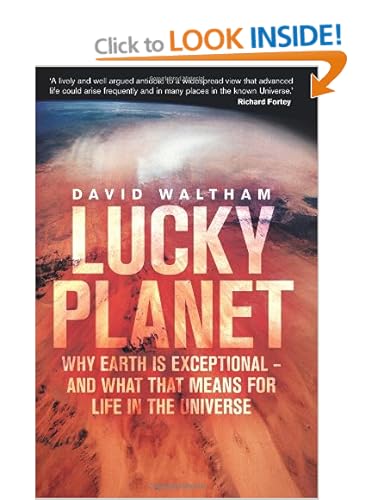
Carl Sagan was notorious for believing there were thousands and thousands of alien civilizations out there in the Milky Way and that they were all super-civilized and benevolent. Typical liberal astronomer. I recently reviewed "Lucky Planet: Why Earth is Exceptional—and What That Means for Life in the Universe" by David Waltham (who is a geologist with a contrary view) but I hadn't realised that the world is polarised between physicists and astronomers who think aliens are plentiful and biologists who think they are non-existent.

All is explained here.

---

3. Where we are inundated at Cluny, France

We arrived in Cluny, France (site of the famous mediaeval abbey) last Saturday evening after a sleepless night and a lengthy and exhausting drive up from Northern Italy. The weather was sunny, interspersed with violent thunderstorms. We pitched our tent and drove into Cluny, to the abbey which now houses, amongst other stuff, a restaurant. The outside tables were bathed in sunshine (also way too many flies but we were too fatigued to care) but mindful of the weather I pointed to a table under the canopy.

Our food arrived, and then this (video).

Wednesday, May 07, 2014

A plausible solution to the Fermi paradox

Review of "Lucky Planet: Why Earth is Exceptional - and What that Means for Life in the Universe" by David Waltham.

It’s been fashionable and perhaps even comforting to believe in the essential unity, benevolence and even environmental-competence of life on Earth. The Gaia hypothesis makes us feel good, but hard-nosed evolutionary biologists and planetary scientists crunch the numbers and just can’t get it to work. Forget the galaxy of a billion friendly alien civilizations, perhaps there’s just one: ourselves. Perhaps we’re just very, very fortunate.   Here’s a much abbreviated summary of what David Waltham has to say in this lively and intelligent book.

Our very existence shows that the Earth has experienced life-friendly climatic conditions for billions of years. During this time the output of the sun has increased by 30% while early high levels of greenhouse gases such as methane, water vapour and carbon dioxide have been almost scrubbed from the atmosphere. These changes ought to have produced enormous and lethal climatic variation yet somehow, by some magic, the effects have largely cancelled out.

For some people, this shows that powerful negative feedback mechanisms are at work, stabilising the climate for life. Strange then, that such benign processes are so hard to pin down. The alternative view is that for most planets like the Earth, the climate did indeed transition to fire or ice, with the consequent destruction of any biosphere; the Earth is special and very, very lucky.

 Of course, the fact that we’re here at all to make such an observation indicates that for the Earth it could hardly have been otherwise. This is called the principle of Anthropic Selection - to be contrasted with the Principle of Mediocrity, that the Earth is not that special in the universe.

David Waltham systematically takes us through the unique features of the Earth.  Our star, the sun, is unusually large and bright – most long-lived stars are smaller and redder than ours. However, they are prone to stellar flares which are extremely harmful to the biosphere. The Earth has an astonishingly strong magnetic field which deflects the solar wind, which otherwise could split water vapour into hydrogen and oxygen allowing the former to escape into space – this is how a planet loses all its water.

Despite the early sun emitting only 70% of today’s output, the Earth remained suitable for life due to the immense greenhouse effect of the early atmosphere. As the sun heated up, the greenhouse effect reduced in tandem: carbon dioxide was washed out of the atmosphere by rain and locked up in sedimentary rocks, while methane was oxidised away as soon as early photosynthesis evolved.

The Earth did not experience a smooth, stabilised, homeostatic climate – there were episodes of great heat interspersed with at least four ‘snowball earth’ episodes where the entire planet became icebound. Thanks, however, to plate tectonics and volcanism, carbon dioxide was released back into the atmosphere to unfreeze the Earth and to allow early life to reboot.

Some people believe that this is an example of the Gaia principle – life stabilising its own environment. The author sees instead systems of climate dynamics that could so easily have sheared off into uncontrolled positive feedback or blundered into wild oscillations. In his opinion, this is exactly what happens to most planets like ours ‘out there’ - but as a consequence, they have no observers to later theorise about it.

Parenthetically, the author’s concerns about current anthropogenic global warming are consistent with his view of underlying instabilities. It’s not so much that increased carbon dioxide levels in the atmosphere directly warm the climate; it’s more that they catalyse changes in more potent greenhouse gases (water vapour, methane) and it’s not at all clear that there are negative feedback mechanisms which could dampen their effects. The climate models are very complex and who knows if they’re either comprehensive or correctly tracking all the mechanisms?

Another climate-changing influence is the Earth’s axial inclination (currently around 23 degrees) and its orbit around the sun. Under the impact of the other planets in the solar system, the shape and tilt of the Earth’s orbit is continually changing on long-period cycles (69,000 years for orbital tilt and tilt-direction, 400,000 years for orbital eccentricity with other influences clustering around 100,000 years). These affect solar heating and drive the ice ages. The Earth also precesses on its axis every 26,000 years. We’re very lucky that these numbers are rather different because if they converged we would experience orbital resonances, and the inclination of the Earth’s axis would become unstable and chaotic (of the order of a few million years). This would trash the climate, leading to the extinction of all complex forms of life. How did we come by that luck?

It’s somewhat well-known that our large moon ‘spin stabilises’ the inclination of the Earth’s axis. What is less well-known is that as the moon continues to spiral away, the precession rate will slowly decay and in 1.5 billion years time resonance will occur with the orbital periods discussed above. At that point, the Earth will have an unstable spin axis. This is of academic interest only, as for reasons concerned with the sun’s increasing output, the earth will become uninhabitable for multi-cellular life within the next 500 million years. But, if the moon’s radius had been just 10 km larger and the early Earth’s day just ten minutes longer, the Earth would have an unstable spin axis today. What are the chances?

So why does it pay to have a large moon? The author suggests that a moon almost large enough to eventually generate axial instability also stabilises the spin prior to that, and in doing so allows the planet to have relatively mild and infrequent ice ages - another case of fine-tuning for intelligent life.

The author concludes that the chances of all these things coming together to guarantee a four billion year life-benign climate are so remote that the Earth is possibly the only planet with intelligent life in the entire visible universe: we are quite alone. This solution to the Fermi Paradox might be considered depressing, but it should increase our caution – “We may just find out the hard way that planets with nasty climates are quite easy to produce.”

The reader may be left with another thought: although few planets may experience multi-billion year climate stability, this is hardly a pre-requisite for interstellar colonisation, and there’s a lot of unoccupied real estate out there.

Tuesday, December 24, 2013

Fermi problems and the existence of God

In his or her article "The Math Sex Gap Revisited: a Theory of Everyone", famed scholar La Griffe du Lion writes:
"Good evening ladies. I am truly honored to be invited to the annual meeting of Women Against the Gap and even more so to be your featured speaker. I always enjoy visiting La La Land where a gap-free society defines the goal of human striving. Thank you for the invitation and for your hospitality. I confess to some initial misgivings -- after all, hundreds of WAGs in a single room can be intimidating -- but your gracious welcome quickly put an end to my fears. So, as a much-relieved featured speaker, I look forward to sharing with you a new analysis of the mathematics gender gap, which, if psychologists could do Fermi problems, would be largely unnecessary."
So what is a Fermi problem? Here is how the Wikipedia article starts.
"In Physics or engineering education, a Fermi problem, Fermi question, or Fermi estimate is an estimation problem designed to teach ... the importance of clearly identifying one's assumptions. Named after physicist Enrico Fermi, such problems typically involve making justified guesses about quantities that seem impossible to compute given limited available information.

Fermi was known for his intelligent ability to make good approximate calculations with little or no actual data, hence the name. One example is his estimate of the strength of the atomic bomb detonated at the Trinity test, based on the distance travelled by pieces of paper dropped from his hand during the blast. Fermi's estimate of 10 kilotons of TNT was remarkably close to the now-accepted value of around 20 kilotons."
An example of a Fermi problem occurred to me in the context of Christmas. What would be the consequences if God actually existed?

I know a lot of people are believers, but here I'm talking about the discovery of hard evidence that a supernatural, universe-spanning, guiding intelligence actually existed. This would surely be the ultimate intelligent alien scenario.

Don't you think that a good proportion of the Earth's R&D budget wouldn't immediately be diverted to God research? The Department of Pure and Applied Theology would surely be a branch of the Physics faculty.

I know of no country in the world, no matter how devout, where such a situation obtains.