Showing posts with label Psychohistory. Show all posts

Monday, March 18, 2024

Formal Logic in SF: 'Foundation'

Below is the extract from "Foundation" by Isaac Asimov that I’m mulling over. As a young teenager it first got me interested in Predicate Calculus, which much later I studied in my AI research.


The Foundation Trilogy by Isaac Asimov

Here's the extract.

---

"Said Yate Fulham: "And just how do you arrive at that remarkable conclusion, Mr. Mayor?"

"In a rather simple way. It merely required the use of that much-neglected commodity – common sense. You see, there is a branch of human knowledge known as symbolic logic, which can be used to prune away all sorts of clogging deadwood that clutters up human language."

"What about it?" said Fulham.

"I applied it. Among other things, I applied it to this document here. I didn't really need to for myself because I knew what it was all about, but I think I can explain it more easily to five physical scientists by symbols rather than by words."

Hardin removed a few sheets of paper from the pad under his arm and spread them out. "I didn't do this myself, by the way," he said. "Muller Holk of the Division of Logic has his name signed to the analyses, as you can see."

Pirenne leaned over the table to get a better view and Hardin continued:

"The message from Anacreon was a simple problem, naturally, for the men who wrote it were men of action rather than men of words. It boils down easily and straightforwardly to the unqualified statement, when in symbols is what you see, and which in words, roughly translated, is, 'You give us what we want in a week, or we take it by force.'"

There was silence as the five members of the Board ran down the line of symbols, and then Pirenne sat down and coughed uneasily.

Hardin said, "No loophole, is there, Dr. Pirenne?"

"Doesn't seem to be."

"All right." Hardin replaced the sheets. "Before you now you see a copy of the treaty between the Empire and Anacreon – a treaty, incidentally, which is signed on the Emperor's behalf by the same Lord Dorwin who was here last week – and with it a symbolic analysis."

The treaty ran through five pages of fine print and the analysis was scrawled out in just under half a page.

"As you see, gentlemen, something like ninety percent of the treaty boiled right out of the analysis as being meaningless, and what we end up with can be described in the following interesting manner:

"Obligations of Anacreon to the Empire: None!

"Powers of the Empire over Anacreon: None!"

Again the five followed the reasoning anxiously, checking carefully back to the treaty, and when they were finished, Pirenne said in a worried fashion, "That seems to be correct."

"You admit, then, that the treaty is nothing but a declaration of total independence on the part of Anacreon and a recognition of that status by the Empire?"

"It seems so."

"And do you suppose that Anacreon doesn't realize that, and is not anxious to emphasize the position of independence – so that it would naturally tend to resent any appearance of threats from the Empire? Particularly when it is evident that the Empire is powerless to fulfill any such threats, or it would never have allowed independence."

"But then," interposed Sutt, "how would Mayor Hardin account for Lord Dorwin's assurances of Empire support? They seemed –" He shrugged. "Well, they seemed satisfactory."

Hardin threw himself back in the chair. "You know, that's the most interesting part of the whole business. I'll admit I had thought his Lordship a most consummate donkey when I first met him – but it turned out that he was actually an accomplished diplomat and a most clever man. I took the liberty of recording all his statements."

There was a flurry, and Pirenne opened his mouth in horror.

"What of it?" demanded Hardin. "I realize it was a gross breach of hospitality and a thing no so-called gentleman would do. Also, that if his lordship had caught on, things might have been unpleasant; but he didn't, and I have the record, and that's that. I took that record, had it copied out and sent that to Holk for analysis, also."

Lundin Crast said, "And where is the analysis?"

"That," replied Hardin, "is the interesting thing. The analysis was the most difficult of the three by all odds. When Holk, after two days of steady work, succeeded in eliminating meaningless statements, vague gibberish, useless qualifications – in short, all the goo and dribble – he found he had nothing left. Everything canceled out."

"Lord Dorwin, gentlemen, in five days of discussion didn't say one damned thing, and said it so you never noticed. There are the assurances you had from your precious Empire."

Hardin might have placed an actively working stench bomb on the table and created no more confusion than existed after his last statement."

---

Many people - mostly economists, it seems - have cited psychohistory as the reason they entered their profession. For me it prepared the way for the International Marxist Group.

But today I'm more interested in what ‘symbolic logic’ did for Salvor Hardin.

Within the paradigm of formal logic, the natural language texts Hardin gave to the ‘Division of Logic’ would most likely have been mapped to Richard Montague's baroque fusion of higher-order predicate calculus, lambda calculus and multi-modal logics. Computationally intractable, as it turns out.


Translating English into Montague's formal logic


But a suitable LLM in summarisation mode could do the job in seconds.

Wednesday, September 27, 2017

Why no mathematical models of Marxist economics?

It's been commonplace in recent decades to observe, even decry the extreme mathematization of orthodox micro- and macroeconomics. But Marxist economics - still an active area of research - remains resolutely descriptive and verbal.

Amazon link


If, nevertheless, you search you come across "Mathematical Model of Marxist Economics" (2015) by Wu Yifeng - but that's in Chinese.

Amazon link

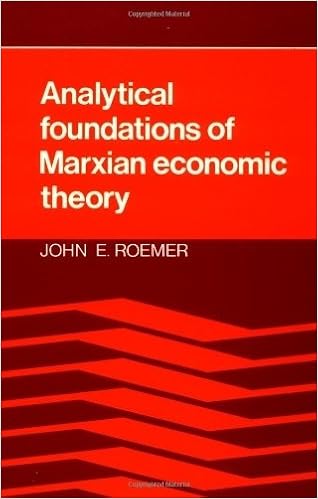
In English we have "Analytical Foundations of Marxian Economic Theory" by John E. Roemer (1989) which is available, partially, as a PDF. Roemer says some sensible things in the introduction about his approach:
"the microfoundations approach consists of deriving the aggregate behavior of an economy as a consequence of the actions of individuals, who are postulated to behave in some specified way. I have taken this approach throughout the book.

For example, in the chapters on the falling rate of profit, it is postulated that a technical innovation is introduced only if it increases profits for a capitalist. This micro approach is different from a macro approach, which might say: We postulate that technical change takes the form of an increasing aggregate organic composition of capital.

From the micro vantage point, one is not allowed to postulate an increasing organic composition of capital unless one can show what individual entrepreneurial mechanism leads to it.

Marxists might question the microfoundations methodology because one of the forceful points of Marx's theory is that the individual is not the relevant unit to examine - it is the class. This might lead one to try and build a model in which classes are the atoms of the system.

I think it should be possible to produce such a model, but I do not believe that model would be contradictory to the ones I have described in this book. The reason is this: that individuals act as members of a class, rather than as individuals, should be a theorem in Marxian economics, not a postulate.

Marx's point is that despite the capitalist's incarnation as a human being, he or she is forced by the system to act as an agent for the self-expansion of capital. Workers, similarly, may have their individual yearnings and habits, but conditions of life force them to acquire a class consciousness and to act, at times, as agents of the working class as a whole and not as their own agent. (This might be the situation, for instance, in a strike, where the striker takes great chances for the good of the strike, which are not personally worthwhile.)

In each case, Marx has claimed that although people exist organically as individuals, we can conclude that they act as members of classes. It is in this sense that class behavior is a theorem and not a postulate of the Marxian theory.

Taking the argument a step further, I would say that it is not only admissible, but important, to take a microfoundations approach in Marxian theory. A common error in Marxian discussions is functionalism: to assume that a mechanism necessarily exists to perform actions that must be performed to reproduce the system.

Put more simply, if the occurrence of X will further the reproduction of capitalist relations, then X occurs. For example, if racist attitudes exist among the working class, then capital will be strong. Therefore, capitalism foments racism.

What is missing here is a description of the mechanism by which this is accomplished. It may be in the interest of capital as a whole to maintain discriminatory wage differentials for black and white workers of equal productivity, but why should the individual, profit-maximizing capitalist respect this differential when he or she can increase profits by unraveling the differential - that is, by hiring only black workers at a slightly higher wage than they are receiving under the racist regime? [For one answer to this question, see Roemer (1979c).]

If we postulate capitalism as a system of anarchic, competitive capitals, each bent on its own expansion, we must face this sort of contradiction from functionalist arguments.

Another example comes from some Marxist-radical theories of education. Capitalism does not require a highly educated working class, so the theory goes, but it does require a well-socialized and docile working class. Schools, then, will serve the role of socializing and channeling people into capitalist society, but not of educating them.

Now, this conclusion may be true, but the functionalist nature of the argument eclipses the mysterious and difficult part of the phenomenon - how does capitalism ensure this role for schools, when teachers try to teach, students try to learn, and so on?

A third example is the role of the state. The capitalist state acts in the interests of the capitalist class - that is the theory. But the theory cannot be convincing unless one can demonstrate the mechanism by which this occurs, especially because capitals do not have a habit of cooperating with each other, as the primary aspect of each capital's existence is self-expansion and competition against other capitals.

What one requires, then, are microfoundations for the role of racism, education, and the state under capitalism. Other examples abound. In the cases when capitalism is guided as if by an invisible hand to coordinate its preservation in the ways mentioned, one requires an explanation of how anarchic capitals produce such a result.

 A second form of functionalism that exists among Marxists is the converse of the first form: If X has occurred, then X must be in the interests of capital. We again can take an example from education:

Because we observe compulsory education, it must be that capital requires such for its reproduction. But this may not be the case: compulsory education may exist because the working class fought for it.

One can find many examples of this form of functionalism in Marxian work: The general consequence of the error is to attribute an omnipotence to the capitalist class that it does not possess in Marxian theory. The capitalist class is pushed along by historical developments: Not everything that happens under capitalism was planned by it, nor is in its best interests. In fact, according to Marx, the general tide of historical development favors the working class. Again, a defense against this form of functionalism is a microfoundations approach.

There is a third form of functionalism among Marxists that, strangely, seems diametrically opposed to the first two forms: If the occurrence of X is necessary for the demise of capitalism, then X will come to pass. We can see the general rule of which these different functionalist forms are special cases if we phrase the general functionalist position this way. We postulate a certain outcome for the social system; functionalism then takes the form of claiming that only events occur which lead to that outcome.

In the first two forms of functionalism discussed, the outcome is the reproduction of capitalist relations; in the third form, the outcome is the transformation of capitalism into socialism. Perhaps the first two forms of functionalism are short-run variants, and the third form is a long-run variant of the general functionalist interpretation of Marxism.

Examples of the third form of functionalism in Marxian economics are prevalent in crisis theory. The system must have crises, because crisis is necessary for capitalist demise. The rate of profit must fall, because only in this way can crisis be brought about. The working class must become impoverished, because otherwise it will never perform its revolutionary task. Bourgeois democracy must transform itself into fascism, because only fascism will heighten the contradictions of capitalism sufficiently to produce revolutionary transformation, which must occur. These arguments are less than convincing; the form of functionalism they involve is similar to that of the utopian socialism of Marx's time, which postulated socialist transformation without a mechanism.

Marx's method was to counter utopian thinking by trying to expose the mechanism that would bring the socialist transformation about. ...

Finally, the equilibrium method has been used in the models in this book. While I have defended the approach of mathematical modeling, and the microfoundations approach, I have less confidence about the equilibrium method. Like many economists of my generation, I am strongly influenced by the power of the equilibrium method: of examining a model when it is at rest, so to speak, in the sense that all the rules that describe how its parts work are simultaneously fulfilled.

What is disturbing about the equilibrium method is that it pictures the typical position of the system as a position the system rarely or never enjoys. Of course, no sophisticated economic model builder would claim that economies are in equilibrium in the sense of a static equilibrium model. A model is only an ideal type.

However, there seems to be a deep contradiction between using models whose main analytical trick is to postulate a position that is precisely at variance with the most interesting and important aspect of capitalist economy as described by Marxian theory - its incessant, contradictory motion.

There is, therefore, the danger that if this intuition is correct, the equilibrium method will prevent one from seeing the most important aspects of the Marxian theory of capital. Knowing no other method, I use the equilibrium method, with the vague thought that, when rereading these pages in twenty years, its obsolescence as a modeling tool for Marxian theory may be clear.

(I might add that there is plenty of precedent in Marx's modeling of his theory for the equilibrium method: Consider, for example, the notion of equalization of profit rates among capitals, or the models of balanced growth designed to show that capitalism was capable of reproducing itself.) ..."
After this thoughtful introduction we encounter chapter 1.
"1 Equilibrium and reproducibility: the linear model

1.1 A brief review

We begin with a discussion of what constitutes an equilibrium, in Marxian terms, of a capitalist economy, and for this chapter we study a linear, Leontief specification of production.

Capitalists all have access to the same Leontief production system {A, L}, where

   A is an n x n input matrix of commodities

   L is a 1 x n vector of direct labor inputs.

If p is a l x n commodity price vector and the wage is normalized at unity so that prices p are interpreted as wage prices, then the usual notion of an equilibrium-price vector in a Marxian system is a vector p for which there exists a nonnegative number π such that

   p = (1 + π)(pA + L)           (1.1)

The vector pA + L is the vector of unit costs of production (assuming that there are no fixed capital costs), and so π may be interpreted as the uniform profit rate for the economy.

There may be, of course, many pairs (p, π) satisfying Equation 1.1.

We add more information to the system by requiring that workers each receive a subsistence vector of commodities b, an n x 1 vector. By subsistence, we mean simply that the wage must be precisely sufficient for b to be affordable, thus

   pb = 1                                 (1.2)

Here, the unit of time that denominates L, which is the same unit of time for which the wage of unity is paid, is to be thought of as one working day.

Combining (1.1) and (1.2), we see immediately that

   p = (1 + π)p(A + bL)         (1.3)

Thus, for a vector p satisfying (1.1) and (1.2) to exist, it is necessary and sufficient that the augmented input coefficient matrix M = A + bL possess an eigenvalue 1/(1 + π) that does not exceed one, to which can be associated a nonnegative eigenvector p.

According to the Frobenius—Perron theorem, if M is an indecomposable matrix, then M has a unique eigenvalue that can qualify; that is, M possesses a unique positive eigenvalue to which can be associated a nonnegative eigenvector. It is, furthermore, the content of Morishima-Okishio's fundamental Marxian theorem (FMT) that if the rate of exploitation e is positive, then the Frobenius eigenvalue of M will be less than one, and so the associated profit rate will be strictly positive. ..."
and so it goes on. One reviewer writes:
"The analytical rigor in treating the subject is among the things that make the book worth buying for anyone interested in mathematical economics: sitting down with paper and pencil for a couple of months in reading the book will be a beautiful intellectual experience, and it will add a whole set of "weapons" to the neoclassically trained economist."
But perhaps we just don't yet have the right (agent-based?) mathematics for Marx.

---

I'm been reading Duncan Foley's excellent primer on Capital.

PDF link

Foley is a clear and creative thinker who is prepared to bring some simple mathematics to the table. He's interested in presenting the conceptual apparatus of Marxism in an orderly manner rather than simply providing a slimmed-down exegesis of the books themselves. His approach is very much rooted in applying Marxism to the present day economy, which informs both his appraisal and his examples.

He reconstructs in mathematical form the circulation of capital and Marx's simple and expanded reproduction equations before moving on to the 'transformation problem', crisis theories and Marx's concept of socialism. Here's the table of contents:
Contents

1 On Reading Marx: Method                            1
2 The Commodity: Labor, Value, Money        12
3 The Theory of Capital and Surplus Value    31
4 Production under Capitalism                       49
5 The Reproduction of Capital                       62
6 The Equalization of the Rate of Profit         91
7 The Division of Surplus Value                   105
8 The Falling Rate of Profit                          125
9 The Theory of Capitalist Crisis                  141
10 Socialism                                                 158
Suggested Readings                                    173
References                                                   177
Index                                                             181
In addition as you can see, this introductory book is quite short.
.
---

When I did my PhD research - the formal theory of intentional agents - I explicitly rejected the framework of differential equations used by the control theorists and the cyberneticists (cf Ross Ashby). For the same reason I am somewhat skeptical about aspects of Peter Turchin's Cliodynamics.

My approach was in the classical AI tradition of modal logics and generalised automata theory where intentional agents (those with perceptions, beliefs, goals, plans, actions) are modelled explicitly. I still think this is the best approach to a twenty-first century formalised Marxist psychohistory where we're interested in history at the simulation level.

Tuesday, November 10, 2015

Wolves amongst the stars


About a month ago I read Liu Cixin's epic 'The Three-Body Problem' as described in this post. In volume two of the trilogy, 'The Dark Forest', the Trisolaran invasion fleet has been launched from the nearby Centaurus system and is 400 years out from Earth. Trisolaran technology appears invincible and worse, the Trisolarans can listen to everything happening on Earth and have a fifth column of human supporters for their genocidal mission.

Earth turns to the Wallfacers - and Luo Ji  in particular. Here's a rather lengthy extract where Luo Ji is explaining some unpalatable truths to his burly police bodyguard, Shi Qiang.
They crossed the highway to where the embankment blocked out the lights of the residential area. Groping about in the dark that surrounded them, Luo Ji and Shi Qiang sat down on the sandy ground.

"Let's begin," Luo Ji's voice sounded in the dark.

"Give me the easy version. At my level, I'm not going to understand anything complicated."

"Everyone can understand, Da Shi. The truth is simple. It's the kind of thing that, once you hear it, you'll wonder why you didn't come up with it yourself. Do you know about mathematical axioms?"

"I took geometry in high school. 'Only one straight line can be drawn between two points.' That kind of thing."

"Right. So now we're going to set out two axioms for cosmic civilization.

"First, survival is the primary need of civilization. Second, civilization continually grows and expands, but the total matter in the universe remains constant."

“And then?"

"That's it."

"What can you derive from those little things?"

"The same way you can figure out an entire case from a bullet or a drop of blood, cosmic sociology is able to describe a complete picture of galactic and cosmic civilization from those two axioms. That's what science is like, Da Shi. The cornerstone of every discipline is quite simple."

 "So let's see you derive something."

...

"... The universe is big, but life is bigger! That's what the second axiom means. The amount of matter in the universe remains constant, but life grows exponentially. Exponentials are the devils of mathematics. If there's a microscopic bacterium in the ocean that divides once every half hour, its descendants will fill the entire ocean in the space of a few days, so long as there are sufficient nutrients. Don't let humanity and Trisolaris give you a false impression. These two civilizations are tiny, but they are only in their infancy. Once a civilization passes a certain technological threshold, the expansion of life through the universe is frightening. For instance, take humanity's present navigation speed. In a million years, Earth civilization could fill the galaxy. And a million years is a short time measured against the universe."

"So you're saying that, taking the long view, the entire universe might have that kind of... what are they calling it, a 'dead hand'?"

"No need for the long view. Right now the entire universe has been dealt that dead hand. Like Hines said, civilization may have started in the universe billions of years ago. Looking at the signs, the universe might be packed full already. Who knows how much empty space there is in the Milky Way or the universe, or how many resources are left?"

"But that's not right, is it? The universe looks empty. We haven't seen any other alien life apart from Trisolaris, right?"

"That's what we'll talk about next. Give me a cigarette."

Luo Ji groped about in the dark for a while before taking the cigarette from Shi Qiang's hand. When Luo Ji next spoke, Shi Qiang realized he had moved to a spot three or four meters away.

"We need to increase the distance to make it feel more like outer space," Luo Ji said.

Then he lit the cigarette by twisting its filter, and Shi Qiang lit one of his own. In the dark, two tiny red planets stood in distant opposition.

"Okay. To illustrate the problem, we now need to establish the most elementary model of cosmic civilization. These two balls of flame represent two civilized planets. The universe is made up of only these two planets, and apart from them there's nothing else. Erase all of our surroundings. Can you locate that feeling?"

"Yeah. That's an easy feeling to find in a dark place like this."

"Let's call these two civilized worlds your civilization and my civilization. They're separated by a great distance, say, a hundred light-years. You can detect that I exist, but you don't know any details. However, I'm completely ignorant of your presence."

"Right."

"Now we need to define two concepts, 'benevolence' and 'malice' between civilizations. These words themselves aren't very rigorous in a scientific context, so we've got to restrict their meaning. `Benevolence' means not taking the initiative to attack and eradicate other civilizations. 'Malice' is the opposite."

"That's a low bar for benevolence."

"Next, consider your options for dealing with me. Please remember that the axioms of cosmic civilization should be kept in mind throughout the process, as well as the distance scale and the environment of space."

"I could choose to communicate with you."

"If you do that, you should be aware of the price you'll pay: You'll have exposed your existence to me."

"Right. In the universe, that's no small thing."

"There are different degrees of exposure. The strongest form of exposure is when I know your precise interstellar coordinates. Next is when I know your general direction, and the weakest is when I only know of your existence. But even the weakest form of exposure makes it possible for me to search for you, because since you've detected my existence, I know that I'll be able to find you. It's only a matter of time from the standpoint of technological development."

"But my boy, I could still take the risk to talk to you. If you're malicious, then it's my bad luck. But if you're benevolent, then we could have further exchanges and ultimately be united into a benevolent civilization."

"Okay, Da Shi. Now we've come to the crux of it. Let's return to the axioms of cosmic civilization: Even if I'm a benevolent civilization, can I determine at the start of our communication whether or not you are also benevolent?"

"Of course not. That would violate the first axiom."

"So once I've received your message, what should I do?"

"Naturally, you ought to determine whether I'm benevolent or malicious. Malicious, and you eradicate me. Benevolent, and we can continue communicating."

The flame on Luo Ji's side rose up and moved back and forth. Evidently he had gotten up and was pacing.

"That's fine on Earth, but not out in the universe. So next we'll introduce an important new concept: the chain of suspicion."

"That's an odd term."

"The term is all I had at first. It wasn't explained to me. But, later, I was able to infer its meaning from the words themselves."

"Who didn't explain it?"

"... I'll tell you later. Let's continue. If you think I'm benevolent, that's not a reason to feel safe, because according to the first axiom, a benevolent civilization can't predict that any other civilization is benevolent. You don't know whether I think you're benevolent or malicious. Next, even if you know that I think you're benevolent, and I also know that you think I'm benevolent, I don't know what you think about what I think about what you're thinking about me. It's convoluted, isn't it? This is just the third level, but the logic goes on indefinitely."

"I get what you mean."

"That's the chain of suspicion. It's something that you don't see on Earth. Humanity's shared species, cultural similarities, interconnected ecosystem, and close distances means that, in this environment, the chain of suspicion will only extend a level or two before it's resolved through communication. But in space, the chain of suspicion can be very long. ...."

Shi Qiang took a drag on his cigarette, and his contemplative face emerged from the darkness for a moment.

"... In actual cosmic civilization, the biological differences between different groups might be as high as the kingdom level, and cultural differences are even further beyond our imagining. Add to this the vast distances between them, and you have chains of suspicion that are practically indestructible."

"That means that the outcome is the same, regardless of whether we're benevolent civilizations or malicious civilizations?"

"That's right. That's the most important aspect of the chain of suspicion. It's unrelated to the civilization's own morality and social structure. It's enough to think of every civilization as the points at the end of a chain. Regardless of whether civilizations are internally benevolent or malicious, when they enter the web formed by chains of suspicion, they're all identical."

"But if you're much weaker than I am, you're not a threat to me. So I could always communicate with you, right?"

"That won't work, either. Here we need to introduce a second important concept: the technological explosion. I didn't get a full explanation for this, either, but it was far easier to infer than the chain of suspicion. Human civilization has five thousand years of history, and life on Earth might be as much as a few billion years old. But modern technology was developed over the course of three hundred years. On the scale of the universe, that's not development. It's an explosion! The potential for technological leaps is the explosive buried within every civilization, and if it's lit by some internal or external factor, it goes off with a bang. On Earth it took three hundred years, but there's no reason why humanity should be the fastest of all cosmic civilizations. Maybe there are others whose technological explosions were even more sudden.

"I'm weaker than you, but once I've received your message and know of your existence, the chain of suspicion is established between us. If at any time I experience a technological explosion that suddenly puts me far ahead of you, then I'm stronger than you. On the scale of the universe, several hundred years is the snap of a finger. And it might be that my knowledge of your existence and the information I received from our communication was the perfect spark to set off that explosion. That means that even though I'm just a newborn or growing civilization, I'm still a big danger to you."

Shi Qiang watched Luo Ji's flame in the darkness as he thought for a few seconds, then looked at his own cigarette.

"So I have to keep quiet."

"Do you think that will work?"

They smoked. The balls of flame brightened and their faces emerged from the darkness like the gods of this simple universe, deep in thought. Shi Qiang said,

"No, it won't. If you're stronger than me, then since I was able to find you, one day you'll be able to find me. And then there will be a chain of suspicion between us. If you're weaker than me, you could experience a technological explosion at any time, and that would take us back to the first case. To sum up: one, letting you know I exist, and two, letting you continue to exist, are both dangerous to me and violate the first axiom."

"Da Shi, you've really got a clear mind."

"My brain can keep up with yours so far, but we're only getting started."

Luo Ji was silent in the dark for a long time. His face emerged in the weak light of the ball of flame two or three times before he said,

"Da Shi, this isn't a start. Our reasoning has already reached a conclusion."

"Conclusion? We haven't figured anything out! Where's the picture of cosmic civilization you promised?"

"If neither communication nor silence will work once you learn of my existence, you're left with just one option."

In the long silence that followed, the two flames went out. There was no wind, and the dark silence turned thick as asphalt, connecting sky and desert into a murky whole. At last Shi Qiang uttered one word in the darkness: "F***!"

"Extrapolate that option out to the billions upon billions of stars and hundreds of millions of civilizations, and there's your picture,"

Luo Ji said, nodding in the darkness.

"That's... that's really dark."

"The real universe is just that black."

Luo Ji waved a hand, feeling the darkness as if stroking velvet.

"The universe is a dark forest. Every civilization is an armed hunter stalking through the trees like a ghost, gently pushing aside branches that block the path and trying to tread without sound. Even breathing is done with care. The hunter has to be careful, because everywhere in the forest are stealthy hunters like him. If he finds other life—another hunter, an angel or a demon, a delicate infant or a tottering old man, a fairy or a demigod—there's only one thing he can do: open fire and eliminate them. In this forest, hell is other people; an eternal threat that any life that exposes its own existence will be swiftly wiped out. This is the picture of cosmic civilization. It's the explanation for the Fermi Paradox."

Shi Qiang lit another cigarette, if only to have a bit of light.

"But in this dark forest, there's a stupid child called humanity, who has built a bonfire and is standing beside it shouting, 'Here I am! Here I am!"' Luo Ji said.

"Has anyone heard it?"

"That's guaranteed. But those shouts alone can't be used to determine the child's location. Humanity has not yet transmitted information about the exact position of Earth and the Solar System into the universe. From the information that has been sent out, all that can be learned is the distance between Earth and Trisolaris, and their general heading in the Milky Way. The precise location of the two worlds is still a mystery. Since we're located in the wilderness of the periphery of the galaxy, we're a little safer."

"So what's the deal with the spell?"

...
Liu Cixin's science fiction is old-school and high-concept, inspired equally by Isaac Asimov's psychohistory and China's ancient history. This second volume grapples with the problem: how can you deal with an extermination force of overwhelming military superiority, almost perfect data intelligence but one which is hundreds of years away, past any planning horizon politicians, the military and the people are accustomed to?

As ever, his solutions are ingenious .. and implicit in the excerpt above.

In volume three, Death's End (April 2016), his ambitions seem to be set even higher.