Showing posts with label Lytes Cary Manor. Show all posts

Thursday, November 07, 2024

I Hate To Lose


Down to Lytes Cary Manor (National Trust), about half an hour’s drive from home. A walk through the grounds, damp and gooey clay, the odd mud pool on the path down to the river. Overcast skies. No sign of that unshielded fusion reactor, so dangerously close at 160 million kilometres.

“Do you think we'll see anyone else?” Clare asked, (the car park had been almost full).

“No,” I said confidently, thinking that the wise visitor would have stuck to the house and immediate gardens, and then made a fast retreat to the tea room.

I got the impression that she'd said, or thought, that we would see around six people.

Halfway round our circuit, just after we had admired the bridge, a man passed us. We exchanged greetings. It was 12.15 pm.

“I always think that we should say good afternoon only after lunch,” she said. (We had said good morning).

“That’s my view too,” I said, though my mind was more on the fact we had, now, met somebody.

“I think there is a better way to think about this,” I said, “something a little less binary. When I said we wouldn’t see anyone else, I really meant we should see zero-ish people. I had in mind a distribution. One is very close to zero, so on balance I'm still right about this.”

She looked at me in disbelief.

Soon afterward, in the distance, we spotted two other walkers. That made a total of three, as we headed back towards the tea room for our hot chocolates.

“OK,” I said, “We’re really talking about two binomial distributions here. Divide our walk into, say, n = 12 equal time slots and assume the probability of encountering another walker in each of these time slots is p. We’re really disagreeing about the value of p.

“In my view p was about one twelfth, which means I should have perhaps expected on average to meet just one person. You said we’d meet six people so for you p is one half - twelve times one half is six.”

They do look like rabbits. The tea room is in the manor house, top left

It was hard to see if she was following the argument as her attention seemed fixed on the weeds growing in the adjacent field, which looked like a crowd of rabbits.

"Now, our standard deviations are different: for me, using the formula sqrt(npq) n = 12; p = one twelfth;  it's just under one - while for you with p = a half, it’s around 1.73, the square root of three.

"So seeing three people for me is two standard deviations out - while for you it’s only 1.73 sds.

“Although technically this aligns more to you, I think morally we’d have to call it a draw.”

She turned to me and said, “Even when you lose you hate to lose.”

Wednesday, September 14, 2016

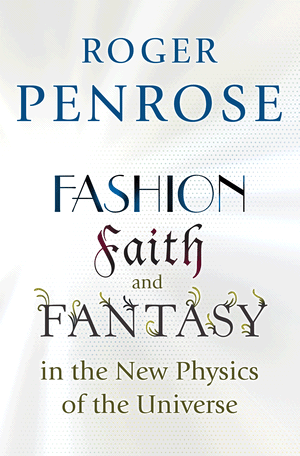
Fashion, Faith, and Fantasy

Amazon link

My hard copy has just arrived, a respite from reading Gareth Stedman Jones' theory-and-history-dense biographical tome, "Karl Marx: Greatness and Illusion".


Here is how Peter Woit describes Penrose's book.
"Besides a mathematical appendix, the book is divided up into four parts:

"Fashion

"This is the section that deals with string theory, and Penrose’s central objection is to the use of extra spatial dimensions as a crucial part of the theory. When trying to use string theory as a unified theory, an assumption is made that one can take four space-time dimensions very large, and the rest very small, decoupling the large and small dimensions. Penrose argues that there is no reason to believe one can consistently do this, that there should be couplings between these degrees of freedom that cannot be ignored, leading to instability of the theory, rather than a stable ground state with large dimensions.
...

"Faith

"In this section Penrose addresses the measurement problem of quantum mechanics, pointing out correctly that our standard story about quantum mechanics introduces an “ontological shift”, indicating that something more is going on than a well-understood consistent framework. He favors the idea that perhaps the introduction of gravity into the usual framework could resolve this problem, backing this up a dimensional analysis argument that a relevant effect could come from gravity, while being too small to be observable so far.
...

"Fantasy

"Here Penrose describes in detail some basic problems in the theory of cosmology, and how they are supposedly resolved by the theory of inflation. He explains that characterizing this as “fantasy” is not meant to be purely critical, that “fantasizing” about the moment of the big bang is what theorists do in the absence of compelling evidence, and that he just has other fantasies he thinks worthwhile.
...

"A new physics for the universe?

"In a final section, Penrose describes some of his more positive ideas addressing the problems pointed out in the earlier sections. This begins with a wonderful summary of the theory of twistors, and I strongly suspect that he’s right that this very different way of thinking about space-time geometry will ultimately be part of any successful integration of our understanding of quantization and geometry. That this geometry is very specific to four space-time dimensions provides yet another reason for skepticism about the fashion of theories with more spatial dimensions."
Update: I have just been reading the mathematical appendices and - just as with The Road to Reality - Penrose's concept of 'lay person' essentially equates to: reader trained in mathematics and physics to at least graduate level, but not a practising post-doctoral physicist!

---

You might also be interested in John Baez's blog, Azimuth, where he has four pieces published so far under the general title, "Struggles with the Continuum". Part one is here, and each part links to the next.
"Is spacetime really a continuum? That is, can points of spacetime really be described—at least locally—by lists of four real numbers (t,x,y,z)? Or is this description, though immensely successful so far, just an approximation that breaks down at short distances?

"Rather than trying to answer this hard question, let’s look back at the struggles with the continuum that mathematicians and physicists have had so far."
Part one is devoted to Newtonian mechanics and considers point particles moving under gravity. Is this well-understood and well-behaved?

No!
"Xia proved in 1992 that with 5 or more particles, there are solutions where particles shoot off to infinity in a finite amount of time!"
The second part introduces the quantum mechanics of charged point-particles (deploying the uncertainty principle). This makes a difference, but things break down with more than three spatial dimensions.

Part three brings in special relativity, and part four quantum field theory.

There is at least one more part promised, and the level of analysis is not beyond that of a maths/physics graduate - at least to get the general idea.

--

Today, another one of "the last days of summer", found us at Lytes Cary Manor in the 28 degrees sunshine.

Lytes Cary Manor, Somerset

We had a picnic, swished off a wasp or two, took a walk around the woodland trail then sat in the gardens for a while, watching the Yeovilton helicopters training overhead. Then we came home.

Thursday, May 26, 2016

Lytes Cary Manor

Phew, what a scorcher! It was 16 degrees when we set out to Lytes Cary Manor (NT) and a shocking 19 when we returned home. Clare fled indoors from her zero gravity seat on our front driveway, clutching her cup of tea and complaining of the heat.

It's going to be a long summer.

Your author and his wife fronting Lytes Carey Manor

Lytes Cary Manor

An advanced case of topiary

Nigel in the Bijou Garden

Clare: "Enough already!"

Our picnic consisted of two egg rolls, a Viennese Whirl and a piece of fruit each plus hot drinks from a thermos.

Saturday, October 05, 2013

National Trust: Tintinhull, Montecute, Lytes Cary Manor

But first, a René Magritte pastiche.

"The Son of Man" - Magritte

Our homage to Magritte

We ran our National Trust cards well into the red zone today, visiting three sites in succession: Tintinhull Garden, Montecute House and Lytes Cary Manor. The National Portrait Gallery has an Elizabethan collection in the Long Gallery at Montecute which was particularly impressive.

Tintinhull Garden (National Trust)

Autumn flowers at Tintinhull Garden

Swinging in Montecute Gardens (National Trust)

The garden at Lytes Cary Manor (National Trust)

In another mysterious case of quantum teleportation this morning my debit card mysteriously disappeared from my wallet (this after the strange vanishing of my car keys last Tuesday). I really feel that I am at the centre of some very advanced physics in which quantum entanglement generates non-trivial, macroscopic wormholes. I just wish I knew where the other end was.