Monday, November 14, 2016

"Arrival": the strong Sapir–Whorf hypothesis is back!

"Arrival" at Wikipedia (spoilers)


Tyler Cowen
:
"I’ve never seen a movie before where I wanted to yell at the screen “It’s called the Coase theorem!”, and furthermore with complete justification.

"There is plenty of social science in this film, including insights from Thomas Schelling and the construction and solution of some non-cooperative games, mostly by introducing a more dynamic method of equilibrium selection.

"There are homages to Childhood’s End, 2001, Close Encounters, Interstellar, Buddhism, Himalayan Nagas, Eastern Orthodox, the theology of the number 12, and more.  It’s hard to explain without spoiling the plot, but definitely recommended and maybe the best Hollywood movie so far this year.  Nice sonics too."
And Steve Sailer:
"Arrival is a girl sci-fi movie in the tradition of Jody Foster’s Contact. Amy Adams plays a linguist (or some other kind of language-related academic) with a sad back story much like Sandra Bullock’s in Gravity. She is hired by the US Army to try to communicate with the aliens inside the giant flying saucer hovering a few feet above Montana. The plot is aimed at a female audience: the titanic history-changing events are really just a cover for a story about the loss of loved ones.
...
"Arrival takes place mostly in a northern valley of clouds, rain, green grass, and dim light. There is almost no action in Arrival and what does happen is shown obliquely, often with the camera pointing at a person reacting to whatever it is we really want to see. Dialogue is not on the on the nose and can be a little hard to hear. Amy Adams’ disoriented scientist is plagued by insomnia and in much of the movie is either on the verge of nodding off or is just waking up. The style of the movie is similarly blurry.

"Overall, I’d say: good, not great. But the movie is different enough that I’ll leave open the possibility that it may eventually become the consensus that it’s very good."
The dialogue is pretty mumbly and for the first half of the movie the homages to standard tropes are so linear and stacked-up that one simply sits there, ticking them off. The film conceptually comes to life only at the end where the revelations kick in, leaving you scratching your head as you leave the cinema - and that's assuming you're up to speed with the strong Sapir–Whorf hypothesis.

I refrained from looking at my watch and Clare confirmed she was not bored, although she found Amy Adams' character, Louise Banks, maddeningly over-controlled.

I think this one might grow on you.

---

Stephen Wolfram writes about how he 'did the science' on Arrival: "Quick, How Might the Alien Spacecraft Work?" (no spoilers there).

Via Centauri Dreams.

---

Three things the film got right.

  1. Once the aliens arrived, there would be months of utter tedium as smart people tried to engage them with very little progress.
  2. Across the world, people would project their most malign fantasies onto the new arrivals, leading to riots, looting, violence and mayhem combined with insane political and religious activism.
  3. No matter how benign or passive the aliens appeared, some individuals and/or states would want to blow them up.

A reviewer mournfully confided that he promised his wife there would be no explosions: (there's one).

---

Abigail Nussbaum's excellent review.

Sunday, November 13, 2016

Canada builds a wall

Commentator 'Ken' writes on the post, "Nietzsche was right – liberal democracy is flawed" at The Spectator blog today.

" ... In an effort to stop illegal aliens, they erected higher fences, but the liberals scaled them. They then installed loudspeakers that blared Rush Limbaugh across the fields, but they just stuck their fingers in their ears and kept coming. Officials are particularly concerned about smugglers who meet liberals just south of the border, pack them into electric cars, and drive them across the border, where they are simply left to fend for themselves after the battery dies. ..."

"A lot of these people are not prepared for our rugged conditions,” an Alberta border patrolman said. “I found one carload without a single bottle of Perrier water, or any gemelli with shrimp and arugula. All they had was a nice little Napa Valley cabernet and some kale chips. When liberals are caught, they’re sent back across the border, often wailing that they fear persecution from Trump high-hairers."

---

"Canadian border residents say it’s not uncommon to see dozens of sociology professors, liberal arts majors, global-warming activists, and “green” energy proponents crossing their fields at night.

“I went out to milk the cows the other day, and there was a Hollywood producer huddled in the barn,” said southern Manitoba farmer Red Greenfield, whose acreage borders North Dakota. “He was cold, exhausted and hungry, and begged me for a latte and some organic chicken. When I said I didn’t have any, he left before I even got a chance to show him my screenplay, eh?”

Rumours are circulating about plans being made to build re-education camps where liberals will be forced to drink domestic beer, study the Constitution, and find jobs that actually contribute to the economy."

Saturday, November 12, 2016

Mutual incomprehension

From "Psychological Comments".
"... the loss of an election will be felt more strongly by the Left, mostly because they are tender minded, but also because they are worriers who feel that the poor of the world need help which will now be denied them, and that all of society should desire to be like them in their liberal attitudes (or their desire to be seen as liberal and generous).

"From a tough-minded, emotionally stable perspective,  the great Democrat sadness, emotional upset and dismay is just the wailing of the mentally afflicted, wallowing in neurotic catastrophization and self-proclaiming virtue. Republicans see the Democrat response as infantile, the abject collapse of spoilt children who  cannot believe how nasty life has been to them.

"From a tender-minded, emotionally sensitive perspective the Republican win is  just an extension of the insensitive, heartless and individualistic lack of concern they habitually show to anyone who gets in their way. Democrats see the Republican joy as demonic parents: violent, fascistic, dangerous; behaviours typical of oppressors who believe that life favours the brutal."
---

The saccharine John Lewis Christmas video.


Writers to the The Times think it encourages insanitary vermin playing on children's equipment; the Guardian sees it as a metaphor for the girl (Hillary) brutally pipped at the post by the boxer dog (you know who). The best comment: 'What are you thinking of? It isn't even mid-November!'

---

Clare and myself have mutually 'fessed up. She has confided that she hates greens (broccoli, cabbage, green beans) and I have concurred. No more health; we will tolerate salad, tomatoes, lettuce hearts bigged up with sliced apple and walnuts (I'm keener).

So today in Waitrose we had a special non-greens shop. Squash and pickled onions featured prominently  ...

Wednesday, November 09, 2016

President Trump

This morning's result confirms the overwhelming exasperation of ordinary folk with the liberal elite which has run the world so successfully over the last decades, and which continues to colonise the hectoring mainstream media (MSM).

Rod Liddle commented,
"If Trump wins, I wonder if the BBC will be as exultant as it was in 2008, when Obama won? Here’s a small bet – it won’t be. There will be wailing and gnashing of teeth. It’s almost worth him winning for that alone. Oh, and for the Guardian’s tears."
The Brexit dynamic now looks more assured. Rod Liddle again:
"Take Brexit. Whether you were for Remain or Leave, we are leaving and need to secure the best possible future for our country, no? The Democrats have made it absolutely clear that in trade deals we are ‘at the back of the queue’. They were vehemently opposed to Brexit, a position made clear by Hillary Clinton herself, who also opposed any independent trade deal with the UK, worried that it might have an impact upon US jobs.

"There is no such problem with Trump – who not only cheered the Brexit result but has said that a trade deal with Britain would be near the top of his agenda. Whether a Remainer or a Leaver, then, it’s clear that Trump is better for Britain."
Greg Cochran put his finger on why the polls - as for Brexit - were so consistently and spectacularly wrong (here).
"Social Desirability Bias

Posted on November 8, 2016 by gcochran9

"It must be strong today, something like 5 points.

"If so, you’ll be hearing calls for the end of the secret ballot."

Tuesday, November 08, 2016

Can Everett worlds ever merge?

This post follows up an issue from my review of "The Many Worlds of Hugh Everett III", by Peter Byrne. From the Everett FAQ site.
"Assuming that we have a reversible machine intelligence to hand then the experiment consists of the machine making three reversible measurements of the spin of an electron (or polarisation of a photon).

(1) First it measures the spin along the z-axis. It records either spin "up" or spin "down" and notes this in its memory. This measurement acts just to prepare the electron in a definite state.

(2) Second it measures the spin along the x-axis and records either spin "left" or spin "right" and notes this in its memory. The machine now reverses the entire x-axis measurement - which must be possible, since physics is effectively reversible, if we can describe the measuring process physically - including reversibly erasing its memory of the second measurement.

(3) Third the machine takes a spin measurement along the z-axis. Again the machine makes a note of the result.

According to the Copenhagen interpretation the original (1) and final (3) z-axis spin measurements have only a 50% chance of agreeing because the intervention of the x-axis measurement by the conscious observer (the machine) caused the collapse of the electron's wavefunction.

According to many-worlds the first and third measurements will always agree, because there was no intermediate wavefunction collapse. The machine was split into two states or different worlds, by the second measurement; one where it observed the electron with spin "left"; one where it observed the electron with spin "right".

Hence when the machine reversed the second measurement these two worlds merged back together, restoring the original state of the electron 100% of the time.

Only by accepting the existence of the other Everett-worlds is this 100% restoration explicable."

Monday, November 07, 2016

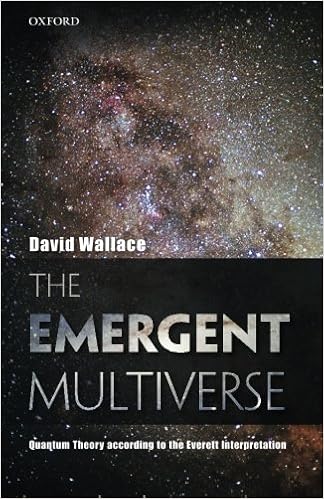
'The Many Worlds of Hugh Everett III' - Peter Byrne

Amazon Link

I finally got round to reading Peter Byrne's biography of Hugh Everett III.

It's a good book, weaving between three themes: Everett's thesis on the 'Many Worlds Interpretation'; his career as a cold-war nuclear strategist for the Pentagon; and his curiously unconventional personal life (swinger, incipient alcoholic, heavy smoker, womaniser, cynic, libertarian, genius).

The 'Many-Worlds' work was his proudest achievement, although he never published a word on quantum mechanics after his thesis paper. The physics establishment ignored the concept for two decades, while individuals around Bohr were poisonously hostile.

The historical treatment works well, showing how the controversies reflected ongoing preoccupations and progress in the community. Cosmology, quantum gravity and decoherence were later catalysts for renewed interest, as was quantum computing (David Deutsch a key visionary here).

Everett's ideas were continually misunderstood, often wilfully. His concept of 'splitting universes' whenever a 'measurement' is made is actually a topological statement that the universe (multiverse) is a network (not a tree, which would fail time-reversibility) consisting of a non-denumerable infinity of evolving universes, each like our presently observed one, linked by 'measuring events'.

Three major issues continue to puzzle researchers. Everett believed he had derived the Born probability rule from his topology: many physicists disagree. The dispute seems highly technical.

Then there is the problem of the 'preferred basis', which reflects that the concept of superposition is itself basis-dependent, so that the act of splitting seems both arbitrary and non-consistent from point to point on the multiverse network (Everett thought this a non-issue as the act of measurement itself presupposes a basis).

Finally, and a point not brought out by the book, the state vector evolves (via the Schrödinger equation) in Hilbert space, not our familiar four-dimensional spacetime. Yet the Everettian multiverse seems to be a network of spacetime universes. How do we get from the ontology of Hilbert space to that of ordinary spacetime? This seems to be an active research question.

Peter Byrne's book has the usual problems of pop-sci. It's conceptually too remote for a purely lay reader while too imprecise for someone who knows some quantum mechanics (the failure to differentiate spacetime and configuration space, for example).

There are the odd errors of authorial comprehension - Byrne does not appear to understand computer science and his explanation of the Halting Problem is just wrong.

Finally, it's hard to write about the people doing the math and computer simulations for thermonuclear warfare, optimal counterforce strategies and assured destruction without taking some moral stance - but it's just parochial judging those guys, including Everett, from the 'superior' standpoint of an impeccable pacifistic-liberal. Biting the hand that fed you, methinks.

If you want to get a handle on the strange birth and tortuous development of the MWI, you couldn't do better than read this book. And as a bonus you get a voyeuristic tour of scarily-dysfunctional Everettian family life as well.

---

Sean Carroll has a good defence of the MWI.

---

If you have a graduate level of understanding of quantum mechanics, here is your next step.

Amazon link

The definitive introduction to Everettian quantum mechanics.

---

Update: In the comments you will see a discussion as to whether it is really true that worlds can merge as well as split. Splitting occurs via the thermodynamically-irreversible process of decoherence and thus is overwhelmingly the likely thing to happen. Yet under very special circumstances, distinct worlds can merge. This is highlighted in my follow-up post.


Friday, November 04, 2016

Our recent vacation in the Lake District

Just a few photos.

Clare climbs up Gummer's How, Windermere

View across Windermere from Wray Castle Boathouse

Your author at Kirkstone Pass

We also took in Beatrix Potter's house, Hill Top, I bought hipster jeans and plaid shirts at Mountain Warehouse, Ambleside and we chilled with the swans and Japanese tourists at Bowness.

I can recommend the Cuckoo Brow Inn - if only they would stabilise and uprate their woeful WiFi!

Thursday, November 03, 2016

Finally, consciousness as an engineering problem!


I noted this recent research from MIT: "Making computers explain themselves:
new training technique would reveal the basis for machine-learning systems’ decisions"
"In recent years, the best-performing systems in artificial-intelligence research have come courtesy of neural networks, which look for patterns in training data that yield useful predictions or classifications. A neural net might, for instance, be trained to recognize certain objects in digital images or to infer the topics of texts.

"But neural nets are black boxes. After training, a network may be very good at classifying data, but even its creators will have no idea why. With visual data, it’s sometimes possible to automate experiments that determine which visual features a neural net is responding to. But text-processing systems tend to be more opaque.

"At the Association for Computational Linguistics’ Conference on Empirical Methods in Natural Language Processing, researchers from MIT’s Computer Science and Artificial Intelligence Laboratory (CSAIL) will present a new way to train neural networks so that they provide not only predictions and classifications but rationales for their decisions."
The article is itself pretty opaque  - we appear to be at the very beginning of this difficult road.

But ..

A neural net system C which observes another neural net system B and confabulates a symbolic, causal, intentional model explaining how B behaves. Does any of that sound familiar?

The most convincing (obviously still hand-waving) paradigm for thinking this through is due to R. Scott Bakker's Blind Brain Theory (BBT). I do advise you to read his PDF here.

Wednesday, November 02, 2016

Fly like a bird

Drone Girl

I wrote to my nephew, Chris:
"In the old days Clare would walk up the wild hills with enthusiasm, if not with any substantial energy. These days, she just wishes she were a bird.

So in my imagined scenario, she gets out the car in the valley car park and settles into her camping chair. On go the VR goggles - comfortable, high-res and adjustable - and with the intuitive controller she launches the drone.

The machine is simple to fly. It automatically senses its environment and will not crash into things. It monitors its power reserves and will fly home by itself before it runs out. Ditto if it loses communications which in any case are robust.

The drone is quiet and has at least 20 minutes endurance. The cameras move in response to Clare's head movements so she has the illusion of 'being the drone'. There's a microphone and a speaker, so she could virtually accompany someone else up the hill.

The drone can be recharged from the car via an adaptor.

---

So this would be a great present! I imagine we're about two or three years away from this - rather high-end - product.

What do you think? Off the top of your head, I mean, without any research."
I got a really detailed reply in just a couple of hours, but it seems my complete wish-list is still two or three years out.

There is another alternative: I could attach a pair of wireless cameras to my hat, like a pair of bunny ears. As I scampered up the hill, Clare could be 'looking through my eyes' from the comfort of home. We could even talk to one another - fancy!

---

Chris suggested I look at this:


The price tag is a pretty hefty £1,000 .. but is sure to come down.

Tuesday, November 01, 2016

Transgressive Science-Fiction

"The Garden of Earthly Delights"

I still recall the shell-shocked faces of the BBC Newsnight team at the Cannes Film Festival. Kirsty Wark had been too scared to go while Mark Kermode, who had attended, self-consciously praised and defended Lars von Trier's latest film. It was the transgressive "Antichrist".

In mainstream literature think Bret Easton Ellis; in painting, Hieronymus Bosch; in TV, 'Game of Thrones'.

Transgressive art is characterised by psychological and often physical violence; visceral, graphic and explicit sex; profane language; the unleashing of the id; subversion of our safe little lives.

In science-fiction there are some notable practitioners (most transgressive first):

  1. Scott Bakker (Neuropath)
  2. William Barton (When We Were Real)
  3. Richard Morgan (Takeshi Kovacs novels)
  4. Peter Watts (The Rifters Trilogy; Blindsight & Echopraxia)
  5. Dan Simmons (Hyperion Cantos - Simmons just makes the cut)

I'm currently reading 'Neuropath'. It's difficult, though wholly engrossing - if you can stomach psychopathic brain-control torture, edgy relationships, dense discussion of mind, brain and consciousness.

Amazon link

OK, let me do it this way. Look at your most significant other: his or her smile, affectionate glance, amusing quip. Now make the the skull transparent and look again with the eyes of an MRI scanner. For every quirk of personality you love so much, there's that small net of neural tissue lighting up. That's all there is and ever has been. Meaningless.

Oh, and you too.

One of the themes of this novel is how resistant people are to even engaging with this concept. They shy away - too transgressive.