LIGO instruments measure gravitational waves at a time resolution of milliseconds. We were both intrigued that planned devices will be able to measure gravitational radiation with a cycle time of a billion years (!) - at 57 minutes 13 seconds.
Thursday, February 11, 2016
The LIGO announcement
BBC News rapidly broke away from the 3.30 pm news conference back to the studio, where their own woefully ill-informed correspondent recycled the headlines. The press conference, aimed at lay people, was crammed full with awesome videos and clear explanation. So if you really want to know why this is such a big deal, here's the video - you may have to advance it a little to the start.
LIGO instruments measure gravitational waves at a time resolution of milliseconds. We were both intrigued that planned devices will be able to measure gravitational radiation with a cycle time of a billion years (!) - at 57 minutes 13 seconds.
LIGO instruments measure gravitational waves at a time resolution of milliseconds. We were both intrigued that planned devices will be able to measure gravitational radiation with a cycle time of a billion years (!) - at 57 minutes 13 seconds.

Wednesday, February 10, 2016
Quotes
Quote from Andrew Ng, Chief Scientist at Chinese search giant, Baidu:
An anonymous comment at Scott Alexander's Slate Star Codex:
---
Watch out for the LIGO announcement tomorrow that the coalescence of two orbiting black holes has been observed through their gravitational wave signature:

"Worrying about AI evil superintelligence today is like worrying about overpopulation on the planet Mars."---
An anonymous comment at Scott Alexander's Slate Star Codex:
“Slate Star Codex is 140 IQ discussion about 105 IQ issues.”(Ouch! That post has more amusing and cringe-inducing stuff).
---
Watch out for the LIGO announcement tomorrow that the coalescence of two orbiting black holes has been observed through their gravitational wave signature:

"The masses of the black holes will be 36 and 29 solar masses at the beginning; and 62 for the resulting black hole. The reconstructed orbital speed will be almost exactly the speed of light. As a bonus, they will also observe the "ringdown to Kerr"More here.
"My simulated sister is smarter than me"
Apologies that this is a bit techie - and it won't make sense without reading the previous post.
Yesterday I did some simple stats to show that my sister is most likely 8 IQ points smarter than me (to be fair and by symmetry, the converse could also be true).
Health warnings:
Intuitively, you wouldn't expect every sibling to be exactly the average (they're not clones) but over a large family the pluses and minus would sort of average out to the mid-parental mean. But what about if we're just considering the deviation from average, without caring about the sign?
We seem to have a choice: halve the expected difference between two siblings, or find the average (absolute) deviation from the mean. As we saw yesterday, these give different answers.
I therefore decided to run an Excel simulation using the built-in RAND() function. Here's the four coin-set (taking values from 0 to 4):
If you like, you can consider this a simple four gene model for intelligence, with each gene presenting as two alleles, each of which code up or down for IQ by 7.5 points.

I ran each 100 toss simulation ten times and noted the results in the table on the right.
If we go back to selecting embryos for implantation, which is the right statistic to use to measure our likely IQ gain over the biological default of just taking what comes?
The leftmost statistic, 5.625 IQ points above the mean, would be sort of accurate if we were conceptually considering two embryos, one randomly varying and the other always exactly on the parental midpoint mean. But it wouldn't work, not least because the random embryo might well be below the mean but we're counting all variation as positive. So it's not realistic.
The statistic we get by halving the expected inter-sibling gap of 8.2 IQ points is better as we always select the smarter of the two embryos. However, since both X and Y are varying freely on the range {0,1,2,3,4} it's a bit difficult to correlate the abs(X-Y)/2 gap with the range-midpoint (mean) of 2. At this point we handwave and mutter about symmetry.
Yesterday I did some simple stats to show that my sister is most likely 8 IQ points smarter than me (to be fair and by symmetry, the converse could also be true).
Health warnings:
- expected value only when averaged over large numbers of copies of my sister and myself;
- equally true for my brother and myself - the stats are gender-blind.
Intuitively, you wouldn't expect every sibling to be exactly the average (they're not clones) but over a large family the pluses and minus would sort of average out to the mid-parental mean. But what about if we're just considering the deviation from average, without caring about the sign?
We seem to have a choice: halve the expected difference between two siblings, or find the average (absolute) deviation from the mean. As we saw yesterday, these give different answers.
I therefore decided to run an Excel simulation using the built-in RAND() function. Here's the four coin-set (taking values from 0 to 4):
IF(RAND()>0.5,1,0) + IF(RAND()>0.5,1,0) + IF(RAND()>0.5,1,0) + IF(RAND()>0.5,1,0)and here is the last part of the spreadsheet model showing 100 tosses of two 4-coin sets (random variables X and Y) showing the number of heads.
If you like, you can consider this a simple four gene model for intelligence, with each gene presenting as two alleles, each of which code up or down for IQ by 7.5 points.

I ran each 100 toss simulation ten times and noted the results in the table on the right.
- The heading "Mean-IQ" refers to ten runs of the IQ (7.5) value in the "abs(X-Y)" column on the left, showing the mean difference in IQ between the two siblings;
- the heading "Dec-IQ" refers to ten runs of the IQ (7.5) value in the "abs(X-2)" column on the left, showing the average deviation (+ and -) of a single sibling's IQ from the parental-midpoint mean.
If we go back to selecting embryos for implantation, which is the right statistic to use to measure our likely IQ gain over the biological default of just taking what comes?
The leftmost statistic, 5.625 IQ points above the mean, would be sort of accurate if we were conceptually considering two embryos, one randomly varying and the other always exactly on the parental midpoint mean. But it wouldn't work, not least because the random embryo might well be below the mean but we're counting all variation as positive. So it's not realistic.
The statistic we get by halving the expected inter-sibling gap of 8.2 IQ points is better as we always select the smarter of the two embryos. However, since both X and Y are varying freely on the range {0,1,2,3,4} it's a bit difficult to correlate the abs(X-Y)/2 gap with the range-midpoint (mean) of 2. At this point we handwave and mutter about symmetry.
And what do you do when the presented embryos are all below the expected average?*
---
* Which with two embryos will occur 25% of the time. I feel like spending some more money and genotyping a few more ...
---
* Which with two embryos will occur 25% of the time. I feel like spending some more money and genotyping a few more ...
Tuesday, February 09, 2016
"My sister is smarter than me"
Well, maybe.
Your brother or sister could be exactly the same intelligence as yourself, but that's not the way to bet. Yesterday I wrote about the Carl Shulman and Nick Bostrom paper, "Embryo Selection for Cognitive Enhancement: Curiosity or Game-changer?". They said that the average distance in intelligence between two siblings was 8.4 IQ points.
Hmm.
When I saw that figure I was mightily impressed by their mathematical skills. After much thinking I decided that what they had done was this. They had taken the Gaussian distribution for the IQ of offspring with
They had then computed the expected value of abs(X-Y). The absolute value is important here: the expected value of the mere difference (X-Y) is zero, as one sibling taken at random will on average be no brighter or dimmer than the other.

I hate these messy integrals incorporating the bivariate Gaussian distribution with weird boundaries! And apparently so do Carl and Nick: they got their answers by simulation.
But there is another way where we can still be analytic. The answer is in the power of four.
Take four coins and toss them. Count the number of heads - there are five possible outcomes: 0. 1. 2, 3, 4. The respective probabilities are 1/16, 4/16, 6/16, 4/16. 1/16.
The mean number of heads is 2 and the standard deviation of the number of heads is 1. How convenient.

When you draw the histogram you get something like the above, which is not a million miles away from looking rather ... normal.
If we wanted to make this about sibling intelligence, map the number of heads into IQ scores:
Now imagine if we had one set of four coins to our left "the daugher IQ" and another set to our right "the son IQ". Throw simultaneously and count the number of left heads and right heads.
The difference (abs, remember, absolute value) in the number of heads is the IQ difference - each head counts as 7.5 IQ points. What do we get?
There's a spreadsheet for that.
Now these three tables are either self-evident after a little consideration, or too long to explain. I simply draw your attention to the figure in the bottom right in bold. The sum of all the entries in the third table = 1.09375.
This is the expected value of the difference in number of heads between left and right, "daughter" and "son" coin sets.
To change it into an IQ figure we multiply by 7.5 giving 8.2 ("my sister is 8 IQ points smarter than me!" ... or maybe conversely ...).
If we want the gap between each sibling's expected IQ from the mean expected IQ (over all possible siblings) we halve it to get 4.1. Think about it - don't you just love stats *.
This compares to Carl's and Nick's number of 4.2 based on ten million simulations (table below). Not a bad approximation to the normal distribution and you can see what's going on.
---
Admittedly, extending to the case of 'best of ten siblings' seems a few coin sets too far.

---
* and then I worry about this ...

which equates to 0.75 * 7.5 = 5.625 IQ points.
Time for a simulation ...
Your brother or sister could be exactly the same intelligence as yourself, but that's not the way to bet. Yesterday I wrote about the Carl Shulman and Nick Bostrom paper, "Embryo Selection for Cognitive Enhancement: Curiosity or Game-changer?". They said that the average distance in intelligence between two siblings was 8.4 IQ points.
Hmm.
When I saw that figure I was mightily impressed by their mathematical skills. After much thinking I decided that what they had done was this. They had taken the Gaussian distribution for the IQ of offspring with
mean = parental midpoint IQ; standard deviation = 7.5,and considered two random variables from this distribution. Let's call them, with a bow to genetics, X for daughter and Y for son.
They had then computed the expected value of abs(X-Y). The absolute value is important here: the expected value of the mere difference (X-Y) is zero, as one sibling taken at random will on average be no brighter or dimmer than the other.
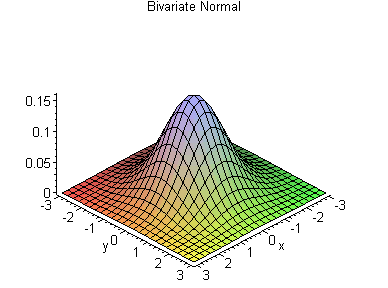
I hate these messy integrals incorporating the bivariate Gaussian distribution with weird boundaries! And apparently so do Carl and Nick: they got their answers by simulation.
But there is another way where we can still be analytic. The answer is in the power of four.
Take four coins and toss them. Count the number of heads - there are five possible outcomes: 0. 1. 2, 3, 4. The respective probabilities are 1/16, 4/16, 6/16, 4/16. 1/16.
The mean number of heads is 2 and the standard deviation of the number of heads is 1. How convenient.
[SD = √(npq) = √(4 * 0.5 * 0.5) = 1].

When you draw the histogram you get something like the above, which is not a million miles away from looking rather ... normal.
If we wanted to make this about sibling intelligence, map the number of heads into IQ scores:
2 heads = IQ 100Warning, IQ can go down as well as up.
3 heads = IQ 107.5
4 heads = IQ 115.
Now imagine if we had one set of four coins to our left "the daugher IQ" and another set to our right "the son IQ". Throw simultaneously and count the number of left heads and right heads.
The difference (abs, remember, absolute value) in the number of heads is the IQ difference - each head counts as 7.5 IQ points. What do we get?
There's a spreadsheet for that.
 |
| Each cell in the bottom table is the product of the corresponding cells in the top two |
Now these three tables are either self-evident after a little consideration, or too long to explain. I simply draw your attention to the figure in the bottom right in bold. The sum of all the entries in the third table = 1.09375.
This is the expected value of the difference in number of heads between left and right, "daughter" and "son" coin sets.
To change it into an IQ figure we multiply by 7.5 giving 8.2 ("my sister is 8 IQ points smarter than me!" ... or maybe conversely ...).
If we want the gap between each sibling's expected IQ from the mean expected IQ (over all possible siblings) we halve it to get 4.1. Think about it - don't you just love stats *.
This compares to Carl's and Nick's number of 4.2 based on ten million simulations (table below). Not a bad approximation to the normal distribution and you can see what's going on.
---
Admittedly, extending to the case of 'best of ten siblings' seems a few coin sets too far.
---
* and then I worry about this ...

which equates to 0.75 * 7.5 = 5.625 IQ points.
Time for a simulation ...
Monday, February 08, 2016
Choose the best of your virtual children
I wrote critically of Nick Bostrom in my review of his "Superintelligence" book. But when he's not writing in a philosophical straightjacket, his intelligence and creativity produce rather better results, as here with Carl Shulman.
Suppose you have nine brothers/sisters. Your nine siblings will, of course vary in height, weight ... and intelligence. We know how to think about the relationship between the IQ of parents and their offspring (Steve Hsu explains here).
So Carl and Nick have this table in their paper, from which you can see that the maximum IQ gap within ten children (dimmest to smartest) might be as much as 23 IQ points. Yes, I find that surprising too.
The table is based on a large scale simulation (10 million couples) and what I take it to be saying is this: if you use ten embryos and decide to implant the smartest, then you'll get an average 11.5 IQ point gain over just selecting a random embryo with no pre-screening for intelligence at all.
Is that important? It's the difference between a clerical and a professional job.
If you come from a large family, consider your siblings and consider whether any of this makes any sense.
We already do embryo selection for single-mutation diseases. A fertilised egg (in vitro) is allowed to divide until you have, say, an eight-cell clump - at this stage there is no functional differentiation. One cell is then extracted and its genome sequenced looking for the faulty gene. If the genome is fine, the seven remaining cells are implanted and the embryo grows to term with no ill effects; otherwise, discard and repeat. (It is more complex than this).
For IQ-based embryo selection to catch on we need a predictive model which can take a sequenced genome and predict with tight accuracy the resulting IQ (assuming decent nutrition, no abuse etc). We can't do this now as the relevant genes haven't yet been identified. But that should change within five to ten years. And we need to get the cost right down: doing 10 whole-genome sequences could be pricey.
Apart from the hassle of IVF and any legalistic hurdles, the way would then be open. What might be the consequences? Carl and Nick have a table - click on it to make it bigger.

---
Just a note about IES on the right-hand side.
I blogged that Toby Young had a piece about this back in September last year.
Suppose you have nine brothers/sisters. Your nine siblings will, of course vary in height, weight ... and intelligence. We know how to think about the relationship between the IQ of parents and their offspring (Steve Hsu explains here).
- We take the average of the parents' IQ, and that is the mean IQ of their children.
- The children do not of course have identical IQs, they're not clones; instead they populate the usual Gaussian distribution with standard deviation in the 7-11 IQ point range (rather than the usual population IQ SD of 15). The authors were conservative and used 7.5 in their simulation below.
So Carl and Nick have this table in their paper, from which you can see that the maximum IQ gap within ten children (dimmest to smartest) might be as much as 23 IQ points. Yes, I find that surprising too.
The table is based on a large scale simulation (10 million couples) and what I take it to be saying is this: if you use ten embryos and decide to implant the smartest, then you'll get an average 11.5 IQ point gain over just selecting a random embryo with no pre-screening for intelligence at all.
Is that important? It's the difference between a clerical and a professional job.

If you come from a large family, consider your siblings and consider whether any of this makes any sense.
We already do embryo selection for single-mutation diseases. A fertilised egg (in vitro) is allowed to divide until you have, say, an eight-cell clump - at this stage there is no functional differentiation. One cell is then extracted and its genome sequenced looking for the faulty gene. If the genome is fine, the seven remaining cells are implanted and the embryo grows to term with no ill effects; otherwise, discard and repeat. (It is more complex than this).
For IQ-based embryo selection to catch on we need a predictive model which can take a sequenced genome and predict with tight accuracy the resulting IQ (assuming decent nutrition, no abuse etc). We can't do this now as the relevant genes haven't yet been identified. But that should change within five to ten years. And we need to get the cost right down: doing 10 whole-genome sequences could be pricey.
Apart from the hassle of IVF and any legalistic hurdles, the way would then be open. What might be the consequences? Carl and Nick have a table - click on it to make it bigger.

---
Just a note about IES on the right-hand side.
"The effectiveness of embryo selection would be vastly increased if multiple generations of selection could be compressed into less than a human maturation period. This could be enabled by advances in an important complementary technology: the derivation of viable sperm and eggs from human embryonic stem cells. Such stem cell derived gametes would enable iterated embryo selection (henceforth, IES):All this and we haven't even mentioned genetic engineering, or CRISPR-Cas9.
1. Genotype and select a number of embryos that are higher in desired genetic characteristics;
2. Extract stem cells from those embryos and convert them to sperm and ova, maturing within 6 months or less;
3. Cross the new sperm and ova to produce embryos;
4. Repeat until large genetic changes have been accumulated."
...
"Using IES could deliver much more extreme results, and the fixed costs of using IES to produce enhanced embryos could be spread across large numbers of enhanced children. On the other hand, IES would compromise the typical genetic relationship between parents and children. To avoid negative effects of inbreeding, IES would require either a large starting supply of donors, or the expenditure of substantial selective power to reduce harmful recessive alleles. These factors would tend to push towards IES offspring being less genetically related to their parents (though more related to one another), and could reduce the appeal of IES."
I blogged that Toby Young had a piece about this back in September last year.
Thursday, February 04, 2016
Awareness
Today was a day I had not been looking forward to. 11.30 am found me reclined on a hard couch as the dentist pointed a pint-sized hypodermic in the general direction of my lower jaw. During the infusion of vast quantities of anaesthetic, I meditated upon the Trojan levels of destruction he was about to inflict upon my lower left premolar. It's called crown prep.
My sister was right: although tooth demolition is without pleasure, the alginate moulds upon which one bites while they harden (both before and after drilling) are a considerably less aesthetic experience.
---

Fast forward to this afternoon and my attendance at the TTC Speed Awareness Course. There were 23 of us in that bright, modern, anonymous seminar room at the Somer Valley Enterprise Park, 12 women and 11 men. Most of us were quiet, attentive, let's-get-this-over-with types; there were threeloudmouths more extravert individuals - thank God - who provided the obligatory degree of audience participation.
The presenters were a genial retirement-age ex-cop (Stan) and a no-nonsense woman of similar age called Kate. To be fair, they were both very professional and often amusing. The general story on these courses is that everyone thinks they're going to be terrible and then ends up being quite impressed; our hosts were clapped at the end of the four hours (this doesn't always happen).
What did we do? It's a coaching exercise. We were told facts about impact injuries at various speeds; we did photo/video based hazard analysis; we group-assessed the consequences and aftermath of car accidents. We were given hints on speed control and some indication that speed limits are not quite so arbitrary as I guess we had all believed. It was manipulation but it was subtle.
---
This was the first outing for my windscreen-mounted radar detector, although I did not mention this during the group activity where we were invited to share what behavioural changes we had made as a consequence of getting a speeding ticket.
Driving to the session I encountered no cameras and the device was quiescent. As I turned into a parking bay (I later observed, at the moment the car was facing the automatic doors of Paulton House), a well-modulated female voice announced, "K-band radar has been detected, please check your speed."
On the way home, as we bounced over some rough road, the radar detector fell off.
My sister was right: although tooth demolition is without pleasure, the alginate moulds upon which one bites while they harden (both before and after drilling) are a considerably less aesthetic experience.
---

Fast forward to this afternoon and my attendance at the TTC Speed Awareness Course. There were 23 of us in that bright, modern, anonymous seminar room at the Somer Valley Enterprise Park, 12 women and 11 men. Most of us were quiet, attentive, let's-get-this-over-with types; there were three
The presenters were a genial retirement-age ex-cop (Stan) and a no-nonsense woman of similar age called Kate. To be fair, they were both very professional and often amusing. The general story on these courses is that everyone thinks they're going to be terrible and then ends up being quite impressed; our hosts were clapped at the end of the four hours (this doesn't always happen).
What did we do? It's a coaching exercise. We were told facts about impact injuries at various speeds; we did photo/video based hazard analysis; we group-assessed the consequences and aftermath of car accidents. We were given hints on speed control and some indication that speed limits are not quite so arbitrary as I guess we had all believed. It was manipulation but it was subtle.
---
This was the first outing for my windscreen-mounted radar detector, although I did not mention this during the group activity where we were invited to share what behavioural changes we had made as a consequence of getting a speeding ticket.
Driving to the session I encountered no cameras and the device was quiescent. As I turned into a parking bay (I later observed, at the moment the car was facing the automatic doors of Paulton House), a well-modulated female voice announced, "K-band radar has been detected, please check your speed."
On the way home, as we bounced over some rough road, the radar detector fell off.
Wednesday, February 03, 2016
"Dark Star Safari" - Paul Theroux

Somewhere in "Dark Star Safari" Paul Theroux writes "How nice it would be, I thought, if someone reading the narrative of my African trip felt ... it was the next best thing to being there, or even better - because reading about being shot at and poisoned and insulted was in general less upsetting than the real thing" (p. 406).
Here is what the New York Times had to say back in 2003.
''Dark Star Safari,'' his latest travel book, charts the author's arduous journey through Africa, from Cairo to Cape Town, by truck, bus, ferry, train and bush taxi. Theroux sets out ''hoping for the picturesque,'' and at first finds plenty of it. The pyramids of Sudan leave him feeling humbled and uplifted. In the walled city of Harar, a Maltese nun cooks him a gourmet meal and beguiles him with tales of the lover she left for God. An Ethiopian, once a political prisoner, recounts how in his cell he translated ''Gone With the Wind'' on tiny sheets of cigarette-pack foil -- 3,000 in all -- and later published the translation.The NYT review goes on to chastise Theroux for egregious rage at the 'agents of virtue' of the aid bureaucracies and a tendency to 'go light' on the 'crimes of western imperialism'. But that's just their standard dogma; Paul Theroux is much more interesting than that.
Soon, however, the trip becomes a nightmare. Danger dogs Theroux at every turn, from armed Somali highwaymen in Kenya to land mines in Mozambique. Beggars importune, disease and squalor press in. A man with a runny nose sells oranges, ''handing the snot-smeared fruit to customers.'' Appalled by ''the filth, the dirt, the litter,'' beset by ''fungal infections, petty extortion, mocking lepers, dreary bedrooms, bad food, exploding bowels,'' Theroux narrates a Job-like ordeal during which he is ''abused, terrified, stranded, harassed, cheated, bitten, flooded, insulted, exhausted, robbed, lied to, browbeaten, poisoned, stunk up and starved.''
I was interested in Paul. He sees so much, so very acutely, yet does not draw conclusions. He is a 'how does it feel?' man, not a 'why is it this way?' analyst. No wonder his sons do so well on TV.
What he feels is an affinity with the rural Africa - the order and stability, in a timeless wilderness, of tribal subsistence farming. His fanciful desire is to end his days in that Africa and lose himself in small good works, teaching and writing.
The hurried West, with its shallow diversions and pointless buzz, has imposed itself as an alien force in Africa - aid & trade - creating slum cities and atomising traditional society. The result is disrespect, endless panhandling, crime, disease and violence. Only Africans can help Africa, Paul feels, but notes that every time Africans are left to their own devices - free of their subsidised and corrupt governments - they relapse to the timeless stability of subsistence farming.
Why is this? Paul doesn't know and more importantly, doesn't care.
---
In the end I had Paul Theroux marked down as an INFP. Not very introverted - he is perfectly happy to meet people and chat with strangers (the writer's obligation) - but equally content to blend in, shabby and unobtrusive, mostly the quietist observer. Also the only way to stay safe.
I had already read his follow-up travelogue, The Last Train to Zona Verde and was convinced that if anyone really wanted to understand the likely future of Africa they need not read the fantasies of The Economist or the optimistic deceptions of politicians, it was sufficient just to absorb Paul's immersive prose.
But I was wrong: as the NYT review showed, liberal prejudice can filter just about anything.
Monday, February 01, 2016
Red Lion Square

In 1974, aged 23, I finished my teacher training course and had already decided that no way was I going to take a job in a secondary school. Two maths teaching practices with the recalcitrant kids of London had seen to that. That summer found me instead working for London Underground at the southern terminus of the Northern Line, cleaning tube trains.
This job was more enjoyable than it sounds. I would turn up around 11 pm and spend some hours dusting and mopping the allotted number of carriages; later I graduated to washing down the outsides of trains, rubber booted in a long protective gown, scraping with a spiky brush dipped in a bucket of acid.
By 2.30 am we had done enough and then we kipped on the trains before clocking off at dawn. With all day free, a complimentary bus & tube pass, and real money I was delighted. My workmates were also interesting: the dispossessed of the world washed up in Morden. I remember a Nigerian teacher - unable to work as such due to unrecognised qualifications – with whom I shared many erudite conversations in our small tea-room at night.
So it was as a proletarian that I participated in the infamous Red Lion Square demonstration of Saturday 15 June 1974. Here is how Wikipedia describes it:
"The British far-right organisation, the National Front booked Conway Hall in Red Lion Square for a meeting to take place on 15 June 1974. A counter-demonstration was called by the London Area Council of Liberation (formerly the Movement for Colonial Freedom). This counter-demonstration attracted support from groups not directly under the control of Liberation, including the International Marxist Group (IMG), the Communist Party of England (Marxist-Leninist) and the International Socialists (later the Socialist Workers Party).Picture us as we marched into the square. The IMG was a large contingent, marching in order about eight abreast. IMG stewards including myself, walked outside the crocodile moving up and down the ranks giving directions. Outside of us the police also marched, but as we came towards Conway Hall the side roads and the hall itself were blocked by cordons of police reinforced with horses.
...
"The front of the Liberation march came westwards along Theobald's Road and entered Red Lion Square by Old North Street before turning right where a platform was set up for the meeting. A police cordon blocked the square to the left of Old North Street.
...
"The cordon was then charged by the larger contingent from the IMG who were closely followed by the smaller CPE(M-L) contingent . Several minutes of pushing and scuffling followed. There were several charges and countercharges. The police cordon was reinforced by members of the Special Patrol Group and by mounted police who eventually succeeded in forcing the demonstrators back.
"Photos show the use of truncheons by some police officers. At least one demonstrator reported being knocked to the ground and trampled by a police horse.
...
"A large number of demonstrators were arrested. Photos show that many who were arrested had their hair pulled or were otherwise treated with what appeared to be excessive force by police."
The IMG intended to stop the National Front from using Conway Hall and charged the police cordon. I was close to the action but was rapidly ejected from the mêlée and found myself fifty yards away, wondering what to do next. As I could see my comrades struggling with the police, some being arrested, I figured I needed to return to the fray and had soon locked arms with the front line, pushing and shoving with the police not twenty yards from the hall entrance itself.
In my opinion, the police did not abide by middle-class demo-etiquette. I was grabbed by the hair and ‘private parts’ and dragged to the ground, where I was immobilised by a couple of extremely large constables. The IMG surged back and I was dragged into a police van with other, equally disoriented demonstrators.
As we were driven off, the supervising policeman in the back revealed he was from Norfolk, drafted in as extra manpower. He seemed genuinely baffled to be dealing with us: “”What are people like you doing mixed up in all this?” – We were far from his staple diet of low-lifes.
I gave a stock answer, “Those who ignored fascism in the past were overrun by it,” which even at the time seem less than totally compelling as a narrative about the rather marginalised National Front. The real answer was that most Saturdays I was doing a demo, it was one of the main ways the IMG recruited, so I was there as part of the road to revolution. But that argument seemed too cynically utilitarian to use.
Things were busy at the police station where I was banged up in a narrow cell which looked like a toilet, white porcelain tiles and a single bench. I was bailed by one of the ‘red lawyers’ who always attend demos.
My trial came a few months later. I was charged with assault on the police, a stock indictment. Several officers stood up in court and gave bored recitals about how I had stood there, punching them until they had managed to restrain me and lead me away. My lawyer carefully cross-examined them to ensure their version of events was minutely described. I was looking at six months.
During the police evidence I remember shouting in exasperation that none of this was true – I was genuinely shocked at the idea that policemen might calmly stand up in a court of law and just lie – but was shushed by my lawyer for my naivety. Only later did I understand that everyone knew this was a tedious charade and they all just wanted to get through the script.
We had a secret. I am now embarrassed to talk about it, but at the time I had an intense attachment to what can only be described as thick, woollen, diamond-patterned, Rupert Bear trousers. These were exceptionally distinctive. I had steered a bee-line to where the action was, but so had half the press and their photographers. My defence team had their pictures, many of which featured a young man in Rupert Bear trousers being wrestled to the floor and then squashed by burly cops.
Press photographers hate to be subpoenaed in these circumstances for all the obvious reasons. Nevertheless we had the guy there and the photographs were duly shown to the magistrate. Let us say there was plainly discordance between the official version of events and what the photographic record actually showed: with great reluctance, the magistrate acquitted me.
I was very lucky; most of the arrested had no such compelling defence and went down.
---
While I was having my mini-drama of being arrested, a student in our contingent from my old university (Warwick), Kevin Gately, was actually killed. The IMG view was that he had been hit over the head by a police baton from the Special Patrol Group but this was never definitively proved.
My story merited a few column inches in the papers: “London tube worker acquitted of police assault”.
My parents were mortified.
---
IMG-related: Occupying the Embassy and A Mission to Prague.
How Much Do Our Genes Influence Our Political Beliefs?
This is the title of a New York Times piece in July, 2014, which had an illuminating thesis. Click on the table below to make it larger.
In my previous post, I quoted Scott Alexander's figures that elite US universities, like Harvard or Yale, sort something like 90:10 liberal vs. conservative. That academics - particularly in the social sciences - are bleeding-heart lefties is a truth universally acknowledged. In business, to the contrary, I have rarely found the ranks of management thus populated. Occupations are a great sorter, not just for intelligence but also for temperament and personality type.
In Keirsey/Myers-Briggs terms I suggest:
"Identical twins are more likely than fraternal twins to share traditional values with their twin siblings, suggesting a biological link on cultural outlook.High heritability for political outlook doesn't mean you are destined to share your parents' views; after all, you are neither a clone nor an average mixing of your parents. It does mean that your unique genome is providing you with temperament/personality settings which inform your political outlook.
"In this table, 0 represents no correlation in outlook; 1 represents identical outlooks. In reality, the numbers fall in between, but identical twins are much more culturally alike (higher numbers) than fraternal twins.
"In an email, Ludeke explained how to interpret this information: “These correlations represent the extent to which members of a given type of twin pair resemble each other for the trait in question,” he wrote. “Low correlations, like those we found for fraternal twins, indicate that knowing the scores of one twin won’t give you much, if any, clue for figuring out the scores of the other. On the other hand, based on the correlations presented here, knowing the scores of one identical twin gives you a pretty good indication of the scores of the other.”
"The significance of the different correlations for identical and fraternal twins, Ludeke added, is that “when we see identical twins who are this similar, while fraternal twins are much less similar, we have a good indication that genes account for some of the difference between people for the trait in question.”

In my previous post, I quoted Scott Alexander's figures that elite US universities, like Harvard or Yale, sort something like 90:10 liberal vs. conservative. That academics - particularly in the social sciences - are bleeding-heart lefties is a truth universally acknowledged. In business, to the contrary, I have rarely found the ranks of management thus populated. Occupations are a great sorter, not just for intelligence but also for temperament and personality type.
In Keirsey/Myers-Briggs terms I suggest:
- Liberal-leftists tend to be NF-Idealists
- Libertarians (of left and right) are NT-Rationals
- Conservatives (of left and right) are ST-Guardians
- Populist insurgents are often SP-Artisans.
- The emotion-driven, fuzzy-thinking, heart-on-sleeve, leftist BBC/Guardianista is the classic Idealist-NF. My favourites include Lyse Doucet and Shami Chakrabarti.
- Left-wing Rationals include Jeremy Corbyn and Bernie Sanders; on the Right you have US neocons such as Paul Wolfowitz, John Bolton, Richard Perle - and Michael Gove.
- You find small-c conservative Guardians in all political parties. David Cameron is one, and so is Tom Watson, deputy leader of the Labour Party. Also Hillary Clinton.
- My favourite Artisan is the leader of the Italian Five Star movement, Beppe Grillo, ... and then there's Trump.
Trump is the liberal antichrist .. and he knows it
Scott Alexander (Slate Star Codex) has an interesting piece which you should read from which the following is excerpted:
(British liberals are ideological soulmates of their American co-thinkers while the Republican base doesn't find a ready echo here .. this gives the UK media a free run.)
Trump understands the US culture wars better than his critics. He knows what he has to do to rally the "Red Tribe", the Republican base. Trump in a presidential election or as President? For good or ill, that's an entirely differently-badged animal.
We could debate (nobody does) whether Trump's personality and character would make him a good or terrible candidate for the Presidency, but I'm more interested in what motivates liberals to be so aghast about it.
So back to Scott Alexander on why liberals appear to support every group except putatively their own, which they take to be the root of all evil.
Listening to bien-pensant liberals in the media (TV Channel 4 comes to mind) smugly opining that Trump is crazy, mad, beneath contempt, dangerous, (soon to come: the H-word), it is clear that with Trump we are in the presence of a liberal value-atrocity.
"Donald Trump appeals to a lot of people because despite his immense wealth he practically glows with signs of being Labor class. This isn’t surprising; his grandfather was a barber and his father clawed his way up to the top by getting his hands dirty. He himself went to a medium-tier college and is probably closer in spirit to the small-business owners of the upper Labor class than to the Stanford MBA-holding executives of the Elite.
"Trump loves and participates in professional wrestling and reality television; those definitely aren’t Gentry or Elites pastimes! When liberals shake their heads wondering why Joe Sixpack feels like Trump is a kindred soul even though Trump’s been a billionaire his whole life, they’re falling into the liberal habit of sorting people by wealth instead of by class. To Joe Sixpack, Trump is “local boy made good”.

(British liberals are ideological soulmates of their American co-thinkers while the Republican base doesn't find a ready echo here .. this gives the UK media a free run.)
Trump understands the US culture wars better than his critics. He knows what he has to do to rally the "Red Tribe", the Republican base. Trump in a presidential election or as President? For good or ill, that's an entirely differently-badged animal.
We could debate (nobody does) whether Trump's personality and character would make him a good or terrible candidate for the Presidency, but I'm more interested in what motivates liberals to be so aghast about it.
So back to Scott Alexander on why liberals appear to support every group except putatively their own, which they take to be the root of all evil.
"We have a lot of people [...] boasting of being able to tolerate everyone from every outgroup they can imagine, loving the outgroup, writing long paeans to how great the outgroup is, staying up at night fretting that somebody else might not like the outgroup enough.His answer is this (rather long) essay which you will find unfailingly interesting.
"And we have those same people absolutely ripping into their in-groups – straight, white, male, hetero, cis, American, whatever – talking day in and day out to anyone who will listen about how terrible their in-group is, how it is responsible for all evils, how something needs to be done about it, how they’re ashamed to be associated with it at all.
"This is really surprising. It’s a total reversal of everything we know about human psychology up to this point. No one did any genetic engineering. No one passed out weird glowing pills in the public schools. And yet suddenly we get an entire group of people who conspicuously love their outgroups, the outer the better, and gain status by talking about how terrible their own groups are.
"What is going on here?"
Subscribe to:
Posts (Atom)