Showing posts with label Paul Theroux. Show all posts

Wednesday, February 03, 2016

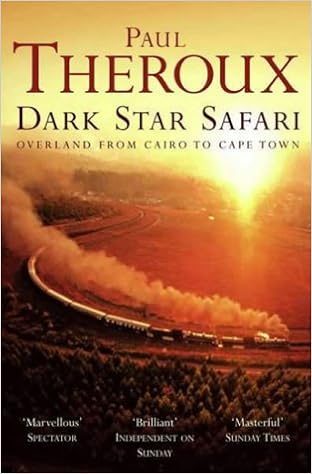
"Dark Star Safari" - Paul Theroux


Somewhere in "Dark Star Safari" Paul Theroux writes "How nice it would be, I thought, if someone reading the narrative of my African trip felt ... it was the next best thing to being there, or even better - because reading about being shot at and poisoned and insulted was in general less upsetting than the real thing" (p. 406).

Here is what the New York Times had to say back in 2003.
''Dark Star Safari,'' his latest travel book, charts the author's arduous journey through Africa, from Cairo to Cape Town, by truck, bus, ferry, train and bush taxi. Theroux sets out ''hoping for the picturesque,'' and at first finds plenty of it. The pyramids of Sudan leave him feeling humbled and uplifted. In the walled city of Harar, a Maltese nun cooks him a gourmet meal and beguiles him with tales of the lover she left for God. An Ethiopian, once a political prisoner, recounts how in his cell he translated ''Gone With the Wind'' on tiny sheets of cigarette-pack foil -- 3,000 in all -- and later published the translation.

Soon, however, the trip becomes a nightmare. Danger dogs Theroux at every turn, from armed Somali highwaymen in Kenya to land mines in Mozambique. Beggars importune, disease and squalor press in. A man with a runny nose sells oranges, ''handing the snot-smeared fruit to customers.'' Appalled by ''the filth, the dirt, the litter,'' beset by ''fungal infections, petty extortion, mocking lepers, dreary bedrooms, bad food, exploding bowels,'' Theroux narrates a Job-like ordeal during which he is ''abused, terrified, stranded, harassed, cheated, bitten, flooded, insulted, exhausted, robbed, lied to, browbeaten, poisoned, stunk up and starved.''
The NYT review goes on to chastise Theroux for egregious rage at the 'agents of virtue' of the aid bureaucracies and a tendency to 'go light' on the 'crimes of western imperialism'. But that's just their standard dogma; Paul Theroux is much more interesting than that.

I was interested in Paul. He sees so much, so very acutely, yet does not draw conclusions. He is a 'how does it feel?' man, not a 'why is it this way?' analyst. No wonder his sons do so well on TV.

What he feels is an affinity with the rural Africa - the order and stability, in a timeless wilderness, of tribal subsistence farming. His fanciful desire is to end his days in that Africa and lose himself in small good works, teaching and writing.

The hurried West, with its shallow diversions and pointless buzz, has imposed itself as an alien force in Africa - aid & trade - creating slum cities and atomising traditional society. The result is disrespect, endless panhandling, crime, disease and violence. Only Africans can help Africa, Paul feels, but notes that every time Africans are left to their own devices - free of their subsidised and corrupt governments - they relapse to the timeless stability of subsistence farming.

Why is this? Paul doesn't know and more importantly, doesn't care.

---

In the end I had Paul Theroux marked down as an INFP. Not very introverted - he is perfectly happy to meet people and chat with strangers (the writer's obligation) - but equally content to blend in, shabby and unobtrusive, mostly the quietist observer. Also the only way to stay safe.

I had already read his follow-up travelogue, The Last Train to Zona Verde and was convinced that if anyone really wanted to understand the likely future of Africa they need not read the fantasies of The Economist or the optimistic deceptions of politicians, it was sufficient just to absorb Paul's immersive prose.

But I was wrong: as the NYT review showed, liberal prejudice can filter just about anything.

Thursday, September 05, 2013

"The Last Train to Zona Verde" - Paul Theroux

"The Last Train to Zona Verde" is Paul Theroux's account of his solitary, backpacking trip from Cape Town through Namibia, Angola and all points north to Timbuktu. In the event, his luck and spirits run out in Angola and he decides enough is enough - time to return home. The following excerpt from the full review at American Renaissance captures his reasons
"Angola’s problem, Mr. Theroux decides, is not a lack of money or development aid, but too much of both. The government is a “thieving tyranny” that keeps virtually all the money it earns from foreign oil and mining companies. The difference between it and other African kleptocracies is only one of degree. In Africa, “only foreigners seem to care about the welfare of Africans.” He means whites, since the only other non-whites are the Chinese, and they are there only to make money. They care nothing about and do nothing for the black population—no Western sentimentality for them. It’s the same with the Western corporations looting the place of its natural wealth. The foreign aid workers and development specialists think they care, but Mr. Theroux considers them self-absorbed fools, whose officious meddling only makes things worse, and further entrenches tyranny.

Angola has great potential. The country is rich in natural resources, especially oil, diamonds, and gold. It also has the “hilly, cool, and fertile” Planalto, or high plains, much of it over a mile above sea level. Yet, there is little or no farming. Village people are moving to the cities. Those with any education, Mr. Theroux finds, want to leave for the United States. There seems to be little hope for a continent whose best-educated people all want to flee.

Mr. Theroux does find one Angolan who is optimistic about the country and wants to stay: a white man of Portuguese descent named Rui da Camara e Sousa. His grandfather was governor of the colony early in the last century. Mr. Sousa is a developer who is profiting from the building boom in Luanda, the capital. Mr. Theroux finds his optimism hard to fathom. Even with the new construction, “everything looked crooked or improvisational, with a vibration of doomsday looming.” The slums were a horror, and “the government was corrupt, predatory, tyrannical, unjust, and utterly uninterested in its people.”

Mr. Sousa lived on the salubrious Restinga peninsula, near the coastal city of Lobito. I use the past tense because a few months after Theroux visited him, Mr. Sousa was murdered by intruders who stole “a computer, a television, and a mobile phone.”

Mr. Theroux is an intrepid and resourceful traveler, who has completed, or nearly completed, all of his previous trips. Not this time. As he approached the northern border of Angola, formed by the Congo River, Mr. Theroux finally decided to abort his journey. First, his credit card had stopped working, and he was running out of cash. He learned later that someone had printed his name and credit card number on a duplicate card, and had run up $48,000 in charges.

Second, he realized that he would see only a variation on what he had already seen: a nightmare world of poisoned and ruined landscapes; impoverished, starving villages; and “cities that were indistinguishable from one another in their squalor and decrepitude.” Traveling any further, “meant traveling into madness.”

Third, he decided that he had pushed his luck far enough. As a 70-year-old white man alone in Africa, he was a natural target for thieves and hustlers. There was simply no reason to tempt fate by going on.

He also kept remembering the words of another white Angolan. As they contemplated the reeking, swarming slums of Luanda, this man said, “This is what the world will look like when it ends.” With that doomsday vision seeming all too real, Mr. Theroux decided to head home."
Paul Theroux

Mr Theroux's personality can be read off the pages of his book: he is somewhat detached and introverted yet keenly curious about the people he meets and their stories. He is naturally optimistic and improvisational, and is more concerned with values than intellectual analysis. In short, he's an INFP.

Theroux is too experienced a writer to dwell over-long on the hardships of his journey. We sit alongside him as he accepts a scrawny chicken leg in the bush, covered with flies - he desperately burns the stringy limb in a fire to sterilise the fly-droppings. We don't hear so much about the lack of sanitary facilities, the intimidation and personal thefts. Only in the last chapter does his pent up fury about the state of Africa finally burst onto the page.

His thesis is that in the last analysis, the African elites, the kleptocracies - hand in glove with foreign companies, governments and aid agencies - do not care in the slightest for the millions living in squalid shanty towns surrounding their tiny oases of western excess. Since they don't care, there can be no hope of progress.

This doesn't prevent foreign companies making plenty of money behind their own security cordons - and this is what you hear about in The Times and The Economist when they write about 'Africa rising economically'.

Paul Theroux's book is a journey from his initial naivety and hopefulness to his final recognition of the grim and hopeless reality for the African masses. He notes that in these places he is truly a lone observer: everyone else is too scared, too bought-off or too determined not to acknowledge the facts on the ground.