Eventually the Internet got around to telling me.
"As I read the historic news, there’s one question that kept gnawing at me: how close would you need to have been to the merging black holes before you could, you know, feel the distortion of space? I made a guess, [...] you’d need to be very close.From Scott Aaronson's blog, a post appealingly titled "The universe has a high (but not infinite) Sleep Number", h/t SSC.
"Even if you were only as far from the black-hole cataclysm as the earth is from the sun, I get that you’d be stretched and squished by a mere ~50 nanometers (this interview with Jennifer Ouellette and Amber Stuver says 165 nanometers, but as a theoretical computer scientist, I try not to sweat factors of 3).
Even if you were 3000 miles from the black holes—New-York/LA distance—I get that the gravitational waves would only stretch and squish you by around a millimeter. Would you feel that? Not sure. At 300 miles, it would be maybe a centimeter—though presumably the linearized approximation is breaking down by that point.
[...]
"Now, the black holes themselves were orbiting about 200 miles from each other before they merged. So, the distance at which you could safely feel their gravitational waves, isn’t too far from the distance at which they’d rip you to shreds and swallow you!
In summary, to stretch and squeeze spacetime by just a few hundred nanometers per meter, along the surface of a sphere whose radius equals our orbit around the sun, requires more watts of power than all the stars in the observable universe give off as starlight.
"People often say that the message of general relativity is that matter bends spacetime “as if it were a mattress.” But they should add that the reason it took so long for humans to notice this, is that it’s a really friggin’ firm mattress, one that you need to bounce up and down on unbelievably hard before it quivers, and would probably never want to sleep on."
Victor Toth writes:
"A gravitational wave is like a passing tidal force. It squeezes you in one direction and stretches you in a perpendicular direction. If you are close enough to the source, you might feel this as a force. But the effect of gravitational waves is very weak. For your body to be stretched by one part in a thousand, you’d have to be about 15,000 kilometers from the coalescing black hole.---
"At that distance, the gravitational acceleration would be more than 3.6 million g-s, which is rather unpleasant, to say the least. And even if you were in a freefalling orbit, there would be strong tidal forces, too, not enough to rip your body apart but certainly enough to make you feel very uncomfortable (about 0.25 g-forces over one meter.) So sensing a gravitational wave would be the least of your concerns.
"But then… you’d not really be sensing it anyway. You would be hearing it. Most of the gravitational wave power emitted by GW150914 was in the audio frequency range. A short chip rising in both pitch and amplitude. And the funny thing is… you would hear it, as the gravitational wave passed through your body, stretching every bit a little, including your eardrums."
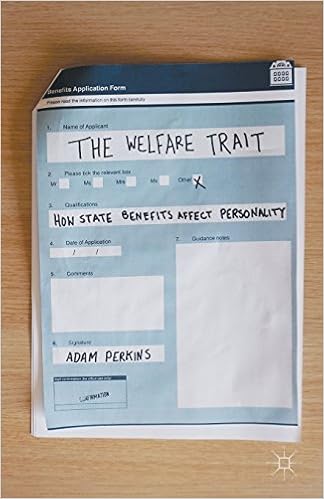
I'm reading "The Welfare Trait: How State Benefits Affect Personality" by Dr Adam Perkins of King's College, London. He talks about the employment-resistant personality and how such people feature disproportionately on welfare. There they tend to have lots of children, both for increased benefits and because they're rather feckless, (A-, C-, in the five-factor jargon).
 |
| Amazon Link |
Dr Perkins is worried about dysgenic consequences - plainly the potential is there - but how big is the effect? I'm waiting to see whether Dr Perkins gets quantitative, but if he does, he'll be using the Breeder's Equation.
Time for a quick review from West Hunter - this is the Breeder's Equation:
"R = h2S.Dysgenics too: as personality has similar heritability to intelligence (0.5), still mulling over the application of this to the profligate underclass ...
"R is the response to selection, S is the selection differential, and h2 is the narrow-sense heritability. This is the workhorse equation for quantitative genetics. The selective differential S, is the difference between the population mean and the mean of the parental population (some subset of the total population).
"For example, imagine a set of parents with IQs of 120, drawn from a population with an average IQ of 100. Suppose that the narrow-sense heritability (in that population, in that environment) is 0.5 . The average IQ of their children will be 110. That’s what is usually called regression to the mean.
"Do the same thing with a population whose average IQ is 85. We again choose parents with IQs of 120, and the narrow-sense heritability is still 0.5. The average IQ of their children will be 102.5 – they regress to a lower mean.
"You can think of it this way. In the first case, the parents have 20 extra IQ points. On average, 50% of those points are due to additive genetic factors, while the other 50% is is the product of good environmental luck. By the way, when we say ‘environmental” we mean “something other than additive genetics”. It doesn’t look as if the usual suspects – the way in which you raise your kids – contributes much to this ‘environmental’ variance, at least for adult IQ. In fact we know what it’s not, but not much about what it is, although it must include factors like test error and being hit on the head.
"The kids get the good additive genes, but have average ‘environmental’ luck – so their average IQ is 110. The luck (10 pts worth) goes away
"The 120-IQ parents drawn from the IQ-85 population have 35 extra IQ points, half of which are from good additive genes and half from good environmental luck. But in the next generation, the luck goes away… so they drop 17.5 points.
"The next point is that the luck only goes away once. If you took those kids from the first group, with average IQs of 110, and dropped them on an uninhabited but friendly island, they would presumably get around to mating eventually – and the next generation would also have an IQ of 110. With tougher selection, say by kidnapping a year’s worth of National Merit Finalists, you could create a new ethny with far higher average intelligence than any existing. Eugenics is not only possible, it’s trivial."
You might also want to take a look at this.

