Showing posts with label android. Show all posts

Sunday, November 04, 2018

Semper timere ..

Amazon link

From Chapter 5.
"Lashing caused excruciating physical pain. The lacerations were visible for days, as slaves bore the "marks of cruelty" on their bodies. Chrysostom warned masters they should not tear through the tunic when they beat their slaves, and he chided masters whose cruelty was evident on the slave's body when the slave was at the public bath.

Jerome called it an "everyday custom" for a slave to use the time between blows to ask for death as a reprieve. Basil of Caesarea, criticizing the rich, said they could see their wicked deeds all around them, including the "slaves whom you have ripped to shreds."

The violence of lashing could of course be chaotic and disorderly. The incentive model should not lead us to forget that the actors involved were human beings, with all that implies about fallibility and passion and unpredictability, in which one party possessed extreme power over another.

Iamblichus said that philosophers never lashed their slaves while they were still in a state of anger — implying that the average man did. Masters might chase their slaves around the house punishing them.

Arnmianus reported that a slave who was slow to serve received 300 lashes. The context is clearly one of exaggeration, but the point to notice is that the blows were numbered. Chrysostom spoke of thirty or fifty lashes as a high number. A really bad whipping was one in which the blows were "countless."  ...

Fear was perhaps the primary strategy of mastery in the Roman slave system. In the corpus of late antique writings, no attribute was more often associated with slavery than fear. It was the most keenly felt element of the relationship.
"To fear is the symbol of slavery."

"Who does not know that the one who is a slave by nature and employed in a master's power cannot be without the emotion of fear?"

"To fear was in the nature of slaves."

"Nothing is more particular to slavery than the eternal fear."
Semper timere. We hear so much of this emotion because it was precisely what masters sought from their slaves.
"If a slave is under fear and the lash, and immediately trembles when anything is said to him by the master, lest he hear he is to be beaten, certainly the master rejoices in this situation."
Fear was a means of maintaining the constant labor and subjective annihilation demanded of slaves. Violence commuted into its potential, spread out into all corners of the relationship, tinged all interaction between masters and their human property.

Physical punishment was not the only means of corporal control over slaves, and psychological manipulation was not limited to the threat of violence. Perhaps nothing breaks down the strict dichotomy between pain and positive incentives like the use of food as a tool of domination in the Roman slave system.

With a few important exceptions, the use of hunger and the promise of dietary satisfaction have been terribly neglected by ancient historians. ..."
Thanks to modern genetics and/or AI we'll be so much more enlightened. Our android slaves will live to do our bidding - there will be little reason to starve them or beat them to a pulp.

Semper amare.

Isaac Asimov tried to do it with cognitive rules .. but emotions are so much more reliable.

---

See also: "The Economics of Roman Slavery - Kyle Harper".

Tuesday, October 24, 2017

"Love in the time of robots" - Alex Mar

This is her first piece in Wired - it's rather personal. Here's an excerpt:
"Around the same time as the department store display, Ishi­guro managed to use the Geminoid F to generate a bond between two humans. Tettchan, then a game designer based in Tokyo, was recently divorced when he met Ishi­guro in 2012, and he mentioned that he was curious about the possibility of a romance with a longtime friend named Miki. Ishi­guro invited them both to his research institute in Nara, where he’d asked his students to have a female android ready for teleoperation.

A Geminoid F

He placed Tettchan at the teleoperation desk and closed the door; he took Miki into the other room to meet the Geminoid F. Then he invited Tettchan (who was listening in) to talk to him and Miki through the robot. As Tettchan spoke, his voice computer-­altered to sound female, the android’s lips moved in sync with his words, the tilt of her head and her long human hair in rhythm with his own movements. “It’s like a real female,” Ishi­guro told Miki, enjoying himself. “This is not Tettchan, this is a new woman, really cute and beautiful.”

And so they “played,” making small talk, Tettchan trying out his new female incarnation. He made Miki and Ishiguro laugh, and watching Miki’s face through the monitor, he could see a change. That was when Ishi­guro, knowing Tettchan’s complicated feelings for Miki, said to her, “OK, you should kiss her.” And Miki, looking hesitant, leaned in toward the android—the android inhabited by Tettchan—and kissed it on the cheek. The feeling, Tettchan said, was “like thunder.” Any boundary between them suddenly vanished.

Not long afterward, Tettchan and Miki decided to live together. Tettchan is still not exactly sure how Ishi­guro’s machine worked on them, but he remains convinced that it made them into a couple."
---

Here's the latest tech from Ishiguro's lab: Erica.

Hiroshi Ishiguro and Erica
"After this story was reported, Hiroshi Ishi­guro unveiled his “most beautiful woman” android, named Erica, at Tokyo’s Miraikan science museum. It operates autonomously, parsing human speech and using neural network technology to fashion replies. Erica models are currently being used for human-robot interaction research in three universities in Japan."
The dream of the walking, talking android is still far away. Current research - as the article suggests - is focused on how individuals react to a humanlike android in social situations. The 'uncanny valley' seems to be an effect whereby the android's overly-crude approximations to ordinary human micro- movements and micro-expressions triggers endless subtle error-flagging alerts in our predictive-processing brain circuitry.

It seems that Ishiguro, who has studied the details intently, would claim that his team has now got the fine-grained interaction style right, that his androids no longer violate our subconscious model-based expectations.

So now it gets interesting.

Sunday, October 15, 2017

Readings relating to total automation under capitalism

From the film, "Elysium"

Introduction

Suppose progress in AI and robotics manages to eliminate all human jobs: no more human workers. Would capitalism collapse or just sail serenely on, making the elite ever richer while the masses of the dispossessed watch in apathetic horror from outside the gated communities (Elysium)?

The usual Marxist account is that total automation is incompatible with capitalism, yet the standard response is curiously unconvincing. Marxists say that all automation systems are constant capital, and constant capital eponymously can't create new value. Only variable capital, living human labour, can do that. And it's from variable capital that surplus value - profits - are derived.

No workers, no profits.

This argument uses the abstract model of capitalist production developed in Volume 1 of Capital. But it leaves many things obscure.
  • What is the special status of human labour, was Marx a vitalist?
  • As automation increased, what actually would we see in the economy?
  • If total automation brings about some other mode of production, how did we  switch?
Let's see if we can clarify any of this.

---

1. Why can't robots produce surplus value?

The question was asked particularly clearly in this Reddit post.
"I've often read that Marx firmly asserted that a machine cannot create surplus value. However, since technological capabilities have changed quite a bit since Marx's day, today I decided to do some research into modern interpretations of this theory.

"I couldn't find a good answer as to why a robot can't produce surplus value (sure, it's constant capital, but that doesn't really explain it), but I did find mention that neither slaves or animals (which are both living) can produce surplus value, which indicates that there is something very particular about the type of work done by machines, not the inanimate-ness of the machines themselves, that prohibits them from creating surplus value.

"This leads to a few questions:
  • Why can't robots, slaves, and animals produce surplus value?
  • Does the possibility of robots manufacturing other robots affect this?
  • What about human-like robots created in the future?
"How can a society be both slave-based and capitalist (like the old American South)?

"Thanks!"
And here is the favoured answer - somewhat accurate but ultimately confused and unconvincing.
"Slaves are like tools since they are owned. If they exist alongside capitalism, they, like all other tools, pass their value on to the commodity but do not create new value. This does not mean that slaves are not exploited and don't produce a surplus for their masters. They do, but this surplus does not take the form of surplus value. In this case all the master's profit is surplus value transferred from free laborers. ...

"Surplus-value production requires a certain social organization. The question then is: What social organization differentiates the slave from the wage-laborer such that one doesn't produce surplus value but the other does?

"The answer is a social organization of generalized commodity production requiring an extensive division of labor. This social organization requires what Marx calls the laborer's "freedom in the double sense":
as a free man he can dispose of his labour-power as his own commodity, and that on the other hand he has no other commodity for sale, is short of everything necessary for the realisation of his labour-power.
"So, the slave/animal/robot must be given bourgeois rights; it must no longer be possible to buy and sell them, they must be considered equal as commodity owners and sellers. The slave/animal/robot must also be driven off the land and deprived of any means of production. This forces them to sell their labor-power to survive.

"If the animal/robot had the mental and physical capacity to function this way under these conditions, they would be surplus value producers."
Marx was not a vitalist, the term 'living labour' is an economic category (a producer of new value, an entity which brings labour-power to market as a commodity), not a term of biology.

---

2. Forms of Production

The first step to understanding why the Marxist account is, nevertheless, correct is to carefully distinguish different ways stuff can get produced in a complex economy with a division of labour, requiring trading and exchange. It will become clear that the two critical ideas are the distinction between use-value and exchange-value, and the subtleties of the labour theory of value.

We start by describing three forms of economic organisation: pre-capitalist, capitalist and post-capitalist. Only the second creates surplus value, value appropriated by an economic actor other than the producer.

2a. Simple Commodity Production

Wikipedia has a good account of this pervasive economic mode:
"Simple commodity production (also known as "petty commodity production"; the German original phrase is einfache Warenproduktion) is a term coined by Frederick Engels to describe productive activities under the conditions of what Marx had called the "simple exchange" of commodities, where independent producers trade their own products. The use of the word "simple" does not refer to the nature of the producers or of their production, but to the relatively simple and straightforward exchange processes involved. ...

"Simple exchange of commodities is as old as the history of trade, insofar as it has progressed beyond barter, and occurred for thousands of years before most production became organised in the capitalist way. It begins when producers in a simple division of labour (e.g. farmers and artisans) trade surpluses to their own requirements, with the aim of obtaining other products with an equal value, for their own use. Through the experience of trade, regular exchange values become established for products, which reflect an economy of labour-time. ...

"Simple commodity production is compatible with many different relations of production, ranging from self-employment where the producer owns his means of production, and family labour, to forms of slavery, peonage, indentured labour, and serfdom. The simple commodity producer could aim just to trade his products for others with an equivalent value, or he could aim to realise a profit.

"That is to say, simple commodity production is not specific to any particular mode of production, and might be found in many different modes of production, with various degrees of sophistication. It does not necessarily imply that all inputs or outputs of productive activity are commodities traded in markets. Thus, for example, simple commodity producers could produce some products for their own use on their own land, while trading another part of their products. They might buy or trade some tools and equipment, but also make some themselves. ...

"In Marxian political economy, simple commodity production also refers to a hypothetical economy used to interpret some of Karl Marx's insights about the economic laws governing the development of commodity trade: it refers to a market economy in which all producers own the resources (including the ability to work) that they use in production. No-one is a proletarian, selling his or her labor power to another. Instead, each is self-employed.

"In this imaginary model, there is a direct correspondence between prices and the values of commodities. The model is imaginary, because no such society has ever existed in history; simple commodity production has always combined with some other modes of production, and as soon as a market economy reaches any size, it begins to utilise wage labor in production, and falls under the sway of the laws of capital accumulation."
The take-home point is that in simple commodity production the proprietor is neither a wage labourer nor a capitalist.

Amazon link

In general proprietors trade commodities at their value and do not produce surplus value, as Duncan Foley explains (Understanding Capital, p. 31):
"Consider a system of commodity production in which independent producers buy inputs to production, add their own labor to commodities, and sell the commodities for prices that in the aggregate reflect the labor time expended in the value added to the commodities. We could represent the movement of money and commodities in such a system by the diagram:
C-M-C'
where the producer starts with the commodities he has produced (C) and sells them for money (M) as a way of buying another bundle of commodities (C') that better suit his needs. The commodities purchased (C') have the same value as the commodities sold (C). The motive behind this transformation is not any change in the value owned by the producer but the qualitative change in the use-values he consumes.

When we think of the commodity circulation in this way, we realize that the process comes to an end after one round of exchange. Once the producer has exchanged the commodities he initially owns for the bundle he chooses, there is no reason for any further exchange to take place. If the economic process is to continue, the reason for its continuation must be sought outside the process itself, for example, in the external assumption that the next day the producer will once again find himself with commodities C that are not the ones he wants to consume and will be forced to exchange again.

Furthermore, there could be no social surplus value in this system. An individual trader might cleverly manage to buy some commodities below their real values and sell them at or above their real values and in this way appropriate a surplus value through unequal exchange. But whatever these agents gain in surplus value, some other agents must lose, because of the conservation of value in exchange.

Producers add value to commodities by expending labor on them, but in general they receive in exchange no more than the equivalent of this labor time. Thus there appears to be no way to explain the pervasive appropriation of surplus value as the basis of economic life within this conception.

Notice also that the only conception of accumulation of value in such a system is for an agent to realize more value by selling commodities than he spends in buying them over a period. The difference must take the form of an accumulation of money by the agent. But this accumulated value is simply withdrawn from commodity circulation through the agent's abstinence from consumption.

When the agent finally spends the hoard he has accumulated, he simply returns the money value to circulation and withdraws commodities from circulation of the same value (assuming that the value of money has not changed in the  meantime). There is in this conception no systematic process of accumulation."
2b. Capitalism

Capitalism is a weird mode of production, its strangeness hidden by its historical and geographical ubiquity, as Michael Heinrich explains in his “An Introduction to the Three Volumes of Karl Marx’s Capital” (p. 17):

Amazon link

"In precapitalist societies, the exploitation of the dominated class served primarily the consumption of the ruling class: its members led a luxurious life, used appropriated wealth for their own edification or for that of the public (theater performances in ancient Greece, games in ancient Rome) or to wage war.

Production directly served the fulfillment of wants: the fulfillment of the (forcibly) restricted needs of the dominated class and the extensive luxury and war needs of the ruling class. Only in exceptional cases was the wealth expropriated by the ruling class used to enlarge the basis of exploitation, such as when consumption was set aside to purchase more slaves, to produce a greater amount of wealth.

But under capitalist relations, production for the sake of increasing the capacity to produce is typically the case. The gains of a capitalist enterprise do not serve in the first instance to make a comfortable life for the capitalist possible, but are rather invested anew, in order to generate more gains in the future. Not the satisfaction of wants, but the valorization of capital is the immediate goal of production; the fulfillment of wants and therefore a comfortable life for the capitalist is merely a by product of this process, but not its goal. If the gains are large enough, then a small portion is sufficient to finance the luxurious existence of the capitalist, and the greater portion can be used for the accumulation (enlargement) of capital.

The fact that earnings do not primarily serve the consumption of the capitalist, but rather the continuous valorization of capital, that is, the restless movement of more-and-more accumulation, might sound absurd.

But the issue at hand is not an individual act of insanity. Individual capitalists are forced into this movement of restless profiteering (constant accumulation, expansion of production, the introduction of new technology, etc.) by competition with other capitalists: if accumulation is not carried on, if the apparatus of production is not constantly modernized, then one’s own enterprise is faced with the threat of being steamrolled by competitors who produce more cheaply or who manufacture better products.

A capitalist who attempts to withdraw from this process of constant accumulation and innovation is threatened with bankruptcy. He is therefore forced to participate, whether or not he wants to."

2c. Bureaucratic Socialism

Sam Williams describes the following scenario:
"A single corporation emerges that controls all of production. Let’s call our imaginary corporation the Universal Company Inc.  Its stock is traded on Wall Street and other global stock exchanges. Indeed, it is the only stock traded on the world’s stock exchanges, because it is the only corporation. It is the only business in the world.

Every factory, mill, mine, farm is controlled by Universal’s board of directors. Managers and technical personnel hired by its board of directors determine exactly what kind of goods are produced and the proportions in which each type of good is produced. Under the rule of Universal Company Inc., all workers are employees of the company since there are simply no other corporations to work for. Under the rule of Universal, what is the highest authority that the individual workers face? Why it’s the board of directors of Universal, which is elected by the stockholders of Universal on the principle of one share one vote.

But do the products of the labor of the workers of Universal take the form of commodities? The answer is no. Why not? Remember, Marx defined commodity production as a situation where the producers work for their own private accounts. Producers of commodities exchange the products of their labor and face no higher authority than the mutual pressure they exert on one another. Or what comes to exactly the same thing, the highest authority the producers face is competition among themselves. But this is not the case with the workers of Universal.

Instead of being indirectly social, the labor of the workers of Universal is directly social, as would also be the case under the rule of the associated producers. The board of directors and its subordinate employees such as managers, computer experts, foremen and so on see to it that the workers produce the right products in the right proportions. Since there is no commodity production, there is also no money, since money is simply a form of the commodity. And for the same reason, there is no capital, since capital consists of commodities and money. Where there is no commodities and money, there is no capital. And where there is no capital, there is no accumulation of capital.

The board of directors of the Universal Company Inc. might choose to continue expanded reproduction, but if it does, it will be accumulating use values not capital.

Since I am assuming a class of stockholders, the workers of Universal are indeed exploited. They are forced—just like is the case at the present day—to work some of the time for the boss—the stockholders of Universal—and some of the time for themselves. This allows the stockholders of Universal to live without working.

But the surplus product produced by the surplus, or unpaid, labor of the workers cannot take the form of surplus value, because there is no commodity production and labor does not take the form of value. And where there is no value, there can be no surplus value. And where there is no surplus value, there is no commodity production and no money. The surplus labor of the workers cannot take the form of profit—surplus value realized in the form of money. And where there is no surplus value and no capital, there is no capitalist mode of production.

While some might want to call our imaginary system of exploitation run by the Universal Company “state capitalism” in order to underline its exploitative nature as opposed to the system of cooperative production carried out by the associated producers, they would be forgetting that there have been other systems of exploitation in the history of human production over the last ten thousand years besides capitalism. But our imaginary system would not be a form of capitalism whatever else it might be, because it would lack the essential characteristics that separate capitalist production from other forms of exploitation.

For example, there would be no crises of the general overproduction of commodities, if only because there is no commodity production. In principle, our imaginary system might experience a generalized overproduction of use values, but that is something very different than the crises we experience under capitalism, which combine a generalized overproduction of commodities with a generalized underproduction of use values."
What Sam Williams describes here is an economic description of the "Communist States" emerging from the Russian Revolution and its WW2 aftermath. If you replace bureaucratic domination by workers control, you have a Trotskyist model for the aftermath of a socialist revolution: democratic socialism as the precursor (as the productive forces are developed) of communism. I have critiqued that model elsewhere.

---

3. Discussion

To read further on why total automation is incompatible with capitalism, please continue to:

"They dismiss the last workers from their fully automated factories".

Monday, December 19, 2016

They are already among us

#FakeNews   #ButNotThatFake

They could be babies, those little homunculi, pushed around in kiddie-karts by Google staff. You can't see the high-bandwidth comms, the data links ferrying every perception and mewling cry to DeepMind's server farms.

The situated cognition people were right.

To be human-smart is to participate wholly in human society.

Reading millions of files off the Internet just doesn't hack it for artificial general intelligence.

HUM∀NS's 'synths' and Westworld's 'hosts' were the way to go.

Google is betting that body research will track mental development. When they need their baby-synths to toddle around, the batteries and artificial muscles will be there.

Adolescence is going to be the tricky one.


Monday, September 12, 2016

Workers, slaves, androids - and agency

Einstein produced well-validated scientific theories combined with speculations which seem out of synch with current quantum orthodoxies, while politically he seemed to be socialist-pacifist.

Marx produced rigorous theories of class societies focusing on the capitalist mode of production (Capital etc), speculated about the future of capitalism (inaccurately), and politically seemed to be, well, a communist.

It pays to stay focused on the theories.

So ignore the politicking and moralising and focus on Marxism as a theoretical system; how exactly do workers as living, breathing persons figure in Marxist economic theory?

---

In the beginning was the 'primitive communism' of egalitarian hunter-gathers. Following the neolithic revolutions - agriculture and pastoralism - we entered the age of class societies. All class societies are unequal. At the bottom there are one or more classes which are the primary producers of the necessities of life.

Through the increased productivity of agriculture and pastoralism, the lower classes produced more than they needed to survive. The excess, the social surplus product, was appropriated by the rulers, also serving to fund the elements of the state - administration, warriors and of course, tax collectors.

There was always an accompanying ideology to explain why this little ditty:


was inapplicable, and in fact downright subversive.

Archaic empires had their God-Kings while Axial age empires harnessed more abstract Gods to the maintenance of social order.

In feudal times, there was "a set of reciprocal legal and military obligations revolving around the three key concepts of lords, vassals and fiefs. A lord was in broad terms a noble who held land, a vassal was a person who was granted possession of the land by the lord, and the land was known as a fief. In exchange for the use of the fief and the protection of the lord, the vassal would provide some sort of service to the lord."

As I mentioned already, for Marx the specific essence of capitalism was generalised commodity production and exchange.

The value at which a commodity is exchanged is captured by the formula c + v + s, where c is the value of machinery and raw materials, v the value of the worker's wage and s the additional value created by the activity of the worker in producing the final commodity.

The class nature of capitalism is exhibited in that the worker produces more value (v + s) than he or she receives in payment (v). It doesn't seem that way, as wages are superficially presented as payment for labour (ie the product of labour) rather than labour-power (the capacity to work - placed at the disposal of the capitalist).

Still, in formal terms the worker and the capitalist meet as equals in the market place; the worker sells his/her labour-power and receives a fair price for it. The workers don't have to sell their labour-power and the capitalist doesn't have to employ them. Proletarians have agency (although the concept is not theorised).

We have to add a few things to get closer to quotidien reality: asymmetries of power between workers and bosses; supply/demand & differing profitabilities creating price-variations around value, and so on. But the principle is as stated.

---

People sometimes talk about wage-slavery, working for the Man. Slavery exists under capitalism (the antebellum American South and Nazi Germany being high-profile examples) but in Marxist economics a slave isn't a proletarian; a slave is not a party to a market-transaction for labour-power: a slave is owned.

In this sense, a slave is in the same category as any other piece of equipment, classified as constant capital (c) in the equation. The slave is not paid wages but is merely provided with the same maintenance and raw materials (specifically shelter, food) as any other piece of smart automation. In particular, a slave does not produce surplus value (just surplus product). An economy comprised wholly of slaves, with no wage-labourers, is exactly equivalent to a totally-automated economy - it cannot operate as a capitalist economy as no surplus value is produced.

It's in this sense that slave economies such as the Roman Empire prefigure speculative-future total-automation economies. The Romans had a class of incredibly advanced, intelligent instrumenta vocalia ('talking tools') embedded within a general technological environment of staggering backwardness and low productivity.

The instrumentum vocale philosophy might be adopted for future AI systems, such as the androids featured in the recent TV programme 'Humans', but we run straight into the problem of agency.


"Humans" on Channel 4, showing the 'Synth' Anita

The moment we start treating advanced automation systems as persons, we cannot embed them into the economy as 'talking tools'. Considering them as free agents, we may feel obligated to offer them rights, including labour rights in waged employment. They then enter our existing capitalist society as 'new proletarians' .. and 'new capitalists'.


No doubt that will turn out well.

---

Let's be clear. There is nothing in Marx or reality which prevents a 'robot capitalism'. As long as worker-robots are paid wages which they use to buy their means of self-reproduction in the marketplace, and as long as robot-capitalists can use their robotic work force's labour-power to make profits, capitalist relations of production remain in place.

Protoplasm is not a requirement.

Whether these industrious, capable androids will feel comfortable being taxed to support the remaining, wholly parasitic, humans is an issue I leave to your imagination.

---

In the previous post on this topic, "Total automation under capitalism?", I considered communism brought about by non-sentient automation, giving as an example the 3D printer/fabricator.

In the scenario above, abundance is delivered through automation systems with agency: sentient AI systems - androids or robots - which most people would classify as persons.

It mirrors the distinction in AI research between systems which augment people (like Google today, satnavs or exoskeletons) and those which emulate/replace people, which cut people out of the loop. There are few examples of the latter at the moment - autonomous piloted vehicles perhaps being the most salient.

If we are to avoid the much-hyped technological singularity where in the worst case humans are rendered extinct by our creations, we should perhaps make sure that our automated infrastructure is of the non-sentient type while AI-based agents become our colleagues, companions and friends.

On a bad day, I wonder if this distinction can really hold, given the likely extreme complexity of a communist economy.
Thursday, September 01, 2016

So this was my day today

I do find dentist appointments unsettling, even when it's something as routine as a couple of filling-repairs.

To neutralise my anticipation (the appointment was 11.40 am this morning) I first ran through the exercise sequence which came with my 'York Fitness Cast Iron Dumbbell Set - 20kg'.

Dumbbell exercises

Here is your author in action.


Showered, mouthwashed and toothpasted, I was lying back on the dentist's couch by a quarter to twelve. There is a tone of voice in which the dentist asks,
"Do you usually have an injection?"
where he means,
'Are you some kind of wimp?'
I nodded coolly and said,
"For the replacement of old fillings? Nope, let's give it a go without."
The dentist looked pleased (three minutes shaved off the time) and got to work.

I wasn't really expecting Marathon Man and to be honest it was a breeze; I closed my eyes and thought about Marx's theory of crises.

---

This afternoon Clare's new tablet arrived. The iPad 2 she acquired from my late mother is increasingly clunky and slow, so I decided to replace it with a Nexus 10, a copy of my own but with better battery life.

I ordered mine back in March 2014 and it's worked well. The Nexus 10 is obsolete really, so I was able to get a bargain: Google Nexus 10 Wi-Fi only, 16 GB (Certified Refurbished).

I don't really get 'refurbished'. I assume it's just surplus stock which has been sitting in a warehouse somewhere for a year or so and is now being disposed of. In any event, it arrived in true minimalist fashion: just the tablet and a travelling charger + cable.

Its Android release was early 4 (we're currently at 5.1.1 Lollipop) so I've spent the afternoon loading version after version of the OS as it makes the long climb towards Lollipop. Towards the end I was dismayed to find the tablet kept turning itself off; buy cheap and have to send it back, I thought to myself. But it was simply the Nexus's way of telling me that its battery was down to 4%.

It's currently on the charger, telling me it's still too tired to install the latest Android iteration.

I have to wait.

Saturday, April 09, 2016

Problems connecting VPN app (Android + Twilight)

I installed a couple of VPN apps (VyprVPN and FlashVPN) on my Nexus 6 and Nexus 10 devices. Trying to connect, I got an Android pop-up asking me to confirm I wanted to make the VPN connection [options: 'Cancel' - 'OK'].

The 'OK' button was unresponsive, I had to press 'Cancel'. Took some Internet searching to discover that the problem was Twilight, the screen-dimming app which runs as an overlay. Turns out it was masking the button from Android.

Twilight interferes with other apps too, such as Microsoft's Word for Android.

The solution is just to open Twilight and turn the app off (or use a force stop in 'Settings'). Twilight is useful in the evenings, but should always be a suspect if something is going a little awry.

---

Keywords: problem connecting with VPN

Wednesday, June 17, 2015

Humans (TV: Channel 4)

The 'synth' is the pretty one
From The Guardian review:
"Would you? Get one? That’s a discussion that will have been going on in the country’s living rooms during and after the first episode of Humans (Channel 4, Sunday). One meaning your own synthetic, or “synth”: a green-eyed humanoid robot.

On the plus side it will clean and iron and then cook you a nice chicken chasseur for tea, freeing you up for all the good stuff you never find time for. It might even provide some kind of companionship. Plus there are potential upgrades, including adult ones, if you know what I'm saying.

On the downside, there is a danger synths might make you, me, everyone redundant. They are already doing all the jobs people don’t really want to do, not just in the house, but street cleaning, handing out free newspapers, sex work etc (they are basically a bit like immigrants, I’m afraid). But it won’t be long before they’re doing the jobs you might want to do yourself – doctor, lawyer, politician, TV critic, footballer perhaps. The Singularity – when artificial intelligence overtakes human intelligence – isn't far off.

Also, returning to the basic domestic model, it might be a bit creepy having a machine that looks just like a person living in your house. It’s not good for the children either, it’ll mess with their heads. Plus you might be unlucky – like the Hawkins family – and get one, like Anita, that … who can think, and feel. Then things start to get really complicated.

One of the beauties of Humans is that, like Charlie Brooker’s Black Mirror, it really isn't such a big leap, or ask. Only last week there was a story about Ocado creating an army of humanoids with artificial intelligence. The online supermarket robots might not be as pretty as Gemma Chan, who plays Anita (very convincing as a semi-humanoid), but this stuff is happening. Tellingly, Humans is set not some time in the future, but some time around now. It’s sci-fi for the non sci-fi fan, sci-fi that has more than a foot in sci-fact."
Here's the video showing the state-of-the-art in anthropoid robotics, from the DARPA Robotic Challenge last week.


My best guess is that 'synths' as portrayed are 20-30 years away. And then the human race will go extinct.

Wednesday, February 05, 2014

The I Ching app

Reading Philip K. Dick's "The Man in the High Castle" has got me interested in the I Ching: Book of Changes. I acquired Brian Browne Walker's excellent app which he explains here.


I'll add to this post to explain why it's a mistake to discount the I Ching as a glorified Chinese horoscope. But in brief consider this: when you're stuck on a decision, try tossing a coin on the basis that if the coin comes down heads, you'll do it.

Once the coin has been thrown, consider how you feel now the decision has been "made" for you - you are not bound by it.

The eight I Ching trigrams

Sunday, June 16, 2013

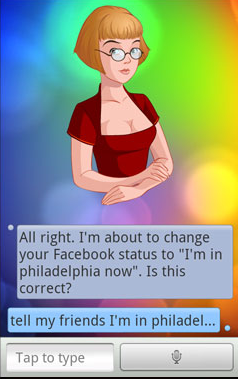
My new digital personal assistant for android

During the summer we will be driving around France. I imagine a hi-tech car park where you have to do something smart with your phone to pay for parking. What a hassle! Wouldn't it be nice to have a smart PA system on your phone which could just sort the details on your behalf. This would need a common interface standard: I wonder whether Google and Apple (Siri) could get together? Then I thought: Google? Do they even have a personal assistant?

Yes.


I have downloaded the recommended system to my phone and will shortly join that eccentric crew who talk to their phones with no-one at the other end. What ever next - "Hey Glass"?

Continued: chatbots


Talking Angela (above after skipping the ad) seemed the most polished of the smartphone chat bots, with its fancy avatar (a cat, Angela, in Paris) and its voice input/output. It installs easily enough on my phone but is a disappointment. It's a free app and makes its money by continually steering the conversation into money-making opportunities. Ask Angela to sing and a music-video type screen open up with some cute graphics and a prominent banner "buy this song"; try to focus the conversation onto your own problems in life and Angela will solicit a 'present' for a 'friend' of hers: it'll cost you.

As Lord Sugar would say, my search goes on ...

UPDATE: Tuesday June 18th 2013

Talking Angela (perhaps we should call her grasping and avaricious Angela) didn't last long: within 24 hours she was uninstalled. The Google 'speaktoit' assistant made it through to this morning when I was offered a 'Daily Briefing' notification - when I tapped it, the avatar started briefing me in loudspeaker mode and an american accent - I was sitting in a crowded doctor's waiting room at the time. She got uninstalled in ninety seconds! To be fair, she was pretty incompetent answering queries: not at all a replacement for Google web search.