Showing posts with label Trotsky. Show all posts

Monday, February 20, 2017

The deep state *is* the state

Much excitement in the States (but also in Brexit Britain) about elements of the state apparatus actively working to undermine the policies of an 'insurgent' government.

The governments in question are of the right, not the extreme left, but the founders of Marxism were clear that a truly revolutionary government cannot just take over the 'controls' of a 'neutral' state apparatus. They will be thwarted at every turn.

This is, of course, true of all bureaucracies. Successful 'turnaround' CEOs bring their own posse of senior managers - and waste no time clearing out the old regime. If they don't, their mission is toast. The political right, in order to to secure their victory, will have to purge the state of their enemies and repopulate it with supporters in their own ideological image.

Marxists, however, are seldom called out on what they think should replace the bourgeois state. Lenin and Trotsky, following the model of the Paris Commune, thought that the mobilised masses, organised in soviets (councils), would constitute a non-bureaucratic socialist state - a social formation not separate from broader society.

Marx himself never wrote much about it.

Yet the state is neither a contingent formation nor just 'bodies of armed men' safeguarding existing property relations. The state has an enormous, and under-analysed, role in social-coordination.

---

Turn now to the economy. All Marxists agree that their post-capitalist economic model will replace private decision-making about the allocation of resources with 'consciously democratic', centrally-planned directives.

Given the complex and highly-technical nature of policy-making and implementation, both as regards the state and the putative planned-economy, this is not going to something managed by the masses through their councils. Nor is it going to be that old favourite, the mere 'administration of things, not of people'.

The PDF version is here

It's hard to resist the conclusion that - until the AIs take over (and where does that leave us?) - the post-capitalist state will continue to be large, bureaucratic and unresponsive. Much like the bourgeois state.

History tends to support that view.

I would guess that Marxists would not agree, but for people proposing a radical makeover of society's fundamentals, they seem remarkably coy about their proposed replacement model.

Such studied casualness wouldn't work in engineering.

Why does the far left get a free pass on something of such fundamental importance?

Thursday, January 05, 2017

And if they had failed?

Amazon link

This year is the centenary of the October Revolution, and everyone is sharpening their agendas.

I expect the dominant narrative will be that the whole thing was a tragic mistake, and that if only Kerensky could have retained power, today Russia would be the new Germany. Or something.

---

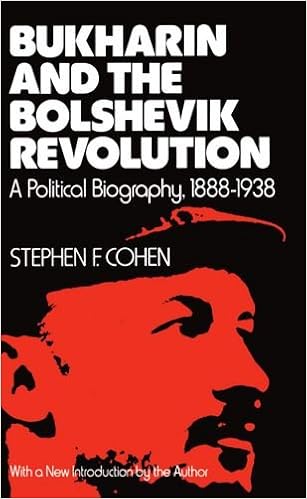
It's a delight to read an intelligent, scholarly account of events through the eyes of a slightly second-rank player. You've heard of Leninists and Trotskyists but seldom of 'Bukharinists'.

No agenda, except to rehabilitate this most-traduced man.

I'm not far into this weighty tome, but two things immediately stand out:
  1. In the summer of 1917, the workers and peasants across Russia were out of control. The peasants were busy expropriating the landlords and creating that regressive peasant-utopia of small self-owned landholdings; the workers had seized the factories and were running them themselves; the army had elected soldiers' councils and was ungovernable.

  2. Kerensky's Provisional Government of moderates and liberals was powerless, while many prominent Bolsheviks balked at leadership. It was only Lenin's iron determination to take charge that avoided a collapse into chaos, probably followed by a German takeover .. and later Allied dismemberment.

Cohen is clear that the new Bolshevik Government had no clue as to what to do next; nothing in the Marxist canon provided a blueprint. Then came the Civil War, as the counter-revolution plus Allied forces tried to topple the new revolutionary power, and top-down bureaucratic command-and-control became the order of the day.

Bukharin was instrumental in the introduction of the New Economic Policy in 1921, which revived the moribund economy (for more about that, scroll down here).

---

I keep coming back to Marxism on this blog: you will look in vain for a clearer analysis of capitalism as a construct of specific recurrent human social relationships. But the focus on the social construction of reality is not well-grounded in human nature. We know a lot more than Marx did.

Capitalism goes with the grain of human nature (at least a human nature with a certain level of intelligence, conscientiousness, agreeableness, trust and low time preference) - it was not consciously designed.

Post-Capitalism - as conceived within the Marxist tradition - requires an attainable human nature at the outer limits of a Social Justice Warrior's wish-list.*

---

I continually speculate on the future target social architecture which synthesises our best understanding of human psychology with the social insights of Marxism. My best attempt, compassionate libertarianism:
  • a safety net for those who don't cope
  • maximal equality of opportunity 
  • highly-constrained elite power.

As Marx suggested, this depends on a much greater development of the productive forces, and as Marx didn't say, some improvements in 'human capital'.*

Scott Alexander once suggested that the task of the current generation might be to take care of the world until we get AI automation and genetic engineering to work. Perhaps that's task enough.

---

* OK, here's the nightmare.

Monday, December 14, 2015

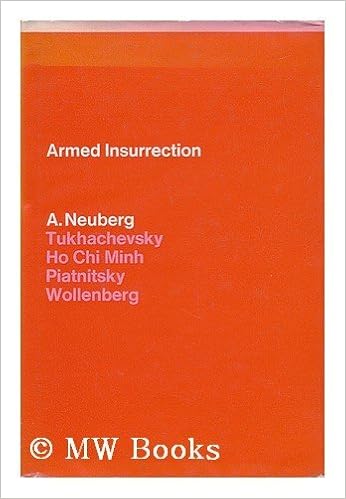
"Armed Insurrection"

People often complain that Marx, Engels and Lenin had little to say about Communism - what would this utopian society be like? As a revolutionary marxist in my early twenties, I was more interested in the practical business of the prior overthrow of capitalism.

I read about the great controversies in the Second International: those who argued for a peaceful road to socialism exploiting bourgeois democracy vs. those like Lenin who said that you might win the government but the state would fight back. Lenin proved his point in the October Revolution in Russia and later, to my excitement, I discovered that the Third International, the Comintern, had written this practical manual. See also this review.


Sadly, I could never afford it.

I was reminded of all this watching the main-stream media (MSM) reacting to Jeremy Corbyn and Marine Le Pen .. and to a lesser extent, Donald Trump ('Muslims') and Tyson Fury.

When faced with challenging opinions outside the liberal orthodoxy, my former trotskyist self would argue that the bourgeoisie goes through five stages:

  1. Ignore them*
  2. Attempt to ridicule them
  3. Threaten them with civil war
  4. Sabotage them
  5. Deploy the military in a coup.

We already saw an endless series of stupid gibes at Corbyn. Today it's the turn of Marine le Pen's Front national to be ridiculed for only getting 40% of the vote (more than UK election winners generally achieve) and losing in the face of a manoeuvre by the French establishment parties, the Socialists and Republicans.

It's telling that the intellectual case for bien-pensant capitalism is apparently so weak that the battle of ideas can't be won on a level playing field. That's what comes of denying reality I suppose - or maybe we should elect genetically-engineer a new people.

The Draka got there first, with Homo Servus. **

---

* See also 'Repressive Tolerance'.

** On this topic see Ken Macleod's good-to-middling novel 'Intrusion'.

Wednesday, February 13, 2013

"The Architecture of Democracy"

This is the title of a book I would like to read (not the American book of this name which already exists and appears to believe the eventual worldwide triumph of 'democracy' is assured).

The book I want to buy and read will be written in the paradigm of sociobiology. It will identify the chief reasons why small-scale and relatively informal governance models which work for tribes or kin-groups, c. 100 strong, don't scale.

Apart from the obvious requirements for hierarchy as the size of a community gets into the tens or hundreds of millions, I would expect a careful treatment of corruption, nepotism and bureaucratisation; the power of vested interests to capture parts of the state and government, the success of populist governments implementing policies which bring a state to ruin, and the abrogation of civilized norms when dealing with out-groups.

Democracy addresses these issues by a careful assignment of limited, but real, power to leadership teams which can be thrown out (almost always against their wills!) by the mass of citizens in a controlled and non-violent process.

Does it work? Not always: it didn't in Chile under Allende, when the policies adopted seemed to be wrecking the economy.

Lenin outlined the soviet model (soviets are elected councils), which on paper creates a form of state which is an organic expression of the self-activity of the masses. What could be more democratic, defined as a state-architecture which genuinely represents the barely-mediated interests of all?

In practice it didn't model the operational arm of Government, the bureaucracy, which in best public choice theory mode promptly took over and transformed the soviets into empty shells. I believe Lenin's architecture here was fundamentally flawed and the outcome inevitable. (Trotskyists disagree .. but comrades, it has actually never worked anywhere, has it?).

Democracy has many bugs but is it really the least bad of all possible architectures? I'm not convinced - we surely have the right conceptual tools now to design credible alternatives - but I still can't seem to find that book on Amazon ...

(Perhaps China will eventually get round to inventing it  *wry smile*).