Showing posts with label STL. Show all posts

Monday, November 17, 2025

Personal Failure Modes

---

The Uses of Failure

Failure is an odd experience. It may be anticipated but is usually unexpected; it leaves a sting but, in hindsight, it sometimes clears the ground for something better.

I have had enough encounters with it to know its habits.

An early example came in 1977, when I decided to escape teaching and try my hand at computing. Jacob’s Biscuits - yes, the biscuit people - set me a written test in flowcharts and algorithms: I had never seen such contraptions before. Grappling against time with these weird algorithmic mazes, I missed the cut-off by a single mark.

No job.

At the time, I was furious: to fail on something so arbitrary, a contrived mess of boxes and arrows. Yet within months I was enrolled at KBS Computer Services on a COBOL programming course, which launched me into employment.

Jacob’s biscuits continued to crumble without my assistance.

A few years later, I was employed as an Assembler programmer at Kienzle Data Systems in Slough but looking for something better. ICL in Bracknell seemed promising (they later became a scandal-prone Fujitsu). By then I did have real credentials - Assembler and COBOL - but I was also married, in debt, and carrying a large monetary loan from Kienzle.

During my interview in Bracknell I asked - perhaps unwisely - whether ICL might extend a similar multi-thousand pound loan as a condition of the great benefits of employing me. 

They declined to offer me the job; in retrospect such a narrow escape. ICL slid into Fujitsu’s embrace and lost any claim to distinction, while I moved on to Standard Telecommunication Laboratories (STL), where I discovered software research and artificial intelligence and launched my career at a much higher level.

STL was taken over by BNR, and then absorbed into Northern Telecom, where my fortunes went up and down. At some point - wearied by Nortel - I went down to the south coast to interview with Ericsson, a telecoms competitor. I took the train, endured the hopeful anxiety of another corporate audition, and was duly rejected.

In the aftermath I struck out as a freelance telecoms designer, trading security for autonomy. This was Interweave Consulting. The work flowed in, the money was much better than anything Ericsson would have paid, and for the first time I felt I owned what I did. And Ericsson flailed in the early 2000s when the boom times ended, a casualty of the new Internet technologies.

Years later, when my own company faltered for a while, I applied to a consultancy in Cambridge (Analysys) that recruited through written intelligence tests. Pass them all or be shown the door. I stumbled on the linguistic puzzles - the to-me contrived “if this, then not that” variety - where success depends more on second-guessing the test-setter’s intent than on actual reasoning.

I failed one section, which meant I failed altogether. They had no further interest in me, my phone call seeking feedback was met with disdainful indifference. In the event, my own firm, Interweave Consulting, soon revived, and I was spared the grind of corporate clever-for-hire left-brain consultancy.

Not every failure involved trying to get in. Sometimes it was about maintaining that superior consultant-mode once inside. At Salford Quays, presenting to a client on a network design for them, on behalf of the project management company I was working with, I was blindsided by detailed questions about Cisco routers. My work had always been at the generic architectural level - designs and functions - not the details of any specific vendor’s catalogue. I really did not know Cisco's detailed product line.

In that moment I was exposed. I bluffed, floundered, and later phoned colleagues in embarrassment, asking with demeaning desperation for assistance. The project was unaffected, I got away with it, but the memory of standing there, empty-handed before the client, still has its edge. I really hate being incompetent in the moment.

What unites these episodes is not that I was right and everybody else was wrong. Each organization I dealt with was acting within its own terms: Jacob’s with its early-days flowcharts, ICL with its financial probity and commodity view of programmers, Ericsson with its bureaucratic tick-boxes, Cambridge with its sui generis puzzles, Salford with its vendor-router queries. Their standards were real; my shortcomings were real. The mismatch was structural.

Failure, then, is very ordinary. It is what happens when two sets of requirements don’t line up. The shock comes from the body, which still registers rejection as horrible; that visceral jolt is what remains in the memory. Yet, looking back, each rejection actually cleared a path. The failures kept me moving until I arrived at places better suited to what I could actually do.

Failure does not define; it diverts and redirects. And often, the door that shuts on you - it turns out in hindsight - is the very one you should not have wished to walk through.

Thursday, October 02, 2025

Spencer-Brown’s Laws of Form (1969)


---

In the early 1980s I was a researcher at Standard Telecommunication Laboratories at Harlow, Essex, part of the formal methods group looking at new ways to formalise software specification. I was studying LISP and Standard ML, Dana Scott's denotational semantics, universal algebra and category theory; my first project was a term-rewriting system for equational logic using the Knuth-Bendix algorithm implemented in LISP on a DEC VAX-11/780.

One of the curiosities which had us excited at that time was Spencer-Brown’s Laws of Form (1969) and its calculus of indications. We were interested because of its minimalism and its central preoccupation with fixed-point recursion.

Subsequently it has had a very odd trajectory.


Logic and mathematics: professional logicians quickly saw that it was not fundamentally new. The “mark” is just a notational variant of Boolean algebra (you can recover it with Sheffer stroke or NOR). In mainstream algebra of logic, it was regarded as a curiosity rather than a breakthrough. By the mid-1970s it had no presence in formal logic journals.

Cybernetics, systems theory, philosophy: it survived longer here. Heinz von Foerster, Francisco Varela, and later Niklas Luhmann used it as a metaphorical resource in second-order cybernetics and social systems theory. They were less interested in Boolean algebra per se than in the idea that “distinction” is the primitive operation underlying cognition and society. That strand persisted into the 1990s.

Countercultural reception: in the 1970s–80s, Laws of Form had a cult readership among New Age circles, artists, and speculative thinkers. It was sometimes marketed as a quasi-mystical work about reality arising from distinction. This further distanced it from academic logic.

Present day

In logic and computer science: almost no mainstream research cites it. One occasionally finds enthusiasts in categorical logic or unconventional computation, but it is marginal.

In systems theory and sociology: Luhmann’s school still invokes Spencer-Brown as a conceptual ancestor, though usually filtered and abstracted.

In fringe communities: there are still societies and conferences dedicated to Laws of Form. A “Laws of Form Society” exists, and occasional workshops are held.

Summary

The calculus of indications did not disappear entirely, but in professional logic it is viewed as redundant. It found a second life in cybernetics, social theory, and a small enthusiast community. Today it survives as a niche interdisciplinary curiosity rather than a live research program in mathematics or computer science.


Friday, August 22, 2025

Imposter Syndrome


This morning in the library the checkout machines were out of order, so I had to do something retro: speak to a librarian at the desk. I was checking out four books for Clare.

The librarian scanned my library card, addressing me by the title printed on it: “Dr Nigel Seel.” It caught me off guard: no one usually calls me that - I rarely use the title, and when I do, it feels faintly fraudulent, like I’m impersonating some more serious person.

On the walk home, I told Clare how odd it felt. She dismissed it briskly. “They just think you’re a medical doctor,” she said, “and no one likes them anymore - they spend all their time debating pro-Hamas resolutions at their conference.”

This seemed both a little unfair and entirely in character for her.

I did feel faintly important for a second or two; I mentioned that to her as well.

But the encounter set me thinking about the PhD itself. There was a trope back in the mid-1980s, when AI was in one of its episodic summer periods, when languages like Prolog were in vogue and researchers were flushed with optimism. It was said with some truth: “what used to be a PhD thesis ten years ago is now a three-week programming project for a keen grad student and a minor paper in a conference.”

I sometimes feared my own thesis might have fallen into that category.

And yet, it was properly examined by a real logician, Professor Raymond Turner of the University of Essex: a respected name in modal logic, author of several books, an influential presence in the field. He read my thesis closely, and deemed it worthy.

What amused me at the time was that the part he found most interesting - the computational agent model I’d used, inspired by the work we were doing at STL - was something I had considered quite secondary. For me, the substance was in how the research grounded logics of belief, knowledge, perception and action in the world of situated, interacting agents. He, however, was more intrigued by the model-structure than the language-semantics.

In AI circles Turner was seen with a fond detachment. “Oh, Raymond,” they’d say. “A proper logician; he doesn’t really understand AI.” He was viewed as not quite of the community. And yet, because his work was so technically formidable, there was a sort of grudging respect, even awe. That he agreed to examine my thesis gave me a degree of credibility: borrowed gravitas.

Looking back now, I don’t think the work was as intellectually heroic as I believed at the time. But that’s how time works, with its mix of belated sense-of-proportion, misty nostalgia and hard-headed realism.

Friday, May 26, 2017

A human-machine cortical interface (in fiction)

The BIAC is the Bio-Inter-Active-Computer.
"For the first couple of days after his arrival in Baltimore, Clifford sat through a series of lectures and tutorials aimed at imparting some essential concepts of BIAC operation and at giving the class some preliminary benefits from the techniques that others had developed.

"The BIAC becomes an efficient tool when you've learned to forget that it's there," one of the instructors told them. "Treat it as if you were learning to play the piano -concentrate on accuracy and let speed come in its own time. Once you can play a piano well, you let your hands do all the work and just sit back and enjoy the music. The same thing happens with a BIAC."

Eventually Clifford found himself sitting before the operator's console in one of the cubicles adjacent to the machine room while an instructor adjusted the lightweight skull-harness around his head for the first time. For about a half-hour they went through the routine of calibrating the machine to Clifford's brain patterns, and then the instructor keyed in a command string and sat back in his chair.

"Okay," the instructor pronounced. "It's live now. All yours, Brad."

An eerie sensation instantly seemed to take possession of his mind, as if a bottomless chasm had suddenly opened up beside it to leave it perched precariously on the brink. He had once stood in the center of the parabolic dish of a large radio telescope and had never forgotten the experience of being able to shout at the top of his voice and hear only a whisper as the sound was reflected away. Now he was experiencing the same kind of feeling, but this time it was his thoughts that were being snatched away.

And then chaos came tumbling back in the opposite direction  - numbers, shapes, patterns, colors ... twisting, bending, whirling, merging ... growing, shrinking ... lines, curves ... .

His mind plunged the whirlpool of thought kaleidoscoping inside his head. And suddenly it was gone.

He looked around and blinked. Bob, the Navy instructor, was watching him and grinning.

"It's okay; I just switched it off," he said. "That blow your mind?"

"You knew that would happen," Clifford said after he had collected himself again. "What was it all about?"

"Everybody gets that the first time," Bob told him, "It was only a couple of seconds ... gives you an idea of the way it works, though. See, the BIAC acts like a gigantic feedback system for mental processes, only it amplifies them round the loop. It will pick up vague ideas that are flickering around in your head, extrapolate them into precisely defined and quantitative interpretations, and throw them straight back at you.

"If you're not ready for it and you give it some junk, you get back superjunk; before you know it, the BIAC's picked that up out of your head too, processed it the same way, and come back with super-superjunk. You get a huge positive feedback effect that builds up in no time at all. BIAC people call it a 'garbage loop.' "

"That's all very well," Clifford said. "But what the hell do I do about it?"

"Learn to concentrate and to continue concentrating," Bob told him. "It's the stray, undisciplined thoughts that trigger it ... the kinds of thing that run around in your head when you've got nothing in particular to focus on. Those are the things you have to learn to suppress."

"That's easy to say," Clifford muttered, then shrugged helplessly. "But how do I start?"

Bob grinned good-humoredly.

"Okay," he said. "Let's start by giving you some exercises for practice. Try ordinary simple arithmetic. Visualize the numbers you want to operate on, concentrate hard on them and also on the operation you want to perform, and exclude everything else. Get it fixed in your mind before I switch you in again. Okay?"

"Just anything?" Clifford shrugged. "Okay."

He mentally selected the digits 4 and 5 and elected to multiply them together, just to see what happened. The torrent of chaos hit him again before he realized Bob had hit the key.

"That was a bit sneaky of me," Bob confessed. "The best time to slot in is often when the problem is clear in your mind. Try again?"

"Sure."

After three more excursions round the garbage loop, Clifford sensed something different. Just for a split-second it was there; the concept of the number 20 seemed to explode in his brain, impressing itself with a clarity and a forcefulness that excluded everyything else from his perceptions. Never before in his life had he experienced anything so vividly as that one simple number for that one brief moment. Then the garbage came at him again and swallowed it up. For a while he just sat there dumbstruck.

"Got it that time, huh?" Bob's voice brought him back to reality.

"I think so, at least for a second."

"That's good," Bob stated, encouraging his pupil. "You'll find for a while that the shock of realizing it's working distracts you enough to blow it. You'll get over that though. Don't try and fight it, just ride it easy. Try again?"

An hour later Bob posed the problem, "Two hundred seventy-three point five six multiplied by one hundred ninety-eight point seven one?"

Clifford gazed hard at the console, visualized the numbers, and almost immediately recited, "Fifty four thousand, three hundred and fifty nine point one zero seven six."

"Great stuff, Brad. I reckon that'll do for a first session. Let's break off for lunch and go have a beer."

 A week later Clifford was learning to-cope with problems in elementary mechanics - situations involving concepts of shape, space, and motion as well as numerical relationships. He found, as his skills improved, that he could create a dynamic conceptual model of a multibody collision and instantly evaluate any of the variables involved.

Not only that, he could, by simply willing it, replay the abstract experiment as many times as he liked from any perspective and in any variation that he pleased. He could "feel" the changing stress pattern in a mechanical structure subjected to moving loads, "see" the flow of currents in an electrical circuit as plainly as that of liquid in a network of glass tubes.

By the end of the fourth week he could guide himself through to the solution of a tensor analysis as unerringly as he could guide his finger out of a maze in a child's coloring book.

The BIAC's adaptive learning system grew steadily more attuned to his particular methods of working and automatically remembered the routines that it had flagged as yielding desired results. As time went on it proceeded to string these routines together into complete procedures that could be invoked instantly, without their having to be assembled all over again.

In this way the machine automated progressively more of the mundane mechanics of solving a whole variety of problems, leaving him ever more free to concentrate on the more creative activity of evolving the problem-solving strategy. It therefore built up its own programs as it went along; and it was all the time expanding and refining its collection.

Programming in the classical sense, even with respect to the parallel programming used in the distributed computing systems of the 1980s and '90s, no longer meant very much.

Clifford imagined a single cube. He imagined that he was looking at from the direction of one of the corners and down on to it. Having fixed the picture in his mind, he opened his eyes and found a fair representation of it staring back at him from the BIAC graphic screen. It was not bad - a bit ragged at one of the corners and the lines were a little wavy here and there, but ... not bad.

Even as he thought about it, the subconscious part of his mind took its cue from his visual perceptions and the imperfections in the displayed image subtly dissolved away.

"Try adding some color," Aggie suggested. ..."
---

The Genesis Machine was published in 1978 and I read it as an artificial intelligence researcher at STL in the 1980s.

Amazon link

I still struggle to think of a better description of the subjective experience of learning to use a cortical-interface to a computer.

The second facet of the novel is a quantum-gravity theory the author calls "k-space" discovered by the scientist-protagonist Brad Clifford. It's a six-dimensional Kaluza-Klein theory-variant with some overtones of String Theory.

Today I have limited patience for pages data-dumping faux-science, but back then it all seemed pretty exotic.

The final component is the plot. Brad and his experimentalist-sidekick Aubrey Philipsz ('with a z') are hounded by powerful bureaucrats who don't understand the significance of Brad's theory, won't let him publish and deny him funds to test and exploit it. The Military-Industrial Complex is the bad guy and the story tells how idealistic, pacifistic Brad and his like-minded chums manage to defeat the warmongers using the eponymous machine they eventually fund against them.

The researchers against the management theme had a powerful resonance at STL in the 1980s!

Sunday, May 07, 2017

Sigfrid von Shrink

The material below expands on some ideas from my most recent post.

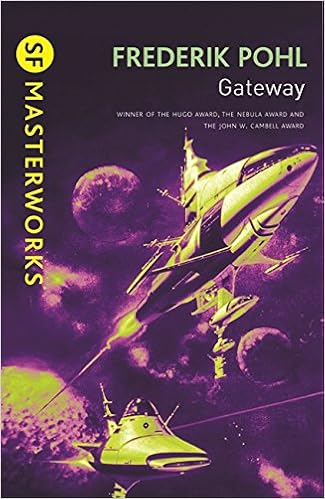
Amazon link

From Wikipedia:
"Gateway is a space station built into a hollow asteroid constructed by the Heechee, a long-vanished alien race. Humans have had limited success understanding Heechee technology found there and elsewhere in the solar system. The Gateway Corporation administers the asteroid on behalf of the governments of the United States, the Soviet Union, New People's Asia, the Venusian Confederation, and the United States of Brazil.

"There are nearly a thousand small, abandoned starships at Gateway. By extremely dangerous trial and error, humans learn how to operate the ships. The controls for selecting a destination have been identified, but nobody knows where a particular setting will take the ship or how long the trip will last; starvation is a danger. Attempts at reverse engineering to find out how they work have ended only in disaster, as has changing the settings in mid-flight. Most settings lead to useless or lethal places.

"A few, however, result in the discovery of Heechee artifacts and habitable planets, making the passengers (and the Gateway Corporation) wealthy. The vessels come in three standard sizes, which can hold a maximum of one, three, or five people, filled with equipment and hopefully enough food for the trip. Some "threes" and many "fives" are armored. Each ship includes a lander to visit a planet or other object if one is found.

"Despite the risks, many people on impoverished, overcrowded, starving Earth hope to go to Gateway. Robinette Stetley Broadhead—known as Robin, Rob, Robbie, or Bob, depending on circumstances and his state of mind—is a young food shale miner on Earth who wins a lottery, giving him just enough money to purchase a one-way ticket to Gateway. ...

" ... once back on Earth as a wealthy man he seeks therapy from an artificial intelligence Freudian therapist program which he names Sigfrid von Shrink."
Sigfrid von Shrink is an astonishingly insightful chatbot-psychotherapist.

In the spirit of 1977, Sigfrid is a timeshared program running on a mainframe.

Sigfrid: when AI was programmed in Fortran .. or BASIC?!

Robin, deeply traumatised and held on a floormat by restraining tapes, is instrumented to the gills for Sigfrid's benefit. The program fires (Freudian) model-based questions, trying to penetrate evasions and projections, forcing him to confront his unnameable terrors.

What a gulf between Sigfrid and Eliza!

---

What would we need, to build such a useful program in real life?
  • General conversation capability anchored by a sense of shared aboutness 
  • Real-world knowledge and psychotherapeutic task competence
  • Conversation-steering abilities.

If the world's AI companies can crack the long-duration contentful-conversation chatbot, Sigfrid is only a further small stretch. And given psychotherapeutic effectiveness in conditions as disparate as schizophrenia and PTSD, such an enormous social gain.

My guess? At least a decade, but not much more.

---

I first heard about Gateway in the early 1980s, when I was working at Standard Telecommunication Laboratories, one of ITT's five worldwide labs. An ITT colleague working in HCI recommended the novel, saying it had the best description of an ideal human computer interface he had ever encountered.
"But is the story any good?" I asked.

"It's not bad," came the answer, damning with faint praise.
Actually, Gateway is excellent, as suggested by this review.

Saturday, August 06, 2016

Failures fortuitously avoided

It is said that all political careers end in failure (the quote has some caveats that are generally ignored).

When I reflect on my own career, I see some failures rather fortuitously avoided.

As a child, I wanted to become a theoretical physicist. I went to Warwick University in 1969 determined to study the subject. For various reasons that all went wrong, but today I read at Backreaction Sabine Hossenfelder's experience:
"I finished high school in 1995. It was the year the top quark was discovered, a prediction dating back to 1973. As I read the articles in the news, I was fascinated by the mathematics that allowed physicists to reconstruct the structure of elementary matter. It wouldn’t have been difficult to predict in 1995 that I’d go on to make a PhD in theoretical high energy physics.

"Little did I realize that for more than 20 years the so provisional looking standard model would remain undefeated world-champion of accuracy, irritatingly successful in its arbitrariness and yet impossible to surpass.

"We added neutrino masses in the late 1990s, but this idea dates back to the 1950s. The prediction of the Higgs, discovered 2012, originated in the early 1960s. And while the poor standard model has been discounted as “ugly” by everyone from Stephen Hawking to Michio Kaku to Paul Davies, it’s still the best we can do.

...

"During my professional career, all I have seen is failure. A failure of particle physicists to uncover a more powerful mathematical framework to improve upon the theories we already have. ... "
---

In my early twenties I was a reasonably-successful member of the International Marxist Group - I was on the National Committee. Just a few years later, I became disillusioned - just a gut feeling that something was wrong with Trotskyism and that the revolution was not going to happen. Most of my comrades of the time remained in left politics their entire lives.

I mention John Ross, the IMG leader and latterly Ken Livingstone aide on the GLC, and Kate Hoey, now a Labour MP, amongst many others.

Still, the revolution never happened, nor are we any nearer to it.

---

In my thirties, at Standard Telecommunications Laboratories (STL) in Harlow, Essex, I worked on my PhD in artificial intelligence. By 1990 that funded research had terminated with the takeover by Canadian telecoms giant Northern Telecom (Nortel).

I briefly considered a career in academia as an AI researcher but there was no obvious possibility, so I bit the bullet and retrained as a telecoms network architect. It proved both interesting and lucrative over the next 25 years.

Had I stayed with AI, I would have entered the twilight of the classical AI research programme known as GOFAI. The field became moribund until the recent explosion of 'deep learning' in the quite-variant neural net tradition.

---

So looking back, I had an opportunity to dedicate my life to changing the world in a political tradition which has proven ineffectual plus two opportunities to push the boundaries of knowledge forward .. in areas where history shows that nothing of great worth emerged.

Instead I got to design a lot of state-of-the-art networks, some of which even got built.

Engineering may be less ethically-challenged than many other professions - but I'd still rather have done the science.

Saturday, May 15, 2010

Nigel Seel CV

Nigel Seel CV

Updated: December 2016.

I was a self-employed telecommunications consultant with 30 years experience of network design; product portfolio, network and systems strategy, and telecommunications architecture.

Now I'm retired and doing a variety of things as documented on my blog.

KEY SKILLS

• Extensive experience of public carrier IP networking and next-generation network design.
• VP-level senior management experience in global corporations.
• Successful strategist and agent of change in large companies.
• Superior analytical, communications and delivery skills.
• The ability to develop a vision and inspire people through to completion.

MAJOR ASSIGNMENTS

Network architecture consultant to international law firm, London -- Jan 2012 - July 2012.

Worked with an international legal firm to define their requirements for a new enterprise network involving multi-site connectivity with data centres. Wrote the RFP and managed the vendor evaluation and selection process through to contract award.

Managed security accreditation (IL2/IL3) at C&W and other clients -- Jan 2010 - Sept 2010.

Network architecture consultant to Peel Media City, Manchester -- Dec 2008 - Jan 2009

Network architecture consultant to Dubai World Central -- Jan 2008 - July 2008

Programme Management - BT Wireless Cities -- May 2006 - Sept 2007

Senior Consultant – Mentor Technology International, working with a number of clients including an MVNO developing a new GPRS-based proposition, a VoIP company moving to SIP, a major multinational bidding into BT's 21st Century Network programme and a leading satellite broadcaster on its IPTV/Video-on-Demand programme. -- April 2004 - Feb 2006

Vice President - Portfolio Development at Cable & Wireless Global -- April 2002 - April 2003

Chief Architect - Cable & Wireless Global -- Jan 2001 - March 2002

Technical Architect - Nortel Networks -- May 1990 - Sept 1999

EMPLOYMENT HISTORY

Independent Consultant Feb 2006 - March 26th 2014
Mentor Technology International Apr 2004 - Jan 2006
Independent Consultant Apr 2003 - Apr 2004
Cable & Wireless Global Jan 2001 - April 2003
Independent Consultant Oct 1999 - Jan 2001
Nortel Networks Sept 1991 - Sept 1999
Standard Telecommunications Laboratories March 1982 - August 1991

EDUCATION

PhD in Artificial Intelligence (“Agent Theories and Architecture”) 1985 - 1989
BA Maths & Computer Science (1st Class) 1984.

Open University 3rd Level Physics courses in Electromagnetism (SMT359, 2008) and Quantum Theory (SM358, 2009) (both with Distinctions).

BOOK

Business Strategies for the Next-Generation Network -- Dec. 2006

PDF available here.

BLOG

http://interweave-consulting.blogspot.com/

Nigel Seel: about me.

Here's a link to my 23andMe genome.

Sciencefiction.com: 2011-2012 I was a contributing writer of science features and reviews.

PUBLISHED PAPERS

1. Seel, N. R. (1984). An Analysis of a Simple Learning System. In Proceedings of the Sixth European Conference on Artificial Intelligence.
2. Seel, N. R. (1986). A formal framework for modelling agents. In Proc. of Cybernetics and Systems 1986. D.Reidel.
3. Seel, N. R. (1988). Modelling Iterated Strategies: a Case Study. In Proceedings of the Eighth European Conference on Artificial Intelligence.
4. Seel, N. R. (1989). A Logic for Reactive System Design. In Proceedings of the Seventh Conference of the Society for the Study of Artificial Intelligence and the Simulation of Behaviour (AISB-89).
5. Seel, N. R. (1990). From Here to Agent Theory. In AISB Quarterly, Quarterly Newsletter of the Society for the Study of Artificial Intelligence and the Simulation of Behaviour, No. 72.
6. Seel, N. R. (1990). Intentional Description of Reactive Systems. In Y. Demazeau & J-P. Muller (Eds.), Proceedings of the Second European Workshop on Modelling Autonomous Agents in a Multi-Agent World. Elsevier Science Publishers B.V./North-Holland. (This is the main technical presentation of my Ph.D work in an accessible form).
7. Lesan, H. & Seel, N. R. (1990). A Conversational Interface to a Constraint-Satisfaction System. In ICL Technical Journal, Vol 7, No. 1.
8. Seel, N. R., Gilbert, G. N and Morris, M. E. (1990). A Project-Orientated View of CSCW. In Proceedings of the Third IFIP Conference on Human Computer Interaction (INTERACT '90).
9. Seel, N. R. and Hughes, P. T. (1990). CSCW for Professional Community Support. Proceedings of the IEE Colloquium on CSCW, 24 October 1990. The Institution of Electrical Engineers, Computing and Control Division, Savoy Place, London WC2R 0BL.
10. Seel, N. R. (1991). The 'Logical Omniscience' of Reactive Systems. Proceedings of the Eighth Conference of the Society for the Study of Artificial Intelligence and the Simulation of Behaviour (AISB-91).
11. Seel, N. R. (1991). Agents in the Human-Computer Interface: Extended Abstract. Proceedings of the IEE Colloquium on Intelligent Agents, 25 February 1991 (Digest No: 1991/048). The Institution of Electrical Engineers, Computing and Control Division, Savoy Place, London WC2R 0BL.
12. Hughes, P. T., Plant, T. A., Morris, M. E. and Seel, N. R. (1991). Collaboration Media: The Problem of Design by Use and the Use of Design. In: Proceedings of the UNICOM Seminar on CSCW "The Multimedia and networking Paradigm", Brunel University, 16-17 July 1991.
13. Seel, N. R. (1991). Perspectives for Distributed Artificial Intelligence.  In AISB Quarterly, Quarterly Newsletter of the Society for the Study of Artificial Intelligence and the Simulation of Behaviour, No. 76.
14. Seel, N. R. (1993). Traffic Management and Routing in SDH Networks. In Proceedings of the ITC Sponsored St Petersburg's Regional International Teletraffic Seminar "Digital Communication Network Management". (Ed.) B. Goldstein, A. Koucherayvy, M. Schneps-Shneppe, LONIIS, St. Petersburg, 15-20 June, 1993.
15. Seel, N. R. (1994). Approaches to SDH Network Design. Networks '94, Budapest, Hungary.
16. Seel, N. R. (1997). Carrier Architecture for IP Services. "Broadband Strategies", 4-5 Dec. 1997, IBC UK Conferences Ltd. , Gilmoora House, 57-61 Mortimer St., London W1N 8JX.
17. Seel, N. R. (2000). The Architecture of SS7-IP Interworking. IBC Workshop "Integrating SS7 and IP in the Network" at the IBC conference: "SS7/IP Interworking"; London, 13-15 March 2000.
18. Seel, N. R. (2000). Carrying IP over Glass. "The 2nd Annual International Optical Networking Forum", 17th-19th April 2000, Rome, Italy. Organised by IBC Global Conferences Ltd.
19. Seel, N. R. (2000). IPv6 Transition Architecture. "Transition To The New Internet".  IBC Global Conferences Ltd. 22nd - 23rd June 2000, Millennium Britannia Hotel, London.
20. Seel, N. R. (2001). Integration Infrastructure Provision. 18th May 2001. OSS Summit, Lake Geneva, Wisconsin, USA. 
21. Garbin, D. A. & Seel, N. R. (2001). Network Service Providers: the Business of Transporting Bits. NGN2001 Conference (Next Generation Networks - McQuillan). November 5-9th, 2001. Boston, USA.