Showing posts with label GOFAI. Show all posts

Friday, December 26, 2025

Why Did GOFAI become Gone AI?


GOFAI vs. the Crushing Realities of Scale

When I was an AI researcher in the 1980s, the dominant paradigm was knowledge representation. AI, we assumed, was essentially the art of representing knowledge in a formal language - predicate calculus, or some applied version of it - and then using that representation via inference rules, plus  heuristics to stop the whole thing from exploding combinatorially.

There was a huge and optimistic research programme around this: fuzzy logic, probabilistic and Bayesian variants, and a menagerie of ad hoc representational structures - frames, scripts, semantic nets - all trying to bottle “commonsense” in forms that could be manipulated in increasingly powerful ways. 

In the mainstream, nobody cared about neural nets. That community existed, of course, but it was marginal stuff in a distinctive physics-based mathematical paradigm we didn't really understand, and which we thought useless.

In hindsight, this now looks extraordinarily short-sighted. The whole approach has been shoved into the cupboard labelled Good Old-Fashioned AI - GOFAI - as if it were a Neanderthal cousin: earnest, ingenious perhaps, but doomed. I assure you it did not feel that way at the time; it felt like the right approach.

Why? Because the way we consciously think about thought is through language. When you ask someone why they did something, they give you reasons. Those reasons come out as propositions. And if you take propositions seriously, the best formal machinery we have for them is logic. So we formalised. We inferred. We drafted and polished the rules. We argued about representation. We believed we were closing in on the core of intelligence: meaning made explicit, knowledge made inspectable, inference made principled and then effectual.

If this was such a plausible programme, why did it fail so completely?

Some people will tell you that GOFAI was about “meaning” and neural nets are about “statistics”. But that opposition is uninformed and usually tendentious. When you ask a large language model a question, you ask something with meaning and you get back something with meaning. If it were all just statistical noise, it would be useless - and it obviously isn’t. So the question is not whether artificial neural net systems have semantic understanding, but how they acquire it and where it lives.

To see the difference, it helps to focus on what we were really trying to do in the 1980s. We were trying to declare meaning in advance. We tried to build a world model by writing down the world: concepts, relations, constraints, defaults, exceptions, and the rules for moving between them. We aimed for explicitness because explicitness feels like the true essence of knowledge. If the machine “knows” something, we should be able to point at it. If it reasons, we should be able to justify it. If it is wrong, we should be able to debug it.

Those are admirable ambitions. They are also, it turns out, ruinously expensive.

The world is not just insanely large; it is also densely structured. Human life is soaked in tacit knowledge: the thousands of micro-regularities that never make it into explicit articulation because they don’t need to. Such commonplace utterances as:

  • “If someone says X in that tone, they probably mean Y.”
  • “If this tool is in that drawer, it implies the last person who used it was doing such-and-such.”
  • “If the kettle is boiling and the milk is out, the next event is likely tea.”

We do not store these things as neat propositions. We carry them as an accumulated, largely unspoken competence - our multi-decade store of condensed experiences.

GOFAI tried to drag that whole submerged continent into the daylight, label it, and file it. And every time you write a proposition you commit yourself: the predicates have sharp boundaries; the ontology has cliff edges; the exceptions multiply. Brittleness is not an engineering accident in that world - it is structural. Logic, by its nature, deals in closed systems: a statement is true or false; a condition holds or it doesn’t; an entailment follows or it doesn’t.

Human cognition, by contrast, lives on slopes. We cope with partial fit, family resemblance, analogy, and improvisation. When our models are wrong, we often degrade gracefully rather than crash. In a certain sense we live by operational not denotational semantics: praxis or dasein, if you like.

The deeper problem, though, was not merely brittleness. It was bandwidth.

Even if you grant that explicit representations are, in principle, adequate - even if you believe you can model “meaning” propositionally - you still have to get enough of it into the machine to matter. That is where the knowledge representation research programme hit the wall. The amount of world-structure a useful system needs is not “a lot”; it is effectively astronomical.

Doug Lenat’s Cyc project is the heroic proof of concept and the cautionary tale in one. It was an attempt to win by scale within the symbolic paradigm: build a vast commonsense knowledge base by hand, assertion by assertion, rule by rule, over decades. It turns out the scale of what a lifetime of expert labour can encode is orders of magnitude below what is required for the kind of fluent, flexible competence we casually expect from “intelligence”.

It is not that Cyc was trivial; it is that the world is not.

So what did the neural approach do differently? It did not “abandon meaning”. It abandoned the fantasy that meaning must be pre-declared by a human engineer.

Large language models are trained on corpora so vast that they function, in practice, as a proxy for civilisation’s accumulated linguistic trace. That trace is not random. It is massively redundant, massively structured, and shot through with regularities about the world - causal regularities, social regularities, narrative regularities, and the implicit ontologies that language users share through use without ever explicitly listing them.

Training is then a brutal compression process. The system is forced, by optimisation pressure, to extract the stable patterns that make text predictable. In doing so it precipitates a semantic geometry: a high-dimensional space (thousands of dimensions!) in which meanings are not discrete atoms with hard edges, but regions and directions - similarity structure, entailment gradients, pragmatic association, contextual modulation. It is representation, certainly, but not the sort that sits obediently on a page as “facts”. It is meaning condensed into weights.

This is why the modern paradigm scales and the older one didn’t. Not because logic is false and vectors are true, but because the neural method exploits a source of structure GOFAI could never match: the pre-existing structure in the world’s textual data dump, harvested at industrial scale.

Symbolic AI tried to build an ontology from the top down, by explicit design. LLMs inherit an ontology from the bottom up, by statistical consolidation. The difference is not merely technical; it is ecological. Neural methods outsource much of the labour of world-modelling to the culture that produced the data. They do not ask a small priesthood of knowledge engineers to type out reality, line by line. They take what humanity has already written - the messy, contradictory, redundant bulk of it - and compress its median regularities into an internal structure that can generalise.

There is, of course, a price.

GOFAI’s great virtue was epistemic. Even when it failed, it failed in the open: you could inspect the rules, challenge the ontology, argue about the premises. Modern systems give you competence first and legibility only as an afterthought. They are astonishingly capable, but they do not come with built-in notions of truth or justification. They optimise. Sometimes that aligns with truth; sometimes it aligns with plausible rubbish. You gain power and lose a certain kind of accountability.

Still, the historical lesson seems clear enough. The decisive factor was not that symbolic representations are “wrong”, but that explicit hand-built representations cannot reach the density required for general intelligence-like behaviour. GOFAI was working with teaspoons; the world required oceans.

In the 1980s we tried to formalise intelligence as propositions plus inference. The 2020s arrived with a different discovery: intelligence scales with the compression of structured experience. Meaning can be precipitated, not merely declared. And once you accept that, the dominance of neural methods stops looking like a betrayal of reason and starts looking like a humiliating empirical fact about where the informational mass of the world really sits.

In the knowledge lies the power, the old knowledge engineers used to say; in the world's data lies the knowledge is the new mantra of the foundation model engineers.


Monday, March 13, 2017

From Bacteria to Bach and Back: The Evolution of Minds

Amazon Link

Daniel Dennett has been a guru of AI research since, .. well, certainly since I started doing it back in the 1980s. His "Intentional Stance" continues to be greatly clarifying.

Here's an extract from an early part of his latest book (above) contrasting 'Good Old-Fashioned AI' with how the human brain does it.
"... a benevolent scheduler doles out machine cycles to whatever process has highest priority, and although there may be a bidding mechanism of one sort or another that determines which processes get priority, this is an orderly queue, not a struggle for life.

"(It is a dim appreciation of this fact that perhaps underlies the common folk intuition that a computer could never "care" about anything. Not because it is made out of the wrong materials - why should silicon be any less suitable a substrate for caring than organic molecules? - but because its internal economy has no built-in risks or opportunities so its parts don't have to care.)

"The top-down hierarchical architecture of computer software, supported by an operating system replete with schedulers and other traffic cops, nicely implements Marx's dictum: "To each according to his needs, from each according to his talents." No adder circuit or flip-flop needs to "worry" about where it's going to get the electric power it needs to execute its duty, and there is no room for "advancement."

"A neuron, in contrast, is always hungry for work; it reaches out exploratory dendritic branches, seeking to network with its neighbors in ways that will be beneficial to it. Neurons are thus capable of self-organizing into teams that can take over important information-handling work, ready and willing to be given new tasks which they master with a modicum of trial-and-error rehearsal."
I think this is a good insight. Elsewhere he talks about the top-down, frozen and brittle paradigm of traditional AI (GOFAI). Sure, there are parameters and learning algorithms, but the basic framework is architecturally fixed within those limits the designer has anticipated.

Biological intelligence is far more flexible than that due to the proactive, adaptationist and self-organising properties of neural nets. Because neural-net learning is sub-symbolic ('weights'), the structure of its converged fixed-point architecture is emergent rather than preordained.

Hence too the power of the new artificial neural net paradigm of AI..

---

I'll have more to say about Dennett's new theory when I've finished the book. At times Dennett comes across as an exceedingly widely-read magpie, taking an inordinate amount of time to get to the point. He seems to feel he should go at the speed of his slowest SJW reader.

I sometimes feel that a Reader's Digest condensed edition (c. 10%) should ship with the volume; I suspect there would be little compression loss.

Memes, the subject of cultural evolution, is his big idea and I'm reminded of Joseph Henrich's "The Secret of our Success" although that author hasn't been cited yet.

Update: March 21st 2017.

I have now finished this book and it's a let down: no big reveal, no advance over previous arguments that consciousness is the (still mysterious) result of sub-personal processes. A bubbly, jolly, agreeable-uncle writing style can't hide sloppy over-use of metaphor ("memes as apps"), the minimal payback from his embrace of 'meme theory', and his inability to explain why you and I can suffer while a brick can't.

If you've read Dennett before, this book really doesn't add any additional value.

Saturday, August 06, 2016

Failures fortuitously avoided

It is said that all political careers end in failure (the quote has some caveats that are generally ignored).

When I reflect on my own career, I see some failures rather fortuitously avoided.

As a child, I wanted to become a theoretical physicist. I went to Warwick University in 1969 determined to study the subject. For various reasons that all went wrong, but today I read at Backreaction Sabine Hossenfelder's experience:
"I finished high school in 1995. It was the year the top quark was discovered, a prediction dating back to 1973. As I read the articles in the news, I was fascinated by the mathematics that allowed physicists to reconstruct the structure of elementary matter. It wouldn’t have been difficult to predict in 1995 that I’d go on to make a PhD in theoretical high energy physics.

"Little did I realize that for more than 20 years the so provisional looking standard model would remain undefeated world-champion of accuracy, irritatingly successful in its arbitrariness and yet impossible to surpass.

"We added neutrino masses in the late 1990s, but this idea dates back to the 1950s. The prediction of the Higgs, discovered 2012, originated in the early 1960s. And while the poor standard model has been discounted as “ugly” by everyone from Stephen Hawking to Michio Kaku to Paul Davies, it’s still the best we can do.

...

"During my professional career, all I have seen is failure. A failure of particle physicists to uncover a more powerful mathematical framework to improve upon the theories we already have. ... "
---

In my early twenties I was a reasonably-successful member of the International Marxist Group - I was on the National Committee. Just a few years later, I became disillusioned - just a gut feeling that something was wrong with Trotskyism and that the revolution was not going to happen. Most of my comrades of the time remained in left politics their entire lives.

I mention John Ross, the IMG leader and latterly Ken Livingstone aide on the GLC, and Kate Hoey, now a Labour MP, amongst many others.

Still, the revolution never happened, nor are we any nearer to it.

---

In my thirties, at Standard Telecommunications Laboratories (STL) in Harlow, Essex, I worked on my PhD in artificial intelligence. By 1990 that funded research had terminated with the takeover by Canadian telecoms giant Northern Telecom (Nortel).

I briefly considered a career in academia as an AI researcher but there was no obvious possibility, so I bit the bullet and retrained as a telecoms network architect. It proved both interesting and lucrative over the next 25 years.

Had I stayed with AI, I would have entered the twilight of the classical AI research programme known as GOFAI. The field became moribund until the recent explosion of 'deep learning' in the quite-variant neural net tradition.

---

So looking back, I had an opportunity to dedicate my life to changing the world in a political tradition which has proven ineffectual plus two opportunities to push the boundaries of knowledge forward .. in areas where history shows that nothing of great worth emerged.

Instead I got to design a lot of state-of-the-art networks, some of which even got built.

Engineering may be less ethically-challenged than many other professions - but I'd still rather have done the science.

Monday, June 13, 2016

Logistic discriminant analysis (= neural nets)

If you were trained (as I was back in the 1980s) on Good Old Fashioned AI (GOFAI), the technical background you studied consisted primarily of formal logic and discrete maths, implemented by symbolic programming languages such as Lisp and Prolog.

Meanwhile, the minority neural net tendency used statistical techniques and differential equations.

It's hard to imagine two more discordant cultures.

In these days of the overarching victory of the latter, I was interested to read the following from the excellent overview book, "Statistics: A Very Short Introduction" (David J. Hand), page 104.
"In fact, logistic regression can be regarded as the most basic kind of neural network."
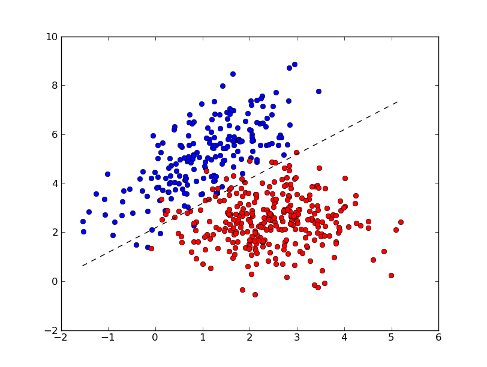
I confess I had never thought of neural networks as simply a mainstream statistical classification tool.


Wikipedia has two articles on the subject: "Discriminant function analysis" and "Linear discriminant analysis" along with "Logistic Regression".

Something to look at further.

---

Marr's Tri-Level Hypothesis

David Marr was one of my heroes when I was an active AI researcher. Outside of computer vision I think he is mostly forgotten now (he died tragically early), but he said something important about methodology in AI research when many around him were writing programs that did vaguely cool stuff while claiming they were advancing science.

Marr distinguished three levels of analysis.

  1. computational level: what does the system do (e.g.: what problems does it solve or overcome) and similarly, why does it do these things

  2. algorithmic/representational level: how does the system do what it does, specifically, what representations does it use and what processes does it employ to build and manipulate the representations

  3. implementational/physical level: how is the system physically realised (in the case of biological vision, what neural structures and neuronal activities implement the visual system).

His terms are not great (he was trained as a biologist): his computational level is really the theory of system behaviour in the environment of interest; his second level might be better described as an architectural level, describing the various ways the system's capabilities could be decomposed into subsystems and their inter-relationships; finally comes the issue of specific processing mechanisms and algorithms.

It's still common to see people waving the banner for one of these elements of analysis, while ignoring the others. Only confusion results.

Neural networks are an architecture. As currently understood and built, the term denotes a distributed, connected computational architecture well-suited to a certain class of problems, namely pattern recognition, feature extraction and classification.

This is a proper subset of the cognitive problems animals (including humans) have to solve in the world.

Artificial neural networks today consume Terabytes of training data, solving recognition/ classification problems of interest to Google, Facebook and the like.

I am reminded of the man who has a hammer.

The easy wins will fade away well before they achieve the purported Holy Grail of Artificial General Intelligence.

I hasten to add the obvious: in any event, you and I are considerable more than arid and cerebral AGIs.