Tuesday, September 25, 2018

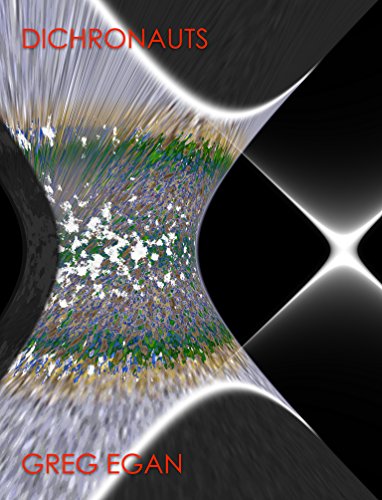
"Dichronauts" - Greg Egan


Amazon link

Grant Hutchison wrote this insightful review on Amazon.
"To some extent this is a companion volume to Egan's Orthogonal trilogy. In those books, he imagined what it would be like to live in a universe in which the time dimension behaved geometrically in exactly the same way as the three spatial dimensions, rather than with the hyperbolic coordinate relationship (described by special relativity) that we see in our own universe.

In this book, Egan describes a universe in which one of the spatial dimensions has time-like properties - introducing the hyperbolic relationships of relativity into everyday spatial coordinates. (The title, Dichronauts, meaning "travellers in two times" is a reference to the fact that his story universe has two time-like dimensions (time and "axial") and two regular spatial dimensions.

So we have a world in which simply trying to rotate an object can change its apparent shape; where it's impossible to rotate a north-facing object to face east, or an east-facing object to face north; where the stable shape for a planet is the hyperboloid depicted on the cover; where light can't travel to the north or south; and where falling over in those directions can have lethal consequences.

As with Orthogonal, Egan's aliens have one utterly alien property (in this case, we have two intelligent species that exist as commensals, one threaded through the skull of the other), but otherwise behave and speak like clever and amiable humans. And that's fine, because Egan's imagined world is strange enough without him expecting us to accommodate to an alien society, too. I'm therefore reminded of Hal Clement at his best, though Egan's characters have more humour.

The story is a quest, in which the reader finds out more about the world along with the story's characters. There are some surprises, and one toe-curling moment I certainly didn't see coming.

I knock off a star only because I think Egan's world may simply be too strange for many readers. In Orthogonal, one could amble along accepting that there was something a little odd about time without fretting about the details. In this story, almost every event is influenced by the strange spatial geometry, and if you don't find the geometry of special relativity engaging, you may be left floundering.

Egan provides some explanatory detail in the Afterword (which could productively be read first, since it contains no significant spoilers), and much more information on his website."
In fact the best advice is to read Egan's website physics primer first.

I read the first volume of the Orthogonal series and could't get into it. I felt that Egan was basically interested only in the setting - the physics - and was merely compelled by the fact that he was writing a novel to parachute some characters and plot in. Alternate spacetime topologies are plainly somewhat interesting, but one feels that 90% of the value is to be found on Egan's website in the relevant physics essays.

So I don't think I'll be reading Dichronauts any time soon. As another reviewer wrote:
"I really wish Grey Egan would stop writing these thought experiment alternate physics books. They're too much like hard work and are, frankly boring. He is a writer of enormous talent and needs in my opinion to concentrate on narrative and character rather than narrow concept world building."
My thoughts exactly.

Wednesday, September 19, 2018

Life on Mars


The Atacama desert in Chile is high, dry and cold. It has been used by NASA as a Mars simulator.

No-one lives there.

Yet people say they want to live on Mars.

Revealed preferences say: no, they don't.

---

It would not be too difficult to engineer a replica lunar or martian landscape in the Atacama. The excess gravity would be the only inauthentic part of the experience since tourists would be wearing climate-controlled spacesuits. Perhaps there's something you could do with a gantry and bungee cords.

I suspect the mean excursion time might be an hour - more if there was a pressurised dome with a coffee shop and cakes.

Or there again, hyper-realistic VR might do it.

---

All the universe we know about is like this, except where it's worse (planetary gas giants, stellar surfaces).

I'm really not sure galactic tourism is all it's cracked up to be.

Oh yes, aliens. Those creatures which emerged as the top predators on their planet and - subject to the usual biological instincts to expand their numbers and range - have ventured out into the Galaxy.

I suspect they will look ugly and scary, and will consider us competitor-vermin. Even the deepest dyed-in-the-wool liberal might have to accept that there are species-boundaries to effective altruism.

So let's not go there for our vacation. At least not until the Terran Space Navy has thoroughly pacified them.

Monday, September 17, 2018

Human Dodos, Communist Man, Draka Serfs

Amazon link

A couple of years ago I wrote some posts reviewing Francis Fukuyama's "The Origins of Political Order". From the Wikipedia article:
"From chimpanzee hunting groups to tribes

In his quest for the origins of political order, he first looks at the social order among chimpanzees, notes that the war-like hunting group, rather than the family, was the primary social group, and claims the same for humans. Humans went further: to survive they formed tribes, whose armies were superior to hunting groups by their sheer size.

He uses recent work in sociobiology and other sources to show that sociability built on kin selection and reciprocal altruism is the original default social state of man and not any isolated, presocial human as suggested by Hobbes and Rousseau. He suggests that Hobbes and Locke present a fallacy when they argue humans developed cooperative ability only as a result of the invention of the state.

This is because chimps, the genetic ancestors to humans, engage in kin relations based on cooperation, and so Hobbes and Locke must be mistaken suggesting humans were once sociable, lost this instinct and then regained it due to the state.

Challenge of tribes on the road towards the state

The next step was to escape beyond tribalism and the "tyranny of cousins", to join tribes into larger coalitions towards states, again due to the advantage of larger armies. This was done with the aid of religion. This was because as groups grew in size, maintaining cooperation became more difficult as face-to-face interactions with much of society became difficult. Religion offered a way of providing a combining social force to hold society together.

For example, Fukuyama cites Mohammed as an example of what Weber labels a "charismatic leader" because he used the idea of an 'umma' (community of believers) to bind together the territory that he ruled over. This challenge to transcend tribalism partly remains today in many parts of the world outside Western civilization, for example in Afghanistan and in Somalia.

Restrictions on marriage and inheritance as a strategy against corruption

Loyalty to the tribe or the family, rather than to the state, leads to corruption and weakening of the state. Various strategies were used to overcome the corruption. One such strategy was restrictions against marriage among the ruling official class to make sure that loyalties would not lie with family or tribe.

  • Mandarins or Scholar-officials, who were the ruling class of China, were not allowed to pass on the lands given to them by the emperor to their own children and were restricted as to whom they were allowed to marry.

  • Mamluk slaves, the ruling class of Egypt and the Ottoman Empire, were told which slaves to marry while their children could not inherit from them. Janissaries were originally forced into celibacy or prohibited from having a family.

  • Pope Gregory VII forced Catholic priests in Europe to become celibate and they were prohibited from having a family for the same reason.

  • Spanish administrators in South America were restricted from marrying local women and from establishing family ties in the territories they were sent to."
It should be added that the elites of empires of archaic despotism used extreme violence to break the powers of the clans. People do not take kindly to having a boot stamping on a human face - forever.

---

The three articles I wrote were:
  1. 'The natural state of humanity is clannishness'
  2. Human Dodos
  3. Human Dodos: the FAQs
which should be read in that order. I compared Jonathan Haidt's liberals (Myers-Briggs NFs) to dodos. Their naive optimism, their overarching (albeit abstract) compassion and their gullible belief in generalised human 'goodness' makes them easy meat for predators. Social liberalism is very much a northern european psychological trait, while most of the world's population (to its own economic detriment) continues to organise itself clannishly. Fukuyama's taming process has a way to go - and is not making any progress.

It's generally observed that extreme liberalism is required in a population to make Communism work. No more state, no more police, no more armies, no more war. We'd better believe in general niceness.

Just as Marx suggested that the historic role of capitalism was to develop the productive forces to enable the communist transition, perhaps it also has the historic task of breeding humans nice enough to make communism work at all. Then recall that a society of doves is unstable in the presence of predators. And then there is always the way of the Draka, which always seemed to me more likely.

---

It's worth noting that western societies - so apparently liberal in appearance - are capable of extreme and non-liberal violence whenever push comes to shove. In America only about 20% of the population self-declare as liberals. Despite much sjw noise and fury, social liberalism is more a convenient facade for the imperial west.

I recall that fateful phrase: "Notice how the liberals all leave the room, wringing their hands, once the bullets start flying."

Monday, September 10, 2018

The Interpretation of Quantum Theory (again!) - Philip Ball

Amazon link

I'm into extreme diminishing returns on books about the interpretation of quantum theory. And here is another, only worth considering because Peter Woit has bothered reviewing it:
"Philip Ball’s Beyond Weird is the best popular survey I’ve seen of the contemporary state of discussions about the “interpretation” of quantum mechanics. ...

Instead of spending a lot of time in the rut of Bohmian mechanics, Ball dismisses it quickly as:
But it is hard to see where the gain lies… Even Einstein, who was certainly keen to win back objective reality from quantum theory’s apparent denial of it, found Bohm’s idea ‘too cheap.”
Dynamical collapse models like GRW also get short shrift:
It’s a bodge, really: the researchers just figured out what kind of mathematical function was needed to do this job, and grafted it on… What’s more of a problem is that there is absolutely no evidence that such an effect exists.
As for the “Many-Worlds Interpretation”, which in recent years has been promoted in many popular books, Ball devotes a full chapter to it, not because he thinks it solves any problem, but because he thinks it’s a misleading and empty idea:
My own view is that the problems with the MWI are overwhelming – not because they show it must be wrong, but because they render it incoherent. It simply cannot be articulated meaningfully… 

The MWI is an exuberant attempt to rescue the ‘yes/no’, albeit at the cost of admitting both of them at once. This results in an inchoate view of macroscopic reality suggests we really can’t make our macroscopic instincts the arbiter of the situation…

Where Copenhagen seems to keep insisting ‘no,no and no’, the MWI says ‘yes, yes and yes’. And in the end, if you say everything is true, you have said nothing.
There’s a lot of material about serious efforts to go beyond Copenhagen, by understanding the role that decoherence and the environment play in the emergence of classical phenomena out of the underlying quantum world. This discussion includes a good explanation of the work of Zurek and collaborators on this topic, including the concept of “Quantum Darwinism”. ... "
The comments on Woit's post are also interesting.

---

For what it's worth (which is nothing) I suspect that we don't understand what the equations of quantum theory mean because we're still thinking in terms of the primacy of the 4D continuum. Starting from a more foundational space, ('spacetime is emergent'), quantum theory might just seem .. obvious.

Anyway, it's on my Kindle stack to look at later.

---

Update: Here's the review/

Sunday, September 09, 2018

Shades of Scarlett Conquering

There was an interview with Elvis Costello in The Times yesterday: "My culture fix: Elvis Costello". He was asked this question:
"The lyric I wish I’d written

There are countless couplets to admire, but they could only have been imagined by their authors, so envy is futile.

Lines I love are: “I believe in love, Alfie/ Without true love we just exist, Alfie/ Until you find the love you miss you’re nothing, Alfie,” from Alfie by Burt Bacharach and Hal David.

And: “Dressed in stolen clothes she stands, cast iron and frail/ With her impossibly gentle hands and blood-red fingernails,” from Shades of Scarlett Conquering by Joni Mitchell."

Good choices.

'The Hissing of Summer Lawns' was Joni Mitchell's 1975 transition album, as she began to explore jazz. For me the standout tracks are: "Shades of Scarlett Conquering",  "Edith and the Kingpin" and "Harry's House; Centerpiece".

Here's the track.


... and here are the lyrics - Elvis Costello's choice in verse 4.
Out of the fire like Catholic saints
Comes Scarlett and her deep complaint
Mimicking tenderness she sees
In sentimental movies
A celluloid rider comes to town
Cinematic lovers sway
Plantations and sweeping ballroom gowns
Take her breath away

Out in the wind in crinolines
Chasing the ghosts of Gable and Flynn
Through stand-in boys and extra players
Magnolias hopeful in her auburn hair
She comes from a school of southern charm
She likes to have things her way
Any man in the world holding out his arm
Would soon be made to pay

Friends have told her not so proud
Neighbors trying to sleep and yelling "Not so loud!"
Lovers in anger Block of Ice
Harder and harder just to be nice
Given in the night to dark dreams
From the dark things she feels
She covers her eyes in the x-rated scenes
Running from the reels

Beauty and madness to be praised
'Cause it is not easy to be brave
To walk around in so much need
To carry the weight of all that greed
Dressed in stolen clothes she stands
Cast iron and frail
With her impossibly gentle hands
And her blood-red fingernails

Out of the fire and still smoldering
She says "A woman must have everything"
Shades of Scarlett Conquering
She says "A woman must have everything"

Brilliant. But listening to the album overall (including this track) it's difficult to disagree with this sentiment from Stephen Holden in Rolling Stone:
" Four members of Tom Scott's L.A. Express are featured on Hissing, but their uninspired jazz-rock style completely opposes Mitchell's romantic style ... "
With characteristic thoroughness and total concentration, Joni focused on selecting just the right jazz musicians to play with. The result, in 1976, was that work of genius, Hejira.

Tuesday, September 04, 2018

Diary: Bikes in Barnstaple

We were in Barnstaple yesterday for the Tour of Britain, stage 2.

Barnstaple is the main town of North Devon in the southwest of England. Old and quaint, it's been ravaged by post-war planning: the old medieval streets pierced by a throbbing, flashing dual carriageway while sixties brutalism - white slats and breezeblock - infiltrates streets of older, fading yet more humane architecture.

The town seems on a cusp. There are pockets of gentrification, where the facades, decor and offers (coffee, food) are just as urbane and hipster as any bubble metropolis. Elsewhere you encounter boarded-up shops on the High Street, a general shabbiness and too much litter. There are beggars.

Barnstaple needs an injection of capital, a spring in the step and a sense of civic pride. As a typical English market town, it's far from alone in lacking these things.

---

So this is the Tour of Britain swishing through their first pass of Barnstaple (the finish was also here later).


As you can see, Clare and myself were encouraged by the motorbike-marshal to join with others in blocking the main Alexandra Road so that the riders would continue straight on to Victoria Road.

Chris Froome leads the peloton on to the roundabout

... closely followed by the rest of the Sky team: G is third in the picture

We passed Chris Froome and the rest of the Sky team later in the afternoon. This was on the M5 near Taunton heading up towards Bristol (stage 3): they were in the team bus and we were heading home.

Tuesday, August 28, 2018

Where did the capitalists come from? - Henri Pirenne

The high-bourgeoisie rules the planet. World-striding 'entrepreneurs' and bankers live gilded lives. The top 1% et cetera.

But it was not always so.

How fragile was the state of being a capitalist in the beginning! Unlike the lords of feudalism or antiquity, the proto-capitalists had no military forces at their disposal and relied upon alien, hostile institutions for the security of their business transactions - and for their own personal safety. How often were moneylenders simply killed or exiled by those powerful nobles indebted to them?

Reflecting upon Helen Dale's tantalising question - Could the Roman Empire have produced capitalism in 200 BC? - I came upon this strange, short and enticing free book.


Amazon link

This 36 page text is the address of Henri Pirenne (1862-1935) given at the International Congress of Historical Studies, London, April, 1913. It's a really interesting 40 minutes read (did I mention it's a free Kindle book?).

Here is some of what Pirenne, who had an interesting life, has to say.
"The ancestors of the bourgeoisie must then be sought, specifically, in the mass of those wandering beings who, having no land to cultivate, floated across the surface of society, living from day to day upon the alms of the monasteries, hiring themselves to the cultivators of the soil in harvest time, enlisting in the armies in time of war, and. shrinking from neither pillage nor rapine if the occasion presented itself.

It may without difficulty be admitted that there may have been among them some rural artisans or some professional peddlers, But it is beyond question that with very few exceptions it was poor men who floated to the towns and there built up the first fortunes in movable property that the Middle Ages knew.

Fortunately we possess certain narratives which enable us to support this thesis with concrete examples. It will suffice to cite here the most characteristic of them, the biography of St. Godric of Finchale.  He was born of poor peasants in Lincolnshire, toward the end of the eleventh century, and from infancy was forced to tax his ingenuity to find the means of livelihood. Like many other unfortunates of all times, he at first walked the beaches on the outlook for wreckage cast up by the sea. Then we see him, perhaps by reason of some fortunate find, setting up as a peddler and travelling through the country with a little pack of goods (cum mercibus minutis).

At length he gathers together a small sum, and one fine day joins a troop of town merchants whom he has met in the course of his wanderings. Thenceforward he goes with his companions from market to market, from fair to fair, from town to town. Having thus become a professional merchant, he rapidly gains a sufficient sum to enable him to associate himself with other merchants, charter a boat with them, and engage in the coasting trade along the shores of England, Scotland, Denmark, and Flanders.

The company is highly successful. Its operations consist in carrying to a foreign country goods which it knows to be uncommon there, in selling them there at a high price, and acquiring in exchange various merchandise which it takes pains to dispose of in the places where the demand for them is greatest and where it can consequently make the greatest gains.

At the end of some years this prudent practice of buying cheap and selling dear has made of Godric, and doubtless of his associates, a man of important wealth. Then, touched by divine grace, he suddenly renounces his fortune, gives his goods to the poor, and becomes a monk.

The story of Godric, if one omits its pious conclusion, must have been that of many others. It shows us, with perfect clearness, how a man beginning with nothing might in a relatively short time amass a considerable capital. Our adventurer must have been favored by circumstances and chance. But the secret of his success, and the contemporary biographer to whom we owe the story insists strongly upon it, is intelligence.  ...

The fortunes acquired in the wandering commerce by the parvenus of the eleventh and twelfth, centuries soon transformed. them into landed proprietors. They invest a good part of their gains in lands, and the land they thus acquire is naturally that of the towns in they reside. From the beginning of the thirteenth century one sees this land held in large parcels by an aristocracy of patricians, viri hereditarii, divites„ majores„ in whom we cannot fail to recognize the descendants of the bold voyagers of the gilds and the hanses.

The continuous increase of the burghal population enriches them more and more, for as new  inhabitants establish themselves in the towns, and as the number of the houses increases, the rent of the ground increases in proportion. So from the commencement of the thirteenth century, the grandsons of the primitive merchants abandon commerce and content themselves with living comfortably upon the revenue of their lands.

They bid farewell to the agitations and the chances of the wandering life, They live henceforward in their stone houses, whose battlements and towers rise above the thatched roofs of the wooden houses of their tenants. They assume control of the municipal administration; they and their families monopolize the seats in the échevinage or the town council. Some even, by fortunate marriages, ally themselves with the lesser nobility and begin to model their manner of living upon that of the knights. ...

This was destined to last, as is familiar, until the moment when in England at the end of the eighteenth century, on the Continent in the first years of the nineteenth, the invention of machinery and the application of steam to manufacturing completely disorganized the conditions of economic activity.

The phenomena of the sixteenth century are reproduced, but with tenfold intensity Merchants accustomed to the routine of mercantilism and to state protection are pushed aside. We do not see them pushing forward into the career which opens itself before them, unless as lenders of money. In their turn, and as we have seen it at each great crisis of economic history, they retire from business and transform themselves into an aristocracy.

Of the powerful houses which are established on all hands and which give the impetus to the modern industries of metallurgy, of the spinning and weaving of wool, linen, and cotton, hardly one is connected with the establishments existing before the end of the eighteenth century Once again, it is new men, enterprising spirits, and sturdy characters which profit by the circumstances."
Henri Pirenne confuses his mercantilists with his capitalists. The former buy cheap and sell dear; most of what they accomplish is the shifting of value around. Capitalists, on the other hand, buy labour-power and appropriate surplus value: they do preside over the creation of new value. Capitalism as a mode of production requires the employment of workers in commodity production for the market - not a feature of medieval times except at the margins of the highly-regulated guilds.

However, his 'stages theory', in which the merchants and proto-capitalists of each generation make their money and cash in, to join and reinvigorate their pre-capitalist elites, is surely correct. It was ever so.

---

The Roman Empire enslaved available labour. It didn't seem to have occurred to anyone that this might be a moral atrocity: there were no abolitionists in antiquity, although slaves were often freed on a personal basis.

The main thing preventing a capitalist transition seems to have been the lack of proto-capitalists. There were certainly many 'new men' who made their fortunes in trade around the Mediterranean and farther afield. As Pirenne similarly observes for the mediaeval period, it was invariably the case that they then bought status and prestige by converting their fortunes into land and slaves.

As a matter of fact, Roman artisan workshops did not expand into proto-companies powered by wage labour, which would have marked the onset of capitalism-proper.


Amazon link

I'm still struggling to put my finger on exactly why no bourgeoisie developed in Rome, but maybe this book by the renowned Ellen Meiksins Wood will help (I've just started it). More later.

---

Marx anticipated all this with his knockabout "Genesis of the Industrial Capitalist", Chapter 31 of the first volume of Capital.
Friday, August 24, 2018

"Crashed" - Adam Tooze

Amazon link

From Michael Roberts's blog:
"Tooze’s new book makes a massive contribution to the economic history of the global financial crash of 2008-9.  Tooze shows what happened and how it came about that the great credit boom of the early 2000s eventually led to the biggest financial disaster in modern economies and the ensuing deepest slump in capitalist production since the 1930s.

And he concludes that the way this was dealt with by ‘the powers that be’, namely through bailouts of the banks and the general saving of the wealth of the rich at the expense of the rest of us, has provoked the emergence of a ‘populist’ reaction against ‘capitalism’, whether leftist as in Greece or Spain, or rightist as with Trump, Brexit and the Liga in Italy.

So the legacy of the first ten years of 21st century capitalism is still with us in the second decade.  And worse, the underlying problem of rising debt and an uncontrolled financial sector has not been resolved.  The financial crisis of 2008-9 could well return.

There have been other intriguing analyses of the great financial crash before Tooze’s. The most popular was The Big Short by Michael Lewis (which was made into a movie).  Lewis tells the story of the investment banks who sold ‘toxic’ mortgage backed bonds to their clients (mainly other investment banks and rich individuals, often from Europe), knowing full well that they were rotten. As the property bubble started to burst, these banks then secretly went ‘short’ (betting on a collapse). As Lewis puts in his book, “Goldman Sachs did not leave the house before it began to burn; it was merely the first to dash through the exit – and then it closed the door behind it.”

In my own book on this period, The Great Recession, which is a chronological account, month by month, of the crisis from 2005 to 2010, I describe how the big banks in particular completely escaped the consequences of this scam, thanks to the US government.  Indeed, the whole ugly story of the activities of Goldman Sachs and other investment banks before, during and after the credit crunch and the Great Recession beggars belief.

But Tooze’s long book covers the significant financial crises of the previous ten years in much more detail than Lewis or me – and is global in scope.  Its length does not mean it is boring at all, as he presents us with vignettes of the major players and their decisions.  He shows how they ensured that the stronger and luckier big banks gained at the expense of the weaker and smaller; and how government intervention provided funding for the culprits of the financial disaster at the expense of the victims, working people, tax payers and small businesses.

It was ‘socialism for the rich and capitalism for the poor’: such is the stuff of the capitalist order."
Someone in the comments asks for Michael Roberts's opinion on how we get out of this mess.
"Do you write anywhere about what a socialist economy might look like and how a transition to such an economy might happen – and here I’m talking about the ‘economics’ rather than the politics of change?

In a world where everyone had agreed that need rather than profit should govern production, and given a political mandate to achieve that, what would you aim for and how would you engineer the change?"
I await with interest any response - but we've never had one before. Not from any Marxist economist, not to single Roberts out.

One feels like a literate, educated inhabitant of the Roman Empire or any feudal state during one of their many dislocating crises. There must be a better way, you muse to yourself,.

But the historical preconditions are just not ready.

Truly, you say to yourself, there is no qualitative alternative on offer. Just hunker down and mitigate.

And don't do stupid stuff like the Venezuelans, things which would crash the economy .. and make Adam Tooze's account look like a picnic.

Thursday, August 23, 2018

"Postmodernism, or, The Cultural Logic of Late Capitalism" - Fredric Jameson

Amazon link

I've just begun reading Fredric Jameson's masterpiece and was struck by this excerpt (page 4):
"As for the postmodern revolt against all that [i.e. modernism], however, it must equally be stressed that its own offensive features from obscurity and sexually explicit material to psychological squalor and overt expressions of social and political defiance, which transcend anything that might have been imagined at the most extreme moments of high modernism—no longer scandalize anyone and are not only received with the greatest complacency but have themselves become institutionalized and are at one with the official or public culture of Western society.

What has happened is that aesthetic production today has become integrated into commodity production generally: the frantic economic urgency of producing fresh waves of ever more novel-seeming goods (from clothing to airplanes), at ever greater rates of turnover, now assigns an increasingly essential structural function and position to aesthetic innovation and experimentation.

Such economic necessities then find recognition in the varied kinds of institutional support available for the newer art, from foundations and grants to museums and other forms of patronage. Of all the arts, architecture is the closest constitutively to the economic, with which, in the form of commissions and land values, it has a virtually unmediated relationship.

It will therefore not be surprising to find the extraordinary flowering of the new postmodern architecture grounded in the patronage of multinational business, whose expansion and development is strictly contemporaneous with it. Later I will suggest that these two new phenomena have an even deeper dialectical interrelationship than the simple one-to-one financing of this or that individual project.

Yet this is the point at which I must remind the reader of the obvious; namely, that this whole global, yet American, postmodern culture is the internal and superstructural expression of a whole new wave of American military and economic domination throughout the world: in this sense, as throughout class history, the underside of culture is blood, torture, death, and terror. "
Postmodernism is surely a liberal project. Jonathan Haidt (Moral Foundations Theory) has highlighted liberal blindness to the moral dimensions of sanctity, respect for due authority and sexual/social propriety. Pussy Riot are rightly postmodernist icons.

Jameson here nails the moral selectiveness of fashionable liberal opinion.

---

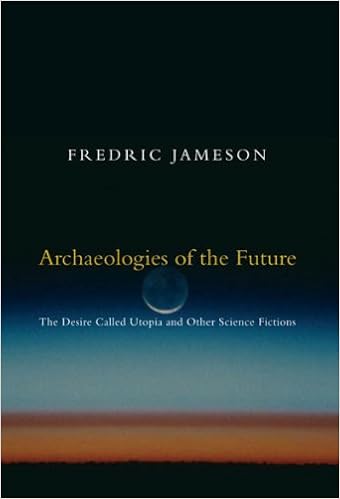
Jameson is undeniably brilliant - his work suffused in the culture of Western Marxism and the Frankfurt School. I'm debating whether to get his later (2005) review, "Archaeologies of the Future: The Desire Called Utopia and Other Science Fictions".

Amazon link

"This is a brilliant study of utopia and science fiction, from Thomas More to Philip K. Dick, by the master literary critic. "Archaeologies of the Future", Jameson's most substantial work since "Postmodernism", investigates the development of the Utopian form since Thomas More, and interrogates the functions of Utopian thinking in a post-Communist age.

The relationship between utopia and science fiction is explored through the representations of otherness...alien life and alien worlds...and a study of the works of Philip K. Dick, Ursula LeGuin, William Gibson, Brian Aldiss, Kim Stanley Robinson and more."      [From the Amazon page].

Wednesday, August 22, 2018

The house painter takes a break


Clare takes a break from painting our front room. I wish I could claim credit for this pencil sketch .. but no, it's the magic of my new Honor 10 AI phone again!