 |
| Or it might just be a touch chilly ... |
Sunday, January 11, 2015
Nous sommes tous Charlie
In my Marxist days, I would have been penning articles about the bourgeois hypocrisy of leaders such as Hollande, Cameron and Merkel marching piously in Paris in defence of political correctness. I would have pointed out that the crass, obscene and unfunny cartoons of Charlie Hebdo posed no threat to the established order, despite the professed '68 Marxism of the authors, as the establishment never believed in any of the propositions lampooned in the first place.
In the spirit of the new diversity, the fact that apparently we are now "all Charlie", let me outline three excitingly innovative views of the recent events in Paris. Naturally, these accounts are designed both to be true and to offend.
1. The Physicist's view
Various atoms and molecules in the Paris area recently continued to conform to the predictions of the Standard Model of Quantum Mechanics and General Relativity. As expected.
2. The Psychopath's view
Various biological machines in the Paris area with conflicting goals came into conflict. Some of the machines were destroyed.
3. The Jihadi's view
[Censored].
Do you think I'm crazy?
---
Sigh: one is not meant to explain one's work .. but: (1) is meant to get you thinking about the nature of 'free will' in all this; (2) is meant to highlight the methodological 'dispassionate' approach of rational science vs. emotionalism-altruism-empathy in human affairs. As for (3), I think we've had enough secularists floundering to represent to the world at large a community which organises itself (in contradistinction to a society ordered by abstract principles and the law) as an 'honour culture'.
In the spirit of the new diversity, the fact that apparently we are now "all Charlie", let me outline three excitingly innovative views of the recent events in Paris. Naturally, these accounts are designed both to be true and to offend.
1. The Physicist's view
Various atoms and molecules in the Paris area recently continued to conform to the predictions of the Standard Model of Quantum Mechanics and General Relativity. As expected.
2. The Psychopath's view
Various biological machines in the Paris area with conflicting goals came into conflict. Some of the machines were destroyed.
3. The Jihadi's view
[Censored].
Do you think I'm crazy?
---
Sigh: one is not meant to explain one's work .. but: (1) is meant to get you thinking about the nature of 'free will' in all this; (2) is meant to highlight the methodological 'dispassionate' approach of rational science vs. emotionalism-altruism-empathy in human affairs. As for (3), I think we've had enough secularists floundering to represent to the world at large a community which organises itself (in contradistinction to a society ordered by abstract principles and the law) as an 'honour culture'.

Saturday, January 10, 2015
Roomba's first outing (Vimeo)
Just playing with Vimeo. Back in 2007 I bought Clare a Roomba for Christmas. This rather primitive video (camera phones were so primitive back then!) shows its first outing in our bedroom, from our house in Andover, Hampshire. How nostalgic, looking back to the days when we were Roomba-naive!
Two fuzzy notions made crisp
1. Family and Friends
Family is easy; your kin group which is defined and preferred through inclusive fitness. Friends corresponds to that circle of individuals with whom one practices reciprocal altruism (qv). Since reciprocal altruism requires trust extended over time, it's not surprising that friendship tends to be psychologically regulated.
2. Birds vs Frogs (or Lee Smolin's seers vs. master craftsmen)
Freeman Dyson calls mathematicians who take a lofty conceptual view of their subject birds and those who work in details and solve their problems consecutively frogs. Smolin has a similar division in mind for theoretical physicists.
The crisp distinction is between deduction and abduction. Deduction draws consequences from theories and boundary conditions - and is the home territory of the master craftsmen and frogs; abduction is the creative synthesis of the most parsimonious and elegant theory which can be conjured up to explain the available data - the business of seers and birds.
(Your author, to tell the truth, has always felt more avian).
Family is easy; your kin group which is defined and preferred through inclusive fitness. Friends corresponds to that circle of individuals with whom one practices reciprocal altruism (qv). Since reciprocal altruism requires trust extended over time, it's not surprising that friendship tends to be psychologically regulated.
"According to Trivers, the following emotional dispositions and their evolution can be understood in terms of regulation of altruism.
- Friendship and emotions of liking and disliking.
- Moralistic aggression. A protection mechanism from cheaters acts to regulate the advantage of cheaters in selection against altruists. The moralistic altruist may want to educate or even punish a cheater.
- Gratitude and sympathy. A fine regulation of altruism can be associated with gratitude and sympathy in terms of cost/benefit and the level in which the beneficiary will reciprocate.
- Guilt and reparative altruism. Prevents the cheater from cheating again. The cheater shows regret to avoid paying too dearly for past acts.
- Subtle cheating. A stable evolutionary equilibrium could include a low percentage of mimics in controversial support of adaptive sociopathy.
- Trust and suspicion. These are regulators for cheating and subtle cheating.
- Partnerships. Altruism to create friendships."
2. Birds vs Frogs (or Lee Smolin's seers vs. master craftsmen)
Freeman Dyson calls mathematicians who take a lofty conceptual view of their subject birds and those who work in details and solve their problems consecutively frogs. Smolin has a similar division in mind for theoretical physicists.
The crisp distinction is between deduction and abduction. Deduction draws consequences from theories and boundary conditions - and is the home territory of the master craftsmen and frogs; abduction is the creative synthesis of the most parsimonious and elegant theory which can be conjured up to explain the available data - the business of seers and birds.
(Your author, to tell the truth, has always felt more avian).
Thursday, January 08, 2015
Charlie Hebdo .. and internal colonies
France, like the UK, has lots of Muslims - probably in excess of 5% of its population (exact numbers are not counted by the rigorously secular state). The Muslims tend to derive ethnically from France's ex-colonies in North Africa. As many of them are geographically concentrated, they constitute internal colonies.
Islam, like Judaism and Christianity, started out as a religion of pastoralists. Lots of references in the key texts to shepherds, and sorting out sheep from goats. Christianity was refashioned into a docile religion for the subjects of empire (another Roman achievement) while those same Romans dispersed the Jews after AD 70 and 135 so that their subsequent history was mostly within the empires of others - pastoralism was then not really their thing.
Islam, not so much.
What do we know about pastoralists? They keep animals (cattle, horses) in environments which don't support farming. Cattle are easy to steal and relatively low-maintenance. If you lose your cattle you don't get to have many descendants, so pastoralists are a might touchy about showing personal weakness, do not respond well to slights and have been known for their endemic blood feuds.
The more cattle you have, the wealthier you get so there are returns to scale. However, keeping the pastoralist "empire" together is tricky: it's just too easy for one clan or tribe to steal off the others. Islam is helpful to pastoral empire-builders, a 'glue-religion' which creates a framework for inter-tribal cooperation under a common deity and set of rules. However, as a cursory examination of Islamic world history shows, even a binding religion can't suppress the inherent centrifugal forces of pastoralism. And it always ends in violence.
So not all internal colonies are equal. A Chinese internal colony would, no doubt, be industrious, non-violent and successful; ditto the Jewish equivalent, historically the ghetto. History supports such observations. Again, Islamic internal colonies .. not so much.
This is not fundamentally a discussion at the level of values: free speech is pretty abstract and always circumscribed; it's about the norms and protocols of the way we organise society, the ways we relate to each other. People sometimes model social organisation using the game-theoretic model of "hawks vs. doves". The secularised West is ideologically a "dove" culture; Islamic culture, following its pastoral roots, is in most variants "hawk".
In the absence of any easy answers*, I would predict selective and enhanced surveillance and containment are going to be the outcome of all of this, across Europe.
---
* So what are the alternatives? Historically, socially-deprecated internal colonies have either been expelled (the Jews pretty much everywhere, the Muslims in Spain) with much suffering - or forcibly assimilated. The two policies were often pursued simultaneously.
Naturally any such operation in contemporary Europe would be met with the most ferocious and violent opposition from the said internal colony, together with a collapse of social cohesion on the part of the state attempting the ethnic cleansing.
That is not to say that it hasn't happened within recent history (Balkan wars, Soviet Russia under Stalin, the Nazis): just that a liberal democratic state can't do it. **
---
** That's not to say we won't get gradualist or 'at-the-margins' versions of these policies advocated by populist parties amongst others: a kind of 'Reconquista-lite'.
Islam, like Judaism and Christianity, started out as a religion of pastoralists. Lots of references in the key texts to shepherds, and sorting out sheep from goats. Christianity was refashioned into a docile religion for the subjects of empire (another Roman achievement) while those same Romans dispersed the Jews after AD 70 and 135 so that their subsequent history was mostly within the empires of others - pastoralism was then not really their thing.
Islam, not so much.
What do we know about pastoralists? They keep animals (cattle, horses) in environments which don't support farming. Cattle are easy to steal and relatively low-maintenance. If you lose your cattle you don't get to have many descendants, so pastoralists are a might touchy about showing personal weakness, do not respond well to slights and have been known for their endemic blood feuds.
The more cattle you have, the wealthier you get so there are returns to scale. However, keeping the pastoralist "empire" together is tricky: it's just too easy for one clan or tribe to steal off the others. Islam is helpful to pastoral empire-builders, a 'glue-religion' which creates a framework for inter-tribal cooperation under a common deity and set of rules. However, as a cursory examination of Islamic world history shows, even a binding religion can't suppress the inherent centrifugal forces of pastoralism. And it always ends in violence.
So not all internal colonies are equal. A Chinese internal colony would, no doubt, be industrious, non-violent and successful; ditto the Jewish equivalent, historically the ghetto. History supports such observations. Again, Islamic internal colonies .. not so much.
This is not fundamentally a discussion at the level of values: free speech is pretty abstract and always circumscribed; it's about the norms and protocols of the way we organise society, the ways we relate to each other. People sometimes model social organisation using the game-theoretic model of "hawks vs. doves". The secularised West is ideologically a "dove" culture; Islamic culture, following its pastoral roots, is in most variants "hawk".
In the absence of any easy answers*, I would predict selective and enhanced surveillance and containment are going to be the outcome of all of this, across Europe.
---
* So what are the alternatives? Historically, socially-deprecated internal colonies have either been expelled (the Jews pretty much everywhere, the Muslims in Spain) with much suffering - or forcibly assimilated. The two policies were often pursued simultaneously.
Naturally any such operation in contemporary Europe would be met with the most ferocious and violent opposition from the said internal colony, together with a collapse of social cohesion on the part of the state attempting the ethnic cleansing.
That is not to say that it hasn't happened within recent history (Balkan wars, Soviet Russia under Stalin, the Nazis): just that a liberal democratic state can't do it. **
---
** That's not to say we won't get gradualist or 'at-the-margins' versions of these policies advocated by populist parties amongst others: a kind of 'Reconquista-lite'.
Permanent jobs are much better (still!)
Congratulations to Adrian on getting his first permanent job (in finance) yesterday. Finance, along with marketing, is one of the two core experience-areas for career progression so .. result!
Wednesday, January 07, 2015
"The Book of Strange New Things" - Michel Faber
Just finished reading "The Book of Strange New Things"by Michel Faber to my wife, Clare, in half-hour nightly chunks. Here is what The Guardian made of it:
Faber is the ultimate 'show not tell' writer, so what might at first sight appear a rather low-key travelogue is in reality a quietly furious critique of institutional stupidity and personal inadequacy.
"Beatrice Leigh is a nurse, an evangelical Christian, a cat owner and “an independent and capable woman”, not necessarily in that order. She lives in a Britain perhaps not so far in our future, in which “institutions that have been around forever are going to the wall” and a collapsing economy and deteriorating climate have become indices for one another. It would be easier for Bea if she had her husband Peter’s support, but he can’t help: he’s trillions of miles away, on a planet called Oasis, with a mission to convert its alien inhabitants. The conversations of Bea and Peter, which scaffold Michel Faber’s astonishing and deeply affecting sixth novel, are held via a kind of interstellar email. The awkwardness of this medium amplifies to screaming pitch our sense of the emotional space between them. “Sometimes,” she tells him angrily, “I feel as though your leaving caused things to fall apart.”Here is what I see. A writer - Michel Faber - whose beloved wife and collaborator, Eva, is dying of cancer while he can only look on impotently. His anger and frustration channelled into a novel about a weak, superficial and fickle man who indulges his evangelical Christianity on Oasis as a psychological crutch while his pregnant wife is abandoned to global civilisation collapse back on Earth.
"Peter, meanwhile, finds it hard to focus on anything but his situation. The jump between worlds causes him to hallucinate. Oasis is too much to take in. His mission is financed by and carried out under the auspices of a shadowy corporate called Usic. They need him but won’t say why. The base personnel describe themselves as “a community”, “in partnership” with the indigenous population – “we do not use the word ‘colony’ ”. Yet many of them specialise in oil and mining technology, and Usic is already building infrastructure to support a larger population. Trade has begun, although it has taken a weirdly localised form: the Oasans produce food for the human settlement; in return, they seem to want only Earth analgesics and the Bible, the eponymous “book of strange new things”. On being shown a picture of Peter’s pet cat, they ask if it’s a Christian. When he tells them that, though he loves it anyway, the cat can’t be a Christian because it’s an animal, they respond: “We also love those who have no love for Jesus. However, they will die.” Finding a way through these mysteries requires Peter, whose Christianity is never presented as less than honest, to identify and dismantle his own deep temperament – avoidant, confused, manipulative, mistaking obsession for commitment.
"Like every fiction of Faber’s, The Book of Strange New Things is determined not to be mistaken for any other fiction written by Faber. At the same time, it’s difficult to read the description of an alien face as “a placenta with two foetuses – maybe three-month-old twins, hairless and blind – nestled head to head, knee to knee”, or an energy-saving light bulb as “a segment of radioactive intestine suspended from a wire”, without remembering the hallucinatory intensity of work such as Under the Skin. Oasis is a strange world, half paradisal, half dull, prime real estate for the imagination realised with determined sensuality. The atmosphere is full of “the sound of agitated leaves”, although there are very few leaves anywhere. The rain tastes sweet. The Oasans always wear gloves, and hooded pastel-coloured robes made of a fabric “disconcertingly like bath towel”. When they try to pronounce an “s”, they make the noise of “a ripe fruit being thumbed into two halves”.
"This is a big novel – partly because it has to construct and explain its unhomely setting, partly because it has such a lot of religious, linguistic, philosophical and political freight to deliver – but the reader is pulled through it at some pace by the gothic sense of anxiety that pervades and taints every element. Earth is becoming untenable. The more he feels at home with the Oasans, the more guilt Peter feels at abandoning his wife. The Usic personnel – who think of themselves as outcasts, members of a foreign legion – seem self-repressed to the edge of explosion. The Oasans, with their inexplicable faces and obsession with sharp objects can’t, surely, be as simple, gentle and fragile as they seem. And has their language, literalistic to the core, caused them to make a basic mistake about the Christian promise of eternal life? Even the planet’s low-diversity ecology seems to harbour some tension in need of resolution. The reader is desperate for relief, which can only come from turning another page, and then another and another.
"In Peter’s quarters at the Usic base, he finds “a red button on the wall labelled EMERGENCY, but no buttons labelled BEWILDERMENT”. Equally lost in the wild, dragged on by a mounting sense of urgency, we dread some upshot both ironic and gruesome: but while its surface finds the comic in everything from corporate architecture to the communication of taken-for-granted religious concepts, the deepest levels of the book privilege directness over irony. What you see is what you get: humans and aliens patiently trying to dismantle the very concepts of human and alien; making contact, making the best they can of a bad job. “We need a certain proportion of things to be OK,” Bea tells Peter, “in order to be able to cope with other things going wrong.” Perhaps that’s all we can ever hope for.
"Meanwhile, we have their letters, full of heartbreaking chat and a growing anger on her side, and on his a kind of restless evasiveness as he tries to find her life as interesting as his own. He misses her desperately, but he’s charmed and overwhelmed by all the strange new things; alone with everything they used to handle as a couple, she’s increasingly frustrated and desperate. The tragedy is that while we know that, Peter doesn't. If he spends the novel lagging behind the edge of the present, Bea spends it trying to stay ahead. She’s less concerned with understanding than keeping her head above the water. History is happening too fast and too completely for them. But what begins on Oasis must end on Earth and if Peter sets out as a holy fool, God requires him to finish as Orpheus. “I hear rain again. I love you and miss you. Don’t worry about anything.”
Faber is the ultimate 'show not tell' writer, so what might at first sight appear a rather low-key travelogue is in reality a quietly furious critique of institutional stupidity and personal inadequacy.
Saturday, January 03, 2015
"Proxima"/"Ultima" - Stephen Baxter
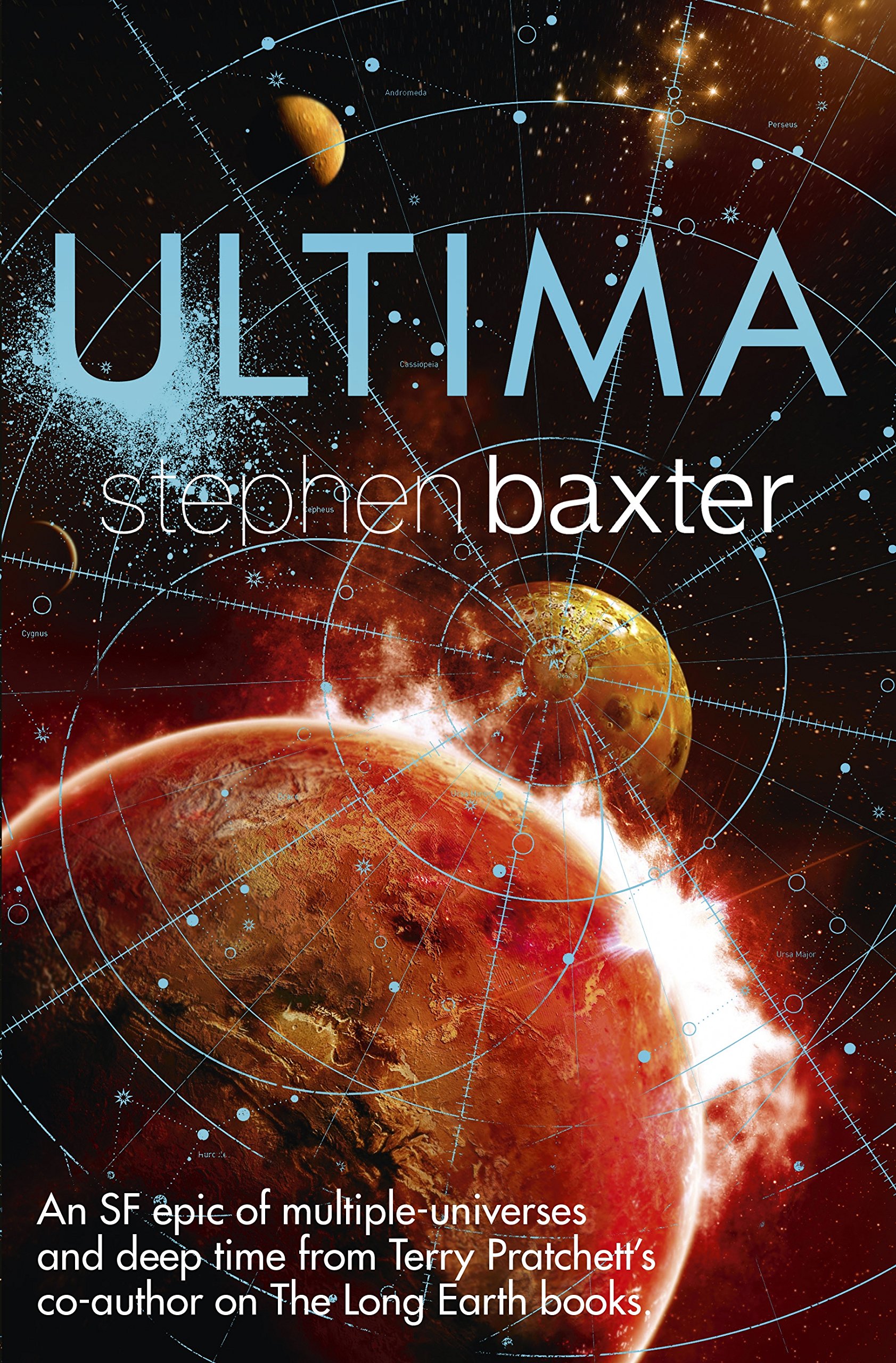
From the review at The Bookbag.
" In Proxima, alien hatches were discovered across the galaxy, hatches that when opened caused completely unimaginable events to occur - amongst many strange happenings, one character suddenly had a twin she didn't have previously , and one hatch led to a different earth, where the Roman Empire never died.Well, I beg to differ. I read these two blockbusters back to back hoping for some transcendent plot-revelation .. which failed to ever materialise. It seems that there is some Stephen Baxter conservation law:
"It is there that Ultima begins - on a world where the Roman Empire never fell, and the technology and culture is markedly different as a result.
"This world is explored in length. Great length, and to be honest, reading about it begins to feel like quite a chore. Proxima was heavily character driven, and I went into Ultima hoping for more exploration of Yuri and Stef, but instead had to read what felt like a science fiction history book, with little tension, drive or excitement to make me want to keep turning the pages. It's a very well written exploration of a strange new culture, but given that the last book left me invested in characters and gripped to find out what would happen, I was disappointed to have to slowly read through a section that did absolutely nothing to thrill, entertain or challenge me.
"Thankfully, things do pick up - characters begin to become vivid again, and the story picks up such a pace that the finale is genuinely quite staggering - and I concede that it did make reading the book, especially the lackadaisical first two or so hundred pages, worthwhile. In addition, the ideas and concepts that Baxter is dealing with, as well as a diverse cast of voices with which he tells his story, really do come together to make for a fantastic story in the end."
Characterisation + Setting + Plot = constant.Setting-wise, Baxter recycles his Roman Empire studies from previous books together with lots of scientific extrapolation about planets circling red dwarf stars. This subtracts from his characterisation, his menagerie of black-and-white-delineated characters who are merely activated stereotypes (marionettes might be a better word). The plot is all that keeps the pages ticking over, but in the end that reduces to just another tedious multiverse fantasy.
So sorry, couldn't recommend these two. Use the sparse hours of your life more productively.
Friday, January 02, 2015
The binary million
Today is the first and only time in my life I celebrate my binary millionth birthday. Naturally I got a nice card, helpfully re-purposed, from my wife.
I always say it's the thought that counts, don't you?
Here's the streaming video of the traditional ceremony of present-giving, in which I am eternally doomed to both joy and disappointment. Be warned that it's 800 MB with c. 6.5 minutes run-time. Sorry about the quietness of the sound - the humour, such as it is, is back-loaded.
Remember: absolutely no-one is making you watch home videos! No homework or future test involved.
 |
| The cover of my card |
 |
| The greeting inside |
I always say it's the thought that counts, don't you?
Here's the streaming video of the traditional ceremony of present-giving, in which I am eternally doomed to both joy and disappointment. Be warned that it's 800 MB with c. 6.5 minutes run-time. Sorry about the quietness of the sound - the humour, such as it is, is back-loaded.
Remember: absolutely no-one is making you watch home videos! No homework or future test involved.
Thursday, January 01, 2015
Dreamers and Doers
Sean Carroll has a guest post by Chip Sebens on the Many-Interacting-Worlds Approach to Quantum Mechanics. Here's the first part of it.
---
"In Newtonian physics objects always have definite locations. They are never in two places at once. To determine how an object will move one simply needs to add up the various forces acting on it and from these calculate the object’s acceleration. This framework is generally taken to be inadequate for explaining the quantum behavior of subatomic particles like electrons and protons. We are told that quantum theory requires us to revise this classical picture of the world, but what picture of reality is supposed to take its place is unclear. There is little consensus on many foundational questions: Is quantum randomness fundamental or a result of our ignorance? Do electrons have well-defined properties before measurement? Is the Schrödinger equation always obeyed? Are there parallel universes?
"Some of us feel that the theory is understood well enough to be getting on with. Even though we might not know what electrons are up to when no one is looking, we know how to apply the theory to make predictions for the results of experiments. Much progress has been made―observe the wonder of the standard model―without answering these foundational questions. Perhaps one day with insight gained from new physics we can return to these basic questions. I will call those with such a mindset the doers. Richard Feynman was a doer:
"The new approach seeks to take seriously quantum theory’s hydrodynamic formulation which was developed by Erwin Madelung in the 1920s. Although the proposal is distinct from the many-worlds interpretation, it also involves the postulation of parallel universes. The proposed multiverse picture is not the quantum mechanics of college textbooks, but just because the theory looks so “completely different psychologically” it might aid the development of new physics or new calculational techniques (even if this radical picture of reality ultimately turns out to be incorrect)."
Click here for the rest of it.
***
The essential mystery of quantum mechanics is that the theory is built around the dynamics of a thing called the wave function (hence wave mechanics), conventionally labelled ψ. The value of the wave function at each point in space and time is given by the solution to the Schrödinger equation (with appropriate boundary conditions): you imagine the ψ wave flowing around obstacles, through slits, and interfering with itself. The trouble is, the wave function is (apparently) not a 'real entity'. For one thing its values are complex, not real (all observables are real numbers); for another, in its multi-particle mode, the wave function lives in an arbitrarily high-dimension space called configuration space, not our conventional 3 + 1 dimensional space-time.
The wave function, as mentioned, is not itself observable. But if you square the value of the wave function (e.g. in a region of space at a point in time) you get the probability of observing the attribute-value of your interest (e.g. the probability of finding the particle in that region at that time).
The theory is incredibly accurate in giving you the correct probabilities; but it does not tell you what reality is actually doing. About that, quantum mechanics is not just silent - it informs you that your prior beliefs about the world consisting of well-defined particles with defined positions and momenta cannot be true (Bell's theorem).
Gulp!
The doers get on and calculate .. and design the modern technological world; the dreamers wonder whether there is completely non-obvious way to reconstruct the world of appearances ('reality') such that (relativistic) quantum mechanics turns out to be true in that structure of reality.
To date, no-one ever quite succeeded. Maybe Chip Sebens is onto something; maybe the Everett many-worlds formulation of quantum mechanics (still a work-in-progress) can be made to work.
It is my birthday tomorrow (I've reached binary one million) and I expect a present which will shed further light on these perplexing issues.
---
"In Newtonian physics objects always have definite locations. They are never in two places at once. To determine how an object will move one simply needs to add up the various forces acting on it and from these calculate the object’s acceleration. This framework is generally taken to be inadequate for explaining the quantum behavior of subatomic particles like electrons and protons. We are told that quantum theory requires us to revise this classical picture of the world, but what picture of reality is supposed to take its place is unclear. There is little consensus on many foundational questions: Is quantum randomness fundamental or a result of our ignorance? Do electrons have well-defined properties before measurement? Is the Schrödinger equation always obeyed? Are there parallel universes?
"Some of us feel that the theory is understood well enough to be getting on with. Even though we might not know what electrons are up to when no one is looking, we know how to apply the theory to make predictions for the results of experiments. Much progress has been made―observe the wonder of the standard model―without answering these foundational questions. Perhaps one day with insight gained from new physics we can return to these basic questions. I will call those with such a mindset the doers. Richard Feynman was a doer:
“It will be difficult. But the difficulty really is psychological and exists in the perpetual torment that results from your saying to yourself, ‘But how can it be like that?’ which is a reflection of uncontrolled but utterly vain desire to see it in terms of something familiar. I will not describe it in terms of an analogy with something familiar; I will simply describe it. … I think I can safely say that nobody understands quantum mechanics. … Do not keep saying to yourself, if you can possibly avoid it, ‘But how can it be like that?’ because you will get ‘down the drain’, into a blind alley from which nobody has yet escaped. Nobody knows how it can be like that.”"In contrast to the doers, there are the dreamers. Dreamers, although they may often use the theory without worrying about its foundations, are unsatisfied with standard presentations of quantum mechanics. They want to know “how it can be like that” and have offered a variety of alternative ways of filling in the details. Doers denigrate the dreamers for being unproductive, getting lost “down the drain.” Dreamers criticize the doers for giving up on one of the central goals of physics, understanding nature, to focus exclusively on another, controlling it. But even by the lights of the doer’s primary mission―being able to make accurate predictions for a wide variety of experiments―there are reasons to dream:
-Feynman, The Character of Physical Law (chapter 6, pg. 129)
“Suppose you have two theories, A and B, which look completely different psychologically, with different ideas in them and so on, but that all consequences that are computed from each are exactly the same, and both agree with experiment. … how are we going to decide which one is right? There is no way by science, because they both agree with experiment to the same extent. … However, for psychological reasons, in order to guess new theories, these two things may be very far from equivalent, because one gives a man different ideas from the other. By putting the theory in a certain kind of framework you get an idea of what to change. … Therefore psychologically we must keep all the theories in our heads, and every theoretical physicist who is any good knows six or seven different theoretical representations for exactly the same physics.”"In the spirit of finding alternative versions of quantum mechanics―whether they agree exactly or only approximately on experimental consequences―let me describe an exciting new option which has recently been proposed by Hall, Deckert, and Wiseman (in Physical Review X) and myself (forthcoming in Philosophy of Science), receiving media attention in: Nature, New Scientist, Cosmos, Huffington Post, Huffington Post Blog, FQXi podcast… Somewhat similar ideas have been put forward by Böstrom, Schiff and Poirier, and Tipler.
-Feynman, The Character of Physical Law (chapter 7, pg. 168)
"The new approach seeks to take seriously quantum theory’s hydrodynamic formulation which was developed by Erwin Madelung in the 1920s. Although the proposal is distinct from the many-worlds interpretation, it also involves the postulation of parallel universes. The proposed multiverse picture is not the quantum mechanics of college textbooks, but just because the theory looks so “completely different psychologically” it might aid the development of new physics or new calculational techniques (even if this radical picture of reality ultimately turns out to be incorrect)."
Click here for the rest of it.
***
The essential mystery of quantum mechanics is that the theory is built around the dynamics of a thing called the wave function (hence wave mechanics), conventionally labelled ψ. The value of the wave function at each point in space and time is given by the solution to the Schrödinger equation (with appropriate boundary conditions): you imagine the ψ wave flowing around obstacles, through slits, and interfering with itself. The trouble is, the wave function is (apparently) not a 'real entity'. For one thing its values are complex, not real (all observables are real numbers); for another, in its multi-particle mode, the wave function lives in an arbitrarily high-dimension space called configuration space, not our conventional 3 + 1 dimensional space-time.
The wave function, as mentioned, is not itself observable. But if you square the value of the wave function (e.g. in a region of space at a point in time) you get the probability of observing the attribute-value of your interest (e.g. the probability of finding the particle in that region at that time).
The theory is incredibly accurate in giving you the correct probabilities; but it does not tell you what reality is actually doing. About that, quantum mechanics is not just silent - it informs you that your prior beliefs about the world consisting of well-defined particles with defined positions and momenta cannot be true (Bell's theorem).
Gulp!
The doers get on and calculate .. and design the modern technological world; the dreamers wonder whether there is completely non-obvious way to reconstruct the world of appearances ('reality') such that (relativistic) quantum mechanics turns out to be true in that structure of reality.
To date, no-one ever quite succeeded. Maybe Chip Sebens is onto something; maybe the Everett many-worlds formulation of quantum mechanics (still a work-in-progress) can be made to work.
It is my birthday tomorrow (I've reached binary one million) and I expect a present which will shed further light on these perplexing issues.
Subscribe to:
Posts (Atom)