Showing posts with label Cancer. Show all posts

Monday, May 15, 2017

"I have already been absent, non-existent"

Jenni Diski - writer

I thought this Jenni Diski (1947-2016) article worth noting. Here's an excerpt.
" I am appalled at the thought, suddenly, that someone at some point is going to tell me I am on a journey.

"But much as I hate it, the journey – that deeply unsatisfactory, often deceitful metaphor – keeps popping into my head. Like my thoughts about infinity, my thoughts about my cancer are always champing at the bit, dragging me towards a starting line.

From ignorance of my condition to diagnosis; the initiation into chemotherapy and then the radiotherapy; from the slap of being told that it’s incurable to a sort of acceptance of the upcoming end. From not knowing, to "knowing", to "really" knowing; from being alive and making the human assumption that I will be around "in the future", to coming to terms with a more imminent death. ...

"The end of the 'journey' doesn’t come until you either die cancer-free of something else, or die of the effects of a regeneration of the cancer cells. Good and bad; from here to eternity, and from eternity to here.

"But I have been not here before, remember that. By which I mean that I have been here; I have already been at the destination towards which I’m now heading. I have already been absent, non-existent.

"Beckett and Nabokov know:
I too shall cease and be as when I was not yet, only all over instead of in store.

From an Abandoned Work

The cradle rocks above an abyss, and common sense tells us that our existence is but a brief crack of light between two eternities of darkness.

Speak, Memory
"This thought, this fact, is a genuine comfort, the only one that works, to calm me down when the panic comes. It brings me real solace in the terror of the infinite desert. It doesn’t resolve the question (though, as an atheist I don’t really have one), but it offers me familiarity with:
“The undiscovered country from whose bourn/ No traveller returns.”
"I’ve been there. I’ve done that. And it soothes. When I find myself trembling at the prospect of extinction, I can steady myself by thinking of the abyss that I have already experienced. Sometimes I can almost take a kindly, unhurried interest in my own extinction. The not-being that I have already been."
---

Jenni Diski's insight here is real, but for those who know some physics a deeper consolation (perhaps) is that our lives persist in spacetime, a consequence of Einstein's great discovery which I wrote about in my sciencefiction.com article "Sub Specie Aeternitatis".

Friday, November 18, 2016

Cryogenically frozen for years: then what?

From the BBC - the story is carried by many outlets.
"A 14-year-old girl who wanted her body to be preserved, in case she could be cured in the future, won a historic legal fight shortly before her death.

The girl, who was terminally ill with a rare cancer, was supported by her mother in her wish to be cryogenically preserved - but not by her father.

She wrote to the judge explaining that she wanted "to live longer" and did not want "to be buried underground".

The girl, who died in October, has been taken to the US and preserved there."
Her letter is quite poignant.
"I have been asked to explain why I want this unusual thing done.

"I am only 14 years old and I don't want to die but I know I am going to die.

"I think being cryopreserved gives me a chance to be cured and woken up - even in hundreds of years' time.

"I don't want to be buried underground.

"I want to live and live longer and I think that in the future they may find a cure for my cancer and wake me up.

"I want to have this chance.

"This is my wish."
---

In order of likelihood, most likely first.

  1. Civil disturbances result in loss of cooling sometime over the coming centuries.
  2. The best they can do is clone her from her DNA - so no memories.
  3. They scan her brain and recreate her mind in a total VR simulation.
  4. She is resurrected as a physical android with brain emulation.
  5. They scan her brain, run her mind as an emulation controlling a biological clone body.

The most unlikely option? She gets thawed out, they fix freezing damage and her cancer, and she resumes life in the future.

---

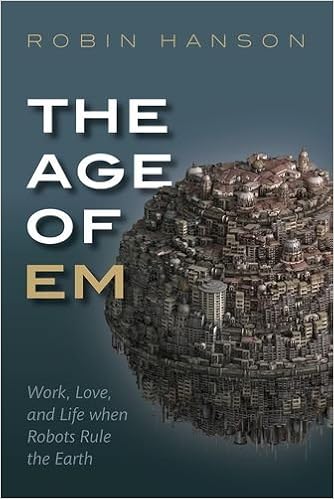
Brain scanning was discussed in Robin Hanson's book. Em stands for 'brain emulation' via scanning.


In this scenario, the girl (like other cryonauts) becomes a human time capsule, a resource for future historians.

No-one seems to dispute that both neurological and other organic damage will result from the cryogenic process. Presumably a sufficiently robust scanning procedure could review, edit and fix errors - mostly.

We don't have the faintest glimmerings today of such technology.

Saturday, January 24, 2015

Colonoscopy Pathology Report

I recently wrote about my colonoscopy experience (in December 2014). Today I received the pathology report: here's the relevant text.


Always good to know you've got to go back, even if it's 2020.

Here's the story on "benign tubular adenoma".
"What is a polyp in the colon?

A polyp is a projection (growth) of tissue from the inner lining of the colon into the lumen (hollow center) of the colon. Different types of polyps look different under the microscope. Polyps are benign (non-cancerous) growths, but cancer can start in some types of polyps.

What is an adenoma?

An adenoma is a polyp made up of tissue that looks much like the normal lining of your colon, although it is different in several important ways when it is looked at under the microscope. In some cases, a cancer can arise in the adenoma.

What are tubular adenomas, tubulovillous adenomas, and villous adenomas?

Adenomas have several different growth patterns that can be seen under the microscope by the pathologist. There are 2 major growth patterns: tubular and villous. Because many adenomas have a mixture of both growth patterns, some polyps may be called tubulovillous adenomas. Most adenomas that are small (less than ½ inch) have a tubular growth pattern.
...
The most important thing is that your polyp has been completely removed and does not show cancer. The growth pattern is only important because it helps determine when you will need your next colonoscopy to make sure you don’t develop colon cancer in the future."

Wednesday, January 07, 2015

"The Book of Strange New Things" - Michel Faber

Just finished reading "The Book of Strange New Things"by Michel Faber to my wife, Clare, in half-hour nightly chunks. Here is what The Guardian made of it:
"Beatrice Leigh is a nurse, an evangelical Christian, a cat owner and “an independent and capable woman”, not necessarily in that order. She lives in a Britain perhaps not so far in our future, in which “institutions that have been around forever are going to the wall” and a collapsing economy and deteriorating climate have become indices for one another. It would be easier for Bea if she had her husband Peter’s support, but he can’t help: he’s trillions of miles away, on a planet called Oasis, with a mission to convert its alien inhabitants. The conversations of Bea and Peter, which scaffold Michel Faber’s astonishing and deeply affecting sixth novel, are held via a kind of interstellar email. The awkwardness of this medium amplifies to screaming pitch our sense of the emotional space between them. “Sometimes,” she tells him angrily, “I feel as though your leaving caused things to fall apart.”

"Peter, meanwhile, finds it hard to focus on anything but his situation. The jump between worlds causes him to hallucinate. Oasis is too much to take in. His mission is financed by and carried out under the auspices of a shadowy corporate called Usic. They need him but won’t say why. The base personnel describe themselves as “a community”, “in partnership” with the indigenous population – “we do not use the word ‘colony’ ”. Yet many of them specialise in oil and mining technology, and Usic is already building infrastructure to support a larger population. Trade has begun, although it has taken a weirdly localised form: the Oasans produce food for the human settlement; in return, they seem to want only Earth analgesics and the Bible, the eponymous “book of strange new things”. On being shown a picture of Peter’s pet cat, they ask if it’s a Christian. When he tells them that, though he loves it anyway, the cat can’t be a Christian because it’s an animal, they respond: “We also love those who have no love for Jesus. However, they will die.” Finding a way through these mysteries requires Peter, whose Christianity is never presented as less than honest, to identify and dismantle his own deep temperament – avoidant, confused, manipulative, mistaking obsession for commitment.

"Like every fiction of Faber’s, The Book of Strange New Things is determined not to be mistaken for any other fiction written by Faber. At the same time, it’s difficult to read the description of an alien face as “a placenta with two foetuses – maybe three-month-old twins, hairless and blind – nestled head to head, knee to knee”, or an energy-saving light bulb as “a segment of radioactive intestine suspended from a wire”, without remembering the hallucinatory intensity of work such as Under the Skin. Oasis is a strange world, half paradisal, half dull, prime real estate for the imagination realised with determined sensuality. The atmosphere is full of “the sound of agitated leaves”, although there are very few leaves anywhere. The rain tastes sweet. The Oasans always wear gloves, and hooded pastel-coloured robes made of a fabric “disconcertingly like bath towel”. When they try to pronounce an “s”, they make the noise of “a ripe fruit being thumbed into two halves”.

"This is a big novel – partly because it has to construct and explain its unhomely setting, partly because it has such a lot of religious, linguistic, philosophical and political freight to deliver – but the reader is pulled through it at some pace by the gothic sense of anxiety that pervades and taints every element. Earth is becoming untenable. The more he feels at home with the Oasans, the more guilt Peter feels at abandoning his wife. The Usic personnel – who think of themselves as outcasts, members of a foreign legion – seem self-repressed to the edge of explosion. The Oasans, with their inexplicable faces and obsession with sharp objects can’t, surely, be as simple, gentle and fragile as they seem. And has their language, literalistic to the core, caused them to make a basic mistake about the Christian promise of eternal life? Even the planet’s low-diversity ecology seems to harbour some tension in need of resolution. The reader is desperate for relief, which can only come from turning another page, and then another and another.

"In Peter’s quarters at the Usic base, he finds “a red button on the wall labelled EMERGENCY, but no buttons labelled BEWILDERMENT”. Equally lost in the wild, dragged on by a mounting sense of urgency, we dread some upshot both ironic and gruesome: but while its surface finds the comic in everything from corporate architecture to the communication of taken-for-granted religious concepts, the deepest levels of the book privilege directness over irony. What you see is what you get: humans and aliens patiently trying to dismantle the very concepts of human and alien; making contact, making the best they can of a bad job. “We need a certain proportion of things to be OK,” Bea tells Peter, “in order to be able to cope with other things going wrong.” Perhaps that’s all we can ever hope for.

"Meanwhile, we have their letters, full of heartbreaking chat and a growing anger on her side, and on his a kind of restless evasiveness as he tries to find her life as interesting as his own. He misses her desperately, but he’s charmed and overwhelmed by all the strange new things; alone with everything they used to handle as a couple, she’s increasingly frustrated and desperate. The tragedy is that while we know that, Peter doesn't. If he spends the novel lagging behind the edge of the present, Bea spends it trying to stay ahead. She’s less concerned with understanding than keeping her head above the water. History is happening too fast and too completely for them. But what begins on Oasis must end on Earth and if Peter sets out as a holy fool, God requires him to finish as Orpheus. “I hear rain again. I love you and miss you. Don’t worry about anything.”
Here is what I see. A writer - Michel Faber - whose beloved wife and collaborator, Eva, is dying of cancer while he can only look on impotently. His anger and frustration channelled into a novel about a weak, superficial and fickle man who indulges his evangelical Christianity on Oasis as a psychological crutch while his pregnant wife is abandoned to global civilisation collapse back on Earth.

Faber is the ultimate 'show not tell' writer, so what might at first sight appear a rather low-key travelogue is in reality a quietly furious critique of institutional stupidity and personal inadequacy.

Thursday, January 03, 2013

Pining for the gym

What's the noun from 'pine'? Whatever - I'm suffering from gym-pining. My voice is roughened, my head stuffed and my body suffused with lethargy. I am probably surrounded by a penumbra of germs. No, going to the gym would be a bad mistake.

I caught part of a stupid Channel 5 list programme, something about dieting fads. Number forty-something was going to the gym and catching MRSA or similar from the sweat-drenched handles of a weight machine or exercise bike. I was furtively looking up 'cotton gym gloves' when Clare discovered me and I was roundly abused as a 'Jesse': the shame.

In 'The Fast Diet' Dr Michael Mosely links obesity to cancer. The population statistics are compelling but what's the mechanism? Apparently, fat doesn't just sit there inertly, it causes chronic inflammation. This suppresses DNA repair processes which facilitates the production of cancerous cells.

Then, in a further twist, the immune system response we call inflammation is recruited by the tumour to improve its blood supply and even to facilitate metastasis. It's so not good to be overweight (he said with the zeal of the convert).