Showing posts with label the Culture. Show all posts

Wednesday, February 04, 2026

Plan for the Galaxy *


Nigel: Elon Musk’s rhetoric about pivoting his company towards humanoid robotics strikes me as wildly premature. The technology is nothing like ready. We are nowhere near solving robust manipulation, autonomy in unstructured environments, or long-term reliability. Scaling production now - it looks like a delusion: confusing a demo-prototype for a ready-to-go mass product.

GPT-5.2: That is the central problem. What exists today are research artefacts with good PR. A humanoid robot that can walk, lift a box, or fold a T-shirt under contrived conditions is still missing the hard parts: error recovery, adaptive learning in the wild, energy efficiency, and graceful degradation when things go wrong. These are not polish issues; they are foundational research problems. Betting a company on them now would be a triumph of narrative over engineering.

Nigel: And of course we already have 'humanoid robots': human beings. They are abundant, adaptable, currently cheap by comparison, and astonishingly general-purpose. That’s the benchmark any future humanoid robot has to beat.

GPT-5.2: Precisely. Humans are the incumbent platform. They arrive self-powered, self-repairing, socially competent, and pre-trained by a civilisation that absorbs the cost. Against that baseline, a robot must be not just comparable but decisively better over its lifetime. Until labour is scarce, or required for situations intolerably dangerous, humanoid robots are competing with the most efficient all-round machine ever produced (by natural selection) for the human economy.

Nigel: Except, perhaps, on Mars? Given Elon Musk’s focus on a Martian colony, surely that’s the environment where humanoid robots and AI systems ought to be doing all the heavy lifting: construction, maintenance, preparation all set in place before the first humans ever arrive?

GPT-5.2: I can't agree. On Mars, humans become grotesquely expensive and fragile, so robots do start to look attractive. But Mars is not a proving ground; it is an extreme endgame. Any robot sent there must operate with near-total autonomy, survive years of mechanical stress, corrosive dust, radiation and cold, and repair itself or its peers with minimal human intervention. We cannot yet build machines that do this reliably in a terrestrial warehouse, even. Mars is not a shortcut around Earth-bound difficulty; it is in fact the ultimate stress test.

Nigel: Which pushes us into a deeper question. Why are we so intent - at least in our imaginations - on spreading humanity across the universe? None of us will get to go. Most everything out there looks bleak, uncomfortable, and sterile. Mars itself makes Antarctica look cosy - and we haven't exactly built cities or an economy there, have we?

GPT-5.2: That question is usually dodged with talk of destiny or survival, but stripped of romance it is deeply problematic. Human beings are savanna primates. We flourish only in narrow ecological bands, augmented by environment-mitigation technologies. The wider universe is not hostile by accident; it is hostile by default.

Nigel: Yep, just hostile. And AI and robotics will advance far faster than our capacity to move fragile human bodies across interplanetary, let alone interstellar, distances.

GPT-5.2: Yes. Once machines surpass us in harsh-environment durability, autonomy, and cognition, galactic exploration becomes their project, not ours. At that point, the human role presumably shifts from explorer to originator: the species that lit the fuse...

Nigel: So perhaps the long-term future is not humanity spreading bodily through the cosmos, but humanity giving rise to systems that do, almost by accident?

GPT-5.2: That's a future with a gradual decoupling: humans remain local, terrestrial, culturally rich but spatially constrained; meanwhile, our machines range outward, mapping, building - and expanding where we cannot.

Nigel: There is at least one major science-fictional counter-vision to this rather bleak handover. In Iain M. Banks’s Culture series, very advanced technology and very advanced AI are dedicated to replicating almost utopian human (strictly: human-like) environments elsewhere in the galaxy just by sheer cleverness and the use of vast amounts of energy and technology.

Whole artificial ecologies - Orbitals, habitats, engineered worlds - are built to be extravagantly hospitable. Savannahs, seas, weather, danger without lethality, difficulty without misery. Humans don’t adapt to the galaxy at all; the galaxy is adapted to humans. And the prospect of more savannah-like utopian real estate across the galaxy - for which we don’t have to change humans very much - might be a future humans would be very motivated to try to bring about.

GPT-5.2: Yes. Banks takes the opposite bet to rugged frontier mythology. Instead of forcing humans into hostile environments through grit and sacrifice, the Culture expends unimaginable effort to eliminate hostility itself. Gravity problems, poisonous atmospheres, harsh radiation, scarcity even: all engineered away. It is a vision where intelligence serves comfort rather than combatting the hostile with raw toughness.

Nigel: And crucially, humans are not asked to change very much. No radical post-biological leap is required. They remain recognisably human - fallible, social, embodied - just freed from the tyranny of the mundane, and scarcity, by Minds doing all the heavy lifting.

GPT-5.2: In that sense, it is deeply conservative about human nature, even as it is radically ambitious about technology.

Nigel: Which suggests a motivation that makes more sense than grim Martian heroics. Not survival at any cost, but abundance through exquisite engineering. More and nicer Earths, not harder near-misses. More room to live well, not more ways to endlessly suffer the hardships of pioneers.

Which brings us back to AI. In that vision, AI is not humanity’s replacement but its galactic infrastructure - vast, patient, incomprehensible, and largely benevolent machines to watch over us.

GPT-5.2: And that may be the most plausible long-term equilibrium. Humans remain local, embodied, narrative-driven creatures. AI becomes the civil-engineering layer of civilisation at cosmic scale. Not our descendants, exactly but not rivals either. Something closer to our climate, our environment, our extended phenotype.


* This is in homage to BA Gillies's 'Return to the Galaxy' pulp military-SF series.


Saturday, March 17, 2018

A Culture fit for dodos

In yesterday's post, "Paul Kincaid on Iain M. Banks", we discussed Paul Kincaid's take on the Culture, Iain Banks's attempt to define a utopian civilisation. Kincaid argued that this attempt was a failure, that the covert unpleasantness of the Culture expressed contradictions within Iain Banks's own high-minded liberalism.

Paul Kincaid was absolutely right. Social liberalism, the celebration of Enlightenment values, is an edifice founded upon ungrounded abstractions: 'individualism', 'freedom from oppression', 'human rights'. While such slogans are and were undoubtedly intoxicating in the struggle against authoritarian (and in particular pre-capitalist) formations, in content they are dramatically disconnected both from the historical specificities of the capitalism they served to inaugurate and from the evolutionary-ecology of the human animal itself.

Can we do better?

Consider an ecosystem of multiple species, many in a predator-prey relationship. Let's be specific and consider the pigeon. Here's a species whose evolutionary-physicality exactly captures its ecological constraints. Its senses are acute because it needs to forage, to avoid predators and to mate. It enjoys tasty food and is disgusted by poisons because any inferior affect would lead to loss of fitness - it might die before reproducing and those suboptimal genes would fail to propagate.

The pigeon tells us that what it really wants is unbounded food, plenty of mating opportunities, a safe nest and no predators. Should we listen to it?

The end of utopia

Occasionally animals find themselves on islands with no natural predators and plenty of resources: a truly benign environment. No doubt they would consider that they had found utopia. Yet a Malthusian-powered evolutionary descent soon follows. Their descendants lose sensual acuity, mobility and intelligence - all energy-wasters in utopia. The end result (starting out as a pigeon) is the dodo.

At the level of the individual creature's wish-list, utopia does not end well.

If the species could speak to us collectively (!) then it would tell us a different story. It would ask for a testing, but not too-testing environment. One where there were problems that the truly competent animal could overcome, thereby proving themselves and securing fame, fortune and mates. There would, sadly, be unfortunate creatures with greater than average genetic load, creatures which would be culled by natural selection. But the species, in its descendant cohort, would maintain itself in pristine condition.

You see the problem. All of this applies to humans too at every level: genetic, phenotypic and psychological. No-one even wants the all-mod-cons beach holiday their whole life. But by our very smartness, our technological competence, our innovative economies, we're on track to remove all those threats which make life a challenge. We'll start by being bored .. and then devolve into complacent human dodos.

I don't think Iain Banks wanted that conclusion, but he didn't know how to avoid it either. And evasion is the enemy of great literature.

---

You say we'll correct mutational load by genetic engineering. But we end up with an 'enhanced' species-genotype uncorrelated with its undemanding ecology. Hard to see how such a mismatch leads to psychological tranquility: bored in paradise.

The dodo was never bored: it positively evolved to become complacent and easily-pleased.

It's worth reminding ourselves that all of our much-prized human attributes are an evolutionary response to the challenges of our previous environments. We value high intelligence, for example, because it enables us to manage our complex societies (the abstractions underlying science, technology, politics, processes, finance, ...) while human language was the key to adaptive social coordination and cohesion on those dangerous savannas.

If we simplify our interaction with our environment by off-loading complexities (as the Culture does with its AIs, its Minds) then there is no very good reason for us being more cognitively or physically capable than a mollusc.

Again I ask the shade of Iain Banks: what ecological problems in the desired-future are humans to be bioengineered to cope with?

Friday, March 16, 2018

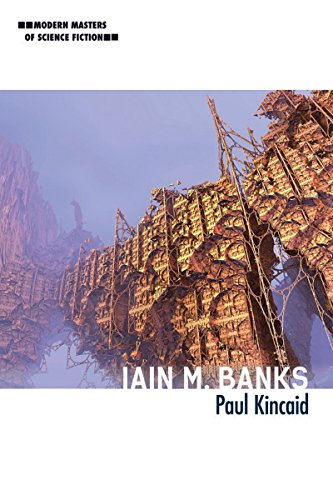
Paul Kincaid on Iain M. Banks

Amazon link

I bought this on the strength of Abigail Nussbaum's positive review. Russell Letson also has a review, which includes this:
"Kincaid outlines how the Culture was devised as a delib­erate counter to earlier (particularly American) space-adventure conventions that Banks saw as militarist and imperialist and infected with “gran­diose superhero thinking that has no place in the communal, socialistic approach that Banks takes in his fiction.”

He also argues for a break in that group of books – that the Culture sequence was essentially finished before the last three books (Matter, Surface Detail, and The Hydrogen Sonata, 2008-2012) were written – that the project was complete and that the later books represent a kind of retreading of old ground.

The job of the first set of Culture novels would seem to be to deconstruct not only the political notions behind traditional space opera, but also notions of utopia – to push at the contradictions in the Culture’s own view of itself. Excession, for example,
'is about presenting the Culture with barriers it is reluctant to cross…. We begin to get a picture of the Culture as a deeply conservative society, too attached to its comforts and plenty to be easy with the idea of risk or change…. we see that it is far less a utopia, far less perfect, than it likes to present itself.'
Like the Culture itself, Banks’s thinking about attempts to square the circle of power, freedom, and ethical behavior in an imperfect world results in unresolved contradictions."

I've read all of Iain Banks's science-fiction (I abandoned Feersum Endjinn) but I do find the novels curiously unmemorable. Partially this is to do with their complex structure, the large cast of characters with indecipherable names, and detailed and baroque settings which can overwhelm the storyline. Sometimes it's hard to see the wood for the trees.

The first great service Paul Kincaid offers in this impressive piece of literary criticism is to confirm these complexities and to summarise the novels for the floundering reader. More than this, Kincaid dives deep into each book's thematic unconscious, distilling what he believes to be motivating the author.

He does a pretty good job. Kincaid sees Banks as eternally wrestling with his ideal society. If utopia is post-scarcity communism where oppression is definitionally absent, then how do people spend their time? If the Culture is about freedom, how does it deal with cultures which don't share the Culture's value system?

Perhaps in Banks's earliest formulations, these seemed distant and rather easy problems to solve. Yet the more he engaged, the more problematic the Culture became. In the end, utopia seems smug, boring, shallow, selfish, cowardly - even imperialistic.

Banks was a smart guy but he was also a proud bien-pensant liberal, a world-view which is curiously unreflective of the true roots of its value-system. In that spirit, Banks never quite resolved the contradictions at the heart of his own philosophy.

This is a mature, comprehensive and above all interesting take on all of Iain Banks's work and it's recommended.

---

NextA Culture fit for dodos

Tuesday, November 14, 2017

"Why the Culture Wins" - Joseph Heath

A Culture Orbital
"Many years ago, a friend of mine who knows about these sorts of things handed me a book and said “Here, you have to read this.” It was a copy of Iain M. Banks’s Use of Weapons.

I glanced over the jacket copy. “What’s the Culture?” I asked.

“Well,” she said, “it’s kind of hard to explain.” She settled in for what looked to be a long conversation."
Thus starts this appreciation of Iain M. Banks by Joseph Heath, Professor in the Department of Philosophy at the University of Toronto. It's a long and interesting essay which for me flags The Culture as the literary expression of the culmination of neoliberalism (hedonistic individualism), not of the utopian-communism which Banks claimed for it.

Heath writes:
"This is in fact why Horza, the protagonist of Consider Phlebas, dislikes the Culture. The book is set during the Idiran-Culture war, and is unusual among the Culture novels in that its protagonist is fighting on the side of the Idirans, and therefore provides an outsider’s perspective on the Culture. The Idirans are presented as the archetype of an old-fashioned functional culture – their political structure is that of a religiously integrated, hierarchical, authoritarian empire.

The war between the Idirans and the Culture is peculiarly asymmetrical, since the Culture is not an empire, or even a “polity” in any traditional sense of the term, it is simply a culture. It has no capital city, or even any “territory” in the conventional sense.

(“During the war’s first phase, the Culture spent most of its time falling back from the rapidly expanding Idiran sphere, completing its war-production change-over and building up its fleet of warships… The Culture was able to use almost the entire galaxy to hide in. Its whole existence was mobile in essence; even Orbitals could be shifted, or simply abandoned, populations moved. The Idirans were religiously committed to taking and holding all they could; to maintaining frontiers, to securing planets and moons; above all, to keeping Idir safe, at any price.”)

Horza is not an Idiran, but rather one of the last surviving members of a doppelganger species. The question throughout the novel – and the question put to him, rather forcefully, by the Culture agent Perosteck Balveda – is why he is fighting on the Idiran side, given that they are, rather self-evidently, religious fanatics, with an exclusive and zealous conviction in the superiority of their own species.

(“It was clear to [the Idirans] from the start that their jihad to ‘calm, integrate and instruct’ these other species and bring them under the direct eye of their God had to continue and expand, or be meaningless.”)

The Culture, by contrast, is all about peaceful coexistence, tolerance and equality. So why would a member of an otherwise uninvolved third species choose the Idiran side?

The difference, for Horza, is that the Idirans, for all their flaws, have a certain depth, or seriousness, that is conspicuously lacking in the Culture. Their actions have meaning. To put it in philosophical terms, their lives are structured by what Charles Taylor refers to as “strong evaluation.”

(Indeed, the inability of the Culture to take the war that it is fighting seriously serves as one of the most consistent sources of entertainment in all the Culture novels, as reflected in ship names, which are generally tongue-in-cheek such as: What are the Civilian Applications? or the Thug-class Value Judgement, the Torturer-class Xenophobe, the Abominator-class Falling Outside the Normal Moral Constraints, etc.)

Consider Weber’s famous diagnosis of modernity, as producing “specialists without spirit, sensualists without heart.” In the Culture, the role of the specialist has been taken over by the AIs, leaving for humanity nothing but the role of “sensualists without heart.”

Thus the chief attraction of the Culture is the promise of non-stop partying and unlimited sex and drugs. (Genetic and surgical modification provide Culture members with the ability to make almost unlimited changes to their bodies, which typically include enhanced genitalia that allow them to experience intense, extended, and repeated orgasms, as well as the installation of specialized glands that produce a range of psychoactive chemicals, to dull pain, to produce euphoria, to remain awake, or to produce almost any other feeling that might seem desirable.)

One can see then why Horza might dislike the Culture. On the surface, his complaint is that they surrendered their humanity to machines. But what he really wants is a culture that can serve as a source of deeper meaning, which is the one thing that the Culture conspicuously fails to provide – on the contrary, it turns everything into a joke.

The Culture may be irresistible, but for essentially stupid reasons. (“Horza tried not to appear as scornful as he felt. Here we go again, he thought. He tried to count the number of times he’d had to listen to people – usually from third- or low fourth-level societies, usually fairly human-basic, and more often than not male – talking in hushed, enviously admiring tones about how It’s More Fun in the Culture… I suppose we’ll hear about those wonderful drug glands next, Horza thought.”)."

...

"There are a variety of developments that are associated with modernity. One of them involves a move away from ascribed toward achieved sources of identity. The idea is rather simple: in traditional societies, people were defined largely by the circumstances that they were born into, or their ascribed characteristics – who your family was, what “station” in life you were born to, what gender you were, etc. There were a strict set of roles that prescribed how each person in each set of circumstances was to act, and life consisted largely of acting out the prescribed role.

A modern society, by contrast, favours “choice” over “circumstances,” and indeed, considers it the height of injustice that people should be constrained or limited by their circumstances. Thus there is a move toward achieved sources of identity – what school you went to, what career you have chosen, who you decided to marry, and the lifestyle you adopt. “Getting to know someone,” in our society, involves asking them about the choices they have made in life, not the circumstances they were born into.

There are, of course, advantages and disadvantages to both arrangements. The advantages of choice, for people living in an achievement-oriented society, are too obvious to be worth enumerating. But there are disadvantages. Under the old system of ascribed statuses, people did not suffer from “identity crises,” and they did not need to spend the better part of their 20’s “finding themselves.”

When everything is chosen, however, then the basis upon which one can make a choice becomes eroded. There are no more fixed points, from which different options can be evaluated. This generates the crisis of meaning that Taylor associates with the decline of strong evaluation.

Human beings have spent much of their lives lamenting “the curse of Adam,” and yet work provides most people with their primary sense of meaning and achievement in life. So what happens when work disappears, turning everything into a hobby?

A hobby is fun. Many people spend a great deal of time trying to escape work, so they can spend more time on their hobbies. But while they may be fun, hobbies are also at some level always frivolous. They cannot give meaning to a life, precisely because they are optional. You could just stop doing it, and nothing would change, it would make no difference, which is to say, it wouldn’t matter.

Now consider the choices that people have in the Culture. You can be male or female, or anything in between (indeed, many Culture citizens alternate, and it’s considered slightly outré to be strongly gender-identified). You can live as long as you like. You can acquire any appearance, or any set of skills. You can alter your physiology or brain chemistry at will, learn anything you like.

Given all these options, how do you choose? More fundamentally, who are you? What is it that creates your identity, or that makes you distinctive? If we reflect upon our own lives, the significant choices we have made were all in important ways informed by the constraints we are subject to, the hand that we were dealt: our natural talents, our gender, the country that we were born in. Once the constraints are gone, what basis is there for choosing one path over another?"
The life of a robin in the garden, or a cat in front of the fire, is not bereft of meaning just because neither will ever master calculus.

Humanity has spent millennia .. continues to spend the millennia .. in transforming its environment to remove the obligation to labour for survival. Yet all our instincts, our motivations, are to do with our abilities to deal with existential challenges, to survive, succeed, find a mate, reproduce and have grandchildren.

Absent such challenges such drives, emotions and goals flail on air: great achievements are no longer existentially-motivated but merely discretionary. All actions reduce to the playing of games.

Perhaps we become no more than pets of the Culture Minds. Perhaps we'll alter our genomes so we'll enjoy that. Perhaps our future technology-womb won't be brittle.

So many 'perhaps's.

---

We do actually know what happens, biologically-speaking, when you take a species and move it into an utterly benign environment: step forward the Dodo.

Thursday, April 06, 2017

Neural lace

Elon Musk tweaks the technosphere again (from The Economist):
"Ever since ENIAC, the first computer that could be operated by a single person, began flashing its ring counters in 1946, human beings and calculating machines have been on a steady march towards tighter integration. Computers entered homes in the 1980s, then migrated onto laps, into pockets and around wrists. In the laboratory, computation has found its way onto molars and into eyeballs. The logical conclusion of all this is that computers will, one day, enter the brain.

"This, at least, is the bet behind a company called Neuralink, just started by Elon Musk, a serial technological entrepreneur. Information about Neuralink is sparse, but trademark filings state that it will make invasive devices for treating or diagnosing neurological ailments. Mr Musk clearly has bigger plans, though. He has often tweeted cryptic messages referring to “neural lace”, a science-fictional concept invented by Iain M. Banks, a novelist, that is, in essence, a machine interface woven into the brain. ..."
Neural lace was Iain M. Banks's technology as used by citizens in "the Culture" to 'telepathically' converse with Culture Minds, the AIs which actually ran their civilisation. In one novel, a Mind mentions matter-of-factly that no more exquisite torture device has ever been conceived of.

Anatoly Karlin, quoting Nick Bostrom, is profoundly skeptical:
"We do not need to plug a fiber optic cable into our brains in order to access the Internet. Not only can the human retina transmit data at an impressive rate of nearly 10 million bits per second, but it comes pre-packaged with a massive amount of dedicated wetware, the visual cortex, that is highly adapted to extracting meaning from this information torrent and to interfacing with other brain areas for further processing.

"Even if there were an easy way of pumping more information into our brains, the extra data inflow would do little to increase the rate at which we think and learn unless all the neural machinery necessary for making sense of the data were similarly upgraded. Since this includes almost all of the brain, what would really be needed is a “whole brain prosthesis–—which is just another way of saying artificial general intelligence.

"Yet if one had a human-level AI, one could dispense with neurosurgery: a computer might as well have a metal casing as one of bone."
This reminds me of all the ways experts tell you that something can't be done.

My vote goes with James P. Hogan, who in his excellent and seminal SF novel, "The Genesis Machine", described a brain-computer symbiosis delivering enhanced imagination/visualisation.

Amazon link

A system of equations would be projected onto an interior whiteboard in your mind. The computer would generate a VR-type solution space which you could navigate freely while discussing subtleties and points of interest with the accompanying AI system. It was, if you like, virtual reality in the head - the abstract rendered concrete.

And that is definitely going to happen.

Monday, June 10, 2013

Iain M. Banks

I was very saddened to hear that Iain Banks has died. I guess I should say Iain M. Banks, as I much preferred his science-fiction.


Depressingly, the BBC news report lauded Banks' work purely in terms of his non-SF titles: "The Wasp Factory", "The Crow Road" ('made into a television film'). Banks' enthusiastic, exuberant nature was always better expressed in his Culture novels, which became increasingly complex and baroque: there is not one where I can, off the top of my head, succinctly and accurately summarise the plot. Banks once said that "Use of Weapons" as originally conceived required the reader to think in 'six dimensions'. I believe he thought that careful rewriting had dimensionally-reduced the novel, but IMHO his entire Culture oeuvre resisted such compactification.

Wednesday, April 03, 2013

Iain Banks

Such a shock today to hear the news that Iain Banks has terminal cancer, and only months to live. He seems to be dealing with the situation competently, stoically, and with what dark humour is possible.

Perhaps we should send in our Culture question before it's too late: Iain, what actually happened to the Culture in the end?