Showing posts with label quantum field theory. Show all posts

Sunday, August 16, 2026

What Exactly Does a Quantum Field Operator Do?

What is Quantum Field Theory really about? And what does it tell us about reality? The only way to answer these questions is to go to the formalism itself - but that's really hard.

I already asked an earlier chatbot version to sketch out an answer, which I guess was pushing at the state-of-the-art back in October 2025. What a difference ten months makes!

So here is GPT-5.6 with this prompt: Is it possible to rewrite the original post incorporating the insights of this thread (our prior discussion this evening) and have the resulting text understandable by a good physics graduate (using sufficiently student-friendly explanatory text)?


What Exactly Does a Quantum Field Operator Do?

Quantum field theory is often introduced by saying that particles are “excitations of fields”. This is useful shorthand, but it conceals a conceptual problem. What sort of thing is a quantum field, mathematically? What does it take as input? What does it return? And at what point in the mathematics does anything resembling an actually observable electron appear?

One useful way of keeping the story straight is to keep track of the type signatures all the way through. The signatures tell us what kind of mathematical object is being supplied at each stage and what kind of object comes back. They also expose several places where ordinary QFT language slides rather casually from one ontological category to another.

1. Start with a classical field

A classical scalar field has the familiar form

φ : M → ℝ,

where M is a spacetime manifold. Give the field a spacetime point x,

x ∈ M,

and it returns a real number:

φ(x) ∈ ℝ.

The type signature is therefore completely straightforward:

spacetime point → field value.

This makes it tempting to imagine a quantum field in the same way, perhaps as

Φ : M → ℂ, (complex numbers)

so that each spacetime point carries some sort of quantum amplitude.

That is not what a quantum field is.

2. In QFT spacetime enters through a test function

We commonly write a quantum scalar field as Φ(x), where x is a spacetime point. But this notation is formal. Quantum fields are generally too singular to be ordinary operator-valued functions defined independently at every point.

The mathematically better object is an operator-valued distribution.

Instead of giving the field a single spacetime point, we give it a suitable test function f defined over spacetime and assigning real or complex numerical weights across a spacetime region:

f : M → ℂ.

More precisely, f belongs to some chosen space of test functions. For example,

f ∈ C∞c(M),

the smooth functions of compact support. One may instead use Schwartz functions, which are smooth and rapidly decreasing; a Gaussian belongs to that latter class.

The field is then smeared with f:

Φ(f) = ∫ d4x  f(x)Φ(x).

The crucial point is that spacetime has not disappeared from the type signature. It has moved one level down. The argument supplied to the quantum field is itself a function whose domain is spacetime.

So the quantum field has, schematically, the higher-order signature

Φ : (M → ℂ)test → {operators}.

Or, making the usual test-function space explicit,

Φ : C∞c(M) → {operators}.

This is already quite different from the classical case.

The classical field maps

spacetime point → number.

The quantum field maps

spacetime test function → operator.

3. What kind of operator?

Quantum states are represented by vectors in a Hilbert space H. Field operators are generally unbounded, so they are not literally defined on every vector in H. We therefore introduce a suitable dense domain

D ⊂ H.

Then, schematically,

Φ(f) : D → D,

or in some formulations D → H.

Combining the two stages gives the curried type signature

Φ : C∞c(M) → (D → D).

Since a test function is itself a spacetime function, we can display the same idea more explicitly as

Φ : (M → ℂ)test → (D → D).

This is perhaps the most revealing single type signature in the whole discussion.

Give the quantum field a spacetime test function f, and it gives you an operator:

f → Φ(f).

Give that operator a quantum state |Ψ⟩, and it gives you another quantum state:

|Ψ⟩ → Φ(f)|Ψ⟩.

So the complete curried chain is

f → Φ(f) → Φ(f)|Ψ⟩.

The equivalent uncurried form is

Φ̃ : C∞c(M) × D → D,

with

Φ̃(f, |Ψ⟩) = Φ(f)|Ψ⟩.

Nothing here has returned either an amplitude or an electron. The output is another state vector.

4. The familiar Φ(x) notation

Physicists nevertheless routinely write

Φ(x).

Here x is indeed a spacetime variable:

x = (t, x) ∈ M.

Formally this makes the field look as though it had the signature

Φ : M → (D → D).

That is a very useful mnemonic, but it is not the rigorous type. The pointwise object Φ(x) is distributional. The mathematically controlled object is the smeared operator Φ(f).

So one should mentally read

Φ(x)

as convenient notation for the spacetime dependence of an operator-valued distribution, not as an ordinary function which takes a spacetime point and returns a perfectly well-defined operator.

5. Where do creation and annihilation operators enter?

For a free scalar field, the same quantum field Φ introduced above can be decomposed formally into positive- and negative-frequency parts:

Φ(x) = Φ(+)(x) + Φ(−)(x).

Here Φ(+)(x) contains annihilation operators, while Φ(−)(x) contains creation operators. Schematically,

Φ(x) ∼ a + a†.

The creation and annihilation operators are therefore not different fields. They are components appearing in the mode expansion of the same free quantum field.

A creation operator has, again schematically, the signature

a† : D → D.

Applied to the vacuum,

a†|0⟩ = |1⟩.

Physicists naturally say that a† has “created a particle”. But look at the type signature. Its domain is D, and its codomain is also D, a suitable dense domain of state vectors in the Hilbert space.

It does not have the signature

D → {physical particles}.

The mathematical output is a state vector.

6. The electron field

The electron field is more complicated because it is a Dirac spinor field, but the same distinction applies.

Formally one writes a mode expansion of the form

ψ(x) ∼ a u e−ipx + b†v eipx,

Here u and v are Dirac spinors carrying the spinor structure of the electron and positron modes; a and b† are the operators acting on Fock space. Momentum and spin labels and normalisation factors have been suppressed.

Here a annihilates an electron mode, while b† creates a positron mode. The adjoint field contains the corresponding electron-creation operator a†.

Again the fundamental type structure is not

spacetime → electron.

It is closer to

ψ : (M → spinor)test → (D → D).

The details of spinor test-function spaces need not concern us here. What matters is the ontological sequence:

spacetime dependence → test function → operator → quantum state.

When an electron creation operator acts on the vacuum,

a†s(p)|0⟩ = |p,s; electron⟩,

the output is a state with the mass, charge, spin and momentum quantum numbers associated with an electron.

We call it a one-electron state.

But a one-electron state and an electron are not the same kind of thing. One is a vector in a mathematical state space. The other is what we take that vector to represent physically.

7. This is the first ontological jump

The innocent-looking sentence

“the operator creates an electron”

therefore compresses two claims.

The mathematical claim is:

|0⟩ → |one-electron state⟩.

The interpretative claim is:

this state represents a physical situation in which an electron exists.

The first follows from the formalism. The second connects the formalism to the world.

For routine calculations the distinction is harmless. For ontology it is crucial.

No operator encountered so far has electrons as elements of its codomain.

8. Where do complex amplitudes appear?

We now add another state, represented by a bra ⟨Χ|. Given an operator A and states |Ψ⟩ and |Χ⟩, we can form the matrix element

⟨Χ|A|Ψ⟩.

This time the output really is a complex number:

⟨Χ|A|Ψ⟩ ∈ ℂ.

Its type signature is therefore schematically

D* × (D → D) × D → ℂ.

Substituting a smeared field operator gives

(⟨Χ|, f, |Ψ⟩) → ⟨Χ|Φ(f)|Ψ⟩ ∈ ℂ.

So, if we curry everything, the journey can be displayed as

(M → ℂ)test → (D → D) → ℂ

once the initial and final states have also been supplied.

This is where amplitudes enter. They are not values of the quantum field at spacetime points. They arise after operators and states have been combined.

9. Correlation functions have the same lesson

Consider a two-point function:

⟨0|Φ(f)Φ(g)|0⟩.

Here we have supplied two spacetime test functions, obtained two operators, acted on the vacuum and finally paired the resulting state with the vacuum bra.

The type journey is roughly

(f,g) → (Φ(f),Φ(g)) → Φ(f)Φ(g)|0⟩ → ℂ.

The result is a complex-valued correlation.

Similarly, the familiar time-ordered expression

⟨0|T{Φ(x)Φ(y)}|0⟩

is the Feynman two-point function or propagator, again understood distributionally.

It is therefore misleading to think of the propagator as something that the field simply “has” at two points. It is the result of several layers of mathematical construction.

10. An amplitude is still not an observation

There is another ontological step to keep separate.

A complex number such as

⟨Χ|A|Ψ⟩

is not itself an observed event.

In a scattering calculation, suitable amplitudes are used, together with normalisation and phase-space factors, to calculate measurable cross-sections or decay rates.

More generally, a possible measurement outcome can be represented by an effect E. For a normalised state |Ψ⟩,

P(E) = ⟨Ψ|E|Ψ⟩.

Here P(E) is already a probability, a real number between 0 and 1, not a complex amplitude.

So the relevant type transition is

ℂ (amplitude) → [0,1] (probability) → actual event.

P(E) = ⟨Ψ|E|Ψ⟩.

The corresponding type is

(E, |Ψ⟩) → P(E) ∈ [0,1].

We have now moved from operators and state vectors to a real probability.

But even this probability is not the observed event.

It is a number predicted by the theory.

11. Where is the observable electron?

Suppose an electron reaches a detector.

The experiment may produce a charge pulse, an ionisation track, a bright pixel or a stored digital count. Those are physical events.

The QFT description may contain a prepared state, field operators, interaction Hamiltonians, amplitudes and probabilities. Schematically:

preparation → state → QFT dynamics → amplitude → probability.

Then, in the physical world,

a detector event occurs.

This final event is not an element of the Hilbert space, not an operator and not a complex number.

Nor did any function in the QFT formalism ever have the signature

F : something → {actual electrons}.

There is no electron-valued codomain.

This is the point at which the ontology becomes impossible to conceal beneath notation.

12. What, then, is a “one-electron state”?

A one-electron state is a state carrying the characteristic quantum numbers of the electron: its mass, electric charge, spin and momentum.

Within the theory we identify such states by their transformation properties and conserved quantum numbers.

So the mathematical classification

|Ψ⟩ ∈ {one-electron states}

is extremely precise.

The statement

“there is an electron”

is the physical interpretation placed upon such a state.

That interpretation is overwhelmingly successful experimentally. But it is still an interpretation relating one ontological category, a mathematical state, to another, a physical entity or event.

13. Interacting theories make the distinction sharper

The free-field picture can tempt us into thinking that particles are simply produced by applying creation operators (a vacuum state goes to a one-electron state, then to a two-electron state in distinct modes):

|0⟩ → a†|0⟩ → (a†)2|0⟩.

That picture is exact for free Fock space and enormously useful pedagogically.

But real electrons interact with the electromagnetic field. A physical electron is not simply the pristine state a†|0⟩ of a non-interacting Dirac theory. It is dressed by its electromagnetic interaction, and in QED the presence of massless photons makes the asymptotic particle story technically subtle.

Nevertheless, particle states remain extraordinarily effective in appropriate regimes, particularly in scattering experiments. The S-matrix and LSZ machinery connect local quantum fields to asymptotic particle states.

This suggests a reversal of the naïve textbook picture.

Instead of thinking

particles are primary and fields create and destroy them,

the formalism itself is better described as

local quantum fields generate relations between quantum states, from which particle descriptions emerge in appropriate regimes.

That is a statement about the structure of QFT, not a proof that fields are the ultimate furniture of reality.

14. The complete signature journey

We can now assemble the whole chain.

First comes spacetime, represented by a four-dimensional Lorentzian manifold M:

x ∈ M.

A test function is defined on spacetime:

f : M → ℂ.

The quantum field takes an admissible spacetime test function and returns an operator:

Φ : (M → ℂ)test → (D → D).

Supplying f gives

Φ(f) : D → D.

Supplying an initial state gives another state:

Φ(f)|Ψ⟩ ∈ D.

Supplying a final-state bra gives a complex matrix element:

⟨Χ|Φ(f)|Ψ⟩ ∈ ℂ.

A suitable measurement construction gives a probability:

P(E) ∈ [0,1].

And finally, outside the mathematical codomains of the theory, the laboratory produces an actual physical event.

The ontological journey is therefore:

spacetime → function on spacetime → operator → quantum state → amplitude → probability → observed event.

15. Keeping everything really clear

Keeping the signatures visible prevents several familiar but misleading identifications.

A quantum field is not a function from spacetime to complex amplitudes.

A field operator does not return a particle.

A creation operator does not have electrons in its codomain.

A one-electron state is not the same category of thing as a physical electron.

An amplitude is not an observation.

A probability is not the event whose probability it gives.

And a detector event is not a vector in Hilbert space.

QFT relates these different levels with extraordinary quantitative success. But the familiar phrase “the electron field creates an electron” compresses a long mathematical and interpretative journey:

spacetime localisation → operator → state → physical interpretation.

For calculation, the shorthand is harmless. For understanding what the theory is actually saying, the type signatures are really essential.


Monday, October 14, 2024

Math prerequisites for QFT


From https://plato.stanford.edu/archIves/sum2020/entries/quantum-field-theory/

ChatGPT tells me: to properly understand quantum field theory (QFT), you need a strong foundation in several advanced mathematical topics. Here's a comprehensive list:

1. Multivariate Calculus

Partial derivatives and multiple integrals are essential for understanding the dynamics of fields and their variations in space and time.

2. Calculus of Variations

Used to derive the equations of motion for fields (e.g., the Euler-Lagrange equations in field theory).

3. Linear Algebra

Essential for handling vector spaces, matrices, and transformations, particularly in the context of quantum states, operators, and symmetry transformations.

4. Differential Equations

Both ordinary and partial differential equations are fundamental for understanding the equations governing fields.

5. Complex Analysis

Vital for contour integrals, residue theory, and Green’s functions, which appear frequently in QFT calculations like propagators and Feynman diagrams.

6. Group Theory

Key to understanding the symmetries of physical systems, which is foundational in QFT. This includes:

     - Lie groups and Lie algebras (continuous symmetries)

     - Representation theory for handling particle behavior under symmetry transformations.

7. Topology

Important for understanding concepts like gauge fields, topological invariants, and instantons, which are key in advanced field theories.

8. Functional Analysis

Understanding Hilbert spaces, operators, and distributions is essential, especially for quantum mechanics and the extension to quantum fields.

9. Tensor Calculus

Necessary for understanding general relativity, but also useful in QFT for handling fields with multiple indices (e.g., spinors, gauge fields).

10. Differential Geometry

Particularly important in gauge theories (like quantum electrodynamics or quantum chromodynamics), where connections and curvature in fiber bundles describe interactions.

11. Fourier Analysis

Essential for transitioning between position and momentum space, which is frequently used in QFT calculations.

12. Measure Theory and Probability Theory

Understanding path integrals in QFT requires familiarity with measure theory, as these integrals generalize probability integrals over functions.

13. Algebraic Structures

Concepts like Clifford algebras, used to describe spinors, and Grassmann numbers, which are used in the path integral formulation for fermions.

14. Renormalization Group and Scaling Theory

The renormalization process requires understanding scaling, divergences, and the behavior of physical quantities at different energy scales.

15. Spectral Theory

Important for analyzing the spectrum of operators, which is relevant when discussing the energy levels of quantum fields.

---

Each of these topics contributes to different aspects of QFT, from the algebraic structure of symmetries to the analytic techniques needed to solve and interpret physical problems.


I studied topology, complex analysis and (partial) differential equations along with linear algebra and vector calculus in my undergraduate modules in maths and physics. I studied the calculus of variations (the Euler-Lagrange equations) in the first part of my maths MSc course which I dropped out of (pressure of work). So plainly I am a long way from the entry foyer to QFT comprehension. Indeed there are no royal roads to quantum field theory.

Friday, August 30, 2024

What is an Electron Really?

From ChatGPT

This summary, the result of a little prompt-dialogue between ChatGPT and myself, seems as good an account as any other, and is consistent with Matt Strassler's book, "Waves in an Impossible Sea" .


In the realm of classical physics, an electron is often conceived as a tiny, negatively charged particle orbiting the nucleus of an atom. However, modern physics, particularly Quantum Field Theory (QFT), offers a radically different perspective.

In QFT, an electron is not a point-like particle but rather a quantum excitation of an underlying entity known as the electron field. This field pervades all of space, and what we perceive as an electron is simply a localized disturbance or excitation within this field. This excitation carries certain properties—such as charge, spin, and mass—that we associate with the electron.

The electron's position is not definite until it is measured. Instead, the electron exists in a superposition of possible states, each corresponding to a different location. This superposition means that the electron doesn’t have a single, well-defined position but rather a range of probabilities (quantum amplitudes really) of being found in various locations.

When we incorporate the Many-Worlds Interpretation (MWI) of quantum mechanics, this notion takes on an even more intriguing aspect. According to the MWI, each possible position of the electron corresponds to a different “world” or branch of reality. 

In one world, the electron might be detected at a particular point, while in another world, it appears somewhere else. These different worlds coexist in a vast multiverse which constitutes reality, and the electron’s delocalization can be understood as it existing in multiple worlds simultaneously, with each world realizing a different outcome of its position. Note that in each specific world, the electron is still an 'excitation of the electron field', a 'wavicle' according to Strassler.

This is a difficult ontology to imagine or believe, but it's the best we can do today.

Friday, August 17, 2018

Relativistic Schrödinger equations

Amazon link

Note: some chapters of Robert Klauber's excellent book are downloadable for free.

---

In my intermittent progress through Robert Klauber's excellent "Student Friendly Quantum Field Theory" I'm currently working through the relativistic versions of the Schrödinger equation (prior to hitting QFT-proper).

These are indexed by spin. Schrödinger's non-relativistic equation which is the staple of introductory quantum mechanics courses, works for spin-1/2 fermions like the electron to which it is usually applied.

The most direct relativistic counterpart is Klein-Gordon, which Schrödinger considered first but couldn't make work for the hydrogen atom. This is because it actually applies to spin-0 particles (scalar bosons such as the Higgs particle).

The correct relativistic equation for the electron and other spin-1/2 fermions is named after Dirac, while vector bosons such as the photons (spin 1) have their own Proca equation.

So I was wondering if the spin-2 graviton has its own equation .. but then I recalled that quantum theory can't do gravity yet - see this.

Here's a convenient, semi-impenetrable table.


Tuesday, July 24, 2018

Quantum Gravity and the double-slit experiment

The backlog of books I wish I had already read continues to grow.

Amazon link

"Fields of Color explains Quantum Field Theory to a lay audience without equations. It shows how this overlooked and misunderstood theory resolves the weirdness of Quantum Mechanics and the paradoxes of Relativity. The third edition contains a new and simple solution to "the most controversial problem in physics today": the measurement problem." .. from the Amazon page.

Note (updated Friday 27th July 18): having now read this book I don't endorse it. It's simplistic, misleading and dumbed-down to the max. The author, who is an experimentalist, seems to believe that fundamental physics is best understood through a bluff, no-nonsense, concrete interpretation which in no important sense violates our everyday intuitions. Hard to reconcile with the maths (Hilbert space vs spacetime) .. the problematic ontology of operator-valued fields .. and so on. I accept that he believes what he says and that his intentions are good.

---

This post is about quantum gravity. Marginal Revolution  provided a link to this article: "a good explanation of why a theory of quantum gravity in particular is needed". The points made are not unfamiliar (see this superior post from Backreaction*) but the issue is at least somewhat clear.


 " ...you put a (preferably uncharged) test particle in the middle between the slits to see where the gravitational pull goes. If the gravitational field is quantized, then in half of the cases when the electron goes through the slit, the test particle will move left, in the other half of cases it would move right (it would also destroy the interference pattern). If the gravitational field is classical however, the test particle won’t move because it’s pulled equally to both sides. " (Backreaction).

Note that in the former case there's a measurement leading to a 'collapse of the electron wavefunction'.

Take the seemingly-related question: what is the electric field at a point 'at the screen' of an electron in a state of spatial superposition transiting the two slits? (Of course, we know that the electric field is quantised - the photon is the EM field quantum).

I don't recall this matter ever coming up in the usual QM discussion of the two slit experiment. Those are always concerned solely with the spatial trajectory of the electron itself.

It seems to me that this question can't be addressed within quantum mechanics, which assumes a classical electromagnetic field. Surely one must turn to quantum field theory? (See also this from Physics StackExchange). I don't have any top-level, hand-wavy intuitions about that, though. But the book above by Brooks might help.

Still, in QFT the fields are propagating within a fixed spacetime. When it comes to gravitation we're talking about the dynamic metrical structure of spacetime itself. That theory (quantum gravity) really isn't anchored down at all: the reality underpinning spacetime is utterly unlike the continuum of our naive intuitions.

---

* I had never studied the Schrödinger–Newton equation.

Monday, July 02, 2018

"The end of spacetime" - Nima Arkani-Hamed

Recently via Lubos Motl's blog.


"Nima Arkani-Hamed talks about the demise of spacetime, simplification in QFT, amplituhedrons which turn scattering amplitudes into high school geometry volumes, and other things."
Ideal if you have a spare ninety minutes 😏 .. . It's a public lecture, so not too technical.

Wednesday, November 29, 2017

Ed Witten speaks ...

Ed Witten is the foremost theoretical physicist alive today, although his introspective nature does not make great TV: consequently he's largely unknown to the general public.

Ed Witten (from Quanta magazine)

Peter Woit's recent post points towards an interview of Witten by Natalie Wolchover of Quanta magazine. Here is some of what Witten had to say:
"I tend to think that there isn’t a precise quantum description of space-time — except in the types of situations where we know that there is, such as in AdS space. I tend to think, otherwise, things are a little bit murkier than an exact quantum description. But I can’t say anything useful.

The other night I was reading an old essay by the 20th-century Princeton physicist John Wheeler. He was a visionary, certainly. If you take what he says literally, it’s hopelessly vague. And therefore, if I had read this essay when it came out 30 years ago, which I may have done, I would have rejected it as being so vague that you couldn’t work on it, even if he was on the right track."
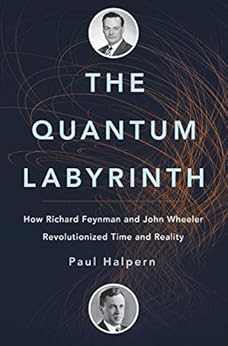
By synchronicity, I'm currently reading this (which I have also reviewed):

Amazon link

which is a biographical account of the tangled lives of John Wheeler and Richard Feynman. Wheeler was the visionary, the 'big picture' guy, while Feynman was the 'let's get down to the basics and do the calculations' artisan-theorist.

Somehow the whole was greater than the parts: birds and frogs.

Witten continues:
"I tend to assume that space-time and everything in it are in some sense emergent. By the way, you’ll certainly find that that’s what Wheeler expected in his essay. As you’ll read, he thought the continuum was wrong in both physics and math. He did not think one’s microscopic description of space-time should use a continuum of any kind — neither a continuum of space nor a continuum of time, nor even a continuum of real numbers.

On the space and time, I’m sympathetic to that. On the real numbers, I’ve got to plead ignorance or agnosticism."
The whole interview is Witten playing the role of Feynman to the shade of Wheeler.

---

Other posts on emergent spacetime: and here's Wheeler's essay (pdf) which Witten referenced - it is infuriatingly vague, written in Wheeler's characteristic mangled-syntax english.

Friday, January 15, 2016

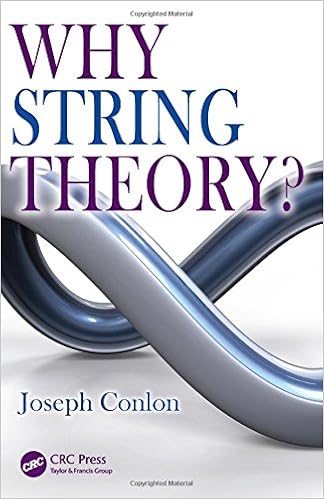
“Why String Theory?” by Joseph Conlon (review)

Amazon link: this review is also posted there

The title suggests that Joseph Conlon’s book is a defence of string theory against its detractors; it is so much more than that.

He begins by reviewing the strengths and limitations of the Standard Model. The Standard Model is a somewhat ramshackle construction which, to the surprise of its constructors, has proven extraordinarily successful and resilient over the decades, culminating in the recent discovery of the predicted Higgs boson at the LHC. We know, however, that the Standard Model is wrong because it assumes a fixed spacetime (i.e. no gravity) - it has proved impossible to successfully quantise gravity within the framework of the Standard Model.

Conlon’s approach is historical. The first inklings of string theory came about through attempts to understand the strong nuclear force in the 1970s, where string harmonics emerged mathematically from observed scattering patterns. It later transpired that the ‘strings’ were an epiphenomenon of the correct quantum field theory – quantum chromodynamics – where the force lines did indeed tend to bunch up into strings. The glory years of QFT saw string theory relegated to a backwater.

The end of the seventies saw attempts to quantise gravity under the assumptions of supersymmetry.  It turned out that these ‘supergravity’ theories had severe problems which string theory seemed to solve in a very natural way. Suddenly people began to take notice and the string community rapidly expanded. These were the years of five different string theories, and the realisation that they were all different limits of one underlying theory – M-theory - an insight due to Ed Witten.

The author reviews quantum field theories, string theory and the AdS/CFT correspondence in his characteristically clear way. But after all this work, is there any direct experimental evidence for string theory? Chapter 7 is very short, consisting of this one sentence: ‘There is no direct experimental evidence for string theory.’

Having got that out of the way, Conlon now explains how the complex and sophisticated toolkit of string theory has led to insights across physics. He discusses the use of string theory in facilitating calculations in quantum field theories in their strong coupling regime via the AdS/CFT correspondence; the modelling of heavy ion collisions; applications in mathematics (relating to ‘monstrous moonshine’); predictions of dark matter candidates such as axions; predictions of dark radiation resulting from the theory’s extra spatial dimensions; and of course the opportunity to model black hole microstates, entropy and spacetime topology changes in what is presumed to be string theory’s core competence, quantum gravity.

The author now moves on to mini-portraits of the main kinds of scientists he see in the community around him. We hear about the revolutionaries who wish to kick over the applecart (not so easy). We hear about the worker ants whose slogan is ‘Vorsprung durch Technik’ – those researchers who kick the can of science up the road with their calculations so that experimentation can progress - little chance of glory but employment prospects are good. Under ‘Stockholm or Bust’ we meet the model builders, those hoping to call nature right and get to Sweden – and those who game the system. There are the super-theorists, like Witten, members of the ‘Most Sublime Brahminate of Princeton’, and those who appreciate that ‘il faut cultiver notre jardin’ - who look for unfashionable areas which to their eyes show great promise and are able to deliver.

Conlon’s final two chapters address (in a fair and evenhanded manner) the well-known criticisms of string theory and provide rebuttals. He then explains why string theory remains so dominant in the field and hazards some guesses as to its future.

Understanding the state-of-the-art in fundamental physics is of course hard, the subject is inaccessible for most physicists let alone the broader community. Conlon writes (p. 198):
“Undergraduate physics is an unparalleled intellectual experience: it is a smorgasbord of the deepest and most powerful thoughts that have ever been thunk. You learn physics at a rate of a Nobel Prize a week, and the resulting frisson of the mind is at a level that is never experienced again. Four years takes you from Newtonian gravity through the laws of heat and energy, past Maxwell's synthesis of electromagnetism and into the laws of special and general relativity, from the basics of quantum mechanics to the Standard Model and quantum field theory. It is wonderful and magnificent.”
Sadly, beyond these well-explored paths there is the slog of the new, where progress slows to a crawl. In this book Professor Conlon has provided – as he promises in his preface - an astonishingly clear tour of modern physics. It is hard to think of a better, clearer or wittier review, and one which will be particularly useful to science undergraduates curious as to where their field is heading. School students who have done some reading around the subject (e.g. who have read books by Brian Greene) might also find this work of great value. It’s highly recommended.

Wednesday, October 14, 2015

Dry humour; periclone


Professor Susskind begins his lecture by stating that Quantum Field Theory can in principle predict all physical phenomena except gravity; however, in practice, the computations are too difficult except in the simplest cases. We can use QFT to explain the Hydrogen atom, he continues, but an atom such as Boron is way too complicated.

 And then, at one minute, he says dryly, "certainly studying human beings is well beyond the capacity of any quantum field theorist that I know."

 And no-one laughs.

---

In certain science-fiction plots, the villain keeps a clone of himself (it's always 'he') which is used to harvest spare parts for transplantation. Now we have pig-to-man transplants coming along, the best results will surely be to engineer the pig to express the same organ genetic markers as you yourself (the brain excepted - obviously!).

This tailored pig, so much like you, needs a generic name: I propose it be called a periclone (Greek prefix peri-), a word which now exists in English on Google for the first time.

When I mentioned this happy thought to my sister, she replied that I'd find it hard to use the gym equipment with trotters.

Wednesday, April 29, 2015

Classic pix: spot the murderer

More pictures from before this blog got started, back in 2005.

2005: Even then the author tried his family's patience

How am I getting on with my Christmas present, "Quantum Field Theory for the Gifted Amateur"? Thanks for asking. You see, QFT is like a big jigsaw puzzle where each of the pieces is itself pretty incomprehensible. You spend a long time delving into Lagrangians (that's a piece of the puzzle), quantum simple harmonic oscillators (another piece), calculus of variations and the Euler-Lagrange equation (another), and so on, without much sense of overall direction.

Gradually, the individual pieces themselves begin to make sense (you grasp enough of the trees to see the local wood) .. and with enough pieces under your belt, you can begin to assemble them to get a picture of QFT as an entirety. (Also see this interesting piece from Sean Carroll).

You see why the big picture of quantum field theory is so inaccessible. I'm about a third of the way through the book, currently looking at quantum (operator-valued) fields. It would be a pretty special amateur to get through the whole of this book, that's for sure.

Meanwhile, Clare is preparing a new hat for me, to update the one in the picture above. Seems to feature the letter 'D' ...

---

2004: working on a contract with Samsung

I was assigned to help Samsung with their bid into BT's 21st Century Network (their transition to a multi-media IP network). My task was to help them both with understanding BT's idiosyncratic ways and with the phrasing of the English response-text. As usual, on the last day we pulled an all-nighter. Young Samsung engineers were out for the count, lying on desks and flopped over chairs. I was busy till dawn when the Samsung VP approached me in surprise. "We were told that all you westerners were decadent; that you all went home at 5.30 at night. We were the ones who worked till we dropped!"

It was clear that that Samsung executive had never worked in consulting - nor experienced a Western corporate bid team in action!

---
One is en vacances, the other is an author with a penchant for murder (2004)

Click on the image to probe further ...

Tuesday, April 21, 2015

"Quirky Quantum Concepts" by Eric L. Michelsen

You've taken a first course in quantum mechanics. You know your way round Schrödinger’s equation, eigenstates and eigenvalues, and you've thoroughly explored the hydrogen atom. But deep down you’re confused.

You read about Schrödinger’s Cat and that you don’t see superpositions ‘in real life’ because of ‘decoherence’, but what’s that? Populist accounts talk airily about the 'leakage of phase information into the environment', but that sort of hand-waving hardly adds clarity. The technical literature discusses the exponential decay of off-diagonal terms in the density matrix ... but what’s physically going on?

You read about the various interpretations. Is the wave function part of reality? Is it just a subjective statement of the experimenter’s state of knowledge? So much ink discussing the significance of Schrödinger’s equation: and of course, that eponymous equation isn't even correct. The road to the truth about quantum mechanics must run through its relativistic cousin, quantum field theory. But what a chasm separates you, the student, from that towering intellectual achievement. No-one can explain in accessible terms what QFT is, the map of the territory. Saying baldly that 'at each point in space and time there are an infinite number of simple harmonic oscillator modes (with creation and annihilation operators) for each type of fundamental particle'  ... doesn't really do it for most people.

What you need is a book in which these concepts are discussed via simple models, mathematically clear but at a level accessible to people who've completed a first course in quantum mechanics at undergraduate level (and understood it). Eric Michelsen has admirably succeeded in this book, which is a natural successor to Gary Bowman’s Essential Quantum Mechanics. In both cases the texts are meant to be read alongside a traditional textbook, but focus on conceptual clarity – what is the maths really saying? – and a careful linkage with what’s observed in reality.

Quirky Quantum Concepts covers many other topics.  There are fine reviews of wave mechanics itself; scattering (barely touched on in most elementary classes); matrix mechanics and density matrices; angular momentum; and the QM treatment of multi-electron atoms. But for me the clear treatment of loss of coherence and the very introductory but rigorous and comprehensible guide to QED/QFT were the high points of this excellent book.

(Note: as a bonus, the PDF is available on the Internet. I bought the book not just through guilt – it’s easier to flip to and fro in hard copy).

Thursday, January 16, 2014

Quantum Field Theory - the big picture

Taken a first course in Quantum Theory and now interested in moving on to Quantum Field Theory?

Every QFT book you were ever recommended hits you like a suddenly-faced vertical cliff face after a no-more-than-vigorous scramble through those non-relativistic woods. You're used to solving the Schrödinger equation to: model the hydrogen atom; understand molecular binding forces; and chart the motion of (slow) particles in potential fields. Suddenly all that's swept away: you have weird new replacements for Schrödinger - the Klein-Gordon, Dirac and Proca equations .. and then jarringly you're into the alien landscape of Feynman diagrams, propagators and highly convoluted integrals.

Nowhere is the big picture ever explained. How does it all fit together?

At last a book which feels your pain:  "Student Friendly Quantum Field Theory - Basic Principles and Quantum Electrodynamics".
"With regard to phenomena, I recall wondering, as a student, why some of the fundamental things I studied in NRQM (non-relativistic quantum mechanics) seemed to disappear in QFT. One of these was bound state phenomena, such as the hydrogen atom. None of the introductory QFT texts I looked at even mentioned, let alone treated, it. It turns out that QFT can, indeed, handle bound states, but elementary courses typically don’t go there. Neither will we, as time is precious, and other areas of study will turn out to be more fruitful. Those other areas comprise scattering (including inelastic scattering where particles transmute types), deducing particular experimental results, and vacuum energy.

"I also once wondered why spherical solutions to the wave equations are not studied, as they play a big role in NRQM, in both scattering and bound state calculations. It turns out that scattering calculations in QFT can be obtained to high accuracy with the simpler plane wave solutions. So, for most applications in QFT, they suffice.

"Wave packets, as well, can seem nowhere to be found in QFT. Like the other things mentioned, they too can be incorporated into the theory, but simple sinusoids (of complex numbers) serve us well in almost all applications. So, wave packets, too, are generally ignored in introductory (and most advanced) courses.

Wave function collapse, a topic of focus in NRQM, is generally not a topic of focus in QFT texts. It does, however, play a key, commonly hidden role, which is discussed herein in Sects. 7.4.3 and 7.4.4, pgs. 196-197. "
And here is how the book begins - from chapter 1 (PDF):
"Before starting on any journey, thoughtful people study a map of where they will be going. This allows them to maintain their bearings as they progress, and not get lost en route. This chapter is like such a map, a schematic overview of the terrain of quantum field theory (QFT) without the complication of details. You, the student, can get a feeling for the theory, and be somewhat at home with it, even before delving into the “nitty-gritty” mathematics. Hopefully, this will allow you to keep sight of the “big picture”, and minimize confusion, as you make your way, step-by-step, through this book."

Best of all, the first three chapters (and a few more) are free and online (available here).

Thanks, Robert D. Klauber!