Showing posts with label Freud. Show all posts

Monday, November 23, 2020

“The Magus” - John Fowles: a Jungian odyssey


Amazon link

---

I think I always had the wrong idea about John Fowles, that he was some kind of middle-brow airport writer. Wasn’t “The French Lieutenant’s Woman” just a version of “The English Patient”?

It pains me to expose my ignorance thus. “The Magus” is wonderful. Its protagonist is me when I was Nicholas’s age: in my mid-twenties, smart, insensitive, needy for girls, utterly self-centred, operationally, if not psychologically, selfish.

And Alison was the girl I was unknowingly looking for, while being all-too-ready to diss her and drive her away. Hyper-logical Nicholas, as one reviewer describes him, understands neither himself nor others. He's a slave to his own dominant drives for knowledge and power, the latter being an overriding desire for autonomy of the self. In short he's a quintessential INTP.

Here is Michelle’s synopsis:

“Nicholas Urfe is a not-very-good schoolteacher with romantic ideas of himself as a solitary heart and poet. (Really, he’s kind of a womanizing bastard.) He accepts a teaching job on a breathtaking but isolated Greek Island and meets Maurice Conchis, an eccentric, wealthy man who interacts with few outsiders. Conchis tells Nicholas stories of the past, weaving reality and fiction while claiming powers verging on the supernatural. When Conchis reveals a beautiful young woman staying with him – claiming she is a ghost – Nicholas’s infatuation draws him into Conchis’s mysteries and deceits.”

Fowles was deeply drawn to Jung (there’s a Freudian analysis of Nicholas at the end, woundingly accurate) and I read the ‘GodGame’ as an extended type-developmental schedule in which Nicholas is forced deeper inside himself, past his dominant Introverted Thinking function to seek his shadow: Extraverted Feeling. Only then can he actually engage with his own feelings and lay a foundation for genuine, reciprocal, kindly relationships. Think Ursula Le Guin's Earthsea.

And Fowles tells us - obliquely - that in the end this is what happens.

---

The book is not kind to the sensibilities of the Woke. Nicholas is an unpleasant, fairly insufferable human being (as was I, and many of us in our twenties). It’s an old fallacy to beat up on the author for portraying human rather than ideal characters.

This is a large, complex novel which speaks to NTs, and NFs - who will be offended, and will bore to shreds those of a Sensing disposition.

I have been thinking about it for days now, and have added more from Fowles to my stack as well as his inspiration, “The Lost Estate (Le Grand Meaulnes)” by Henri Alain-Fournier (Author), Adam Gopnik (translator).

Fowles died in 2005.

Sunday, May 07, 2017

Sigfrid von Shrink

The material below expands on some ideas from my most recent post.

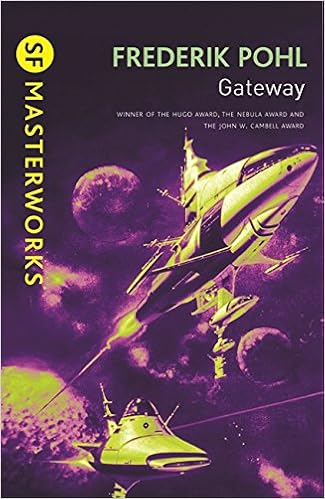
Amazon link

From Wikipedia:
"Gateway is a space station built into a hollow asteroid constructed by the Heechee, a long-vanished alien race. Humans have had limited success understanding Heechee technology found there and elsewhere in the solar system. The Gateway Corporation administers the asteroid on behalf of the governments of the United States, the Soviet Union, New People's Asia, the Venusian Confederation, and the United States of Brazil.

"There are nearly a thousand small, abandoned starships at Gateway. By extremely dangerous trial and error, humans learn how to operate the ships. The controls for selecting a destination have been identified, but nobody knows where a particular setting will take the ship or how long the trip will last; starvation is a danger. Attempts at reverse engineering to find out how they work have ended only in disaster, as has changing the settings in mid-flight. Most settings lead to useless or lethal places.

"A few, however, result in the discovery of Heechee artifacts and habitable planets, making the passengers (and the Gateway Corporation) wealthy. The vessels come in three standard sizes, which can hold a maximum of one, three, or five people, filled with equipment and hopefully enough food for the trip. Some "threes" and many "fives" are armored. Each ship includes a lander to visit a planet or other object if one is found.

"Despite the risks, many people on impoverished, overcrowded, starving Earth hope to go to Gateway. Robinette Stetley Broadhead—known as Robin, Rob, Robbie, or Bob, depending on circumstances and his state of mind—is a young food shale miner on Earth who wins a lottery, giving him just enough money to purchase a one-way ticket to Gateway. ...

" ... once back on Earth as a wealthy man he seeks therapy from an artificial intelligence Freudian therapist program which he names Sigfrid von Shrink."
Sigfrid von Shrink is an astonishingly insightful chatbot-psychotherapist.

In the spirit of 1977, Sigfrid is a timeshared program running on a mainframe.

Sigfrid: when AI was programmed in Fortran .. or BASIC?!

Robin, deeply traumatised and held on a floormat by restraining tapes, is instrumented to the gills for Sigfrid's benefit. The program fires (Freudian) model-based questions, trying to penetrate evasions and projections, forcing him to confront his unnameable terrors.

What a gulf between Sigfrid and Eliza!

---

What would we need, to build such a useful program in real life?
  • General conversation capability anchored by a sense of shared aboutness 
  • Real-world knowledge and psychotherapeutic task competence
  • Conversation-steering abilities.

If the world's AI companies can crack the long-duration contentful-conversation chatbot, Sigfrid is only a further small stretch. And given psychotherapeutic effectiveness in conditions as disparate as schizophrenia and PTSD, such an enormous social gain.

My guess? At least a decade, but not much more.

---

I first heard about Gateway in the early 1980s, when I was working at Standard Telecommunication Laboratories, one of ITT's five worldwide labs. An ITT colleague working in HCI recommended the novel, saying it had the best description of an ideal human computer interface he had ever encountered.
"But is the story any good?" I asked.

"It's not bad," came the answer, damning with faint praise.
Actually, Gateway is excellent, as suggested by this review.

Thursday, May 30, 2013

"Force of Nature" and the MBTI

Back in 2002 I was learning about the Myers-Briggs Type Indicator.  I asked psychotherapist Dee Ann whether there were any attributes of personality which were not captured by it. She replied that pathologies (such as schizophrenia) were outside the scope. But in fact the limitations of personality classification schemes arise in quite ordinary circumstances.

Compare person A who is widely seen as a "force of nature" with person B who is polite, civilized and restrained to a fault. In Freudian terms we can say the first person has an ego strongly dominated by the id with relatively weak superego control. For person B it's the reverse. Interestingly, A thinks B is inauthentic and over-compliant;  B thinks A is impulsive and under-controlled.

In more modern language,  we talk about subconscious drives emanating from the limbic regions of the brain and cortical regulatory inhibition.

The Myers-Briggs Type Indicator does say something about the interaction between subconscious/id, ego and superego;  it's framed as the contrast between the persona and the shadow.  The paradigm is not, however,  that of Myers-Briggs type distinction per se but the breakdown of the normal typological presentation of self mediated by fatigue, stress and the like.

Note: Adrian Raine's book 'The Anatomy of Violence' is extremely informative about the connection between brain functioning and behaviour (and not just criminal behaviour).