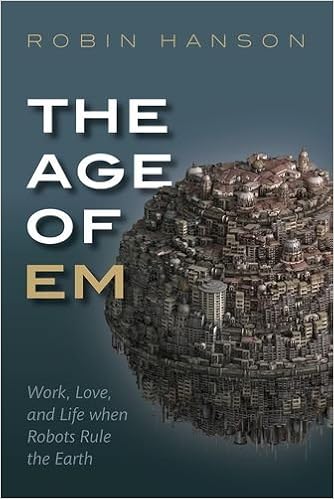
A certain amount of excitement in the
George Mason University sector of the Internet on Robin Hanson's upcoming book, "
The Age of Em: Work, Love and Life when Robots Rule the Earth", due out in April 2016.
According to the Amazon blurb:
"Robots may one day rule the world, but what is a robot-ruled Earth like?
Many think the first truly smart robots will be brain emulations or "ems". Scan a human brain, then run a model with the same connections on a fast computer, and you have a robot brain, but recognizably human.
Train an em to do some job and copy it a million times: an army of workers is at your disposal. When they can be made cheaply, within perhaps a century, ems will displace humans in most jobs. In this new economic era, the world economy may double in size every few weeks.
Some say we can't know the future, especially following such a disruptive new technology, but Professor Robin Hanson sets out to prove them wrong. Applying decades of expertise in physics, computer science, and economics, he uses standard theories to paint a detailed picture of a world dominated by ems.
While human lives don't change greatly in the em era, em lives are as different from ours as our lives are from those of our farmer and forager ancestors. Ems make us question common assumptions of moral progress, because they reject many of the values we hold dear.
Read about em mind speeds, body sizes, job training and career paths, energy use and cooling infrastructure, virtual reality, aging and retirement, death and immortality, security, wealth inequality, religion, teleportation, identity, cities, politics, law, war, status, friendship and love.
This book shows you just how strange your descendants may be, though ems are no stranger than we would appear to our ancestors. To most ems, it seems good to be an em."
Professor Hanson has recently written a preview article of unrestrained optimism entitled "
The "Em" Economy: Imagine a future dominated by brain emulation robots" where he explains:
"If brain-emulation-based robots, built via a computational reproduction of human brain connections, come to dominate the world economy, that economy will grow far faster than today. Driven by abundance of labour resulting in higher returns to capital and lower commuting costs, most of this activity will be concentrated in a few dense cities."
For several years now, I have opportunistically applied standard theories from economics, physics, computer engineering, and many other fields to study the new ways of life that would appear in an em era. I have found, for example, that once the cost to rent an em is substantially less than human subsistence wages, ems quickly dominate the economy. Humans are mostly forced to retire, but live comfortably off of em-economy investments.
I'm sure those 'humans' will be
delighted to be expelled from the workforce - at
every level of skill.
The article continues:
" ... sometime in the next century we’ll see a sudden transition. In less than a decade the world economy would will start doubling every month or faster, and ways of life will change dramatically.
There’s a decent chance that such a new era will result from the arrival of robots as smart as humans. In particular, such robots might be created as “brain emulations,” i.e., from taking a particular human brain, scanning it to record its particular cell features and connections, and then building a computer model that processes signals according to those same features and connections.
A good enough emulation, or “em” as I call it, has close to the same overall input-output signal behavior as its original human. An em thinks and feels like a human. One might talk with it, and convince it to do useful jobs. It can be happy or sad, eager or tired, fearful or hopeful, proud or shamed, creative or derivative, compassionate or cold. An em can learn, and have friends, lovers, bosses, and colleagues."
Nowhere in the piece does Professor Hanson acknowledge that the "ems" might have some
issues working as slaves for the human overlords. I guess there might be one or two other ethical questions too, along the way.
In any event, how likely is any of this stuff? On your behalf I ploughed through this c. 100 page report:
"Whole Brain Emulation - A Roadmap"
from Anders Sandberg and Nick Bostrom of the
Future of Humanity Institute at Oxford University, published in 2008 (there's a shorter paper
here). They concluded (p. 81) that:
"It appears feasible within the foreseeable future to store the full connectivity or even multistate compartment models of all neurons in the brain within the working memory of a large computing system.
Achieving the performance needed for real‐time emulation appears to be a more serious computational problem. However, the uncertainties in this estimate are also larger since it depends on the currently unknown number of required states, the computational complexity of updating them (which may be amenable to drastic improvements if algorithmic shortcuts can be found), the presumed limitation of computer hardware improvements to a Moore’s law growth rate, and the interplay between improving processors and improving parallelism.
A rough conclusion would nevertheless be that if electrophysiological models are enough, full human brain emulations should be possible before mid‐century. Animal models of simple mammals would be possible one to two decades before this."
I suggest that breath-holding is inadvisable .. but I'll probably still read Hanson's book.