Showing posts with label Watson. Show all posts

Friday, November 25, 2016

"My chat bot found my wallet" - Adrian Zumbrunnen

When you turn your website into a chatbot ...


"It was a Saturday afternoon. I met up with a friend to enjoy the occasional good weather by the lake. It was a day void of serious topics or stress. Life is good, I thought to myself.

I headed home after a few drinks to prepare for an upcoming trip. The smile on my face soon vanished when I realized that my pockets felt awfully empty. I braced myself. Three seconds later, I panicked. Where was my wallet?!

My credit card, my ID and personal stuff was in there. I felt like ****.

After calling my card issuer to block my credit card, I waited for the confirmation email to breath some sigh of relief. But to my surprise, there was a much more delightful message waiting for me right there… It was an email from my conversational website:

Title: Chat bot message
Content: I found your wallet by the lake.

Wow! I only lost my wallet 30 minutes earlier and I had already gotten an email. That’s technology working its magic right there!

I answered as fast as I could. The other person sent me his number and we met later that same day. As he was kindly handing me back my wallet, I asked:

“Thanks so much! By the way, I’m just wondering… How did you get in touch with me?”

He looked at me slightly confused and says…

“What do you mean… We had a chat, no?”

That’s when it hit me. This guy thought he was having a real conversation with me on my website."
It's an interesting story, but if you access Adrian's site you will find it hard to imagine you're talking to him (picture above). (Try it).

Adrian provides you with little 'suggestion' buttons to avoid uncontrolled natural language input. This is current best practice, but it makes the experience not dissimilar to filling in a form.

---

Last night I tried the new Thomson Holidays chatbot (powered by IBM's Watson). It fell apart on the second dialogue input. Admittedly it's in beta. (Try it).

Feigenbaum's old AI adage, 'in the knowledge lies the power', holds good for chatbots. The system needs to know an awful lot of dialogue flows to create the illusion of conversation. This makes building chatbots labour-intensive (for machine-learning, you need big pre-recorded conversation datasets).

I have neither, which has demotivated me from experiments with Pandorabots. That, and its simple-minded stimulus-response architecture.

Checked on Replika a couple of days ago which I have signed up to. The iPhone version will be out soon but the Android app is pushed back to 2017. The training method is Q&A via SMS: people are sending 40-50 texts per day to train their replikas. Like I said: labour intensive.

---

You and I know that conversation isn't simply statistically-correlated sequences of 'he says', 'she says'. It's about something. Until the meaning of conversations (data structures representing external environment and internal attitudes) is part of the architecture, chatbot conversations will continue to fall off the rails without any warning.

You can see why capturing knowledge of the real world (and of the human psychological world) is difficult for a paradigm which mostly throws ever more ingenious massively-parallel weight-learning at truly enormous datasets.*

---

* Huge parallel with self-driving cars. Humans drive .. which obscures the fact that driving is many distinct activities, not just one. A relatively closed system like motorway travel in good weather conditions sharply contrasts with the horribly open system of urban driving with complex traffic patterns and uncontrolled pedestrians in bad weather.

Tuesday, December 22, 2015

The Christmas Badger and other stories

Remember all those badgers we saw in our garden earlier this year? I really thought the badgers were gone, driven out by culling and teams of tooled-up Hedgehogs looking for payback.

And then, two days ago, this.


---

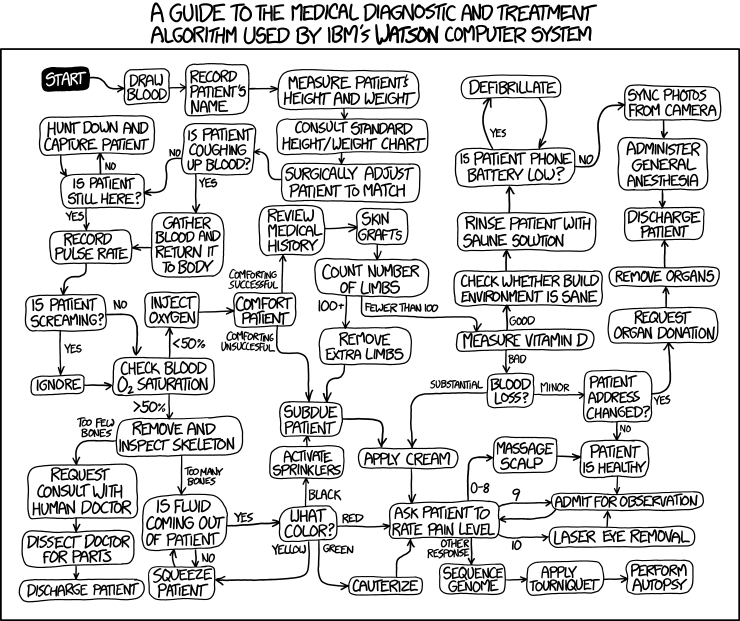
Amidst all the hype about the second coming of Deep Learning AI propelled by Google, Facebook, Baidu, IBM and Microsoft, Randall Munroe at xkcd nails it.


You can point your multi-tiered artificial neural net at vast datasets too large to imagine .. your system can induce optimal concepts to its heart's content on zillions of parallel graphics chips .. and still it will have no common sense.

Please, people, do not trust your life to our new AI overlords!

---

We have Alex staying with us. Last night we ran the BBC Proms programme (stashed way too long on our Sky Box hard drive) featuring Sir András Schiff playing the Goldberg Variations. Seventy five minutes of virtuoso technique and total commitment.

Alex complained of 'lack of musicality' at intervals, to the alleged advantage of Glenn Gould.


Today we reverted to type at M&S Frome where we stocked up on Christmas goodies.

Alex and Clare: the profiterole mountain is yet to come ..
Not long now!

Wednesday, March 11, 2015

<A|Q> = <A|I> <I|Q>

The title is a bit of a joke (don't ask) and even vaguely relevant to the subject of this post, which is the utility of artificial intelligence in thinking about hard stuff like IQ, human intelligence and even consciousness. This thought is not remotely original: Daniel Dennett was writing decades ago that AI and cognitive science would revolutionise traditional Philosophy of Mind topics such as free will, the existence of other people ('other minds'), and the nature of intentionality and agency.

It's a stretch to get from neuronal sludge to introspection. Into that gap flow ideas like 'the soul', philosophical dualism and 'the ghost in the machine'. Once you have a passing acquaintance with the architecture of theorem provers, AI planners and robotic control systems, a lot of things which previously seemed to defy a scientific, materialist explanation suddenly seem .. kinda obvious.

AI systems typically use deduction and/or abduction. Deduction lets you plan your way, despite obstacles, from a starting situation to a goal. The paradigmatic example must be the satnav, although we used to quote chess playing programs. The less familiar abduction looks for a conceptual framework which would economically account for the data under consideration, and which would allow a novel problem to be solved (typically by then applying deduction). We call these learning systems and it's the new hot topic in AI. A good example of such a system might be IBM's Watson.

A while ago I wrote about the Gossip Cat concept: an AI 'toy' which could be a companion to the young or old. It seems that Watson is going to add some value here: the dinosaur toy in the video below is powered by Watson in 'the Cloud'.


(The dialogue model has got to stop aping Wikipedia though. The point is to chat!)

Yes, the dialogue is processed by an AI system - IBM's Watson - in the Cloud. This means that everything spoken in the room is sent off to IBM's servers (somewhere in the States, I imagine) to be interpreted. Has anyone thought at all about the privacy implications of this? Apart from the police and intelligence agencies, obviously.

So then I had a further thought. The toy has been placed in the suspect's household ...  'Watson in the Cloud' is surreptitiously taken offline and a spook-interrogator takes over:

"Tell me Luke, what time is Daddy coming home tonight ... ?"

However ... there's lots of our most precious stuff already in the Cloud: our bank accounts, our savings, ... DropBox. I don't think these privacy issues are the kiss of death per se; what we need are sufficient trust relationships for this novel form of Cloud-based surveillance - it's the unpredictability and 'always-on' character of real-time conversation which presents the challenge.

Friday, January 10, 2014

Kevin Pietersen: the Sherlock of English cricket

Simon Barnes has an excellent article in The Times today, one with resonance for anyone who has ever worked with unreasonable but highly-effective people.
"It’s a shame that Sherlock, the television show, changed from a brilliant and thrilling adventure based on the utterly exceptional qualities of its main character into a self-indulgent and self-referential soap-opera-cum-comedy based on one rather crude characterisation."
Yes, I noticed that too.
"It is an equal shame that precisely the same thing has happened with the England cricket team. The Kevin Pietersen story once again dominates the plot-lines of English cricket. Like Sherlock, it is a drama centred on a uniquely talented individual with questionable social skills.

"In the first half of the most recent episode, someone describes Sherlock to his face as a psychopath. He contradicts, not without smugness: “No. High-functioning sociopath.”

"Well, let’s not stick labels on people. Leave that to those qualified. An “anti-social personality disorder” often includes such traits as small regard for the feelings and welfare of others, inability to learn from experience, no sense of responsibility, lack of moral sense, no change after punishment, lack of guilt, pathological egocentricity and inability to love.

"Pietersen’s perpetually sticky relationships with his cricketing colleagues unquestionably go personality-deep. With my level of expertise I think we can confidently describe him as a high-functioning awkward bugger. And it has been widely reported that his relationship with Andy Flower, the England team director, has broken down disastrously.

"It has even been suggested that Flower will not carry on if Pietersen remains on board. Another version states that Pietersen can stay on board so long as he devotes himself to scoring runs in county cricket at the beginning of the new season, instead of playing in the IPL. Kev can stay, but it’ll cost him getting on for a million quid.

"Flower was a great coach for England until the trip to Australia this winter spoilt his record. His greatest achievements? Defeat of Australia in Australia in 2010-11 and defeat of India in India from one-down in 2012. How did these things come about?

"In Adelaide in 2010, Pietersen changed the series with an innings of murderous certainty in which he scored 227. In Mumbai two years later, England were batting on a turning pitch tailored for India’s needs; Pietersen scored 186, another classic momentum-shifter.

"Flower, like all coaches, is essentially Watson. Coaches, even if they preen like José Mourinho, are at base facilitators, enablers and sounding boards. They don’t solve the case: they are just helping out as best they can.

"Cases are actually solved by the Sherlocks: the high-functioning ones. It was Pietersen, not Flower, who solved The Case of the Prematurely Celebrating Australians and The Case of the Indians Hoist With Their Own Petard.

"We would all sooner deal with Watson, we’d sooner have a drink or a cup of tea with Watson and we save most of our sympathies for Watson, who is always in a perfectly intolerable situation. But if we want to solve the case, we need Sherlock.

..."
The brutally-effective people I knew in business were more Steve Jobs than Sherlock. People who would call you at any hour of the day or night and calmly task you with impossible deadlines; give you jobs and then let slip that they had also asked some other people who had already delivered - so your efforts had been simply wasted (not that they cared or anything, or had bothered to mention this); people who, as peers, simply ignored your existence, wouldn't return calls or attend meetings. People who routinely shouted at people.

It was tough working for or with these people: the only protection was to be an acolyte, tolerated in some subservient role at their court - not being a posse person, I was never very keen nor good at that. The safest place to be was one or two management levels above them, where their destructive effectiveness could be leveraged in fulfillment of one's own higher-level goals. Every successful executive needs an enforcer or troubleshooter.

The choice is not solely between Sherlock or Watson. There are other kinds of talents which work in business and in the world - skills less abrasive which still add value. But we all have our Watson moments as we wonder how much punishment our pleasant, collegial organisation can or should take before we spit this person out. It's actually a genuine dilemma.

Further Reading

Bertrand Russell.
"Natural Killers" in the US Army by Major David S. Pierson.