Showing posts with label Particle Accelerator. Show all posts

Wednesday, November 25, 2015

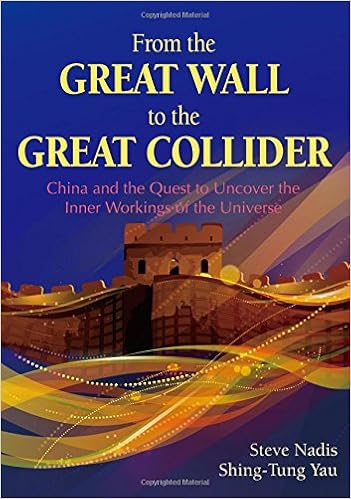
"From the Great Wall to the Great Collider"


Authored by Steve Nadis and Shing-Tung Yau, this book is a disappointment. It has clearly been written as a lobbying pamphlet for the successor to the Large Hadron Collider, directed at opinion-formers in the Chinese government. While there is nothing wrong with that, it does make for a somewhat indigestible read for a general audience.

Chapter 1 gives a potted history of particle physics starting with J. J. Thomson's discovery of the electron and continuing to the present. This is familiar stuff, albeit with an emphasis on the (very important) contributions made by Chinese physicists.

Chapter 2 is particle-accelerator-centric as we move into the search for the Higgs boson; explanations are layman-oriented and familiar.

The justification for the next big accelerator has to be new physics. In chapter 3 the candidates are discussed: the search for supersymmetric particles; deeper analysis of properties of the Higgs particle(s); the potential discovery of dark matter; extra dimensions. This chapter is the best in the book, written with some enthusiasm.

Chapter 4 ('China on Center Stage') is a review of current Chinese experimental high-energy physics and is plainly making the case for further Chinese government investment - an argument continued in chapter 5 which lobbies for a *big* collider (100 TeV collisions and 100 km circumference).

The final chapter itemises all the spinoffs from such a large, complex project: high-technology jobs, international cooperation, national prestige, high-speed computing, storage and communications, superconducting magnets, advanced instrumentation and so on.

In summary, this is a worthy book, let down by its bland and deadening prose style. It is, of course, somewhat interesting to read a high-level summary of the case for the 'next' LHC but in terms of the physics there are many, many popular books out there which do a better job of explaining the state-of-the-art and where it might be going.

Luboš Motl has a somewhat more enthusiastic review on his blog, published on October 26, 2015.

Sunday, November 01, 2015

China will build the next LHC; the HBP is a disaster

From Science Alert Oct 30th 2015:
"China has announced that it will begin construction of the world's largest particle collider in 2020. According to officials, the subterranean facility will be at least twice the size of the Large Hadron Collider (LHC) in Switzerland, and will endeavour to find out more about the mysterious Higgs boson.

"The final concept design won't be completed until the end of next year, so we don't have many details to go on, but the collider is expected to smash protons and electrons together at seven times the energy levels of the LHC, generating millions of Higgs bosons in the process. Best of all, the facility will reportedly be available to the entire global scientific community. "
The Great Collider

There's a book on this (below) due for release shortly (author Steve Nadis writes about the project here); Luboš Motl reviews the book here.


Jess Riedel is not so impressed,
"I think this is a bad development for physics because I am pessimistic about particle accelerators telling us something truly deep and novel about the universe, at least in the next century. Particle physics is a perfect-storm specialty in the sense that it can absorb unlimited amounts of money and physics talent while yielding arbitrarily slow progress on the important questions. If there are tens of billions of dollars flowing into these machines, innumerable physicists will continue to pour their youth into them for extremely incremental results."
but even in terms of spin-offs (computing and communications, high-tech manufacture, magnet and superconducting technologies, general physics education and culture) this has to be a winner for China. Assuming it finally gets the OK from the Politburo.

---

I'm inclined to be impressed by China's big science. Less so on the record of the European Union.
"In 2013 the European Commission awarded neuroscientist Henry Markram $1.3 billion to pursue an audacious goal: building a simulation of the human brain. Markram's initiative, the Human Brain Project (HBP), is now in disarray. Critics blame HBP management and the project's unreasonably ambitious goals. Yet plenty of blame for the HBP's woes rests with the project's funders in Brussels, who put politics ahead of science and exercised poor oversight."

(Scientific American article here).
So we now have this amusing, impassioned and sweary rant about the project which carries a deep ring of truth. In this area, at least, it appears that no-one knows anything.