Showing posts with label Great Collider. Show all posts

Wednesday, November 25, 2015

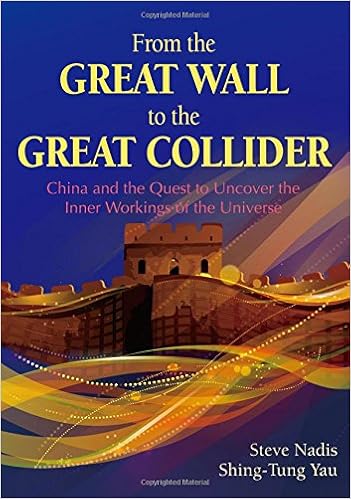
"From the Great Wall to the Great Collider"


Authored by Steve Nadis and Shing-Tung Yau, this book is a disappointment. It has clearly been written as a lobbying pamphlet for the successor to the Large Hadron Collider, directed at opinion-formers in the Chinese government. While there is nothing wrong with that, it does make for a somewhat indigestible read for a general audience.

Chapter 1 gives a potted history of particle physics starting with J. J. Thomson's discovery of the electron and continuing to the present. This is familiar stuff, albeit with an emphasis on the (very important) contributions made by Chinese physicists.

Chapter 2 is particle-accelerator-centric as we move into the search for the Higgs boson; explanations are layman-oriented and familiar.

The justification for the next big accelerator has to be new physics. In chapter 3 the candidates are discussed: the search for supersymmetric particles; deeper analysis of properties of the Higgs particle(s); the potential discovery of dark matter; extra dimensions. This chapter is the best in the book, written with some enthusiasm.

Chapter 4 ('China on Center Stage') is a review of current Chinese experimental high-energy physics and is plainly making the case for further Chinese government investment - an argument continued in chapter 5 which lobbies for a *big* collider (100 TeV collisions and 100 km circumference).

The final chapter itemises all the spinoffs from such a large, complex project: high-technology jobs, international cooperation, national prestige, high-speed computing, storage and communications, superconducting magnets, advanced instrumentation and so on.

In summary, this is a worthy book, let down by its bland and deadening prose style. It is, of course, somewhat interesting to read a high-level summary of the case for the 'next' LHC but in terms of the physics there are many, many popular books out there which do a better job of explaining the state-of-the-art and where it might be going.

Luboš Motl has a somewhat more enthusiastic review on his blog, published on October 26, 2015.

Monday, November 23, 2015

News today: robot cat; ultrasociety; yum-yum

Marginal Revolution highlights Hasbro's new 'companion for the elderly', the 'Joy for All' pet.

The linked Yahoo tech article continues:
“Joy for All” pets are robotic cats that “look, feel, and sound like real cats,” Hasbro claims on its website, which allows customers to choose from one of three varietals — orange tabby, silver, and creamy white. Noting that these pretend pets are “so much more than soft fur, soothing purrs, and pleasant meows,” the toy company claims that the robots “respond to petting, hugging, and motion much like the cats you know and love. This two-way give-and-take helps create a personally rich experience that can bring fun, joy, and friendship to you and your loved ones ages 5 to 105.”
Here's a gruesome YouTube video of the US$99 toy ...


... but it doesn't seem to do much more than Cindy and Daisy.

---

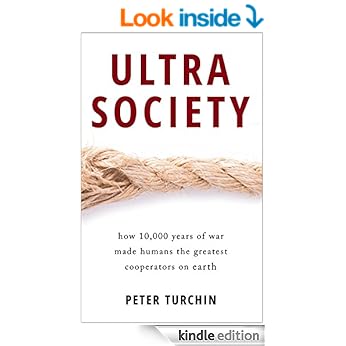
In other news I bought "Ultrasociety: How 10,000 Years of War Made Humans the Greatest Cooperators on Earth" by Peter Turchin (h/t Razib Khan).


Peter Turchin writes:
"We organize ourselves into communities of hundreds of millions of individuals, inhabit every continent, and send people into space. Human beings are nature’s greatest team players. And the truly astounding thing is, we only started our steep climb to the top of the rankings–overtaking wasps, bees, termites and ants–in the last 10,000 years. Genetic evolution can’t explain this anomaly. Something else is going on. How did we become the ultrasocial animal?

In his latest book, the evolutionary scientist Peter Turchin (War and Peace and War) solves the puzzle using some astonishing results in the new science of Cultural Evolution. The story of humanity, from the first scattered bands of Homo Sapiens right through to the greatest empires in history, turns out to be driven by a remorseless logic. Our apparently miraculous powers of cooperation were forged in the fires of war. Only conflict, escalating in scale and severity, can explain the extraordinary shifts in human society–and society is the greatest military technology of all."
You've got to have a soft spot for such refreshing enthusiasm for unremitting combat.

Peter has self-published this on Kindle and pleads for reviews to help it sell (rather as Linda Nagata did for her 'Red' Trilogy). I intend to help him along once I've finished the Great Collider book (about the Chinese proposal to build a successor to the LHC).

---

PS. Zena Skinner's Christmas Cake recipe has now been accessed 141 times.

... (update: Tuesday Nov 24th - 160 times).