Showing posts with label Military AI. Show all posts

Saturday, June 28, 2025

AI in the Battlespace: complete text - Adam Carlton


You may have been following this story serialised here over the last week. But sometimes it's good just to have the PDF of the whole thing, 6,000 words. Here's the link to the complete text PDF version.

'AI in the Battlespace' (PDF).


Wednesday, August 16, 2023

AI Regulation - could we get real, please :) ?


The AI Power Paradox: Can States Learn to Govern Artificial Intelligence — Before It’s Too Late?
by Ian Bremmer and Mustafa Suleyman, August 16, 2023.

This is the latest heavyweight article in the 'heavyweight' international journal, Foreign Affairs. Like all articles on this topic, it's long on pious concerns and feeble technology extrapolation while offering little to nothing compelling in public policy.

So what's the answer? My first thought was that a prudent military might create a last ditch Fortress on the Moon, in case it all goes pear-shaped back on Earth.

But the out-of-our-control AI adversary would be smarter than that. We would be like Neanderthals holed up in some cave with axes and spears against a fully equipped 21st century military task force.

No: instead this. The military should have its own super-smart combat AI systems, massively funded and massively loyal. Then we'd have a chance. Our AIs would be better than their AIs plus those dangerous wild ones.

Forget regulation, it's for ineffectual wimps. Get that black budget request in now!

Next: AI Regulation: what will really happen?

Thursday, February 07, 2019

China dominant in AI by 2025?


Via Bruce Schneier's site, Gregory C. Allen has an interesting report: "Understanding China's AI Strategy: Clues to Chinese Strategic Thinking on Artificial Intelligence and National Security".

He states that "the distance is large between prevailing views in American commentary on China’s AI efforts and what I have come to believe are the facts," although having read the text I have to say that nothing in it particularly surprised me, interesting though it all was.

I found this quote striking:
"In future battlegrounds, there will be no people fighting.” Zeng predicted that by 2025 lethal autonomous weapons would be commonplace and said that his company believes ever-increasing military use of AI is “inevitable […] We are sure about the direction and that this is the future."
My first thought was that this seems more plausible in theatres where there were no civilians, since trying to minimise civilian casualties surely requires AGI and don't hold your breath. But then I remembered Hiroshima and the recent 'liberations' of Mosul and Aleppo and realised that of course it doesn't matter. There are no new issues here at all.

In the comments to Schneier's post, some people with backgrounds in AI proposed that China's claims to global pre-eminence in AI by 2025 are spurious because there have been no conceptual advances in AI at all in recent years. It's all 1970s-style Bayesian statistics and neural nets running on processors now numerous and fast enough to make it all work non-trivially.

There is something in that of course, but I strongly suspect that the road to conceptual breakthroughs to more human-like AI architectures is one which first has to run through those existing ideas and drive them to their limits. If the next step was easy, or even apparent, we'd have a plausible roadmap already. By getting to the front of the engineering state-of-the-art, China can expect to be well placed to initiate and exploit the next set of conceptual advances - indeed, there is no other way.

Monday, February 06, 2017

A battlespace AI


When contemplating AI-controlled cruise missiles, as in yesterday's post, there is a tendency to hear 'AI' and think magic, or imagine we're in the foothills of the Butlerian Jihad.

Still, even without access to classified information, there's a lot we can say about this kind of battlespace AI, just by comparing it with stuff we already know about.

An anti-carrier cruise missile is basically a suicide drone. Its mission is threefold:
  • navigate to the target
  • identify the best choice of target to crash into (and blow up)
  • cope with an extraordinarily hostile environment.
All three of these mission priorities are amenable to current artificial neural net technology:
  • navigation can leverage autonomous vehicle/reconnaissance-drone tech
  • target identification is not dissimilar to existing object/facial recognition tasks
  • the hostile environment can be addressed by massive simulation-training.
I imagine AI prototypes are probably flying drones around right now in simulated attack-scenarios. Steve Hsu has more information on this.

---

There are three interesting issues which arise from the specifics of a combat environment.

1. Target identification/selection

Unlike relatively benign civilian environments, enemy carriers and other ships will attempt to make location and targeting difficult. There will be smoke, perhaps battle damage, explosions and defensive measures such as laser dazzle, jamming, false targets and chaff.

The solution appears to involve multiple sensing platforms illuminating or imaging the target space: satellites; aircraft/drone loitering radars; multiple attack-weapons sharing sensor data on a local net.

Sensor data fusion is a complex but well-researched topic amenable to AI (satirised here).

2. The hostile environment

The incoming missiles will be targeted by the carrier group with everything they have. Antimissiles, guns, lasers. Who can imagine an optimal set of tactics for surviving such an assault?

An AI system which has trained on millions of simulations.

It's somehow similar to AlphaGo.

What we know of AI adversaries is that they often exhibit brilliant but quite counter-intuitive behaviour. That's mostly a plus in the last few kilometres.

3. Autonomy

There's a stupid point here, and an intelligent one.

The stupid argument demands that AI weapons systems have 'no autonomy' - that there will always be a human in the loop.

So ... like with mines, then?

Plainly, if the carrier has already been sunk on cruise missile arrival, the AI will make a fast call on the optimal secondary target. There will be no human in the loop - in fact real-time communications will undoubtedly be 'very difficult'.

However, on a larger scale of strategic autonomy we do need to worry about the unpredictability and lack of transparency of current neural net technology. If, for some obscure tactical reason, an AI weapon concludes that it needs to attack a friendly vessel, then - absent a superhuman common sense (right!) - we should be worrying.

An emergent research area is the design of human-machine interfaces which have explicit, communicable and actionable knowledge about the operations of their powerful but opaque neural net subsystems.

Humans have one of those too: it's called consciousness.

Sunday, February 05, 2017

Revealed preferences

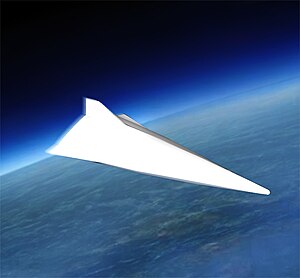
Chinese hypersonic glide vehicle DF-ZF

From the New York Times.
"In August, the state-run China Daily reported that the country had embarked on the development of a cruise missile system with a “high level” of artificial intelligence. The new system appears to be a response to a missile the United States Navy is expected to deploy in 2018 to counter growing Chinese military influence in the Pacific. ...

"The new Chinese weapon typifies a strategy known as “remote warfare,” said John Arquilla, a military strategist at the Naval Post Graduate School in Monterey, Calif. The idea is to build large fleets of small ships that deploy missiles, to attack an enemy with larger ships, like aircraft carriers."
Ultrafast AI-piloted cruise missiles, fabricated at low marginal cost, are pretty much guaranteed to take out an aircraft carrier.

The fact that the US and UK are still investing in these behemoths indicates that they see the next decades of force-projection as targeting third world states, not Russia or China.

Let's hope they're right.

---

The AGM-158C LRASM is the US anti-ship weapon mentioned.

---

What kind of AI could pilot a combat cruise missile?