Showing posts with label Jesus. Show all posts

Wednesday, December 25, 2024

John Dominic Crossan’s views on Jesus’s Resurrection


John Dominic Crossan’s views on Jesus’s Resurrection

Could you summarise what John Dominic Crossan has to say about the historicity of Jesus's crucifixion and resurrection based on his books "Who Killed Jesus" and “The Birth of Christianity”?

I am thinking particularly of Crossan's use of the Gospel of Peter; what Crossan terms the "Cross Gospel"; and the way he sees the Passion and Resurrection narrative very much as the synthesis of Old Testament exegesis and the interpretation of prophecy there.

So in summary, what does Crossan think is the historical development of the Resurrection narrative as found in the New Testament gospels, particularly Mark, based on earlier sources and the motivations of the early (predominantly Jewish) Christian movement?


ChatGPT:

John Dominic Crossan, in works like "Who Killed Jesus?", offers a critical examination of the crucifixion and resurrection narratives, situating them within the historical and theological context of the early Christian movement. His analysis challenges traditional understandings by focusing on how these narratives evolved from earlier sources and were shaped by theological and political motivations.

Crucifixion and the Cross Gospel

The Crucifixion's Historicity: Crossan asserts that Jesus’s crucifixion is one of the most historically certain aspects of his life, largely because of its improbability as a fabricated event. A crucified Messiah was a scandalous and counterintuitive claim, making it unlikely to be invented by early Christians. There are also non-Christian accounts of the event.

The Cross Gospel: Crossan hypothesizes the existence of a pre-Gospel source he calls the Cross Gospel, embedded within the apocryphal Gospel of Peter. He suggests this source predates the canonical Gospels and forms the backbone of the Passion narrative. According to Crossan, the Cross Gospel provided a highly dramatized and interpretive account of Jesus’s death, emphasizing divine vindication and Old Testament fulfillment.

Old Testament Exegesis and Prophecy: Crossan argues that much of the Passion narrative was constructed as a theological synthesis of Old Testament prophecies, especially from Isaiah, the Psalms, and Zechariah. The suffering servant, the righteous one vindicated by God, and the imagery of the pierced figure provided a scriptural framework that early Christians retroactively applied to Jesus’s death.

Development of the Resurrection Narrative

Resurrection as Theological Symbolism: Crossan views the Resurrection narratives as theological affirmations rather than historical descriptions. He contends that the earliest followers of Jesus experienced profound spiritual and communal transformations after his death, which they articulated through their religious tradition of resurrection-theology.

Mark’s Gospel and the Empty Tomb: In Mark, the earliest canonical Gospel, the Resurrection narrative culminates in an empty tomb, but with no post-resurrection appearances of Jesus (the 'longer version' is not original). Crossan interprets the empty tomb as a symbolic story emphasizing divine vindication rather than a literal, historical event. He suggests that Mark constructed this narrative using scriptural motifs, particularly from Daniel and Isaiah, to affirm that God had not abandoned Jesus.

Progressive Development of the Resurrection Appearances: Crossan traces the growth of the Resurrection appearances through the Gospels. In Matthew and Luke, these appearances become more detailed and physical, culminating in the highly dramatized and theological portrayal in John. He argues that these narratives reflect the needs of different early Christian communities to articulate and defend their faith in Jesus’s victory over death.

Motivations of the Early Christian Movement

Apocalyptic Expectations: Early Christians, including Jesus himself, were steeped in Jewish apocalyptic thought, anticipating God’s imminent intervention to establish justice. The Resurrection narrative served as a declaration that this intervention had begun through Jesus.

Vindication of Jesus and the Movement: For Crossan, the Passion and Resurrection narratives sought to vindicate Jesus as the Messiah despite his shameful death. These stories assured followers that his mission and message were divinely endorsed, countering Roman and Jewish critiques.

Unifying a Diverse Movement: The Resurrection became a central theological claim that united diverse Christian groups. By emphasizing Jesus’s triumph over death, it provided a compelling foundation for the movement’s growth and sustained hope in periods of repression.

Conclusion

Crossan’s reconstruction of the historical development of the Resurrection narrative highlights its roots in Old Testament exegesis, early Christian theology, and the socio-political context of a persecuted movement. He sees these narratives not as straightforward historical accounts but as theologically rich creations designed to articulate the significance of Jesus’s life, death, and the transformative impact he had on his followers.


Monday, April 20, 2020

You have permission to do nothing!

The psychology of lockdown: you have permission to read, relax, exercise and not worry about accomplishing anything.

Curious.

Amazon link (the cover is the Conversion on the Way to Damascus by Caravaggio)

I have just finished reading this astonishingly violent, immersive, visceral, sexual and situated account of Paul and the formation of the early Church. It wears its vast learning and research lightly. It's altogether brilliant. I was intrigued: wanted to discover more about the drivers and trajectory of the early church. Who better to consult than Michael White?

Amazon link

My briefest possible summary of his masterly summation/evaluation of the scholarship. Judea and Galilee were part of the territory administered by Herod the Great as a client-king under the Romans. According to Wikipedia: "Upon Herod's death, (4 BCE), the Romans divided his kingdom among three of his sons and his sister—Archelaus became ethnarch of Judea, Samaria, and Idumea, Herod Antipas became tetrarch of Galilee and Peraea, Philip became tetrarch of territories north and east of the Jordan...".

Archelaus proved incompetent and his provinces came under brutal and insensitive direct Roman rule. The result was a flourishing of Jewish messianic and apocalyptic movements. The Jesus movement was one such, rather apolitical and eschewing political violence, focused more on communal solidarity and egalitarianism as a precursor to the generally-held expectation of the imminent arrival of 'The Kingdom' and the overthrow of the Roman oppressors.

The Jesus movement added the belief that - following Jesus' crucifixion c. 30-33 CE - Jesus himself would lead the process in the Second Coming. The Resurrection (a concept already present in Jewish scripture and Graeco-Roman culture and myth) provided a guarantee, a kind of preview, of a generalised resurrection of the bodies of the faithful. Certainly without the inspirational 'visions' of the (bodily) resurrected Christ, the Jesus movement would simply have become one more failed Jewish cult.

Things did not end well, however, for Jewish apocalyptic expectations of imminent victory. The Jewish revolt of 66-73 CE was crushed by Vespasian and his son Titus. The defeat demolished ideological certainties. The Jesus movement outside of Judea (cf. Mark's Gospel) reframed the events as a delay, a clearing of the way prefiguring Jesus's forthcoming arrival; meanwhile the mainstream Jewish community reforming in Galilee initiated the Pharisee-driven rabbinical movement, laying the foundations for later Judaism.

The lines were soon drawn and the Jesus movement anathematised. Matthew's Gospel is a Jewish-Christian counter-polemic, a response to these intense pressures, written within the Jesus movement in Galilee at the time.

The Jesus movement persisted as a low-level Jewish sect but its message proved far more popular amongst gentile sympathisers. It had an appeal particularly to slaves, women and the lower orders - the first shall be last etc. As the social weight of the Jesus movement moved into the Gentile communities in Asia Minor, around the Adriatic and in Rome itself (Paul, Luke) the ideology of the Jesus movement decoupled from its previous deep Jewish, Old Testament roots becoming more abstract, more symbolic, more spiritual (John's Gospel). The community began to bureaucratise with rules for liturgy, leadership structure and an approved canon of sacralised texts.

The Jesus movement appropriated more of its surrounding Graeco-Roman culture, (esp. the Stoics) becoming pre-adapted to its subsequent role as social glue for the later Empire (out of scope for White's book).

Michael White presents an appealingly materialist understanding of the way ever-changing social conditions and pressures drive ideological creativity and innovation ... and then ruthlessly select for those which give meaning to the social tasks facing the sect's adherents.

It is a truth which should be universally acknowledged, especially today ...

Monday, October 15, 2018

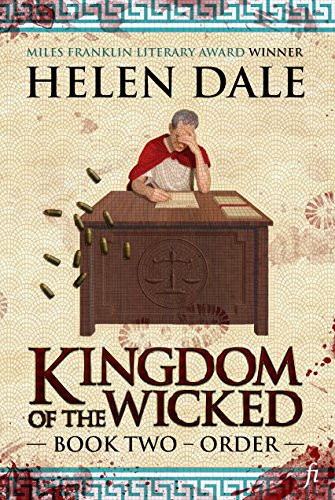
"Kingdom of the Wicked Book Two: Order" - Helen Dale

Amazon link

If "Kingdom of the Wicked Book One: Rules" was about establishing the setting - a high-tech Roman Empire in traditionalist Judea c. 31-33 AD - book two is about the ongoing clash of cultures. In truth, books one and two are just the one novel, with the second part being delayed due to the opaque and irritating rules of publishing.

Book one set up the trial of Jesus (Yeshua Ben Yusuf ) and explored its middle-eastern setting. The Romans look a lot like the Americans today. They're behind in electronics and ahead in genetic engineering. Our familiar western culture inherits judeo-christian hangs-up about sexuality and is 'blessed' with an overabundance of 'compassion'; the classical tradition of Greek and Roman paganism wasn't overly burdened with either.

Book 2 initiates Jesus's trial before Pilate. Evidence is presented in the form of backstories - well elaborated - embellishing the Jesus message and its rather startling effects on both Romans and the orthodox Jewish religious establishment. The Sanhedrin are the more bothered.

"Order" is a keen exploration of this culture clash. Dale tells the story through her well-drawn characters: the Romans are generally hedonistic, sexually inventive and uninhibited (this is not a story you could easily read aloud to your wife or servants); the Jews are extremely moralistic and sexually conservative - reminiscent of fifties America, or the Mormons.

We think we know the plot (the Bible) but the magic of "Kingdom of the Wicked" is that events flow organically from the novel's premises and are not artificially grafted on. Roman capitalism depended upon slavery being abolished (the Stoics were the movers and shakers there); the abolitionist movement also ended crucifixion as being grotesquely cruel. Jesus has not obviously committed a capital offence under Roman law (the affray in the Temple) but the political situation in Judea is deteriorating fast.

The ending is surprising, in more ways than one, but Dale brings it off. An excellent and thought-provoking book.

Tuesday, July 18, 2017

Those predatory trees

Do you remember Tyntesfield (National Trust), just to the south of Bristol? Rumours of those special trees, augmenting their nutrient-poor soil with richer pickings from visitors?

This is Tyntesfield: Victorian-Gothic foreboding

We know we're already too close to the trees

Now maneuvering around Clare

They're quite slow-moving and we were alert after our picnic yesterday, so able to effect an escape.

I pity the old folk though.

---

We wandered the grounds of Tyntesfield and stopped at the tea-shop, surrounded by most of Bristol's young mums with their toddlers and strollers.They were all speaking way too loud and hollerin' out to their kids.
"Joshua!"
I said to Clare,
"Do you think she knows that was Jesus's name in Aramaic?"
Clare thought she would know that.

---

My sister observed:
"Not Joshuawl?"
Me:
"Is that the John Wayne joke? That at the rehearsal for “The Greatest Story Ever Told’, The Duke, playing the Roman soldier who speared Jesus on the cross, said rather flatly: “Truly he was the son of God”.

The director said: “Not like that, say it with awe!”

"Obligingly Wayne repeated his line: “Aw, truly he was the son of God.”

John Wayne with a Bristol accent would certainly be an additional joy!

Monday, April 10, 2017

What did his mother call Jesus?

That old Texan joke: "If the English of the King James Bible was good enough for Jesus, it's good enough for me!"
I understand the local priest's attachment to the Latin Mass. Two thousand years of cultural continuity;  the kinship of fellow-priests down the centuries reciting the same liturgy.

Outreach into the vernacular must have seemed like wanton cultural vandalism.

Still, one should be mindful of the culture within which one basks. The Mother of God did not call her son Jesus (Ἰησοῦς in the language of the hated Empire) - it was the Aramaic Yeshua.