Showing posts with label Helen Dale. Show all posts

Monday, October 15, 2018

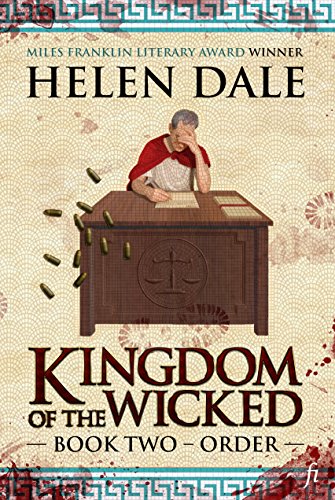
"Kingdom of the Wicked Book Two: Order" - Helen Dale

Amazon link

If "Kingdom of the Wicked Book One: Rules" was about establishing the setting - a high-tech Roman Empire in traditionalist Judea c. 31-33 AD - book two is about the ongoing clash of cultures. In truth, books one and two are just the one novel, with the second part being delayed due to the opaque and irritating rules of publishing.

Book one set up the trial of Jesus (Yeshua Ben Yusuf ) and explored its middle-eastern setting. The Romans look a lot like the Americans today. They're behind in electronics and ahead in genetic engineering. Our familiar western culture inherits judeo-christian hangs-up about sexuality and is 'blessed' with an overabundance of 'compassion'; the classical tradition of Greek and Roman paganism wasn't overly burdened with either.

Book 2 initiates Jesus's trial before Pilate. Evidence is presented in the form of backstories - well elaborated - embellishing the Jesus message and its rather startling effects on both Romans and the orthodox Jewish religious establishment. The Sanhedrin are the more bothered.

"Order" is a keen exploration of this culture clash. Dale tells the story through her well-drawn characters: the Romans are generally hedonistic, sexually inventive and uninhibited (this is not a story you could easily read aloud to your wife or servants); the Jews are extremely moralistic and sexually conservative - reminiscent of fifties America, or the Mormons.

We think we know the plot (the Bible) but the magic of "Kingdom of the Wicked" is that events flow organically from the novel's premises and are not artificially grafted on. Roman capitalism depended upon slavery being abolished (the Stoics were the movers and shakers there); the abolitionist movement also ended crucifixion as being grotesquely cruel. Jesus has not obviously committed a capital offence under Roman law (the affray in the Temple) but the political situation in Judea is deteriorating fast.

The ending is surprising, in more ways than one, but Dale brings it off. An excellent and thought-provoking book.

Tuesday, August 28, 2018

Where did the capitalists come from? - Henri Pirenne

The high-bourgeoisie rules the planet. World-striding 'entrepreneurs' and bankers live gilded lives. The top 1% et cetera.

But it was not always so.

How fragile was the state of being a capitalist in the beginning! Unlike the lords of feudalism or antiquity, the proto-capitalists had no military forces at their disposal and relied upon alien, hostile institutions for the security of their business transactions - and for their own personal safety. How often were moneylenders simply killed or exiled by those powerful nobles indebted to them?

Reflecting upon Helen Dale's tantalising question - Could the Roman Empire have produced capitalism in 200 BC? - I came upon this strange, short and enticing free book.


Amazon link

This 36 page text is the address of Henri Pirenne (1862-1935) given at the International Congress of Historical Studies, London, April, 1913. It's a really interesting 40 minutes read (did I mention it's a free Kindle book?).

Here is some of what Pirenne, who had an interesting life, has to say.
"The ancestors of the bourgeoisie must then be sought, specifically, in the mass of those wandering beings who, having no land to cultivate, floated across the surface of society, living from day to day upon the alms of the monasteries, hiring themselves to the cultivators of the soil in harvest time, enlisting in the armies in time of war, and. shrinking from neither pillage nor rapine if the occasion presented itself.

It may without difficulty be admitted that there may have been among them some rural artisans or some professional peddlers, But it is beyond question that with very few exceptions it was poor men who floated to the towns and there built up the first fortunes in movable property that the Middle Ages knew.

Fortunately we possess certain narratives which enable us to support this thesis with concrete examples. It will suffice to cite here the most characteristic of them, the biography of St. Godric of Finchale.  He was born of poor peasants in Lincolnshire, toward the end of the eleventh century, and from infancy was forced to tax his ingenuity to find the means of livelihood. Like many other unfortunates of all times, he at first walked the beaches on the outlook for wreckage cast up by the sea. Then we see him, perhaps by reason of some fortunate find, setting up as a peddler and travelling through the country with a little pack of goods (cum mercibus minutis).

At length he gathers together a small sum, and one fine day joins a troop of town merchants whom he has met in the course of his wanderings. Thenceforward he goes with his companions from market to market, from fair to fair, from town to town. Having thus become a professional merchant, he rapidly gains a sufficient sum to enable him to associate himself with other merchants, charter a boat with them, and engage in the coasting trade along the shores of England, Scotland, Denmark, and Flanders.

The company is highly successful. Its operations consist in carrying to a foreign country goods which it knows to be uncommon there, in selling them there at a high price, and acquiring in exchange various merchandise which it takes pains to dispose of in the places where the demand for them is greatest and where it can consequently make the greatest gains.

At the end of some years this prudent practice of buying cheap and selling dear has made of Godric, and doubtless of his associates, a man of important wealth. Then, touched by divine grace, he suddenly renounces his fortune, gives his goods to the poor, and becomes a monk.

The story of Godric, if one omits its pious conclusion, must have been that of many others. It shows us, with perfect clearness, how a man beginning with nothing might in a relatively short time amass a considerable capital. Our adventurer must have been favored by circumstances and chance. But the secret of his success, and the contemporary biographer to whom we owe the story insists strongly upon it, is intelligence.  ...

The fortunes acquired in the wandering commerce by the parvenus of the eleventh and twelfth, centuries soon transformed. them into landed proprietors. They invest a good part of their gains in lands, and the land they thus acquire is naturally that of the towns in they reside. From the beginning of the thirteenth century one sees this land held in large parcels by an aristocracy of patricians, viri hereditarii, divites„ majores„ in whom we cannot fail to recognize the descendants of the bold voyagers of the gilds and the hanses.

The continuous increase of the burghal population enriches them more and more, for as new  inhabitants establish themselves in the towns, and as the number of the houses increases, the rent of the ground increases in proportion. So from the commencement of the thirteenth century, the grandsons of the primitive merchants abandon commerce and content themselves with living comfortably upon the revenue of their lands.

They bid farewell to the agitations and the chances of the wandering life, They live henceforward in their stone houses, whose battlements and towers rise above the thatched roofs of the wooden houses of their tenants. They assume control of the municipal administration; they and their families monopolize the seats in the échevinage or the town council. Some even, by fortunate marriages, ally themselves with the lesser nobility and begin to model their manner of living upon that of the knights. ...

This was destined to last, as is familiar, until the moment when in England at the end of the eighteenth century, on the Continent in the first years of the nineteenth, the invention of machinery and the application of steam to manufacturing completely disorganized the conditions of economic activity.

The phenomena of the sixteenth century are reproduced, but with tenfold intensity Merchants accustomed to the routine of mercantilism and to state protection are pushed aside. We do not see them pushing forward into the career which opens itself before them, unless as lenders of money. In their turn, and as we have seen it at each great crisis of economic history, they retire from business and transform themselves into an aristocracy.

Of the powerful houses which are established on all hands and which give the impetus to the modern industries of metallurgy, of the spinning and weaving of wool, linen, and cotton, hardly one is connected with the establishments existing before the end of the eighteenth century Once again, it is new men, enterprising spirits, and sturdy characters which profit by the circumstances."
Henri Pirenne confuses his mercantilists with his capitalists. The former buy cheap and sell dear; most of what they accomplish is the shifting of value around. Capitalists, on the other hand, buy labour-power and appropriate surplus value: they do preside over the creation of new value. Capitalism as a mode of production requires the employment of workers in commodity production for the market - not a feature of medieval times except at the margins of the highly-regulated guilds.

However, his 'stages theory', in which the merchants and proto-capitalists of each generation make their money and cash in, to join and reinvigorate their pre-capitalist elites, is surely correct. It was ever so.

---

The Roman Empire enslaved available labour. It didn't seem to have occurred to anyone that this might be a moral atrocity: there were no abolitionists in antiquity, although slaves were often freed on a personal basis.

The main thing preventing a capitalist transition seems to have been the lack of proto-capitalists. There were certainly many 'new men' who made their fortunes in trade around the Mediterranean and farther afield. As Pirenne similarly observes for the mediaeval period, it was invariably the case that they then bought status and prestige by converting their fortunes into land and slaves.

As a matter of fact, Roman artisan workshops did not expand into proto-companies powered by wage labour, which would have marked the onset of capitalism-proper.


Amazon link

I'm still struggling to put my finger on exactly why no bourgeoisie developed in Rome, but maybe this book by the renowned Ellen Meiksins Wood will help (I've just started it). More later.

---

Marx anticipated all this with his knockabout "Genesis of the Industrial Capitalist", Chapter 31 of the first volume of Capital.
Tuesday, June 19, 2018

Diary: Clare at Bristol Endodontic Clinic

This morning was the long-awaited appointment for Clare to have her specialist root canal work done at this location. She's paid a high price for tripping over at Ham Hill iron age fort last October.

Still no teeth on display (as of yesterday)

The facility is pretty upmarket. Bristol Specialist Dental Clinic: reassuringly expensive. Clare had the area of infection in the root of her front tooth thoroughly cleaned out and a fibre 'post' inserted for strength. A fortnight's mopping up by her immune system will leave her right as rain.

Bristol Specialist Dental Clinic just off the Downs, Bristol

While Clare was flat on her back with her mouth propped open, I was downstairs in reception continuing my flirtation with literary libertarian women. In this case Helen DeWitt, who was briefly notorious last year for the satirical and acclaimed "Lightning Rods" ('how well you get on with Lightning Rods is likely to depend on how far you can believe in a world where female employees in large corporations are willing to have sex on demand with successful male employees in return for double pay.')

She has a book of short stories coming out soon, "Some Trick: Thirteen Stories", which I've ordered (h/t Marginal Revolution) but the novel I'm reading today is her first: "The Last Samurai".

Amazon link

"Eleven-year-old Ludo is in search of a father. Raised single handedly by his mother Sibylla, Ludo’s been reading Greek, Arabic, Japanese and a little Hebrew since the age of four; but reading Homer in the original whilst riding the Circle Line on the London Underground isn’t enough to satisfy the boy’s boundless curiosity. Is he a genius? A real-life child prodigy? He’s grown up watching Seven Samurai on a hypnotising loop – his mother’s strategy to give him not one but seven male role models. And yet Ludo remains obsessed with the one thing his mother refuses to tell him: his real father’s name. Let loose on London, Ludo sets out on a secret quest to find the last samurai – the father he never knew."
Yes, powerful stuff.

Who are my other literary innamorati?

Helen Dale (are they all called Helen?) and Ayn Rand (will I ever get round to "Atlas Shrugged"?).

Wednesday, May 09, 2018

"Kingdom of the Wicked" (Book Two) - Helen Dale

Amazon link

I wrote about book one in November last year: "A high-tech capitalist Imperium in 31 AD".
"I should say 784 ab urbe condita: it seems unlikely that Christianity is going to end up on top when the Roman army is driving around Jerusalem in armoured cars, toting assault rifles. And where a certain Yeshua Ben Yusuf will be on trial for terrorism."
In Helen Dale's two novels, the Romans experienced capitalist lift-off in 212 BC, and by Jesus's time look very much like a modern American occupying force in the Middle-East - with similar issues. At the end of the first book Jesus had been arrested on subversion charges and was about to stand trial, while the zealots have started bombing.

My order has been placed (for 27th May 18).

---

You may think you know what happens next, but do you recall the Roman Empire deploying helicopter gunships?

Wednesday, November 15, 2017

Rural life

Clare buys faggots this morning at Wells Market

Until you have tasted them, you have no idea how delicious this west-country delicacy actually is.

---

My copy of "The Jewish War" arrived today (by Flavius Josephus).

Amazon link

I'm already much educated simply by reading the historical introduction. I feel that my entire life has now been revealed as an attempt to catch up with Helen Dale - (cf. her exciting bio).

Sunday, November 12, 2017

A high-tech capitalist Imperium in 31 AD

Amazon link

I should say 784 ab urbe condita: it seems unlikely that Christianity is going to end up on top when the Roman army is driving around Jerusalem in armoured cars, toting assault rifles. And where a certain Yeshua Ben Yusuf will be on trial for terrorism.

Helen Dale explains her thinking:
"What struck me at once was the attack on the moneychangers in the Jerusalem Temple. All four Gospels record it, and their combined accounts do not reflect well on the perpetrator’s character.

Jesus went in armed (with a whip) and trashed the place, stampeding animals, destroying property and assaulting people. He also did it during or just before Passover, when the Temple precinct would have been packed to capacity with tourists, pilgrims, and religious officials.

I live in Edinburgh, a city that has many large festivals - religious and secular. The thought of what would happen if someone behaved similarly in Princes Street during Hogmanay filled my mind’s eye. This was not a small incident.

It seemed obvious to me that Jesus was executed because he started a riot. Everything else - the Messianic claims, giving Pilate attitude at trial, verbal jousting with Jewish religious leaders - was by the by.

Our system would send someone down for a decent stretch if they did something similar; the Romans were not alone in developing concepts of ‘breach of the peace’, ‘assault’ or ‘malicious mischief’. Those things exist at common law, too. ..."
Jesus was far from 'meek and mild'.
"Finally, instead of bringing Jesus forward in time and placing him in modernity, I thought to leave him where he was and instead put modernity into the past. What, I wondered, would have happened had Jesus emerged in a Roman Empire that had gone through an industrial revolution?

"Other things being equal, what would modern science and technology do to a society with very different values from our own? Would they react with the same incomprehension that we do when confronted by religious terrorism? ..."

"My industrial revolution has its origins when Archimedes survives the Siege of Syracuse in 212 BC and is treated to a Roman version of ‘Operation Paperclip’ (the American retrieval of scientists from defeated Nazi Germany). As a consequence he (or his students) develop calculus and a variety of practical military technologies. In keeping with Roman militarism, the first place the new technologies manifest themselves is in warfare. They then propagate...."
Of course, new technologies can be introduced under slavery, although without the dynamism which capitalist competition alone provides.
"Chattel slavery undermines incentives to develop labour-saving devices because human labour power never loses its comparative advantage. People can just go out and buy another slave to do that labour-intensive job. Among other things, the industrial revolution in Britain depended on the presence (relative to other countries) of high wages, thus making the development of labour-saving devices worthwhile.  ...

"Slavery—and its near relative, serfdom—have been pervasive in even sophisticated human societies, and campaigns for abolition few and far between. We forget that our view that slavery and slavers are obnoxious is of recent vintage. In days gone by, people who made fortunes in the slave trade were held in the highest esteem and sat on our great councils of state.

This truism is reflected in history: The Society for Effecting the Abolition of the Slave Trade met for the first time in 1787. It had just twelve members—nine Quakers and three Anglicans. And yet, in 1807, Parliament passed An Act for the Abolition of the Slave Trade.

The Quaker role in abolition was so vast it is difficult to overestimate. And in the context of both Christianity specifically and human religion more generally, the Religious Society of Friends is theologically distinct. Who in antiquity could perform the Quakers’ role?

In the end, I lit upon the Stoics, and came to admire many aspects of their philosophy when researching Kingdom of the Wicked. ... "
In the novel, slavery has recently been abolished. And now we turn to Jesus's trial itself.
"I have, however, gestured towards three characteristics of Roman law that set it apart from common law. First is the capacity of judges to investigate matters on their own motion. This explains why Pilate is able to source evidence independent of counsel, something considered most improper at common law.

Next is the importance Cornelius [the prosecutor] attaches to obtaining a confession, and the lack of procedural safeguards for the accused. To a Roman lawyer, a confession is the ‘Queen of Proofs’, while his common-law counterpart always suspects that confessions come about thanks to the judicious application of lengths of rubber hose.

Finally, there is the absence of a rule against hearsay, something that is peculiar to the common law."
I've just started the book: it's well-written and taut. We're centred around the Roman administration (central characters Pilate, his family and hangers-on) and the Sanhedrin (major figure the high priest, Joseph Caiaphas).

The Romans are pious yet decadent, hedonistic and sexually uninhibited. The Jews (indistinguishable at the time from their fellow Arab tribes) are socially conservative and sexually repressed, disgusted at the loose ways of their autocratic rulers, the eponymous Kingdom of the Wicked.

Judaea is a hotbed of unrest. Terrorist groups vye with each other in atrocities. There are roadside bombs. And riots.

---

Could capitalism have taken root in Imperial Rome? Marx reminds us that capitalism was never pre-planned as a new mode of production. It took root and expanded where and when it could, and only afterwards was it understood for what it was.

The preconditions for capitalism to emerge seem to be a money economy (which the Romans had) and a strong guild-artisan sector capable of commodity production. At a certain point guild-restrictions on employment of labour are lifted, and the owners of capital begin to accumulate and expand their wealth and power.

They do however need to acquire free labourers, those who have no choice but to work in the nascent factories. In this they compete with landowners who own slaves or control a tied peasantry. The expulsion of landless labourers from agriculture everywhere propelled industrial revolutions.

It is not clear that the proto-bourgeoisie (which barely existed in Roman times) had, at any point, the political or economic clout to seriously contend with the land-owning classes. But it's a complex analysis.

---

My brother notes: "Am surprised that you didn’t include some backstory on [author] Helen Demidenko/Darville/Dale. Her biography is as interesting and extraordinarily as her fiction by all accounts!"

---

Here is the review of "Kingdom of the Wicked Book Two: Order".