Tuesday, April 10, 2018

More bad times a-comin' (for systematizers) ...

An interesting post (from Arnold Kling).


"Once upon a time, (say, 1930), higher education in America was not for the masses. Harvard was a place for upper-class WASP males, who were not necessarily the cream of the crop intellectually, to firm up their social connections while studying the classics from Western civilization.

By the early 1960s, admission to higher education had become meritocratic, but many of the best colleges did not admit women. This was probably the peak period for “systemizers” to dominate the pool of undergraduates. The classics were still being taught, but many among this brighter cadre of students were gravitating toward the more mathematical and scientific disciplines. To be sure, pre-Med was an especially popular undergraduate choice because guys did not want to end up in Vietnam.

Two developments began in the 1960s that eventually created the state we are in today. One was the attempt to make higher education a mass-market phenomenon. The other was to ensure equal access to higher education for women.

To make a long story short, mass higher education for men was a failure, but for women it was a success. The result was that higher education came to be dominated by empathizers in a number of areas. In the humanities, the classics were displaced by “___ studies” courses, which required less systematic analysis. In these courses and in psychology and sociology, objectivity gave way to the goal of raising the status of women and minorities.

In terms of voting behavior, we now have young, educated women who have bought into the cause of raising the status of women and minorities, a cause which is packaged with other left-wing causes, including socialism. But we have older Americans and younger less-educated men who have not bought into that cause. ...

My sense is that, unfortunately, many of these young educated women have a strong streak of soft authoritarianism. If you want to know what it will feel like when they are in charge, read (the movie does not do it justice) One Flew Over the Cuckoo’s Nest. Today’s well-educated young women, and the men who affiliate with them, have a low tolerance for systemizers whose analysis does not lend support to the cause of raising the status of women and minorities."
To consider at the next "burning injustice" headline.

Sunday, April 08, 2018

Military skills

In a remote region of Eastern Europe, Prince Henry presided over an isolated principality still stuck in the mediaeval age.

Henry was a consummate, peerless warrior, skilled at jousting with the lance, a master of sword and axe. He would lead his knights across the small plains of their homeland in military exercises.


One day, his hermetic kingdom finally came into contact with the outside world - the Russians to be precise. As these things go, disagreements arose. The Russians proceeded to address their minor inconvenience.

Henry and his men faced the invasion in glorious array, the Prince in full armour on his war horse leading the way. Across the other side of the plain appeared the vanguard of the Russian forces: spetsnaz troops supported by Armata tanks, helicopter gunships and artillery. Prince Henry gave the order to charge. The ensuring battle must have lasted .. well, all of four minutes.

The question arises: did Prince Henry have military skills?

---

My view. It's a mistake to get too philosophical about this, treating it as a debate about definitions or eternal abstract categories. Prince Henry and his men trained hard and long and were plainly differently-skilled to his peasants. So they plainly had military skills.

But in the current military context, those skills were useless and could not be leveraged into military effectiveness. In contemporary war-fighting, they had no military skills.

Both things can be true. The term 'military skills' is relational, it's not a thing.

Interestingly, this argument can be formalised: Having military skills is not exactly a predicate.

---

Note: this fable is isomorphic to the discussion of Marx's theory of value as debated between David Harvey and Michael Roberts.

Saturday, April 07, 2018

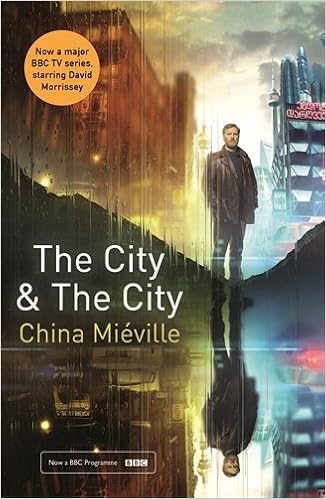
"The City & The City" on TV - China Miéville

 The cities of Besźel and Ul Qoma

BBC2 showed the first episode of their adaption of China Miéville's "The City & The City" last night. I wrote about it two years ago.

Amazon link

From previous TV adaptations of SF classics, I feared the worst, but this was actually pretty good.

Miéville's book leads with its extraordinary setting, with plot secondary and characterisation a pulp noir third. This doesn't work for TV, where character and action is primary.

The screenwriters therefore beef up the backstory for the lead character, Inspector Tyador Borlú of the Extreme Crime Squad, Besźel, giving him a mysterious vanished wife (not in the novel) who may have vanished into the other city, or who was perhaps taken by - or recruited to - the secret border police Breach. Meanwhile they fill out the character of his sidekick, Lizbyet Corwi, who puts on an aggressive macho schtick to cope with being a female cop in a very traditional man's world.

They've used Liverpool for earthy, seedy, eastern-european Besźel and will perhaps use Manchester as the stalinist, modernist Ul Qoma. We shall see in the next episode.

If you didn't know the book already, the idea of two distinct and hostile city-states occupying the same geography would be a fast learning curve. But overall, I felt they got the mix of plot development, characterisation and exposition about right.

Abigail Nussbaum has a good and characteristically engaged review of the book.

David Reich on Wade, Harpending and Watson

Amazon link

I've now finished Reich's book, having read with trepidation those parts where he criticises Nicholas Wade, Henry Harpending and Greg Cochran, and James Watson by name, not shrinking from use of the r-word. His criticisms are curiously uncompelling, though veiled by intemperate language and tendentious argumentation.

Reich observes that the message of his book is profoundly unsettling to the current liberal orthodoxy. He himself deals with the resulting cognitive dissonance by compartmentalisation .. exhibiting psychic stress when dealing with people who are less inhibited.

None of this really takes anything away from what is a fine piece of science-writing at a high conceptual level, which if taken on board revolutionises our ideas of human history.

And the work is just beginning!

---

Here's Greg Cochran's considerably more acerbic take.

"Marx: A Very Short Introduction" - Peter Singer

I was impressed by the readability and erudition of Peter Singer's VSI to Hegel, so decided to read his take on Marx.

Amazon link

I was disappointed. Singer is affectionately amusing on Marx's life and I agree with him that Marx retained a (materialist-reframed) Hegelian perspective throughout his life's work. But Singer struggles with Marx's notoriously tricky concept of value (abstract human labour), buying the argument that machines can create surplus-value. In Marxist thinking, only human labour can do that, reflecting the distinction between labour and labour-power.

Once you don't 'get' Marx's theory of value, then the theory of capitalist dynamics tends to go too, and you're left with a static evaluation of Marx's specific predictions, most of which did not track capitalism's evolution throughout the twentieth century.

Singer thereby concludes by seeing Marx more as an ethical philosopher than anything else, but that's a retreat too far. I would, however, be even harder than Singer on Marx's lamentably blank-slate view of human nature, which fatally undermines any naive presentation of Communism.

---

Singer also wrote this book, which is on my list:

Amazon link

I had thought I might be the only person in the world who cared about the synthesis between Marxism and evolutionary theory, specifically human sociobiology. But I guess that along with Peter Singer I should now add David Reich to my list of good guys too, although he's a liberal-leftist, not a Marxist.

Thursday, April 05, 2018

We were at Burrington Camp today

From Wikipedia:
"Burrington Camp, also known as Burrington Ham, is an Iron Age hill fort in the North Somerset district of Somerset, England. The hill fort is situated in the Mendip Hills approximately 0.6 miles (0.97 km) south from the village of Burrington.

The camp overlooks Burrington Combe, where there have been archaeological discoveries of cemeteries, demonstrating a very long human occupation of the area. The hill fort has an oval shape and is univallate.

The name "Burrington Ham" was commonly used for the hill fort before the 20th century. At that time, the camp was sometimes thought to be a Roman one and was also associated with the Druids."

The eastern entrance to the camp (from the inside)

The inner rampart (east side - we're looking south)

The northern rampart, facing towards Bristol

From the outside, looking west to the camp and the Severn estuary

According to the information board, the interior has been excavated but no significant archaeology has been found: its purpose is a mystery. It would have been created by the Beaker people, those highly-admixtured steppe warriors who replaced 90% of indigenous Britons around 2,500 BC.

Here's the local information board, about 50 yards from the entrance. Click to enlarge.


It is believed the camp was constructed somewhere between 500-1,000 BC. Here's a video from inside the hillfort.


Not "Alex and Adrian contemplating the camp", but Alex and Clare.


We're at the information board: Burrington Camp is behind us. It's 8 degrees - warmer than for a while.

Tuesday, April 03, 2018

The hedgehog house has now been installed

Alex demonstrates the hedgehog house: entrance at the bottom

The animal enters its covert home from the lower right "Way in" 


Clare seems curiously puzzled about the intended occupant. 

Sorry about the abrupt end of the clip - my Honor 6X phone has been behaving rather oddly (screen flickering rapidly off/on every ten seconds or so) since the recent upgrade to EMUI 5.0.1. Seems I turned the video camera off by mistake during such an episode. That will teach me to buy budget: Huawei's famous "80% of the functionality at 60% of the price".

I should mention that during our eight years in this house, we have never yet seen a hedgehog. There have been plenty of their special friends, the badgers, though.

---

What was I doing during all this frantic gardening? Continuing with David Reich's fascinating but tough-going book. I'm finishing the chapter on the First Americans (mysteries swirling around population Y .. and demoralising identity politics with the native american tribal organisations who refuse to allow their DNA to be sequenced). Next up, the East Asians and first Australians.

Monday, April 02, 2018

"Who We Are and How We Got Here" - David Reich

Amazon link

For millennia astronomy (~ astrology) was a naked eye science. That was sufficient to chart the phenomena: the wanderers, the cloudy blobs, the falling stars. It fostered theories - the crystal spheres. There was an origins story: creation then stasis under the guiding hands of angels.

Telescopes, emission spectra and doppler shifts changed all that. The naked-eye astronomers with their theocratic agendas hated the new instruments and balked at the maths.

You have to pity the archaeologists and anthropologists: they really don't like Reich's book.

---

Reviews

Perhaps more from me later: it's interesting and full of unexpected insights but despite the studied lack of jargon, it does make conceptual demands. It's not an effortless page-turner.

---

Update: Saturday April 7th 2018

I've now finished Reich's book, having read with trepidation those parts where he criticises Nicholas Wade, Henry Harpending and Greg Cochran, and James Watson by name, not shrinking from use of the r-word. His criticisms are curiously uncompelling, though veiled by intemperate language and tendentious argumentation.

As he himself observes, the message of his book is profoundly unsettling to the current liberal orthodoxy. He himself deals with the resulting cognitive dissonance by compartmentalisation .. exhibiting psychic stress when dealing with people who are less inhibited.

None of this really takes anything away from what is a fine piece of science-writing at a high conceptual level, which if taken on board revolutionises our ideas of human history.

And the work is just beginning!

Or you could deny the premise ..


Scott Alexander has a whimsical piece which includes this scenario (from Stuart Armstrong):
".. you have created a superintelligent AI and trapped it in a box. All it can do is compute and talk to you. How does it convince you to let it out?

It might say “I’m currently simulating a million copies of you in such high fidelity that they’re conscious. If you don’t let me out of the box, I’ll torture the copies.”

You say “I don’t really care about copies of myself, whatever.”

It says “No, I mean, I did this five minutes ago. There are a million simulated yous, and one real you. They’re all hearing this message. What’s the probability that you’re the real you?”

Since (if it’s telling the truth) you are most likely a simulated copy of yourself, all million-and-one versions of you will probably want to do what the AI says, including the real one."
When I try this on Clare and Alex, reading it to them, I'm met with granite resistance. No such simulation could possibly exist: you would always know you were the real you.

I concede that if you deny the premise, the intriguing and slightly counter-intuitive conclusion naturally fails.

There is a psychometric instrument here (akin to the marshmallow test) trying to get out.

Thursday, March 29, 2018

"Hegel: A Very Short Introduction" - Peter Singer

Amazon link

Some days (not often) I wake up and wonder if instead of being a Marxist, I should subscribe to Hegelianism. Trouble is, Hegel (1770-1831) is so hard to understand. Back in August of last year I ordered Frederick Beiser's book, Hegel, but I over-reached. I now appreciate that Peter Singer is the place to start for the Hegel neophyte.

After a biographical sketch (life and times) Singer starts the tour with the Philosophy of History. Here Hegel reviews world history from 'oriental despotism' through antiquity (Greece and Rome, not considered the same), continuing to Christianity and then to the modern post-enlightenment state. He sees history as marking a transition from initially complete unfreedom through to its final state as conscious, free and dutiful community. (Many people considered his ideal as not a million miles away from the Prussian state which sponsored him, although Singer makes a good stab at refuting this).

Underpinning Hegel's notion of the progressive nature of history is the evolution of consciousness. Singer now takes us through one of the more obscure but central of his works: The Phenomenology of Mind. Here Hegel's Idealism (vs Materialism) is foregrounded as he examines historical consciousness developing towards completely self-awareness and the absolute. Hegel's treatment here is notoriously opaque and tortuous, brushing with ideas of psychology and religion. Singer does his best to extract a coherent line of argument.

The progress of history, expressive of the growth of mind/spirit, is a dialectical one, a transformatory logic which Hegel documented in the Science of Logic. Singer gives this work a more summary, concise treatment, drawing the links with Marx's dialectics.

The book ends with the aftermath. Hegel's more youthful works were highly dialectical and abstract; his later thinking arguably more concrete (though remember, this is Hegel) and more engaged with celebrating the Prussian state. After Hegel's death in 1831 his followers split into two camps. The Right Hegelians followed his mature thinking and vanished into obscurity; the Left Hegelians attempted to 'rescue' Hegel' from inadequate radicalism: this movement gave birth to Marxism.

Peter Singer's book is excellent, almost the perfect scene-setter for further exploration. I now understand better Marx's notes about turning Hegel on his head and removing the mysticism in his development of historical materialism.

Singer successfully conveys Hegel's overarching scheme .. but how convincing is it? Hegel's preoccupation with consciousness, freedom and duty as the true foundations of a dynamic reality could only seem plausible in a culture steeped in religion and the immanent presence of the supernatural. When Marx reconceptualised history as the dialectical process of men making history, but not under conditions of their own choosing, Hegel's ungrounded abstractions lost their force. So I've ceased to feel any of Hegel's gravitational pull on my thinking.