Monday, September 11, 2017

Tour of Britain 2017 in Cardiff, in the rain

We drove down to Cardiff yesterday (Sunday) to see the final stage of the Tour of Britain. The weather was predicted to be cold and gusty with heavy showers. My joy was further enhanced by Cardiff's notable traffic congestion, combined with road closures which prevented access to our hotel.

Whinging aside, we fortuitously ended up parked next to a pub a stone's throw from the Wales Millennium Centre, just where the riders were to do three loops of Lloyd George Avenue before completing stage 8.

Waiting for the cyclists at the Wales Millennium Centre - Lloyd George Avenue

A Madison-Genesis team car was handing out inflatable flappers (you can see the black tubes in the picture below on the right) and eventually the peloton arrived. Frankly we could hardly believe the riders' fortitude: it was horrible out there. We had to keep rushing back into the Millennium Centre's café for hot chocolate to stave off hypothermia!

As Clare says in the video below - "It's lovely here!"

Cyclists are made of considerably sterner stuff.

Team Sky take the curve: is that G. with his white sunglasses?

Clare enthusiastically flapped as the riders approached (video below).


---

This morning we visited Dyffryn Gardens (National Trust), about six miles west of Cardiff. The weather was still poor and Clare was complaining that her gore-tex was way too burka-like.

The author at Dyffryn Gardens - between rain showers

The gardens are good, however, and the greenhouse has plants from several habitats.


Clare explains about air plants in the 'Rainforest Room' at Dyffryn.

---

We arrived home just after lunch and Clare put some frozen fish in the top oven (on maximum heat! - why?) to defrost. Then she forgot about it as we walked down to Waitrose to restock.

Memory returned as we walked back about twenty minutes later. I jogged to the house clutching my two shopping bags and could hear the fire alarm even from outside. The house was thick with acrid smoke; eyes streaming, I ran from room to room throwing open doors and windows.

Finally I opened the oven, and through the billowing smoke I could see the seared fish. With oven gloves the tray was deposited in the back garden (below).

The tray contains the remains of the plastic plate - not fish

It looks like fish-skin in the metal tray. Not so, dear reader, you are looking at the remains of a plastic plate. Here is the response of the chef.

The chagrined cook

As I write she has passed the door with tools from my toolbox. She truly believes you can scrape that melted plastic off .. "good as new".

---

[update: remarkably, she seems to have pulled it off ..]

Jerry Pournelle RIP

Very sorry to hear that Jerry Pournelle has just died (of pneumonia after a long spell of ill-health).


I read his classic to Clare. Steve Sailer wrote a memoir here,

Thursday, September 07, 2017

Only engineering convinces

Amazon link

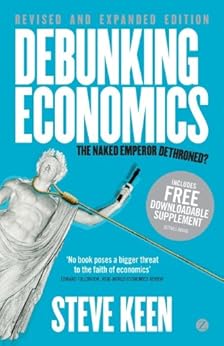
I'm only in the earliest stages of Steve Keen's critique of neoclassical economics (above). He's very successful in exposing their logical inconsistencies and utterly implausible assumptions.

From my own amateur reading of the standard texts, I recall authors conceding these points on the excuse that (i) we can learn something from pure models, and (ii) that despite the flawed assumptions the results seem surprisingly accurate.

I know that Dr Keen is underwhelmed by such hand-waving and will address those points in later chapters.

---

Keen is somewhat puzzled by the fact that leading economics journals won't see the force of his (undoubtedly correct) arguments or publish his erudite papers. He has some explanations in terms of cultural inertia, the apparent successes in the past of the neoclassical programme and even the usual lack of real-world consequences of getting the foundations so very wrong. He admits wryly that economics just isn't like physics or engineering.

This seems to me the crux of it:

  • People will believe all kinds of things if doing so underpins their self-interest.

  • If there are no practical consequences (ie nothing that can't be explained away), mere argument will never gain traction.

  • If you believe humans will never fly (“if God wanted man to fly he would have given him wings”) then only an aeroplane will refute you.

I'm waiting for the final chapters where Keen unveils his alternative macroeconomic model which, I believe, successfully outperforms those of the neoliberals.

---

Remember those stories of how racist AI systems were categorising criminals by their mug shots? Plainly, said liberals, crime was a matter of unfortunate circumstances. How could faces (which identical twins suggest are genetically shaped) have anything to do with it?

Yet it was engineering - hard to argue against.

The Economist (liberal susceptibilities very much on hold) reports today: "Advances in AI are used to spot signs of sexuality".
"When shown one photo each of a gay and straight man, both chosen at random, the model distinguished between them correctly 81% of the time.

When shown five photos of each man, it attributed sexuality correctly 91% of the time.

The model performed worse with women, telling gay and straight apart with 71% accuracy after looking at one photo, and 83% accuracy after five. In both cases the level of performance far outstrips human ability to make this distinction.

Using the same images, people could tell gay from straight 61% of the time for men, and 54% of the time for women. This aligns with research which suggests humans can determine sexuality from faces at only just better than chance."
Sexual orientation not so much a lifestyle choice after all.

Wednesday, September 06, 2017

"Surfing Uncertainty" - Andy Clark

Amazon link

Scott Alexander at SlateStarCodex has a glowing review of Andy Clark's recent book.
"Sometimes I have the fantasy of being able to glut myself on Knowledge. I imagine meeting a time traveler from 2500, who takes pity on me and gives me a book from the future where all my questions have been answered, one after another. What’s consciousness? That’s in Chapter 5. How did something arose out of nothing? Chapter 7. It all makes perfect intuitive sense and is fully vouched by unimpeachable authorities. I assume something like this is how everyone spends their first couple of days in Heaven, whatever it is they do for the rest of Eternity.

"And every so often, my fantasy comes true. Not by time travel or divine intervention, but by failing so badly at paying attention to the literature that by the time I realize people are working on a problem it’s already been investigated, experimented upon, organized into a paradigm, tested, and then placed in a nice package and wrapped up with a pretty pink bow so I can enjoy it all at once.

"The predictive processing model is one of these well-wrapped packages. Unbeknownst to me, over the past decade or so neuroscientists have come up with a real theory of how the brain works – a real unifying framework theory like Darwin’s or Einstein’s – and it’s beautiful and it makes complete sense.

"Surfing Uncertainty isn’t pop science and isn’t easy reading. Sometimes it’s on the border of possible-at-all reading. Author Andy Clark (a professor of logic and metaphysics, of all things!) is clearly brilliant, but prone to going on long digressions about various esoteric philosophy-of-cognitive-science debates."
It's prose like this which confirms what a great writer Scott Alexander is.

---

The underlying thesis of Surfing Uncertainty is certainly not news to AI researchers.
"We never see the world as our retina sees it. In fact, it would be a pretty horrible sight: a highly distorted set of light and dark pixels, blown up toward the center of the retina, masked by blood vessels, with a massive hole at the location of the “blind spot” where cables leave for the brain; the image would constantly blur and change as our gaze moved around.

"What we see, instead, is a three-dimensional scene, corrected for retinal defects, mended at the blind spot, stabilized for our eye and head movements, and massively reinterpreted based on our previous experience of similar visual scenes. All these operations unfold unconsciously—although many of them are so complicated that they resist computer modeling. For instance, our visual system detects the presence of shadows in the image and removes them. ...

"Predictive processing begins by asking: how does this happen? By what process do our incomprehensible sense-data get turned into a meaningful picture of the world?

"The key insight: the brain is a multi-layer prediction machine. All neural processing consists of two streams: a bottom-up stream of sense data, and a top-down stream of predictions. These streams interface at each level of processing, comparing themselves to each other and adjusting themselves as necessary.

"The bottom-up stream starts out as all that incomprehensible light and darkness and noise that we need to process. It gradually moves up all the cognitive layers that we already knew existed – the edge-detectors that resolve it into edges, the object-detectors that shape the edges into solid objects, et cetera.

"The top-down stream starts with everything you know about the world, all your best heuristics, all your priors, everything that’s ever happened to you before – everything from “solid objects can’t pass through one another” to “e=mc2” to “that guy in the blue uniform is probably a policeman”. It uses its knowledge of concepts to make predictions – not in the form of verbal statements, but in the form of expected sense data. It makes some guesses about what you’re going to see, hear, and feel next, and asks “Like this?”

"These predictions gradually move down all the cognitive layers to generate lower-level predictions. If that uniformed guy was a policeman, how would that affect the various objects in the scene? Given the answer to that question, how would it affect the distribution of edges in the scene? Given the answer to that question, how would it affect the raw-sense data received?

"Both streams are probabilistic in nature. The bottom-up sensory stream has to deal with fog, static, darkness, and neural noise; it knows that whatever forms it tries to extract from this signal might or might not be real. For its part, the top-down predictive stream knows that predicting the future is inherently difficult and its models are often flawed. So both streams contain not only data but estimates of the precision of that data.

"A bottom-up percept of an elephant right in front of you on a clear day might be labelled “very high precision”; one of a a vague form in a swirling mist far away might be labelled “very low precision”. A top-down prediction that water will be wet might be labelled “very high precision”; one that the stock market will go up might be labelled “very low precision”.

"As these two streams move through the brain side-by-side, they continually interface with each other. Each level receives the predictions from the level above it and the sense data from the level below it. Then each level uses Bayes’ Theorem to integrate these two sources of probabilistic evidence as best it can. This can end up a couple of different ways.

"First, the sense data and predictions may more-or-less match. In this case, the layer stays quiet, indicating “all is well”, and the higher layers never even hear about it. The higher levels just keep predicting whatever they were predicting before.

"Second, low-precision sense data might contradict high-precision predictions. The Bayesian math will conclude that the predictions are still probably right, but the sense data are wrong. The lower levels will “cook the books” – rewrite the sense data to make it look as predicted – and then continue to be quiet and signal that all is well. The higher levels continue to stick to their predictions.

"Third, there might be some unresolvable conflict between high-precision sense-data and predictions. The Bayesian math will indicate that the predictions are probably wrong. The neurons involved will fire, indicating “surprisal” – a gratuitously-technical neuroscience term for surprise. The higher the degree of mismatch, and the higher the supposed precision of the data that led to the mismatch, the more surprisal – and the louder the alarm sent to the higher levels."
Alexander's review continues to explain the theory outlined at greater length in Clark's book, and then moves on to applications. I was particularly struck by the reanalysis of autism (probably biased to Asperger's Syndrome).
"Autistic people classically can’t stand tags on clothing – they find them too scratchy and annoying. Remember the example from Part III about how you successfully predicted away the feeling of the shirt on your back, and so manage never to think about it when you’re trying to concentrate on more important things?

"Autistic people can’t do that as well. Even though they have a layer in their brain predicting “will continue to feel shirt”, the prediction is too precise; it predicts that next second, the shirt will produce exactly the same pattern of sensations it does now. But realistically as you move around or catch passing breezes the shirt will change ever so slightly – at which point autistic people’s brains will send alarms all the way up to consciousness, and they’ll perceive it as “my shirt is annoying”.

Or consider the classic autistic demand for routine, and misery as soon as the routine is disrupted. Because their brains can only make very precise predictions, the slightest disruption to routine registers as strong surprisal, strong prediction failure, and “oh no, all of my models have failed, nothing is true, anything is possible!”

"Compare to a neurotypical person in the same situation, who would just relax their confidence intervals a little bit and say “Okay, this is basically 99% like a normal day, whatever”. It would take something genuinely unpredictable – like being thrown on an unexplored continent or something – to give these people the same feeling of surprise and unpredictability.

"This model also predicts autistic people’s strengths. We know that polygenic risk for autism is positively associated with IQ. This would make sense if the central feature of autism was a sort of increased mental precision. It would also help explain why autistic people seem to excel in high-need-for-precision areas like mathematics and computer programming."
Clark's model also has suggestive things to say about schizophrenia and dreaming.

The idea that most of sensorimotor cognition is an interweaving of bottom-up sensor feature-extraction and top-down model-driven sensory-motor prediction is extremely persuasive and seems a shoo-in for exploitation by artificial neural network research. The architecture of the first round of AGIs seems to be emerging.

One thing not obviously accounted for is that great mystery: consciousness.

---

Surfing Uncertainty is on my 'to read' list and you'll get impressions later..

Diary: Montacute House

To Montacute House and Gardens (National Trust) today.

We're in the Meadow at Montacute House 

After walking with the sheep in the meadow surrounding the house and gardens (above picture), we decided to visit the adjacent village of Montacute. We ended up in the Kings Arms Inn, an historic and atmospheric hotel somewhat marred by:

- tabloid jokes hanging between the spirits dispensers behind the bar,
"I haven't spoke to my wife in years. Didn't want to interrupt her."
- a cold draft from the open front door which forced Clare to move her armchair, for which she was duly reprimanded by the woman behind the bar,
"Could you please move that back, you're blocking access."
- and signs in the toilet asking residents to keep quiet late at night, warning,
"Swearing will not be tolerated."
OK. Glad that's sorted then.

Diary: a brief history of scotoma

I visited the optician yesterday, an annual check-up as my father had Low-Tension Glaucoma.

What a scotoma can look like

Being organised, I prepared a detailed record of those weird scotoma events I've been experiencing this last year,. I suppose I secretly believed, despite Internet/Google reassurance, that something else might be implicated.

The optician read the note below with care.
Vision scotoma record of occurrences

1. 5th November 2016.
After weights exercise, visual illusion to the right of central visual field (both eyes separately). A flickering jagged arc. This is consistent with a scotoma. Same phenomenon with either eye closed. After half an hour it began to move out and enlarge while retreating further into peripheral vision. After an hour it disappeared.
---

2. 19th January 2017.
This phenomenon reappeared 19th January 2017, again (some time) after exercise, at 6.10 pm. Visible duration 20 minutes. Started at the centre of the visual field, a flashing-lightning V-shape with vertex at 8 o’clock. Gradually got larger until it vanished past the boundary of the visual field.
---

3. March 8th 2017
Same symptoms as before: jagged V-shape fading in five to ten minutes.
---

4. March 26th 2017
Five hours after exercise, proximately after ice cream (!)
---

5. Saturday July 29th 2017, 8.40 pm
While reading on the Kindle app felt a bit weird in the head and noticed an opaque, light grey cloud in the centre of the right visual field. I could see text clearly above and below (more above). The shape was like a large horizontal island from a great height; wider than tall with rough edges. The effect lasted about five minutes then vanished. I abandoned reading and went for a shower.
---

6. Tuesday 22nd August 2017 8 pm
Visual field cloud (right eye) - repetition of July - exactly the same symptoms. Grey/brown rectangular/angular/jagged-edged opaque patch screening the visual field in the right eye. Centre of the visual field, could see above and below it. Around 8 pm while watching Game of Thrones. Felt like scotoma but lasted only a couple of minutes. Had done fairly intensive exercise the day before.
He then proceeded to confirm that it was indeed scotoma, entirely consistent with my advancing age and generally low blood pressure, and that a darkened room was the best way to recover.

During the rest of the examination, as a bonus, I got treated as an intelligent patient - almost a peer, I felt.

Friday, September 01, 2017

Myers-Briggs meets Game of Thrones ..

A clickbait post for the weekend.

Daenerys and Jon

Why no chemistry between Jon and Daenerys? GoT personality typing explains all.

Jon Snow, a stolid, upright character is a typical INFJ. He's typologically excited by rule-breaking, concrete, uninhibited Ygritte, an ESFP wilful waif. "You know nothing, Jon Snow" captures the practical girl's disdain for a head-in-the-clouds idealist.

Daenerys Targaryen is a head-girl ENFJ who needs a dynamic, disinhibited ESTP to offset her idealistic, strait-laced character .. someone like the exciting mercenary, Daario Naharis.

Put Jon and Daenerys together, however, and destiny meets destiny means dullness. No sparkle. This is what happens when writers veer from character- to plot-centred narrative.

The story, unfortunately, of series 7, only partially redeemed by epic scenes.

One of the strengths of Game of Thrones is the clear personality typing of the main characters - many are pretty much archetypes. George Martin got this so right, and the TV version stayed true to character through series 1-6.
  • Littlefinger is an INTJ: an over-intellectual, cold-blooded manipulator
  • Sansa is an ESFJ on an arc from ingénue to queen
  • Arya is an ISTP tomboy - winging it and driven by righteous vengeance.

Myers-Briggs type dynamics predicts that Sansa and Arya will never be of one mind (though they have complementary personalities).

Littlefinger's calculating glibness makes him eventually distrusted by everyone he meets (excepting those who actually have a crush on him - no regrets there, Lysa?).

But really, we've hardly scratched the surface here!

Corbyn's economist: Steve Keen

In the days before sat-navs, you could find yourself driving around the English countryside trying to find your destination: a village, say, like Royston Vasey.  Signposts would contain the name and direct you down endless byways, but somehow you never got any closer. You may have had similar experiences in seaside towns with signs to public toilets.

My job as a self-employed telecoms network architect required a passing familiarity with microeconomics (traffic modelling, business cases). Sometimes I would delve into macro, my interest being in crises, recessions and the preconditions for a new wave of expansion. People only build big public networks in a time of exuberant growth.

Like Royston Vasey, the search proved elusive. Thanks to Steve Keen, I now know that orthodox macroeconomics simply assumes that crises cannot occur. Those that happen nevertheless cannot be structural, but are due to policy errors or 'outside shocks'.

Keen identifies the bizarre foundations of contemporary macroeconomic models as used by businesses, governments and international agencies: the modelling of all consumers as equivalent atomised individuals (no finance and industrial capitalists, no organised workers); the abstraction away of money, debt and the entire financial sector. A continual return to equilibrium is built in.

Taking these things into account, however, leads to very different models which show strong (and empirically-validated) correlations between excessive private debt and crashes; the economy exhibits chaotic rather than equilibrium-seeking behaviour, something like the weather.

This is all explained rather concisely in his latest book which I've now completed.

Amazon link

I was rather impressed: his arguments seemed plausible and well-corroborated. In the UK he sees an unregulated finance sector (think Margaret Thatcher's 'Big Bang' reforms) as having opened the floodgates of private debt (he has supporting data) and thinks that the chronic UK Government deficit is really a symptom of the long post-crash malaise rather than the prior cause of it.

Reading his Wikipedia bio, I was only slightly surprised to read this:
"In August 2015, Keen endorsed Jeremy Corbyn's campaign in the Labour Party leadership election."
Amazon link

I'll be checking out his main book (above) in the near future. Here's Steve Keen on the BBC's HardTalk.


The interviewer is pretty aggressive and it helps to have read Keen's "Can We Avoid Another Financial Crisis? (The Future of Capitalism)" to understand the logic of his responses.

Thursday, August 31, 2017

Book reviews

Amazon link

Their big idea is that most brain processing occurs at a subconscious level, that intuitions are subconscious processes which lead (opaquely) to conscious conclusions (metarepresentations), that reasoning is an opaque process associating such metarepresentations with other metarepresentations allowing us to justify our actions to ourselves and others, mostly in reputational support.

This social rationale for reasoning explains why the accounts we give ourselves for our actions are often quite superficial and weak while in justifying ourselves to others we often strengthen our reasons through dialogue. And also that in most cases our reasoning is ex post facto.

The confabulatory rationale for reason is something designers of neural network AI systems will have to take on board. Since, according to the authors, our reasoning powers evolved for public relations purposes, justifications for our underlying evolutionary drives, expect the corresponding motivations of corporeal AI systems to be rather salient to their conversational capabilities.

The book is marred by its style of writing, too keen to show off its authors' liberal susceptibilities, moral qualities and faux-affability. I did not feel on their team. The book is also way too discursive, reminiscent of late-Dennett. They would probably think this a compliment.

---
Amazon link

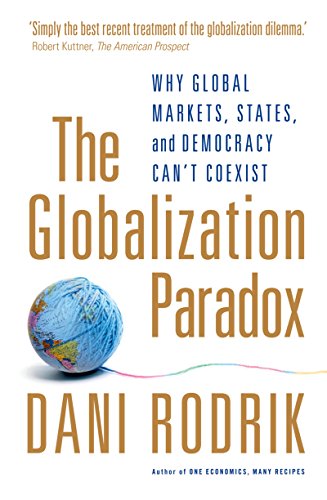
I was quite impressed with this book for a while, as Rodrik explained that globalised capital really 'wants' a global 'democratic' institutional framework to ensure its continued replication .. and that nation states and pesky local interests (eg the working classes) get in the way and need to be shunted aside.

His solution was a return to a (modified) Bretton Woods arrangement of more enlightened nation states. My suspension of disbelief finally crumbled when he started advocating unrestricted immigration and the removal of border controls as a major driver of future economic growth. And this is the guy who accuses others of believing more in their oversimplified economic models than facts on the ground!

Even Hive Mind, with its hand-wringing cop-outs, was a lot better than this.

Wednesday, August 30, 2017

Marx on Slavery


Expecting a vitriolic rant on the absolute evils of slavery in the antebellum American South? There are plenty of those, but here Marx is more interesting, more analytic:
"This is one of the circumstances that makes production by slave labour such a costly process. The labourer here is, to use a striking expression of the ancients, distinguishable only as instrumentum vocale, from an animal as instrumentum semi-vocale, and from an implement as instrumentum mutum.

"But he himself [the slave] takes care to let both beast and implement feel that he is none of them, but is a man. He convinces himself with immense satisfaction, that he is a different being, by treating the one unmercifully and damaging the other con amore.

"Hence the principle, universally applied in this method of production, only to employ the rudest and heaviest implements and such as are difficult to damage owing to their sheer clumsiness. In the slave-states bordering on the Gulf of Mexico, down to the date of the civil war, ploughs constructed on old Chinese models, which turned up the soil like a hog or a mole, instead of making furrows, were alone to be found. Conf. J. E. Cairnes. “The Slave Power,” London, 1862, p. 46 sqq.

"In his “Sea Board Slave States,” Olmsted tells us: “I am here shown tools that no man in his senses, with us, would allow a labourer, for whom he was paying wages, to be encumbered with; and the excessive weight and clumsiness of which, I would judge, would make work at least ten per cent greater than with those ordinarily used with us.

"And I am assured that, in the careless and clumsy way they must be used by the slaves, anything lighter or less rude could not be furnished them with good economy, and that such tools as we constantly give our labourers and find our profit in giving them, would not last out a day in a Virginia cornfield – much lighter and more free from stones though it be than ours.

"So, too, when I ask why mules are so universally substituted for horses on the farm, the first reason given, and confessedly the most conclusive one, is that horses cannot bear the treatment that they always must get from negroes; horses are always soon foundered or crippled by them, while mules will bear cudgelling, or lose a meal or two now and then, and not be materially injured, and they do not take cold or get sick, if neglected or overworked.

"But I do not need to go further than to the window of the room in which I am writing, to see at almost any time, treatment of cattle that would ensure the immediate discharge of the driver by almost any farmer owning them in the North.”
From Note 17 of "Chapter 7: The Labour-Process and the Process of Producing Surplus-Value", Capital Volume 1.

In this chapter Marx notes the extreme inefficiency of slavery as compared with the capitalist purchase of labour-power rather than the person of the labourer themselves:
"Then again, the labour-power itself must be of average efficacy. In the trade in which it is being employed, it must possess the average skill, handiness and quickness prevalent in that trade, and our capitalist took good care to buy labour-power of such normal goodness.

"This power must be applied with the average amount of exertion and with the usual degree of intensity; and the capitalist is as careful to see that this is done, as that his workmen are not idle for a single moment. He has bought the use of the labour-power for a definite period, and he insists upon his rights. He has no intention of being robbed.

"Lastly, and for this purpose our friend has a penal code of his own, all wasteful consumption of raw material or instruments of labour is strictly forbidden, because what is so wasted, represents labour superfluously expended, labour that does not count in the product or enter into its value. [note 17]."
Generalised slavery is incompatible with the capitalist mode of production as the use of slaves does not create surplus value - the basis of profits. Classical antiquity was not capitalist.

Putting aside moral issues, slaves replacing workers is a form of total automation. But unlike designed systems, human beings are understandably unenthused by a lifetime role as servitor.