Thursday, December 03, 2015

Some really good-bad books

Fay Weldon writes one of my favourite classifications:
"In the nineties, moved by the new GOO (‘GOOd read’) classification in Camden public libraries, I devised my own classification scheme as follows.

Good-good books – the best of contemporary literary novels, plus classics which were best-sellers in their day and have withstood the passage of time: all engaging with the intellect, if ‘difficult’.

Bad-good books – pretentious and dreadfully boring, yet taken seriously by the occasional reviewer (usually a friend of the author) and funded by the Arts Council.

Good-bad books – intensely readable, unpretentious and seldom reviewed.

Bad-bad books – worthy only to be hurled into the corner or dropped in the bath."
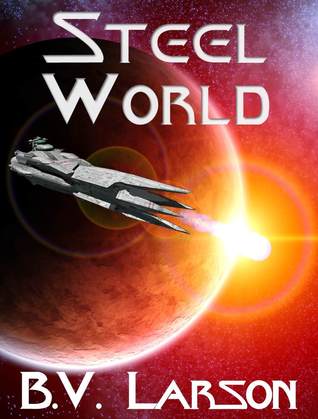
Sometimes you just need to switch off your intellect and enjoy a piece of page-turning escapism. If you are a science-fiction fan, you could do considerably worse than turn to B. V. Larson, for example his Undying Mercenaries series of exceedingly good-bad books.

The first volume ...


Larson also writes insightfully about the craft of successful, self-published writing ("Advice Concerning the Self-Publishing Game ").

---

Steve Hsu has an interesting post on the interpretation of quantum mechanics (PDF here). Basically he does a good job of explaining where the many worlds interpretation comes from, and how decoherence plays a critical role in 'separating branches'. He then sheds a really clear light on the issue of 'where do the Born Rule probabilities come from?' concluding this is still an unresolved problem.

As a bonus, the comments feature the infamous Luboš Motl who is coaxed to clearly explain his own views on quantum reality. As a hard-line 'Copenhagenist', Motl appears to believe that reality is both ill-defined and lacks objective (classical-ish) reality in the absence of sentient observers - a highly counter-intuitive view for sure! Here is how he explains things:
"The conceptually right to describe a world without sentient beings is that an unspecified and unknown initial wave function evolves unitarily according to Schrödinger's equation and never collapses because it's only measurements that may collapse and there are none in your theory. The complete "diffusion" of the wave function (into the linear superposition of dead and alive cats and all objects, small and big, in the most general superpositions of all conceivable states) may be said to be a problem - but another problem is that the initial state is totally unknown, too.

"It makes no sense to say that the initial wave function is a particular thing because one may only say that the wave function is a particular thing [if] something is [a] measurement - if a sentient being becomes aware of the result of some measurement. This is not happening in a universe without sentient beings. So there's no specific science to discuss in a universe without sentient beings at all. The laws may still be the same as they are in our world but they won't be applied in any particular situation because there are no particular situations or particular special wave functions in a world where no one ever measures anything.

"Einstein asked whether there is any Moon over there if no one looks. In practice, classical physics is a good enough approximation, so one may assume that the Moon is pretty much there even before observers look etc. But conceptually, if you care about similar objects for which the quantum effects are strong, the right answer is that the Moon just isn't at any particular location and has no other particular properties if no one looks. The wave function isn't a real object of any type. Its amplitudes can't be measured in a single repetition of the situation. It is only a template storing information allowing to predict probabilities of things that actually can be measured - the observables."
This is all accessible to anyone who has taken and understood QM at an undergraduate level.

Wednesday, December 02, 2015

The onset of Christmas

The Market Square at Wells this afternoon

Clare and myself visited my mother in Swindon this morning and returned via IKEA in Bristol. The Christmas season is just getting underway, and we stocked up on candles, new bedding and other seasonal fare.

Clare thinks big thoughts about the next purchase

Do Swedes really drink alcohol-free Glogg?

We were watching the excellent Channel 4 programme "The Murder Detectives" last night so I offered Clare a drive-by tour of St Paul's, very close to IKEA.

She declined.

Hive Mind: to buy or not to buy?


I've mentioned this before. Here's an extract from the blurb at the book's Amazon page.
"... Over the last few decades, economists and psychologists have quietly documented the many ways in which a person's IQ matters. But, research suggests that a nation's IQ matters so much more.

"As Garett Jones argues in "Hive Mind," modest differences in national IQ can explain most cross-country inequalities. Whereas IQ scores do a moderately good job of predicting individual wages, information processing power, and brain size, a country's average score is a much stronger bellwether of its overall prosperity.

"... Jones argues that intelligence and cognitive skill are significantly more important on a national level than on an individual one because they have "positive spillovers." On average, people who do better on standardized tests are more patient, more cooperative, and have better memories. As a result, these qualities and others necessary to take on the complexity of a modern economy become more prevalent in a society as national test scores rise.

"What's more, when we are surrounded by slightly more patient, informed, and cooperative neighbors we take on these qualities a bit more ourselves. ... "
According to the Wikipedia article, the average IQ for sub-Saharan Africa is 82. For ethnic Europeans the average IQ is 100 and for East Asians (Chinese, Japanese, Koreans) the figure is 105. It's not hard to get significant correlations between such disparate national IQ figures and levels of economic development.

The validity of IQ as a predictor of achievement in very diverse milieux has been empirically verified time and time again so in a sense, what Hive Mind is talking about is hardly very new. This could be a reason not to buy it.

Greg Cochran reviewed it and said some nice things - quite rare from curmudgeon-central! Apparently Jones is quite a good writer too. So why not buy it?

The Hive Mind reviews on Amazon are quite amusing. Most of them are from Garett Jones's colleagues at GMU - as befits academics, they can't just summarise the book and say they like it, they have to write not-so-mini essays! Consider this review from colleague Timothy J. Groseclose, from which I quote this excerpt:
"Jones constructs an example, which I call “the parable of the vases.” In a moment I’ll explain the details of the example, but first let me briefly discuss its importance. The example has significantly affected my thinking, and it is one of the highlights of the book. I do not think it is an exaggeration to say that the parable ranks as one of the all-time great examples in economics. Although it is not quite as insightful and important as Ronald Coase’s crops-near-the-train-track example (which illustrates the efficiency of property rights), I believe it is approximately as insightful and important as: (i) Adam Smith’s pin-factory example (which illustrates the benefits of division of labor) and (ii) Friedrich Hayek’s example of an entrepreneur knowing about an unused ship (which illustrates the value of particular, versus general, knowledge).

"The parable begins with a simplifying assumption. This is that it takes exactly two workers to make a vase: one to blow it from molten glass and another to pack it for delivery. Now suppose that two workers, A1 and A2, are highly skilled - specifically no matter which task to which they are assigned they are guaranteed not to break the vase. Suppose two other workers, B1 and B2, are less skilled - specifically, for either task each has a 50% probability of breaking the vase.

"Now suppose you are worker A1. If you team up with A2, you produce a vase every attempt. However, if you team up with B1 or B2, then only 50% of your attempts will produce a vase. Thus, your productivity is higher when you team up with A2 than with one of the B workers. Something similar happens with the B workers. They are more productive when they are paired with an A worker than with a fellow B worker.

"So far, everything I’ve said is probably pretty intuitive. But here’s what’s not so intuitive. Suppose you’re the manager of the vase company and you want to produce as many vases as possible. Are you better off by (i) pairing A1 with A2 and B1 with B2, or (ii) pairing A1 with one of the B workers and A2 with the other B worker?

"If you do the math, it’s clear that the first strategy works best. Here, the team with two A workers produces a vase with 100% probability, and the team with the two B workers produces a vase with 25% probability. Thus, in expectation, the company produces 1.25 vases per time period. With the second strategy, both teams produce a vase with 50% probability. Thus, in expectation, the company produces only one vase per time period.

"The example illustrates how workers’ productivity is often interdependent—specifically, how your own productivity increases when your co-workers are skilled.

"The example generates an even more remarkable implication. It says that, if you are a manager of a company (or the central planner of an entire economy), then your optimal strategy is to clump your best workers together on the same project rather than spreading them out amongst your less-able workers.

"The parable has some interesting implications for immigration policy. Namely, it suggests that Ann Coulter and Donald Trump may be more correct than they realize. Coulter and Trump, when arguing for more restrictions on immigration, most often invoke political and cultural reasons - e.g. they note that more immigrants will cause crime to increase or cause the U.S. to adopt more left-wing policies. The parable of the vases, however, provides an economic reason: Specifically, when the U.S. allows more low-skilled immigrants into the country, it can lower the productivity of native workers.

"Perhaps more profound is the following implication. Immigration opponents usually make their argument from an own-country perspective. E.g. Trump and Coulter usually focus on the fact that a more open-borders policy hurts American natives. They rarely discuss the fact that such a policy helps potential immigrants. Related, they do not consider the net effect - that is, whether the costs to American natives are greater than the benefits to potential immigrants. The parable-of-the-vases example, however, takes a worldly perspective, not U.S.-centric perspective, and it suggests that the net benefits are negative.

"For example, it suggests the following: Suppose you were the secretary general of the U.N. - someone who is interested in the total economic output of the entire world, not just the output of the U.S. If so, then the parable-of-the-vases example implies that you would want the world’s smartest people to clump in only one or a few countries. You’d want the U.S. to restrict immigration from low-IQ countries because it increases the world’s economic output, not just the U.S.’s. As far as I’m aware, the people who favor more restrictive immigration policies - including Coulter and Trump - have never made this argument."
His rather gushing review is exactly how you write as an academic for whom the scales have just fallen from the eyes!

On balance, I think I ought to buy it, if only to provide a review not from George Mason University.

---

Update: here is my review.


Tuesday, December 01, 2015

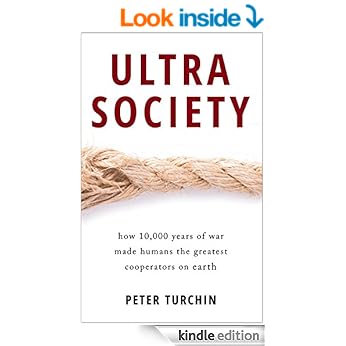
Ultrasociety: an astonishingly insightful account of historical dynamics


Human beings cooperate in their millions, a scale of sociability only equalled by some of the social insects - but those are highly interrelated. So two questions: how did large-scale societies emerge from small-scale hunter-gatherer groups in the not-so-distant past; and how were genetically-diverse humans able to make such a transition at all? Here is a brief and highly-oversimplified summary of Peter Turchin’s answer to the first question, the main concern of his book.

Compared to the dominance hierarchies of chimpanzees and gorillas, human hunter-gatherer groups are much more egalitarian. This is the basis for enhanced cooperation, necessary for cooperative hunting and defence against large predators. Around 11,000 years ago, however, there was a  turn to agriculture, first seen in the middle-east.

Agrarian societies, even early, small-scale ones are not viewed with admiration by hunter-gatherers. They are inegalitarian and bad news for the overwhelming majority. Even the concept of private ownership of lands and crops is anathema to the HG mindset. Most likely it was the improved productivity of agriculture in the presence of constant conflict which led to the first war-leader ‘upstarts’ establishing a durable hold on power.

The first ‘archaic states’ arose in southern Mesopotamia and south-western Iran around 6,000 years ago. These were led by ‘upstarts’ who had successfully legitimised their on-going rule by self-deification, the ‘God-Kings’. Archaic states were bloodthirsty, used extensive human sacrifice and oppressed their subordinate groups who lived in constant fear.

Between 800 and 200 BCE we see the Axial Age, the period of great (and less internally blood-thirsty) empires. Despotism doesn’t scale well, particularly amongst multiple ethnic groups. Great Religions became the glue (Confucianism and Taoism, Buddhism, Judaism, Jainism, Zoroastrianism, Greek Religion/Philosophy all developed around this time). The empire’s rules became decoupled from the person of the ruler, and a theological egalitarianism bound diverse ‘citizens/subjects’ together.

So again, why the transition? The new driver of change was the arrival of the steppe nomads, with their highly mobile cavalry and composite bows - so effective that defence required a further increase in agrarian state size – only empires could defend themselves. The empires themselves now became strong enough to engage in expansionary offensives against other states in winner-take-all conflicts.

The new great religions helped to pacify relationships within the empire, increasing both internal political stability and the cooperation which permits economies of scale. And in an important sense, that has been the historical story to the present day.

This account is grossly unfair to Turchin’s detailed argumentation founded upon his encyclopaedic knowledge and sharp insights into fundamental causal mechanisms. The author is a key leader of the ‘cliodynamics’ movement which seeks to give a mathematical expression to historical evolution;  the material in this book is underpinned by computer simulations of the onset of the Axial Age as explained in his 2013 PNAS paper ‘War, space, and the evolution of Old World complex societies’ (available as a PDF online and worth reading - h/t Razib Khan).

There is a gene-culture coevolution story waiting to be told here – recent work in population genetics based on historical genomes suggests significant plasticity over the time periods of interest in this book. Most likely this has some causal input into why certain transitions took thousands of years: it seems unlikely that it merely took that long to come up with the required new ideas.

In summary, Peter Turchin has written a gripping, original, thought-provoking book which offers a new way of thinking about human history: it is highly recommended.

Monday, November 30, 2015

Holocene nostalgia

Who cares what a non-sentient iceberg thinks?

Matt Ridley has an opinion piece in The Times today:
"Let’s go back a little further, to the Middle Ages. It used to be argued by some that the “medieval warm period” of about a thousand years ago, when mountain glaciers retreated, vines grew further north and Iceland was widely cultivated, was confined to Europe. We now know from multiple sources of evidence that it was global. Tree lines were higher than today in many mountain ranges, for example. Both North Pacific and Antarctic Ocean water temperatures were 0.65C warmer than today.

"Go back yet further, still within the current interglacial period, to the so-called Holocene Optimum of 6,000-9,000 years ago. Ocean temperatures were up to two degrees warmer than today, the Arctic Ocean was nearly or completely ice-free at the end of summer in many years, and the boreal forest in Siberia extended 150 miles further north than today. July temperatures were up to six degrees warmer than today in the Siberian Arctic.

"Was this Holocene Optimum a horrible time of droughts, storms, disease and famine? Not especially. It was the period in which agriculture spread rapidly across the globe from five or seven centres of invention. Abundant rainfall in Africa led to lakes in the Sahara with crocodiles and hippos in them, surrounded by green vegetation in the monsoon season."
As far as I can make out, global warming works to some countries' advantages and not to others. Zones susceptible to weather-related economic activity (agriculture, tourism) move around as do many areas where people today have ended up living.  The losers make more noise than the winners. North-West Europe (cold, damp) seems a likely winner. Shame our liberal hand-wringing prevents us from enjoying it.

Still, something must be done. I'm in the realpolitik camp: developing countries will carry on burning fossil fuels; greenhouse gas ratios will continue to rise. There are loads of things which can be done to mitigate the results and to develop alternative, cleaner and cost-effective power supplies - it's called R&D.

The point Matt Ridley elides is that the cost of moving our global infrastructure to accommodate the Holocene Optimum, nice as it sounds, would be enormous - both in economic transformation and population migration.

---

PS. Did you like the picture above, drawn with my Kids Paint Free app? (Similar). I can also recommend Twilight for those dark evenings when you welcome sleepiness, and Electric Sheep for awesome inspiration (you got the Philip K. Dick reference, right?).

Saturday, November 28, 2015

The Catholic Christmas Bazaar in Wells

Today's piece of family trivia. After yesterday evening's excitement, this morning found us at the town hall supporting the local Catholic Church Christmas Bazaar.

Clare is way too pleased to hang out with Santa

Our wreath bought here

Town Hall view of the Wells Saturday Market

Alex and Adrian on their way to the mulled wine bar
Black Saturday Waitrose on the way back. Rarely has it been so busy - middle-class passive-aggressive trolleying trumping chav wrestling and fisticuffs.

A joy to be home.

...As the wheels churned uselessly ...

It was a last resort - Adrian calling me - to report that his car was irretrievably stuck in mud off the A350 just north of Warminster. Sometimes the satnav demands a U-turn, and sometimes you have to pull off the main road to effect the manoeuvre. And sometimes that side road in the dark is, unbeknownst to you, the entrance to a sodden ploughed field.

Adrian's stranded car
Alex and I arrived about 45 minutes later laden with planks, spades and chocolate bars. After watching them work for a while from the warmth and dryness of my own car, I was persuaded to transfer to the stuck one to reverse out (on those newly-laid planks). At this point a large white van pulled in; the livery said 'Garden Centre' and the guy and girl offered use of their winch.

We compromised: I reversed enough to show in principle we could have gotten out, and then they winched the car to the concrete entrance way. Nice people.

Adrian finally retrieved
Here's Alex's impression of Adrian safely back at ours, checking stuff out on his laptop.

Oh Mighty One - thank you for helping us!
And here's Alex's impression of ...? A Greek God? A Roman Emperor? It's hard to be sure.

Friday, November 27, 2015

Bomb in Syria? Don't bomb?

The weak point of all the arguments for extending UK bombing to the whole of Islamic State is generally agreed to be the lack of a ground strategy, essential to defeat IS and build some kind of replacement governance structure.


Patrick Cockburn writes:
"In Syria, allies on the ground are going to be the armed opposition who are supposedly fighting both Isis and Bashar al-Assad. These forces are dominated by the al-Qaeda affiliate Jabhat al-Nusra and Ahrar al-Sham, a Sunni hard-line group allied to Nusra. The one place where the “moderates” had some strength was in the south where they launched a much-heralded offensive called “Southern Storm” this summer, but were defeated.

"Mr Cameron’s explanation of his strategy is peppered with references to “moderates” whom he wisely does not identify because their existence is shadowy at best. It would, indeed, be very convenient if such a powerful group existed, but unfortunately it does not.

"Mr Cameron’s Government does not seem to have taken on board that it is intervening in a civil war of great complexity and extreme savagery. There is a supposition that, if Assad were to depart, there could be a transitional Syrian government acceptable to all Syrians. A more likely scenario is that the departure of Assad would lead to a collapse of the state and the triumph of Isis and the self-declared caliphate."
In truth, I do think those voting to bomb are aware that air power alone cannot win this one, and that identifying acceptable boots on the ground is highly problematic. Just as with the Iraq adventure (despite Blair's 'true believer' stance) it's clear that the UK establishment 'almost consensus' for bombing in Syria is composed of three elements:

  • The need - as always - to stay close to the Americans (who are doing most of the heavy lifting - or should I say 'dropping');
  • A desire to show some solidarity with the French (and not be upstaged by them militarily in Europe);
  • A desperate urge to be 'relevant' in this crisis in Europe's backyard, and not be consigned to the sidelines when solutions are eventually hammered out.

So realpolitik rules.

Since we know all the players in the region and what their general dynamics are, it should not be difficult - at least conceptually - to figure out the outlines of a plausible end-game.

  • The Alawites are never again going to control the territory of the former Syria - they will end up with an enclave at best.
  • The prospects of a Sunni-Alawite federation in the territory of the former Syria are precisely zero. We're talking of clan-societies with a 'never forgive, never forget' model of retaliation over the centuries. Remind me how long the Sunni-Shia schism has lasted so far?
  • A partition of Syria with the Alawites running their own bit, and vaguely 'acceptable' Sunnis running their bit is actually where this is going. If only we could find those 'acceptable Sunnis' ...

And can any solution endure without the dissolution of an already fictitious integral Iraq? The Kurds, Shia and Sunni are three genies which will not easily be put back into the bottle - and why are we even trying?

Thursday, November 26, 2015

Bath Christmas Market video

Today is the first day of the famous Bath Christmas Market. Here's the video taken as I walked around early this afternoon, just so you get a feel of it.


The market runs from today, November 26th through to 13th December 2015. Here's their website. And here are some pictures.


Bath Abbey and the Christmas Market

Stalls at Bath Christmas Market

A Jane Austen pilgrimage in Bath

Alex, Clare and myself visited Bath today for the delayed Jane Austen pilgrimage, to visit the main houses where she lived. Here is a reference - and here are the pictures (click on them to make them larger).

This is 25 Gay Street, just south of The Circus

Gay Street looking north towards The Circus

The Jane Austen Centre on Gay Street - one of these is real

Jane's house at 3, Queen Square

Alex and the author at Queen Square

Alex and Clare at 13 Trim Street - not Jane's favourite abode

Trim Street from the western end - you can see why ...

27 Green Park Buildings

Clare and the author at Green Park Buildings

Bath Abbey and the first day of the Christmas Market

Stalls at the Christmas Market

The interior of Bath Abbey

I have a (two minute, 200 MB) video of the Christmas Market which I will post subsequently. In other news, I today upgraded this machine upon which I type from Windows 7 to Windows 10. Just left the process running while we were at Bath and it was mostly done on our return. Not as scary as I thought and the desktop looks familiar - not the tiles I was fearing.