Thursday, October 18, 2018

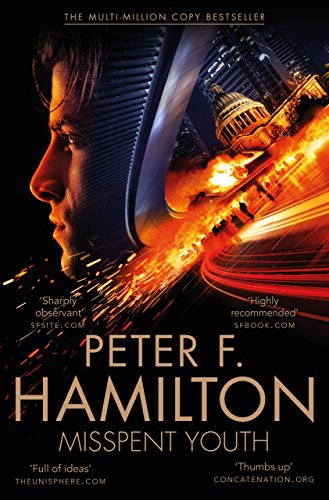
Sex and violence: "Misspent Youth" by Peter Hamilton

Amazon link

Call me a Hamilton completist .. .

Misspent Youth was possibly Hamilton's most-panned novel. Here's David Langford's review for Amazon.
"Peter Hamilton is famed for SF blockbusters of far-future interstellar adventure. By contrast Misspent Youth is a social comedy set in the year 2040 in England. When gene therapy rewinds Jeff Baker's age back to his early 20s he finds that wisdom and experience are no match for hormones...

The rejuvenation treatment, developed by federal Europe to impress laggard America, is so complex and expensive that only one person every 18 months can receive it. Jeff is the first because he's a celebrity inventor, father of the "datasphere" which superseded the Internet.

Family upheavals follow. An "arrangement" with his much younger, still beautiful wife Sue lets her enjoy lovers while the aged Jeff turns a blind eye: now things are different. Meanwhile their 18-year-old son Tim is struggling ineptly with teenage sexual pangs and the impossibility of understanding girls. All part of growing up, but Jeff's renewed youth brings farcical complications.

It's not just that Jeff now fancies Sue again. He can't resist even younger women. An early one-night stand is publicised all over the datasphere. Embarrassment escalates when he's seduced by the granddaughter of a long-time pub companion. Worse, several of Tim's ravishing female schoolmates are interested in Jeff the celebrity stud. The dishiest of all is Tim's latest, most hopelessly adoring girlfriend.

Can it be coincidence that the action mostly happens in Rutland?

This comedy of embarrassments and revelations has a darker background: Europe is plagued by separatist movements whose terrorist habits make the old IRA look like pussycats. The turning point in Jeff's tangled relationships comes when he attends a London conference surrounded by protest that breeds riot -- with Tim among the protesters.

A foreshadowed twist leads to a finale that mixes cynicism with sentiment. En route Misspent Youth is a lot of fun."

It's hard writing about sex. The chasms of the bad sex award and suspicions of self-gratifying wish-fulfillment are never far away. When an old man in a rejuvenated body is graphically described as having hot sex with hot teens, the ghost of paedophilia can't be far behind.

I suppose the bad reviews were to be expected.

It's customary for reviewers to write in the author's defence that the sex scenes were 'not arousing' - artistic sensibilities positively call for such a judgement. I would probably concur: Hamilton is good at writing about sex - the reader does not curdle with the embarrassing sensation that they have stumbled into a p**n novel - the writing really doesn't put hairs on your chest.

It seems to me that Hamilton is, however, more interested in two other things: firstly the experience of being a teenager, where personal relationships are always fraught with raw, emotional turbulence and one is always out of one's depth; and secondly the politics of the European Union (he is not a fan). In 2018, the regime-shaking Euro-angst conjured up in this 2009 novel seems more relevant than ever.

No, my critique of this novel is that - competent writer though he is - the miniature scale of the setting and plot makes much of the writing rather tedious.

"I wish I were Nigella Lawson"


I say to her:

"Suppose you said, 'I wish I were Nigella Lawson,' .. given as how you like her.

So imagine your genome hanging in the air and next to it Nigella's.

Sequencing projects find about one SNP per 1000 bases. That's the basis for the claim that people are 99.9% genetically similar. The human genome is about 3 Gbp long. This suggests about 3 million SNPs are different among two random people.

So imagine molecular scissors tweaking your genome: three million base pair edits until we've made you into Nigella, ta-da!

But wait! We already have a Nigella. In every important sense your wish has already come true!"

--- pause ---

"I thought for a moment you were going to say something sensible."

Tuesday, October 16, 2018

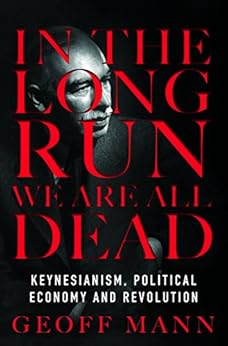
"In The Long Run We Are All Dead" - Geoff Mann

Amazon link

Maddeningly abstract and allusive, Geoff Mann's book situates Keynes within an intellectual arc stretching back to the French Revolution (1789-99) and Hegel's subsequent theorisation of its lessons for modern civilisation. A reminder of the shallowness of contemporary thinking about values, governance and the collapse of the neoliberal project.

Keynes is depicted as taking a stand against delusional neoclassical (and highly mathematicised) theories in which capitalism is assumed to be always at, or returning to equilibrium. Keynes sees the structural instabilities driving boom-bust cycles, highlighting the essential fragility of the 'civilised order'. His vision calls for conscious state action to underpin the conditions of existence of the masses, heading off a revolution of despair after which 'the deluge'.

The author shares many insights into the form elite ideology takes today, as expressed in newspapers, TV, radio and online. For example, the great issue of 'inequality' (a strangely recent concern) is actually a debate within the (bourgeois) middle-class reflecting the relative deprivation of the top 10% as compared to the super-rich 1% or 0.1% due to the neoliberal revolution and specifically the aftermath of 2008/9. The life-history of the broader working class, where unemployment, precarious employment and stagnant, low incomes remain endemic, rarely features in this debate.

Given that the entire history of anti-capitalist revolutions (over, say the last 200+ years) has been one of defeat and/or deeply unpleasant outcomes, the narrative of socialist revolution, the hopeful leap into the unknown, is completely uncompelling. An enlightened Keynesianism, seeking to save (liberal-democratic-capitalist) civilisation - by illiberal political means where necessary - may, in its final inadequacy, open the way to a more profound transformation of social relations. But we cannot assume a blueprint anywhere, and certainly not in the actually-existing Marxist canon.

Mann is too enamoured of fashionable moralistic crusading on climate change for my tastes and fails (as is usual with Marxist analysts) to factor in what we increasingly know about human nature through genomics, psychometrics and sociobiology. These omissions subtract from the force of his final conclusions, which are unnecessarily tentative. But taken as a whole the book is a tour de force of open-mindedness, synthesis and creativity.

See also: "When Keynes comes to town".

Monday, October 15, 2018

"In the Long Run ..." - Geoff Mann

Amazon link

I'm still working my way through this excellent book. Let me quote Michael's Roberts's thoughts from his blog entry, "Best books of 2017".
"Despite the power of Marx’s analysis, it is still the ideas of Keynes that dominate the thinking of heterodox economists in opposing the mainstream. And this is no accident.  In an excellent book, Geoff Mann from Simon Fraser University presents a sophisticated explanation of Keynes’ dominance in the labour and leftist movements.

In his, In the Long Run We Are All Dead, Geoff argues that Keynes rules because he offers a third way between socialist revolution and barbarism, i.e. the end of civilisation as ‘we (actually the bourgeois like Keynes) know it’. This appealed (and still appeals) to the leaders of the labour movement and ‘liberals’ wanting change.  Revolution is risky and we could all go down with it. Mann: “the Left wants democracy without populism, it wants transformational politics without the risks of transformation; it wants revolution without revolutionaries.” (p. 21).

What Mann argues is that Keynesian economics dominates the left despite its fallacies and failures because it expresses the fear that many of the leaders of the labour movement have about the masses and revolution.  As an example, read leading Keynesian, James Kwak’s latest book, Economism. Kwak quotes Keynes: “For the most part, I think that Capitalism, wisely managed, can probably be made more efficient for attaining economic ends than any alternative system yet in sight, but that in itself it is in many ways extremely objectionable. Our problem is to work out a social organisation which shall be as efficient as possible without offending our notions of a satisfactory way of life.” And Kwak comments: “That remains our challenge today.”

To be fair, it ain’t easy opting for an economic policy that threatens the established order. An inferno will follow from the bourgeois media and institutions. In the autobiographical book of the year, economist Yanis Varoufakis, Greek finance minister during the euro crisis of 2015, outlined the tortuous and labyrinthine encounters that he had with the Euro group in trying to combat the hell that the Troika of the IMF, ECB and EU aimed to impose on Greece.

Adults in the room, my battle with Europe’s deep establishment, is a personalised account, to say the least. Varoufakis’ analysis of the crisis and his justification for what happened (the capitulation of the Syriza government and his resignation from the government) bear all the hallmarks of his ‘erratic Marxism’ (as he calls himself). His battle was lost, but the war continues."
Here's my full review: "In The Long Run We Are All Dead" - Geoff Mann.

"Kingdom of the Wicked Book Two: Order" - Helen Dale

Amazon link

If "Kingdom of the Wicked Book One: Rules" was about establishing the setting - a high-tech Roman Empire in traditionalist Judea c. 31-33 AD - book two is about the ongoing clash of cultures. In truth, books one and two are just the one novel, with the second part being delayed due to the opaque and irritating rules of publishing.

Book one set up the trial of Jesus (Yeshua Ben Yusuf ) and explored its middle-eastern setting. The Romans look a lot like the Americans today. They're behind in electronics and ahead in genetic engineering. Our familiar western culture inherits judeo-christian hangs-up about sexuality and is 'blessed' with an overabundance of 'compassion'; the classical tradition of Greek and Roman paganism wasn't overly burdened with either.

Book 2 initiates Jesus's trial before Pilate. Evidence is presented in the form of backstories - well elaborated - embellishing the Jesus message and its rather startling effects on both Romans and the orthodox Jewish religious establishment. The Sanhedrin are the more bothered.

"Order" is a keen exploration of this culture clash. Dale tells the story through her well-drawn characters: the Romans are generally hedonistic, sexually inventive and uninhibited (this is not a story you could easily read aloud to your wife or servants); the Jews are extremely moralistic and sexually conservative - reminiscent of fifties America, or the Mormons.

We think we know the plot (the Bible) but the magic of "Kingdom of the Wicked" is that events flow organically from the novel's premises and are not artificially grafted on. Roman capitalism depended upon slavery being abolished (the Stoics were the movers and shakers there); the abolitionist movement also ended crucifixion as being grotesquely cruel. Jesus has not obviously committed a capital offence under Roman law (the affray in the Temple) but the political situation in Judea is deteriorating fast.

The ending is surprising, in more ways than one, but Dale brings it off. An excellent and thought-provoking book.

Friday, October 12, 2018

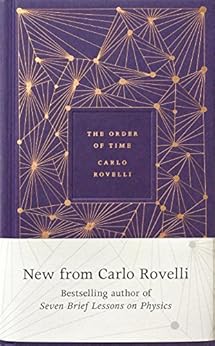
"The Order of Time" by Carlo Rovelli

Amazon link

Roy Simpson, who frequently comments here, sent me a review of the book above to post as a guest blogger. He wrote:
"Here is the review of the Rovelli book. ... I am hoping the Philip Ball book might arrive next week.

A remarkably hot topic right now is the Riemann Hypothesis since there are several (doubtful) claims that it has been solved. Since I haven't really studied this equation much, I am finding papers which make all rather interesting.

For example in 1949 Casimir used "zeta function regularization" in QFT to calculate his effect; then in 1976 Hawking used "zeta function regularization" to do most of his quantum black hole calculations. As I remarked in your blog

zeta (-1) = 1+2+3+4+  ... = -1/12

Also String theory requires 2/(2-D) = zeta(-1) for the number of Dimensions - giving D = 26!

The reason that this curious sum forms is because of (a) complex analytic continuation - taking a function out of its domain of definition in a unique way and (b) p-adic theory which messes up what is meant by "=" (zero distance) via a fractal like metric. So the interconnectedness of mathematics seems to be in evidence here (something the String Theorists are always proud of).."
Here is his review.

---

Review of C. Rovelli : The Order of Time (2018)

By Dr. Roy Simpson, October 2018

The small (214 page) book by Prof. Carlo Rovelli came to my attention as it featured in a “guest interview” in the blog of physicist S. Hossenfelder in August. That interview was conducted by a lawyer with an interest in physics and time and has generated at least 250 comments.

Rovelli has written several very poetic, but informative, popular physics books in recent years and this book continues that theme by discussing his approach to the question of “time” in physics.

In broad terms the book is divided into three parts: first the lessons from General Relativity on time; second the particular ideas about time proposed by Rovelli from his work on Quantum Gravity; third some broader statements about the philosophy of time. None of these parts conveys the details of the theory that a student of physics or a practising physicist would wish (although there are some equations in the notes), but it does all provide a general overview of where Rovelli's thinking is with respect to “Time in Physics” for a general audience. There are links in the end-notes to detailed papers by Rovelli and books by others which can be studied later.

To understand Rovelli's view of physics we should begin by recognising that he is the author of (another) Interpretation of Quantum Mechanics called “The Relational Interpretation”. The underlying idea here was to spread the relational arguments which drove the development of special relativity (time being relative to observers and frames) onto quantum observers and onto physics theories in general. The quantum interpretation that results has some similarity to the original Everett Interpretation, but without the many worlds. He does not believe that “measurement” is a real activity, but only interactions between quantum objects is real. As evident from Part two his relational viewpoint also applies to physics concepts like Entropy – where he emphasises “Relative Entropy” between two subsystems.

To understand why Time is important we also need to understand his research starting point: Quantum Gravity and an associated equation from the 1960s now called the Wheeler-DeWitt equation. Rovelli is also the author of a rival (to String Theory) theory of quantum gravity called “Loop Quantum Gravity” which originated from the Wheeler-DeWitt equation (the latter equation plays no role in String theory, as yet).

The Wheeler-Dewitt equation was derived by making many assumptions in a 1960s attempt at a quantization of General Relativity. This equation was thus a kind of “Schrodinger Equation” for General Relativity, generated by advanced versions of the quantization procedures found in Quantum Mechanics textbooks. Now the Schrodinger equation, in its full dynamic form, is a time dependent equation concerning the wavefunction Ψ(q1,q2,q3;t) where (q1,q2,q3) are position variables and t is the usual Newtonian time parameter. In the Wheeler-DeWitt equation, in which the system quantized is all of general relativity Ψ becomes Ψ(g_ij(p)). Here p is an event in space-time and g_ij is (derived from) the general relativity metric (distance function). The equation becomes a so-called functional equation in the function (of position and time) g_ij(p). Furthermore this derivation requires (perhaps fortunately) that the Schrodinger time parameter t disappears.

In short the Wheeler-DeWitt equation is timeless - Ψ once calculated never changes and this Ψ is meant to describe the entire Universe – for all time! This is known as the “problem of time” in Quantum Gravity, and is especially relevant to the approach taken by Rovelli.

Now time is still present in this model via the metric g_ij(p) and so is introduced the idea of “external variables” and “internal variables” - in particular “internal time”. Thus in the Rovelli approach time is not a fundamental feature of physics but an emergent concept, which he believes can be understood taking a relational approach. The more fundamental concept he calls “change”.

So in Part One of the book Rovelli is reviewing the results of General Relativity (such as the effect of location in a gravitational field on clocks) and presents this as evidence that in standard physics time should be considered as relative, forming part of a network of time. There is no “order of time” amongst the clocks in General Relativity due to lack of simultaneity etc.

In Part Two Rovelli discusses Entropy (also part of the physics discussion of time) and introduces his equation for “thermal time” - which is a time simply derived from the state of a dynamic thermal system, effectively by inverting the usual equation for the dynamical evolution of a thermal system.

Again thermal subsystems have a relative entropy. There is also a quantum version of the same idea. Interestingly an experiment was reported in 2013 that entangled two photons in such a way that photon A used photon B as a local clock, suggesting that hiding inside “quantum entanglement” could be an emergent notion of clock and thus time.

Another consequence of the work on the Wheeler-DeWitt equation is that there can be quantum solutions in which no emergent time forms. Thus time is not even Universal (in the way that “change” might be) as is commonly assumed in physics and “common sense” (naïve intuition). Rovelli makes some remarks about this, but deeper analysis is needed to understand all of this.

Rovelli takes the view that we are on the cusp of more breakthroughs in time research. We shall see.

Thursday, October 11, 2018

When Keynes comes to town

Amazon link

Maddeningly abstract and allusive, Geoff Mann's book situates Keynes within an intellectual arc stretching back to the French Revolution (1789-99) and Hegel's subsequent theorisation of its lessons for modern civilisation. A reminder of the shallowness of contemporary thinking about values, governance and the collapse of the neoliberal project.

Keynes is depicted as taking a stand against delusional neoclassical (and highly mathematicised) theories in which capitalism is assumed to be always at, or returning to equilibrium. Keynes sees the structural instabilities driving boom-bust cycles, highlighting the essential fragility of the 'civilised order'. His vision calls for conscious state action to underpin the conditions of existence of the masses, heading off a revolution of despair after which the deluge.

I have reviewed the book here: "In The Long Run We Are All Dead" - Geoff Mann.

It prompts this analysis of our contemporary predicament in the spirit of Mann's thinking.

---

Social Justice Warriors vs the Populists

There was a time when I did not regularly throw my shoes at the television set, when the TV and print media had not yet morphed into latter-day Pravdas.

It was the time before neoliberalism’s decline, before the great crash of 2008.

First had come the sixties transition from post-war factory-capitalism, familiar from a thousand Stalinist agitprop posters. No more conveyor-belt mass-production 'on the track'. The new middle-class economy was fragmented, individualistic and complicated. It wanted mass university education and greedily consumed its output. Not that those jobs were particularly well paid.

And so were sown the seeds of elite overproduction.

Neoliberalism took recognisable shape in the 1980s, a pivot away from national industrial capitalisms towards a frictionless world with international just-in-time supply chains and global capital flows. The opportunities to seek profitable investment opportunities and attain economies of scale rewarded some industries more than others: high tech and finance to name two.

Naturally there was an inspiring vision to accompany globalisation. It postulated a world without borders, where all impediments to the free availability of factors of production should be removed: no tariffs and no irritating state/legal restrictions.

The vision ordained that outdated prejudices limiting international access to labour should be abolished. Free migration! No cultural barriers! No acknowledgement could be made that any performance differences due to race, gender, sexuality, age etc might have any biological/genetic causation. Differences in outcome were always and everywhere to be understood as socially-constructed pernicious hangovers - to be abolished in the name of an enlightened neoliberalism!

Thus was born the phenomenon of the social justice warrior (SJW), prepped to fight those dinosaurs who hadn't yet got the memo.

Since 2008/9 global economic growth in the advanced capitalist countries has been anaemic. Profitability has been poor and the neoliberalism project has been fraying. Those never signed up in the first place, most specifically the non-graduate industrial working class were getting restive as their communities, workplaces and personal prospects got trashed. And so arose their inchoate political voice: Populism.

Those who were meant to be the foot-soldiers of globalisation (all those idealistic young social science graduates) were increasingly abandoned by a failing project on the defensive. They formed that new class fraction, the precariat. Of course they doubled-down on the SJW vision, feeling betrayed. They are the scarily militant snowflakes of the Labour Party's Momentum organisation .. and similar movements in other countries.

The SJW programme, increasingly absurd, continues to infiltrate the mainstream media and leftist politics. It has nothing whatsoever to do with anti-capitalism, despite its seemingly leftist credentials. It is the anguished shriek of a decaying neoliberalism.*

The Populist-SJW conflicts are global, though taking different forms and tempos in North America, Latin America and the different countries in Europe. In some cases (France) the neoliberal cause is still somewhat in the ascendant (Macron). In most countries though, the neoliberal elites are on the defensive.

Neither side has a programme which can work. Classical neoliberalism is discredited: its globalist-individualism falters while continuing to cause too much collateral damage. The elites fear disruption; they sense the masses stirring. Yet there can be no return to fifties-style nation-state economies.

There will be no proletarian revolution. Capitalism will find a new modus operandi. It will not be the re-establishment of a resurgent neoliberalism. This is a struggle of years as there is no simple solution, no way forward which does not succeed in defeating powerful vested interests.

Most likely is the theme Mann develops in his book, a Keynesian, somewhat covert counter-revolution. The result: a more hands on, activist state creating institutional forms fostering inclusivity for restive groups currently felt irrelevant and disposable by internationalist capital. Theresa May understood this in her much ignored remark that making Brexit work was the only way of saving the neoliberal project.

In the UK, both Corbynism and May-style conservatism are groping towards this solution. It will place constraints on the free disposition of capital and it will be expensive. You can see why powerful (but short-sighted) forces resist this new direction.

But the re-integration of the 60% plus of the population who are not graduates and that larger part of the more educated 40% who have been abandoned by the real elites requires it. The challenge is to develop a programme which addresses both constituencies: in the UK Labour and Conservatives engage from different directions.

But painfully, in fits and starts, with much conflict and perhaps violence, this is where we will end up, maybe a decade out.

---

* Ideologies take on a life of their own. Ideological 'praxis' exhibits a relative autonomy from the material conditions which elicit it.

Put more plainly, even though the SJW agenda derives from and serves the purposes of the neoliberal project, it occasionally bites the hand that nurtures it. Sometimes its logic undermines that project.

Notice the liberal media indulgently rowing back from episodes of overreach. It's usually a humourous demurral and no general conclusions will be drawn.

Monday, October 08, 2018

Using Google Photo Books

(And now you decide to study them?)

Google Photos has a new tab: Photo books. This allows you to get an album printed out and delivered to your door in hard copy as an exciting glossy photo album. I decided that such an album would make a nice memento of our recent trip to Egypt.
18 x 18 cm soft-cover book: £11.99 for 20 pages, £0.49 per add. page, up to 100 pages.

23 x 23 cm hardcover book: £22.99 for 20 pages, £0.69 per add. page, up to 100 pages.

VAT included. Shipping not included.
I went for a soft-cover book of fifty photos. With one photo per page, this was fifty pages for around £12 + £15 = £27. Plus shipping.

Setting up the book in preview mode took about an hour. Google recommends photos (that AI working again!) from your selected album but you can delete some of those suggested and add others.

Each photo can be sized from small to page-filling - as you choose differently-sized versions Google auto-crops, which you may or may not like but you seem to be stuck with its choice (I could be wrong).

You can write an optional caption per photo - I didn't bother. Using drag and drop you can reorder photos.

After a week transiting from Germany, the album arrived this morning. Here's what it looked like.

The hedgehog is ours

The cover: Karnak Temple in Luxor - Google's suggestion

A delighted Clare shows internal pages:

Cleopatra with her son (left) and a Temple picture

The quality of the prints is very good, even the close-cropped ones where the program had warned that there might be blurring due to poor resolution.

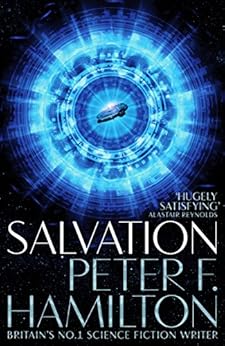
"Salvation" - Peter Hamilton

Amazon link

Fifty eight reviews already at Amazon at time of writing.

This, the first of another door-stopping trilogy, is a mid-future space opera set in a world structured by instantaneous transfer portals ('spatial entanglement' - nope, wouldn't work, should have stuck with wormholes).

Humankind has terraformed and colonised the planets around a number of the nearer stars (you still need a spacecraft to emplace that far gate). The Earth and most planets are dominated by the amoral-capitalist Connexion portal-monopoly ("one step away"), run as a benign despotism by its aged founder.

There is also a parallel civilization of planets and habitats run by the new communists, the Utopials with their gene-fixed gender-fluidity. Does this nod to contemporary identity-politics add any value? It's not clear.

And there are aliens. The religious ones in their arkship, making stopover in the solar system to top up their antimatter tanks while bestowing alien biotech in payment. They're on a trip to eternity to meet their final God. But are they as altruistic and well-meaning as they appear?

Then there are the other ones, who've inserted four humanoid agents into Earth's society. Why? In terms of the novel's characters who are they? Good or bad?

The central dynamic of the novel is the discovery of an unknown alien spacecraft which has crash landed on a newly discovered planet. The discovery team soon determine that the spacecraft contains unknown humans in hibernation pods. Were they abducted? Who are they? What does this mean?

A collection of top people from the various factions who really rule the human universe are sent in a luxurious land-cruiser to investigate, under top quarantine security. This is to prevent any alien incursion into the human datasphere. The journey takes several days which affords an opportunity - in the style of the Canterbury Tales - for each character to recount their back history.

What follows is a series of engaging short stories, techno-thrillers with plenty of mercenaries, espionage, terrorism, kidnappings and high-tech in the trade-mark Hamilton style. When they reach the spacecraft the plot twist kicks in, setting up the next volume.

There is a parallel storyline set hundreds of years in the further future. A group of adolescents is being trained as genetically-enhanced warriors to combat aliens which remorselessly hunt humans throughout the galaxy. Something bad has already happened in these people's past and they only dimly remember the characters we spend so much time with as 'Saints'. I agreed with those reviewers who assess this thread as the weakest part of the novel, lacking colour and intrinsic interest, with bland characters who do not really engage your interest.

After a slow start where one is continually trying to remember weird names devoid of context, the book picks up through the back stories, each of which is quite exciting. I'll certainly be looking at volume 2 when it arrives.

Other thoughts. There is plenty of homage to other works of science fiction. The future troops' training is straight out of Ender's Game; their warships have names like Morgan and McAuley; the house with rooms in different worlds is like the Hyperion Cantos.

I'm appreciative of Hamilton's political skepticism. He doesn't like ideologies, seeing them as weapons against actually-existing humanity. His Utopials, exemplifying politically-correct liberalism, are creepily self-righteous and rather repulsive. Is there a broader message here, some zeitgeist-concern which Hamilton is seeking to address?

In an interview with SyFyWire, Hamilton said, "To some degree it's about the level of trust and mistrust that's developing in the the political arena, with everyone suspicious of anyone who isn't on their side. I managed to blend that paranoia with a whodunnit as five people from different factions embark on a trip together ."

---

Here's an extract from the Kirkus review:
"Early in the 23rd century, when a wrecked alien ship turns up on a remote planet, the all-powerful Connexion Corp, which provides instantaneous travel via quantum-entangled, step-through portals, organizes a team to investigate: security chief Feriton Kayne; Connexion bigwig Yuri Alster; Callum Hepburn, who works for the Utopials, an independent human civilization; Alik Monday, an FBI operative from Corporate Earth; and various assistants.

What’s aboard the alien vessel proves both difficult to fathom and extremely unnerving. The actual investigation moves at glacial speed, though, interspersed as it is with backstories involving team members plus chapters in an independent thread set in the far future, where child soldiers train to meet a mysterious and all-conquering alien enemy.

In the present, meanwhile, we hear about two sets of aliens. The nonhuman Olyix have stopped off at Earth to refuel on their endless voyage across the universe, where, at the end of time, they expect to meet their god; they seem benevolent, but not everyone agrees. The Neána, whom readers know about but none of the characters may, arrived secretly some years ago, grew some human bodies, and sent them out to do—what?

So, readers will contend with a choppy narrative, obvious delays and sidebars, and long stretches that read like an editor’s advice to a first novelist on how not to introduce your characters or propel the storyline and veer dangerously close to dull. It’s a yarn, however, that packs a teeth-rattling wallop when it finally gets there."
---

Sunday, October 07, 2018

"Beyond Weird" - Philip Ball

Amazon link

I mentioned Peter Woit's generally favourable review of this book in a previous post.

"Beyond Weird", despite its cheesy title, makes a good impression from the very start. Ball is an engaging writer who knows his stuff and doesn't patronise the reader. It's like he's talking to a curious colleague who uses quantum theory (a chemist or applied physicist, for example) but doesn't research it. The tone would work well for a recent physics graduate or someone in the final stages of their QM course.

The problem with quantum mechanics is that the mathematics makes plenty of sense in itself (Schrödinger's equation and its many solutions in concrete circumstances such as the structure and behaviour of the hydrogen atom, for example)  but the many constructs of the theoretical apparatus don't align with any compelling concept of 'reality'. To properly engage with the 'interpretation problem' you have to understand the maths, which means taking a course first.

Before I studied quantum mechanics (with the Open University - SM358) I thought I had a grasp - as an educated person with a technical background - of quantum theory, at least at a conceptual level. I knew, or thought I knew, about the uncertainty principle, the wave function and its collapse, the double slit experiment and its paradoxical interpretation and so on.

I spent the first third of my QM course learning a lot of details about Schrödinger's equation in its time dependent and stationary forms, about spin spaces, kets, operators, expansions in terms of eigenfunctions, Hilbert spaces and so on. I was internalising this complex apparatus and making it work and I couldn't anchor any of it into the real world. I was confused, baffled, a sufferer from extreme cognitive dissonance. It was not pleasant.

Eventually I managed to organise all this stuff into something which kind of made internal sense, and kept reminding myself that in the end its only function was to produce a number between zero and one as regards observable outcomes. I had become acculturated, but I still didn't know what any of it really told me about reality.

And I think that only after this 'preparation' is a reader really able to engage profitably with Philip Ball's book.

Ball is good on superpositions and what it would mean if they were observable. He's as good as you could expect on decoherence and einselection, although it would have been useful to have had a more explanatory appendix given its centrality in accounting for 'collapse' (but perhaps that's more a signifier for my own lack of clarity). He is also good at debunking some of the more ontological-realist views of the wavefunction. There are also clear accounts of Bell's theorem and quantum computing.

And then it starts to unravel. Ball clearly has a thing about the many-worlds interpretation (which has a stronghold at his alma mater, Oxford). His customary cool deserts him for visceral distaste. His debunking is anticlimactic, however, depending on philosophical sophistry about identity-continuity before and after 'splitting' of worlds. The MWI does not hang on such arguments.

In the final chapters things get worse. Ball's enthusiasm for 'it from bit', an information-centric approach to the interpretation problem, gets the better of him. Unfortunately the ideas swirling around in this currently active area of investigation are even more formless and confusing than the more conventional ideas he's been debunking all along. We finish the book shaking our heads and asking, 'What was that about?'.

If you read one book on the interpretation of quantum mechanics, and you have studied QM as an undergraduate, this may well be the book for you. It will confirm that you were right to be concerned that the Copenhagen stuff you were taught does not put an end to the discussion, and it will straighten out and firm up many of your questions and half-formed, tentative conclusions.

Just don't think it will give you any final answers: there are none.

---

See also Roy Simpson's review: "A second review of "Beyond Weird" by Philip Ball".