Monday, April 11, 2016

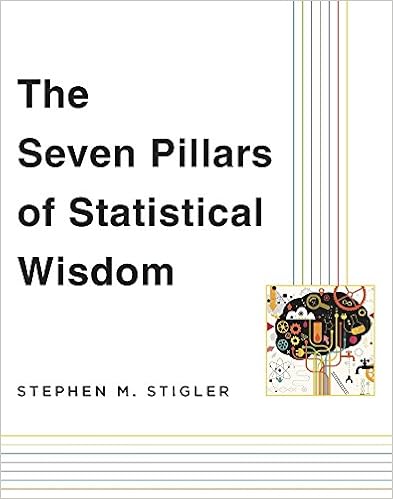
"The Seven Pillars of Statistical Wisdom" by Stephen M. Stigler

A review of: "The Seven Pillars of Statistical Wisdom" by Stephen M. Stigler.


Every student of an abstract subject like maths, physics or even philosophy is familiar with this: you are introduced to a foundational concept yet it seems pretty counterintuitive, and you can think of a number of reasons why the said concept ought to be considered problematic. Yet somehow, the textbooks are less than sympathetic.

My advice is to check the history of the under-motivated concept. The original formulations were often so much more compelling, especially when you realise precisely what problem their authors were trying to solve. Your own misgivings may well be represented in critiques by the innovator’s contemporaries.

It was the very success of later generations which led to the wholesale reconceptualisation of their subject’s foundations.

And so it is with statistics, a subject where deep ideas are often obscured by a focus on technique, and where it sometimes seems that little distinguishes a correct line of argument from an equally plausible, but fallacious, alternative.

Professor Stephen Stigler, in this determinedly historical book, starts with a concept as apparently trivial as the mean, or average, of a sequence of observations. Even this is counterintuitive as it requires discarding information, the individuality of the observations. By what right are ‘bad’ measurements to be treated in the same way as ones we think, or know, to be of higher quality? It took quite a few years for the idea to catch on.

Stigler’s second pillar, information measurement, looks at the processing of large data sets. Opinion polls have made us somewhat aware that the accuracy of the proposed mean is proportional to the square root of the number of observations, not the absolute number.

Sampling was applied to the Royal Mint in Isaac Newton’s time, to ensure that the coins they produced used the right amount of gold. In the absence of a correct theory of standard deviation, the tolerance boundaries were set way too wide. Stigler dryly notes that Newton was warden, then master of the Royal Mint from 1696 to 1727 and that on his death in that year left a sizeable fortune. “But evidently his wealth can be attributed to investments, and there is no reason to cast suspicion that he had seen the flaw in the Mint’s procedures and exploited it for personal gain.”

Later chapters deal with hypothesis testing (pillar 3); statistical processing within the dataset itself, without reference to population norms – as in Student’s t-test (pillar 4); regression to the mean - a concept which proved very hard to pin down (pillar 5); experimental design, particularly when varying multiple qualities at the same time (pillar 6); and finally pillar 7, the notion that a complicated phenomenon may be simplified by subtracting the effect of known causes, leaving a residual phenomenon to which attention may now be focused.

If you are both interested and well-versed in statistics, you will find this book illuminating and witty. The converse also applies.


Saturday, April 09, 2016

People-searching with Google Photos and VPN

Google Photos sorts your pictures into albums based on places and features. In the States, it will also set up albums of people, who you can tag by name. Misguided privacy laws outside of North America have led Google to disable this facial-recognition feature there. But it's quite useful.

This was the proximate reason I was keen to set up a VPN on my android devices, to relocate me virtually to the States. Here's the procedure:
"A footnote on the Google Photos website says that “[Facial recognition] feature isn’t available in all countries,” probably due to privacy laws, but there’s a simple workaround that will help you bring face detection in your Google Photos, no matter where you are.

  1. Go to your Android phone settings, select “Apps”, then select “Photos” under the “Downloaded” section and click the “Clear Data” button to reset your Google Photos app.
  2. Go to the Google Play store and download TunnelBear or Hola or any of your favorite VPN apps.
  3. Open the VPN app and connect. It will essentially trick Photos into thinking that you are connecting from US, a country that is supported by Google Photos for facial recognition.
  4. Open the Google Photos app, scroll past the wizard screen and then under Settings, enable the option that says “Group Similar Faces – Auto Group photos by matching faces.”

"That’s it.

"Disable, or even uninstall, the VPN app, launch Google Photos again and tap the blue search button. You should see a list of faces that Google Photos was able to detect from your uploaded photos. And the feature will automatically become available on photos.google.com as well."
It all works though you have to give the Google AI machine sufficient time to search and catalogue your photos - a few hours should do it.

---

Being as I had the VPN, I was able to track down the scurrilous story of the 'British celebrity threesome injunction scandal'. While obviously I have no interest in prurient tittle-tattle, I take this as a challenge to my Internet skills.

In fact this story is not all over the American media. The mainstream papers don't want to gratuitously undermine a British legal decision. It was left to the ******** ******** to splash the story on its front page. Naturally I can't let you in on the secret.

---

In unrelated news, I spent a large part of yesterday preparing for our upcoming holiday where we'll take in the Tour de Yorkshire, the moors, Scarborough, Whitby and York. Naturally we've made arrangements for the cat who can miss us terribly.

Clare reviewed my admin document, strewn with parking places and GPS coordinates. How she laughed! Never watch the sausages being made, I say ... .

We're not the only ones contemplating the virtues of a holiday.

Problems connecting VPN app (Android + Twilight)

I installed a couple of VPN apps (VyprVPN and FlashVPN) on my Nexus 6 and Nexus 10 devices. Trying to connect, I got an Android pop-up asking me to confirm I wanted to make the VPN connection [options: 'Cancel' - 'OK'].

The 'OK' button was unresponsive, I had to press 'Cancel'. Took some Internet searching to discover that the problem was Twilight, the screen-dimming app which runs as an overlay. Turns out it was masking the button from Android.

Twilight interferes with other apps too, such as Microsoft's Word for Android.

The solution is just to open Twilight and turn the app off (or use a force stop in 'Settings'). Twilight is useful in the evenings, but should always be a suspect if something is going a little awry.

---

Keywords: problem connecting with VPN

Thursday, April 07, 2016

Today's links

Around the Internet today for your amusement and education.

1. 10 Essentials of Quantum Mechanics

As the title suggests, Backreaction lists ten key points. It's a bit subjective as to which is the greatest misconception corrected here, but I'd vote for number 4.
"4. There is no spooky action at a distance

"Nowhere in quantum mechanics is information ever transmitted non-locally, so that it jumps over a stretch of space without having to go through all places in between. Entanglement is itself non-local, but it doesn’t do any action – it is a correlation that is not connected to non-local transfer of information or any other observable.

"It was a great confusion in the early days of quantum mechanics, but we know today that the theory can be made perfectly compatible with Einstein’s theory of Special Relativity in which information cannot be transferred faster than the speed of light."

2. A spat about increasing human IQ

Why did Scott Alexander (Slate Star Codex), Garrett Jones (Hive Mind), and Razib Khan (GNXP) even bother to alert Steve Hsu to this pernicious post, and who is PZ Myers anyway?

Whatever - Professor Hsu gives a reasoned and educational reply.
"Myers is both confused and insulting in his blog post, but I'll refrain from ad hominem attacks, and just focus on the science.

Myers seems to think that humans with much better cognitive abilities than our own can't exist. Sort of like a farmer in 1957 claiming that chickens that are bigger and faster maturing than his own could not exist [...] . I urge Myers to read some books on population genetics before returning to this discussion.

"The argument for why there are probably genomes not very different from our own, but which lead to much better cognitive ability, is very simple, and I went through it in a post called Explain it to me like I'm five years old [...] ."
Worth following the link even if you're older than five.

3. A spat about the KKK on campus (Indiana University)

Via Breitbart (h/t Steve Sailer).
 'Students be careful, there's someone walking around in kkk gear with a whip.'

"Residential hall advisor Ethan Gill quickly wrote an email to his students, warning them of the “threat” on campus: “There has been a person reported walking around campus in a KKK outfit holding a whip. Because the person is protected under first amendment rights, IUPD cannot remove this person from campus unless an act of violence is committed. Please PLEASE PLEASE be careful out there tonight, always be with someone and if you have no dire reason to be out of the building, I would recommend staying indoors if you’re alone.”

"Later in the evening, Gill was forced to retract his warning on his Facebook page, where he clarified that the purported Klansman was actually just an innocent priest dressed in liturgical garments. The “whip” turned out to be the clergyman’s robe-like belt that was tied around his waist."


Are there no safe spaces anywhere any more? Will no-one think of the children?

Wednesday, April 06, 2016

Drink was invented just in time


Self-control has always been valued in human affairs. No collaborative scheme can ever survive if everyone does exactly as they please.

Arguably, as civilization developed in the post-Neolithic, the premium attached to self-control grew, as social relationships straddled ever greater divides of time, place and class.

Death to the insolent and the hot-headed!

Conscientiousness is ever the enemy of spontaneity. Cold planning replaces warm emotion. How do we ever know what a person really thinks, if all we see is their reasoned, prosocial persona?

Self-control undermines social-bonding, replaces affinity with transactional logic. There are no real friends, only 'colleagues' and 'business partners'.

But no-one likes the calculated relationship. Does she love me or is this just manipulation - or worse, could it be that she's just making the best of it?

We need to close down the neocortex, turn off the calculation, erase forward-thinking, 'be ourselves'.

In vino veritas.

It was therefore very fortunate that the Neolithic revolution invented alcohol along with civilization, or we might well have all died out by now in atomised solitude.

---

Notes

1. Turning off prosocial norms is not without risk

Alcohol is a blunt instrument - and blunt instruments can kill. All cultures which have had to live with inebriation evolved biochemical pathways to mitigate its effects - alcohol tolerance.
"The tolerance to alcohol is not equally distributed throughout the world's population, and genetics of alcohol dehydrogenase indicate resistance has arisen independently in different cultures. In North America, Native Americans have the highest probability of developing alcoholism compared to Europeans and Asians." [Wikipedia].
2. The connection between alcohol use and personality type

You might expect that the trade-offs between self-control/rationality and alcohol-induced spontaneity would vary across different personality types. And you would be right.
"Many studies have shown the importance of personality traits as factors related to alcohol use and misuse. The relationship between personality traits and alcohol consumption was studied in a sample of 149 non-alcoholic women using the Karolinska Scales of Personality (KSP) and the Eysenck Personality Questionnaire-Revised (EPQ-R).

"The results showed positive correlations between alcohol consumption and disinhibitory personality traits (sensation seeking, impulsivity, psychopathy, nonconformity) and dimensions (psychoticism and extraversion). Sensation seeking combined with impulsivity were the strongest predictors of alcohol consumption. Anxiety-related traits and neuroticism were not related to alcohol frequency/amount of alcohol use."
3. The social construction of 'drinking'

If alcohol mediates the uncertain line between high-minded prosocial ideals of behaviour and our underlying biological reality (social animals with the usual drives in the engine room) then drinking is clearly going to be the subject of much social construction.

I only draw your attention to 'social drinking', which moderately and tastefully lowers social inhibitions in a controlled way, and 'binge drinking' which ... er ... doesn't.

Tuesday, April 05, 2016

It's spring: time to order the kilt!

Since I discovered my male (Y-chromosome) lineage descends from the High Kings of Ireland I have been considering ordering a kilt, (yes, the Irish wear kilts too).

This is not just a matter of clan loyalty: kilts are more comfortable than trousers in the warmer weather.

But there are some social issues: Peter Turchin observes,
"To convince you of the primacy of social factors I urge you to check out this extremely funny site, Bravehearts in Kilts Against Trouser Tyranny:

"This site is hilarious not because the Bravehearts in Kilts are stupid, but precisely for the opposite reason. Once you have read their passionate defense of the kilt, you (at least if you are a male) will realize that it is us, pant-wearers, who are stupid. In warm climates or during summers in the temperate zone the kilt is much more comfortable to wear than jeans."


I have put off buying my summer kilt until I have figured out the right green-shaded clan tartan. Don't want to get on the wrong side of some exceedingly ferocious fighters!

--

Nobody in antiquity wore trousers except barbarians. Peter Turchin again:
"The basic garment worn by the Greeks was the chiton (basically, same as the Roman tunic). And wearing ‘sacks’ around their legs was something that only barbarians did. The Romans of the Classical Age felt the same way. Citizens were required to wear togas for any official functions, and at other times (e.g., for war) they wore tunics.
...

"Why did the Italians switch from tunics to pants? The answer is the horse. Not only are the horses responsible for why we live in complex, large-scale societies (or, at least, how such large-scale societies first evolved), they are also the reason why males have to swelter in pants in summer, instead of wearing the cool kilt. As I will discuss in my next blog, there is an exceedingly close historical correlation between the adoption of cavalry and switching to wearing pants."
Part II of Peter Turchin's illuminating article here.

Tribes are the thing in the atomised West

Scott Alexander considers the power of ideologies (warning: long but interesting essay including American-themed topics):
"Why is there such a strong Sunni/Shia divide?

"I know the Comparative Religion 101 answer. The early Muslims were debating who was the rightful caliph. Some of them said Abu Bakr, others said Ali, and the dispute has been going on ever since. On the other hand, that was fourteen hundred years ago, both candidates are long dead, and there’s no more caliphate. You’d think maybe they’d let the matter rest.

"Sure, the two groups have slightly different hadith and schools of jurisprudence, but how many Muslims even know which school of jurisprudence they’re supposed to be following? It seems like a pretty minor thing to have centuries of animus over."
We can say the same thing about other apparently-religious conflicts, such as the Protestant-Catholic divide in northern Ireland and some parts of Scotland. But Alexander probes more deeply:
"Nations, religions, cults, gangs, subcultures, fraternal societies, internet communities, political parties, social movements – these are all really different, but they also have some deep similarities.

"They’re all groups of people. They all combine comradery within the group with a tendency to dislike other groups of the same type. They all tend to have a stated purpose, like electing a candidate or worshipping a deity, but also serve a very important role as impromptu social clubs whose members mostly interact with one another instead of outsiders. They all develop an internal culture such that members of the groups often like the same foods, wear the same clothing, play the same sports, and have the same philosophical beliefs as other members of the group – even when there are only tenuous links or no links at all to the stated purpose.

"They all tend to develop sort of legendary histories, where they celebrate and exaggerate the deeds of the groups’ founders and past champions. And they all tend to inspire something like patriotism, where people are proud of their group membership and express that pride through conspicuous use of group symbols, group songs, et cetera. For better or worse, the standard way to refer to this category of thing is “tribe”."
It doesn't take much to generate a sense of tribal camaraderie. I've previously remarked about the benefits of membership of the International Marxist Group in my early twenties: a shared culture of mostly-fun activities .. and guaranteed weekend parties.

Scott Alexander applies this insight to the Shia-Sunni conflict:
"I know very little about early Islam and am relying on sources that might be biased, so don’t declare a fatwa against me if I turn out to be wrong, but it looks like from the beginning there were big pre-existing differences between proto-Shia and proto-Sunni. A lot of Ali’s earliest supporters were original Muslims who had known Mohammed personally, and a lot of Abu Bakr’s earliest supporters were later Muslims high up in the Meccan/Medinan political establishment who’d converted only after it became convenient to do so.

"It’s really easy to imagine cultural, social, and personality differences between these two groups. Probably members in each group already knew one another pretty well, and already had ill feelings towards members of the other, without necessarily being able to draw the group borders clearly or put their exact differences into words. Maybe it was “those goody-goodies who are always going on about how close to Mohammed they were but have no practical governing ability” versus “those sellouts who don’t really believe in Islam and just want to keep playing their political games”.

Then came the rallying flag: a political disagreement over the succession. One group called themselves “the party of Ali”, whose Arabic translation “Shiatu Ali” eventually ended up as just “Shia”. The other group won and called itself “the traditional orthodox group”, in Arabic “Sunni”.

"Instead of a vague sense of “I wonder whether that guy there is one of those goody-goodies always talking about Mohammed, or whether he’s a practical type interested in good governance”, people could just ask “Are you for Abu Bakr or Ali?” and later “Are you Sunni or Shia?” Also at some point, I’m not exactly sure how, most of the Sunni ended up in Arabia and most of the Shia ended up in Iraq and Iran, after which I think some pre-existing Iraqi/Iranian vs. Arab cultural differences got absorbed into the Sunni/Shia mix too.

"Then came development. Both groups developed elaborate mythologies lionizing their founders. The Sunni got the history of the “rightly-guided caliphs”, the Shia exaggerated the first few imams to legendary proportions. They developed grievances against each other; according to Shia history, the Sunnis killed eleven of their twelve leaders, with the twelfth escaping only when God directly plucked him out of the world to serve as a future Messiah.

"They developed different schools of hadith interpretation and jurisprudence and debated the differences ad nauseum with each other for hundreds of years. A lot of Shia theology is in Farsi; Sunni theology is entirely in Arabic. Sunni clergy usually dress in white; Shia clergy usually dress in black and green. Not all of these were deliberately done in opposition to one another; most were just a consequence of the two camps being walled off from one another and so allowed to develop cultures independently.

"Obviously the split hasn’t dissolved yet, but it’s worth looking at similar splits that have. Catholicism vs. Protestantism is still a going concern in a few places like Ireland, but it’s nowhere near the total wars of the 17th century [...]."
Like I said, it's a long essay which, with the comments, covers atheism, evangelical christianity, rationalism, science-fiction and video gaming subcultures, and cultural appropriation (some good points about that).

Alexander's take home message?
"My title for this post is also my preferred summary: the ideology is not the movement. Or, more jargonishly – the rallying flag is not the tribe. People are just trying to find a tribe for themselves and keep it intact. This often involves defending an ideology they might not be tempted to defend for any other reason. This doesn’t make them bad, and it may not even necessarily mean their tribe deserves to go extinct. I’m reluctant to say for sure whether I think it’s okay to maintain a tribe based on a faulty ideology, but I think it’s at least important to understand that these people are in a crappy situation with no good choices, and they deserve some pity.

"Some vital aspects of modern society – freedom of speech, freedom of criticism, access to multiple viewpoints, the existence of entryist tribes with explicit goals of invading and destroying competing tribes as problematic, and the overwhelming pressure to dissolve into the Generic Identity Of Modern Secular Consumerism – make maintaining tribal identities really hard these days. I think some of the most interesting sociological questions revolve around whether there are any ways around the practical and moral difficulties with tribalism, what social phenomena are explicable as the struggle of tribes to maintain themselves in the face of pressure, and whether tribalism continues to be a worthwhile or even a possible project at all."
Read the whole thing there.

Monday, April 04, 2016

The Amazon parcel problem

Alice and Bob are both signed up to Amazon Prime and each is expecting a parcel to be delivered to their respective apartment the very next day. The Amazon delivery person will arrive sometime in the ten hours from 9 am to 7 pm, but there's no more definite information. Let's say delivery has a uniform probability distribution.

Both Alice and Bob plan to be at home to collect the parcel, but each also wants to spend an hour in the bath from where, unfortunately, you can't answer the door.

Alice says,
"The chances of the Amazon guy turning up in any of the 10 hour-long slots is exactly the same. It therefore doesn't matter when I take my bath, I always have just a 1 in 10 chance of missing the parcel."
Bob says,
"I'll be taking my bath at 9 am. If I do that I've got a 9 in 10 chance of the Amazon guy coming later than that.

"But suppose I'm stupid enough to delay the bath till, say, 5 pm. Sure if the guy already came, I'm good. But assuming the parcel hasn't yet arrived, there's now a 50% chance I'll be in the bath when it arrives. I'd be insane to bathe then.

"It's always better to take a bath early when an Amazon parcel is due."
Who's right?

---

Update: (Tuesday, 5th April, 2.15 pm).

I'm  more interested in why Bob's argument might ever be considered psychologically plausible.

Let's say we get to 2 pm and the Amazon guy hasn't come. Then the probability per hour of the parcel arriving in the next five hours has doubled from 10% to 20%.

Definitely riskier to take that bath!

This assumes that Bob forgets the (on average) half the days that the parcel did in fact come earlier - he collected it or it arrived between 9am and 10am and he missed it, being in his bath.

But people have a past-future asymmetry; they forget the past but worry about the future. Early deliveries don't give much cause for worry; late deliveries generate increasing anxiety as the day progresses.

People remember things like that - the late days come to predominate in memory. And they have the higher per-hour probability distribution for when the parcel will eventually be delivered.

'Best to bathe earlier'.

Saturday, April 02, 2016

Heritability, correlation and prediction

We're told that intelligence is 60-80% heritable, and that personality is 40-60% heritable. In some hand-wavy way, we know that heritability captures the nature side of the nature-nurture contribution to traits.

But what does heritability really mean? It's a rather slippery concept. We'll get there by stages.

1. The contribution of genes to a phenotype

Let's take height as our running example (pretty much the same heritability as intelligence). Let's take a person with height P (P stands for phenotype - the measured trait). P is measured in inches away from the population mean height.

How did a person get to be that height? Nature and nurture, right?

We assume that the alleles the person got from their father contributes Xfather inches of height, Xmother counts the inches they received from their mother's alleles they inherited, and then there is a nurture - or environmental - term E inches. So their total height,
P = Xfather + Xmother + E.
Note these are genetic additive effects: each additional allele is plausibly assumed to make its independent contribution into raising or lowering X a fraction. Dominance and epistatic effects are neglected in this simplified conceptual model (in a polygenic trait, they tend not to be large).

Since we're measuring deviations from the mean, the average values across the population of Xfather, Xmother and E must all be zero. And so, therefore, must be the average value of P.

So without loss of generality, we assume Xfather, Xmother and E are normally distributed random variables with mean zero and variances as follows:
Var(Xfather) = Vadditive/2    -- each parent provides half the additive genetic 'input'

Var(Xmother) = Vadditive/2   -- each parent provides half the additive genetic 'input'

Var(E) = Venvironment.
So what is Var(P), the variance of height as we observe it in the population?
Var(P) = Var(Xfather) + Var(Xmother) + Var(E) +

        2Cov(Xfather, Xmother) + 2Cov(Xfather, E) + 2Cov(Xmother, E).
Messy, but if we assume Xfather, Xmother and E are independent, their covariances are zero, so
Var(P) = Var(Xfather) + Var(Xmother) + Var(E),

Vphenotype  = Vadditive + Venvironment
The fraction of the population phenotypic variation due to genetic, additive effects is then simply
h2 = Vadditive/Vphenotype = Vadditive/(Vadditive + Venvironment).
This is the definition of heritability, h2.

So if h2 is 0.5, then 50% of the variance in the phenotype is genetic in origin (additive-genetic, that is) and 50% is environmental (everything else).

Note that the more you reduce environmental variance, for example making sure that everyone's well-fed, properly educated and not knocked about, the more genetic differences predominate .. and heritability goes up. Not what the SJWs really want to hear!

---

2. Correlations

What is the correlation, ρ, between a parent and child for height?

If we have two random variables, A and B, the correlation between them is defined as follows:
ρ =  Cov(A,B)/√(Var(A) * Var(B)).
This is the standard definition.

In the case of one parent and their offspring, under some simplifying assumptions,
Cov(parent,offspring) = Vadditive/2
- this takes a few lines to work out, setting most of the Xfather, Xmother and E cross-terms to zero. It reflects the 50% of genetic material they have in common.

More obviously,
Var(parent) = Var(offspring) = Vphenotype,
So using the formula for ρ above,
ρ = (Vadditive/2) / Vphenotype = h2/2.
This shows that heritability is not the same as the correlation between a child and one of its parents.

In general, the correlation, ρ, on a trait between relatives is equal to the coefficient of relatedness times the heritability, ie ρ = rh2.

---

3. Predictions

If we know the height of both the parents, what's our best prediction of the height of their offspring? In our mind, we draw the best-fit regression line on the scatter-plot of parental-midpoint and offspring heights measured across the population.

If we centre the graph-axes at the mean values of the two populations (parental mid-point heights and offspring heights) then the regression line goes through the origin, with slope β. Then the equation of the regression line takes this simple form:
predicted-offspring-height = β * parental-midpoint-height
with both heights measured as inches in deviation from the respective means.

How do we compute β?

In this special case it turns out that β equals the heritability, so β  = h2. *

This should remind you of the Breeder's Equation.

---

Example: suppose the heritability of height is 0.673 and we know that one parent is 3 inches above the population mean while the other parent is 1 inch above the mean, what's the predicted (expected) height deviation from the mean for their child?
Answer: predicted-offspring-height = β * (3 + 1)/2 = 2h2 = 1.35 inches.
Yes, the child has regressed towards the mean.

---

This is problem 6.3 (p. 149) from 'Population Genetics: a concise guide' by John H. Gillespie, from which all the material above has been summarised.

---

* In general, β = ρ * (σy/σx) where x is the independent variable.

Friday, April 01, 2016

ISIS infosec seems to be rubbish

How ISIS does information security

CNN reports:
"Last summer, a French student was arrested in Paris on suspicion of a plot to take hostages at a concert hall. His name was Reda Hame. According to a transcript of his interrogation obtained by CNN, Hame claimed he had been provided weapons training, including in the use of Kalashnikovs, by Abaaoud in a park in Raqqa in early June. But he'd backed out of the plot when he arrived in France."
According to security researcher the grugq, CNN further reported:
"Hame also revealed to interrogators that ISIS had set up an elaborate encrypted communication system so that it could keep in touch with its European operatives.

"While with ISIS in Raqqa, he said he was instructed to encrypt communications with a software tool called “Truecrypt,” which authorities found on a thumb drive he had been given by Abaaoud. Hame said he had been taught to copy a message into the software, select an encryption option and then paste the message into a password-protected sharing site."
The grugq asks: "How Crap Is This System?"

It's pretty bad - Errata Security has a post suggesting how any half-decent intelligence agency might hack into this ISIS protocol.

ISIS won't have any autonomous cryptographic capabilities - you have to be a first-world state to do that kind of thing right. It's forced to use third party tools and systems. But it's very, very difficult as amateurs to design a system that the NSA, GCHQ or half a dozen other competent organisations can't address.

If the ISIS operatives are not using a VPN, then a 'listener on the wire' will get the IP addresses of dead-drop users. As Errata Security explained, TrueCrypt volumes are not hard to detect in transit. Metadata like IP addresses lead straight to identities. But I doubt that most VPNs are safe either, not when their logs and traffic can also be monitored.

Perhaps the bad guys should just send a courier, clunky as that sounds. But last I heard, couriers speak in plain, not ciphertext; they say that bugging with microphones is pretty good these days.

I like a one-time pad, but distributing it is the trick. If you send those very long random bit sequences on a USB drive, how do you know the intelligence services haven't covertly grabbed and copied it in transit? And then you're toast.

I begin to see why ISIS has been so singularly unsuccessful in the UK this last decade.

---

Note: from one of the comments: "Counterterror experts who reviewed this protocol tell me it reminds them of what al-Qaeda did for yrs: saving "drafts" in Yahoo inboxes" - (these were apparently in plaintext).

*Head-in-hands*.

---

Our transition to a Planetary Hospital

Interesting and reasonably accessible article via Jess Riedel, "Mutation and Human Exceptionalism: Our Future Genetic Load" by Michael Lynch, GENETICS March 1, 2016. From the abstract:
"What is exceptional about humans is the recent detachment from the challenges of the natural environment and the ability to modify phenotypic traits in ways that mitigate the fitness effects of mutations, e.g., precision and personalized medicine.

"This results in a relaxation of selection against mildly deleterious mutations, including those magnifying the mutation rate itself. The long-term consequence of such effects is an expected genetic deterioration in the baseline human condition, potentially measurable on the timescale of a few generations in westernized societies, and because the brain is a particularly large mutational target, this is of particular concern.

"Ultimately, the price will have to be covered by further investment in various forms of medical intervention. "
The famous population geneticist W. D. Hamilton coined the phrase "Planetary Hospital", explained by Bruce Charlton like this:
"It is becoming hard to avoid the conclusion that we have been, for several generations, living in what WD Hamilton (in Narrow Roads of Gene Land, Volume 2) called the Planetary Hospital - in other words, a world in which almost everyone is suffering from significant genetic damage, and an increasing proportion of the population are suffering from genetic disease. "
The dystopian effects of relaxed selection and the removal of purifying selection are well-documented in the population genetics literature. The effects in just a few generations are, however, slight (c. 1% per generation).

Despite Dr Charlton's vividly-expressed concerns. I like to think we may still avoid Idiocracy.