Wednesday, September 09, 2015

A Modest Proposal

Success in life strongly correlates with intelligence. Mass university education for both sexes has led to mass assortative mating, the smart hitching up with the smart. They transition into cognitively demanding jobs such as higher management, finance, accountancy, the law, architecture, IT, science and engineering where pay and prospects are good. Smart couples have smart offspring (the heritability of intelligence is high). In consequence, we are in danger of breeding a stable, stratified society with an intellectually-gifted upper class and a rather dim, under-employed lower class.

Some people don't care about this. Others do care, but don't see how we can avoid it. But Toby Young has a rather bizarre idea as to how to fix it. You should read the whole of his rather long article (here, via Steve Hsu who is name-checked) but the essential proposition is this:
"I’m thinking in particular of the work being done by Stephen Hsu, Vice-President for Research and Professor of Theoretical Physics at Michigan State University. He is a founder of BGI’s Cognitive Genomics Lab. BGI, China’s top bio-tech institute, is working to discover the genetic basis for IQ. Hsu and his collaborators are studying the genomes of thousands of highly intelligent people in pursuit of some of the perhaps 10,000 genetic variants affecting IQ. Hsu believes that within ten years machine learning applied to large genomic datasets will make it possible for parents to screen embryos in vitro and select the most intelligent one to implant. Geoffrey Miller, an evolutionary psychologist at New York University, describes how the process would work:

Any given couple could potentially have several eggs fertilized in the lab with the dad’s sperm and the mom’s eggs. Then you can test multiple embryos and analyze which one’s going to be the smartest. That kid would belong to that couple as if they had it naturally, but it would be the smartest a couple would be able to produce if they had 100 kids. It’s not genetic engineering or adding new genes, it’s the genes that couples already have.

It’s worth repeating this last point, because it deals with one of the main reservations people will have about this procedure: these couples wouldn’t be creating a super-human in a laboratory, but choosing the smartest child from the range of all the possible children they could have. Nevertheless, this could have a decisive impact. “This might mean the difference between a child who struggles in school, and one who is able to complete a good university degree,” says Hsu.

My proposal is this: once this technology becomes available, why not offer it free of charge to parents on low incomes with below-average IQs? Provided there is sufficient take-up, it could help to address the problem of flat-lining inter-generational social mobility and serve as a counterweight to the tendency for the meritocratic elite to become a hereditary elite. It might make all the difference when it comes to the long-term sustainability of advanced meritocratic societies.

At first glance, this sounds like something Jonathan Swift might suggest and, of course, there are lots of ethical issues connected with “designer babies”. But is it so different from screening embryos in vitro so parents with hereditary diseases can avoid having a child with the same condition? (This is known as a pre-implantation genetic diagnosis.) I don’t mean that a low IQ is comparable to a genetic disorder like Huntington’s, but if you allow parents to choose which embryo to take to term, whatever the reason, you’ve already crossed the Rubicon. And screening out embryos with certain undesirable genes is legal in plenty of countries, including Britain.

In an article for Nautilus, Stephen Hsu argues that making this new technology widely available will be essential to prevent it being exploited by the privileged few, thereby exacerbating inequality:

Almost certainly, some countries will allow genetic engineering, thereby opening the door for global elites who can afford to travel for access to reproductive technology. As with most technologies, the rich and powerful will be the first beneficiaries. Eventually, though, I believe many countries will not only legalize human genetic engineering, but even make it a (voluntary) part of their national healthcare systems. The alternative would be inequality of a kind never before experienced in human history.

Hsu isn’t being paranoid. Some rich people, like the movie star Jodie Foster, have already used artificial insemination to try and maximise their children’s IQs utilising the sperm of Nobel Prize-winners. If high-achieving couples in London, Paris and New York are prepared to make their children listen to Mozart in the hope of boosting their intelligence, even though there’s no evidence it has any effect, they wouldn’t hesitate to make use of a technology that actually worked.

Hsu’s solution is to make it freely available to everyone, but that would only help to prevent it making existing inequalities even worse. After all, if people from all classes used it in exactly the same proportions, all you’d succeed in doing would be to increase the average IQ of each class, thereby preserving the gap between them. Wouldn’t it be better to limit its use to disadvantaged parents with low IQs? That way, it could be used as a tool to reduce inequality.

This technology might actually be more effective than anything else we’ve tried when it comes to tackling the issue of entrenched poverty, with the same old problems—teenage pregnancy, criminality, drug abuse, ill health—being passed down from one generation to the next like so many poisonous heirlooms. In due course, why not conduct a trial in a city like Detroit and see if it works? It has become a cliché to point out that the disadvantages of being brought up in a low-income family are apparent when a child is as young as eighteen months, so it shouldn’t take long to see if increasing the IQs of children from deprived backgrounds makes an impact. It would be inexpensive, too, so wouldn’t involve a massive hike in taxation. “The cost of these procedures would be less than tuition at many private kindergartens,” says Hsu.

In a sense, what I’m suggesting is a form of redistribution, except the commodity being redistributed is above-average intelligence rather than wealth. This is a way of significantly reducing end-state inequality that should be acceptable to conservatives (at least, non-religious conservatives) because it doesn’t involve the use of coercive state power. Participation would be entirely voluntary. Let’s call this policy “g-galitarianism”. (For those unfamiliar with the jargon, “g” is commonly used by psychologists and geneticists to stand for “general factor of cognitive ability” and is often used as a synonym for “IQ”. It was first given this designation by Charles Spearman, a British army officer, at the turn of the last century.)

A lot of the resistance to this idea will come from a visceral dislike of anything that smacks of eugenics, for understandable historical reasons. But the main objection to eugenics, at least in the form it usually takes, is that it involves discriminating against disadvantaged groups, whether minorities or people with disabilities. What I’m proposing is a form of eugenics that would discriminate in favour of the disadvantaged. I’m not suggesting we improve the genetic stock of an entire race, just the least well off. This is a kind of eugenics that should appeal to liberals - progressive eugenics."
Young concludes:
"Liberals who deny that there’s any genetic basis to intelligence shouldn’t have a problem with this trial since, according to their logic, the in vitro procedure I’m proposing won’t have any effect on IQ. That doesn’t mean they won’t object, of course. Herrnstein points out this inconsistency in the Appendix to IQ in the Meritocracy: “Thus, the very same people one day abhor the idea of tampering with people’s genes may, the next day, vigorously deny the conclusion that human society involves genetic factors.”
I suspect that Young has his tongue firmly in cheek here. A technique which is guaranteed to give you the smartest kids you can feasibly produce? The middle and upper classes will be all over it!

Culture: Honour vs. Dignity vs. Victimhood


By way of introduction, if you are unfamiliar with the concepts of 'microaggressions' and 'trigger warnings' you should take a look at this first.

OK, to business. Interesting (if somewhat repetitive and breathless) article here, by way of Marginal Revolution.

In the article, Jonathan Haidt writes:
"I just read the most extraordinary paper by two sociologists - Bradley Campbell and Jason Manning - explaining why concerns about microaggressions have erupted on many American college campuses in just the past few years.

In brief: We’re beginning a second transition of moral cultures. The first major transition happened in the 18th and 19th centuries when most Western societies moved away from cultures of honor (where people must earn honor and must therefore avenge insults on their own) to cultures of dignity in which people are assumed to have dignity and don’t need to earn it. They forswear violence, turn to courts or administrative bodies to respond to major transgressions, and for minor transgressions they either ignore them or attempt to resolve them by social means. There’s no more dueling.

Campbell and Manning describe how this culture of dignity is now giving way to a new culture of victimhood in which people are encouraged to respond to even the slightest unintentional offense, as in an honor culture. But they must not obtain redress on their own; they must appeal for help to powerful others or administrative bodies, to whom they must make the case that they have been victimized.

It is the very presence of such administrative bodies, within a culture that is highly egalitarian and diverse (i.e., many college campuses) that gives rise to intense efforts to identify oneself as a fragile and aggrieved victim. This is why we have seen the recent explosion of concerns about microaggressions, combined with demands for trigger warnings and safe spaces, that Greg Lukianoff and I wrote about in The Coddling of the American Mind."
In the cited article, Bradley Campbell and Jason Manning describe the three cultures thus (slightly edited below, mostly to remove citations).
"THE EVOLUTION OF MORAL CULTURE

Social scientists have long recognized a distinction between societies with a “culture of honor” and those with a “culture of dignity”…. The moral evolution of modern Western society can be understood as a transition between these two cultures.

Culture of Honor

Honor is a kind of status attached to physical bravery and the unwillingness to be dominated by anyone. Honor in this sense is a status that depends on the evaluations of others, and members of honor societies are expected to display their bravery by engaging in violent retaliation against those who offend them. Accordingly, those who engage in such violence often say that the opinions of others left them no choice at all … .

In honor cultures, it is one’s reputation that makes one honorable or not, and one must respond aggressively to insults, aggressions, and challenges or lose honor. Not to fight back is itself a kind of moral failing, such that “in honor cultures, people are shunned or criticized not for exacting vengeance but for failing to do so”. Honorable people must guard their reputations, so they are highly sensitive to insult, often responding aggressively to what might seem to outsiders as minor slights.

Cultures of honor tend to arise in places where legal authority is weak or nonexistent and where a reputation for toughness is perhaps the only effective deterrent against predation or attack. Because of their belief in the value of personal bravery and capability, people socialized into a culture of honor will often shun reliance on law or any other authority even when it is available, refusing to lower their standing by depending on another to handle their affairs.

But historically, as state authority has expanded and reliance on the law has increased, honor culture has given way to something else: a culture of dignity.

Culture of Dignity

The prevailing culture in the modern West is one whose moral code is nearly the exact opposite of that of an honor culture. Rather than honor, a status based primarily on public opinion, people are said to have dignity, a kind of inherent worth that cannot be alienated by others.

Dignity exists independently of what others think, so a culture of dignity is one in which public reputation is less important. Insults might provoke offense, but they no longer have the same importance as a way of establishing or destroying a reputation for bravery. It is even commendable to have “thick skin” that allows one to shrug off slights and even serious insults, and in a dignity-based society parents might teach children some version of “sticks and stones may break my bones, but words will never hurt me” – an idea that would be alien in a culture of honor.

People are to avoid insulting others, too, whether intentionally or not, and in general an ethic of self-restraint prevails. When intolerable conflicts do arise, dignity cultures prescribe direct but non-violent actions, such as negotiated compromise geared toward solving the problem. Failing this, or if the offense is sufficiently severe, people are to go to the police or appeal to the courts. Unlike the honorable, the dignified approve of appeals to third parties and condemn those who “take the law into their own hands.”

For offenses like theft, assault, or breach of contract, people in a dignity culture will use law without shame. But in keeping with their ethic of restraint and toleration, it is not necessarily their first resort, and they might condemn many uses of the authorities as frivolous. People might even be expected to tolerate serious but accidental personal injuries … .

The ideal in dignity cultures is thus to use the courts as quickly, quietly, and rarely as possible. The growth of law, order, and commerce in the modern world facilitated the rise of the culture of dignity, which largely supplanted the culture of honor among the middle and upper classes of the West … . But the rise of microaggression complaints suggests a new direction in the evolution of moral culture.

Culture of Victimhood

Microaggression complaints have characteristics that put them at odds with both honor and dignity cultures. Honorable people are sensitive to insult, and so they would understand that microaggressions, even if unintentional, are severe offenses that demand a serious response. But honor cultures value unilateral aggression and disparage appeals for help. Public complaints that advertise or even exaggerate one’s own victimization and need for sympathy would be anathema to a person of honor – tantamount to showing that one had no honor at all.

Members of a dignity culture, on the other hand, would see no shame in appealing to third parties, but they would not approve of such appeals for minor and merely verbal offenses. Instead they would likely counsel either confronting the offender directly to discuss the issue, or better yet, ignoring the remarks altogether.

A culture of victimhood is one characterized by concern with status and sensitivity to slight combined with a heavy reliance on third parties. People are intolerant of insults, even if unintentional, and react by bringing them to the attention of authorities or to the public at large. Domination is the main form of deviance, and victimization a way of attracting sympathy, so rather than emphasize either their strength or inner worth, the aggrieved emphasize their oppression and social marginalization. …

Under such conditions complaint to third parties has supplanted both toleration and negotiation. People increasingly demand help from others, and advertise their oppression as evidence that they deserve respect and assistance. Thus we might call this moral culture a culture of victimhood because the moral status of the victim, at its nadir in honor cultures, has risen to new heights. ...

That victimhood culture is so evident among campus activists might lead the reader to believe this is entirely a phenomenon of the political left, and indeed, the narrative of oppression and victimization is especially congenial to the leftist worldview. But insofar as they share a social environment, the same conditions that lead the aggrieved to use a tactic against their adversaries encourage their adversaries to use that tactic as well. For instance, hate crime hoaxes do not all come from the left."
The problem with cultures of honour is that they don't scale well. Large enterprises, whether of government or industry, require a certain predictability, formality and impersonality of behaviour. Not much works if people keep getting offended all the time and spend their lives fighting or at the very least threatening. But at least the powerful and successful tend to win.

Victimhood is arguably worse: people keep getting offended all the time and then waste everyone's time complaining and seeking sanctions. This levelling down stops almost any behaviour leading to success, which by its nature leads to inegalitarian outcomes of privilege and power. Economists, by the way, have a name for this: it's called rent-seeking behaviour.

If you believe that the future depends upon social and technological progress, then I'm afraid that the dignity culture, with all its faults, is the way to go.

Tuesday, September 08, 2015

Helping out the dork

If you read this recent post, you will have met the dork musing on whether his girl really fancies him or not.


Like Leibniz, we can now cry "calculemus!" using the power of SWI-Prolog.

The dork muses:  "Not sure if she likes me, or she's just a nice person." She shows the dork affection, but what more can he infer? His problem is that nice people show affection to everybody.

In Prolog we write:
shows_affection(girl,dork).

nice(X) :- shows_affection(X,Y).
Y will get successively bound to anyone X shows affection to. When we run a query as to whether the girl is nice, this is what we get:
?- nice(girl).

true.

But ..  if someone likes you, they show affection to you and are (or ought to be) indifferent to others. So the dork needs to check whether the girl is indifferent to all others. Suppose she is, then we write:
indifferent(girl,everyone_else).

likes(X,Y) :- shows_affection(X,Y), indifferent(X,Z), Z\=Y.

We run the query: does the girl like the dork?
?- likes(girl,dork).

true
So under these assumptions the dork gets lucky ,, but he has to check.

---

I tagged this post as humour, and joke. Prolog adds very little except as a check on assumptions, but the tiniest bit of thought is needed to address the dilemma of the cartoon.

Monday, September 07, 2015

The Avalon Marshes

Clare and myself visited the Avalon Marshes today, a wetland nature reserve close to Glastonbury. The signs said there were otters: Clare's eyes took on that thousand-yard stare as she scanned expanses of water looking for evidence. Other signs also warned of ticks bearing Lyme disease: after carefully tucking my trousers into my socks, my eyes took on that cross-eyed look as they scanned the foliage for spherical bloated creatures with sharp, hangy-on claws.

What we did see were dragonflies, in red and blue, and of a size not seen since the Carboniferous.

Clare takes in 'nature'

Your author: ".. WiFi .. please .. soon .. ."
As a memento of the day, Clare bought a new plant, a kind of super-Christmas-tree for the upcoming season. Here's a picture of the new plant and another of the toiling worker.

The New Plant - Xmas lights to come

The new plant needs good earth
Shame about the old plant, the Xmas tree from last year. With its sparse, straggly branches it has failed to pass muster. It now languishes, derooted and waiting to die, in a space just behind where the worker toils above.

Sunday, September 06, 2015

Success in life: is it coz i is nice?


Thought for the day.
"We assessed the association and underlying genetic and environmental influences among intelligence (IQ) and personality in adolescent and young adult twins.

Data on intelligence were obtained from psychometric IQ tests and personality was assessed with the short form of the NEO five factor inventory (NEO-FFI).

IQ and personality data were available for 646 twins. There were an additional 1307 twins with NEOFFI data, and 535 with IQ data. Multivariate genetic structural equation modeling was carried out.

Significant positive phenotypic correlations with IQ were seen for agreeableness (r = 0.21) and openness to experience (r = 0.32). A negative correlation emerged for neuroticism and IQ (r = -0.10).

 Genetic factors explained (nearly) all of the covariance between personality traits and IQ.

Genetic correlations were 0.3–0.4 between IQ and agreeableness and openness. The genetic correlation between IQ and neuroticism was around -0.18. Thus, personality and IQ did not appear to be independent dimensions, and low neuroticism, high agreeableness and high scores on openness all contributed to higher IQ scores."
All that stuff you were told, that personality was independent from intelligence, was so much guff. Smarter people tend to be nicer.

Self-control is also positively associated with intelligence. The famous marshmallow test purported to show that those with self-control got ahead in life. Maybe so, but wait .. they were also smarter.

---

By the way, before you complain that you know people who are nice but dim, or cite The Donald as a counterexample .. which part of the following scatter diagram are you struggling with?

Correlation here is 0.3 
Hint: think Intelligence (IQ) on the horizontal axis and a psychological trait such as Agreeableness on the vertical axis.

Saturday, September 05, 2015

Be your own central heating engineer

Getting cooler isn't it. Nice to know that your Bosch Worcester Greenstar 30CDi gas-fired condensing boiler is working OK.

Last night the central heating failed. That is, the remote controller we have in our living room was registering 19.5 C and showing its little arrow to tell the central heating to turn on - but the pipes remained cold.

Suffering my usual aversion to physical reality and obtuse/opaque systems, I reluctantly went upstairs to the airing cupboard and examined the Siemens RCR10/433 wireless 'base station'. All the lights were out. I prodded the 'Set' button ('Do Not Touch This Button') and then, when nothing much happened, pressed the even scarier 'Reset' button. Then I turned all the power off at the socket and turned it back on again.

Yep, nothing.

This morning I changed the batteries on the Siemens RDJ10RF remote unit while Clare suggested we move blankets away from the boiler and hot water tank to 'prevent overheating'.

As magical thinking failed us, I recalled Adrian's advice of the previous evening and googled 'How can I reset Siemens RCR10/433'. And here was the advice.
If the Siemens thermostat remote unit (RDJ10RF) loses connection to the base station (RCR10/433) next to the boiler (possible symptom: the base station green light goes out).

---

1. Make sure the thermostat remote unit has its vertical switch set to 'run' and the horizontal switch set to 'auto'.

2. Loosen the screw holding the thermostat backing plate (situated underneath, just loosen the screw don't take it all the way out). Take the unit to the boiler.

3. On the wall unit/receiving unit next to your boiler there are two buttons 'Set' and 'Reset'. press and hold the reset button for 4 secs until orange light starts to flash.

4. Then press the 'Set' button on the same unit (the light should flash again).

5. Press the 'Learn button on the back of the thermostat unit - try to be a good meter away from the wall unit /boiler. The lights should flash and then turn green.

6. Press the 'test' button on the back of the thermostat. This sends a test signal to the boiler . The green light should come on again. When this has happened press the test button again to switch off the test signal.

This should now work.

And miraculously, it did. There was, however, more information on the Internet from those people for whom this procedure had not worked.
"I too have a malfunctioning RCR10/433 which responds to a sharp tap. I've done a bit of investigation but not fixed it yet, thought I'd share what I've found so far.

There's a click when the orange light comes on, but the relay contacts don't switch over until given a tap (checked with a multimeter).

There are two obvious possibilities here - duff relay or failing power supply capacitor. The click from the relay suggests the former, but I need to check the voltage applied across the coil to confirm ... ."
I went upstairs armed with a hammer, but was saved by Clare's ecstatic call of "You're a genius!"

The rewards of being in trade, even as a complete amateur.

---

Update September 14th 2015. The central heating has failed to come again today. I did 'all the above' but this time it failed to have any effect. I even tried (gently!) tapping the base station upstairs with the hammer. I can only assume that there is a fault in the room-remote or boiler-end control unit. We are in process of calling in an engineer to take a look ...

... and five minutes later, after calling an engineer, I go upstairs and tap the wretched base station with the hammer again (perhaps a little harder). And mirabile dictu, the heating turns on ...

Update September 23rd 2015. A qualified central heating engineer has now visited and checked everything. He informs me that the controllers are fine; the problem lies with the (rather old) three-way valve which routes hot water between the boiler and the hot water tank and/or the central heating system. Apparently it's sticking and not always responding - he will order a replacement.

 I am put in my place (along with the Internet).

Update October 14th 2015. The engineer has been busy and has not yet come. In his absence the system has continued working rather erratically. I checked the installation guide for the three-way valve (The Honeywell V4073A) - it states that the operating temperature must be less than 52 deg C. I wondered if it was overheating so I cleared clutter around it and left the airing cupboard doors open. Since then, cross your fingers, the central heating has been working OK.

Update October 22nd 2015. The system continues to behave erratically. The Honeywell V4073A three-way valve has hot water in all three of its attached pipes when the CH is set to 'on'. This indicates the valve itself is working; it's just that hot water is not being pumped around the house. The engineer is tied up with a house-construction contract and is not available until the beginning of November - but he has given me the number of his former boss to try in case we need action sooner. I'm on the case.

Update November 4th 2015. The central heating engineer, Ian Hosegood, came today. It turns out the problem was indeed with the Siemens wireless base station (wall-mounted next to the boiler). It was showing the radio link to the living room thermostat as active, but the relay to the boiler/pump had not tripped. This is the bug in the device highlighted above. Ian switched it out for the Honeywell CM927 wireless programmable room thermostat and upstairs relay box.

Finally, the central heating is working again.

---

Friday, September 04, 2015

Clare vs. 'the Cat'

This afternoon I programmed my very first simulation of the family pet, Shadow. In this simplistic iteration, the cat plays a game with the user. The idea is to stack 20 cans of cat food. The user and the cat take turns to stack 1, 2 or three cans at a time: the first to 20 wins.

Here is a transcript of the start of play. The cat's moves are between asterisks ***; the user's moves are signposted with -->.

Miaow, my name is Shadow. The game is to stack 20 cans of cat food. You can choose 1 or 2 or 3 cans at each turn. Me too! First to 20 wins.

Do you want to play first? type y for yes, n for no followed by return.

So, do you want to play first (y/n and press return)? n

*** My move is 2 cans. Total number of cans = 2 ***

enter your number 1, 2 or 3 |: 2

--> You entered 2 cans. Total number of cans = 4

*** My move is 1 cans. Total number of cans = 5 ***

enter your number - 1, 2 or 3: |:  ...

And here is a video of my guinea pig, Clare, playing the cat. What was it that Kipling said about winning and losing? (You may have to double-click on video to get full screen).


The game was an exercise from 'The Art of Prolog' and it took me a while to develop the game-play to program. Here is the folder containing the Prolog program by the way: you may use it to infer the winning strategy.

Thursday, September 03, 2015

AI Progress Report


So I got 'Eliza' working today, the simplified version from 'The Art of Prolog'. Time to take stock and figure out where to go next.

First, Prolog. Its supporters always touted it as a higher-level language than Lisp - though I always found Lisp more congenial, I like to set up data structures and manipulate them explicitly. With Prolog you define relationships between things and the miraculous powers of unification and depth-first search with backtracking pull magical rabbits out of hats. The Eliza program in Prolog can be read in its entirety on one screen, ditto for the blocks world planning system.

This procedural power is the result of enormously complex recursive structures built at execution time by the Prolog system. It frequently defies one's powers of abstraction, short-term memory and inference to visualise what's actually going on. I know you're meant to read and understand the programs declaratively, but in reality you don't get too far without a consideration of what actually happens at run-time.

Still, the power to write ridiculously-powerful programs in just a few lines of code is addictive. It reminds me of the first time I fired the General-Purpose Machine Gun (GPMG). I was good with the Lee-Enfield rifle and prided myself on my accuracy; the GPMG just bounced around and hosed the target. So much power and so little control!

---

Eliza and the Blocks World Planner were little milestones I had set myself, like climbing Pen y Fan. Items on my bucket list if you like. So what next?

Once you know how to set up knowledge bases and inferential systems you have the tools for developing intelligent agents. But, as I have cited before on these pages, 'in the knowledge lies the power'. If your agent lives in a closed-world with a fixed and limited database and rule set, it's going to run out of new things to do pretty fast. The interest comes from its interactions with the wider world.

Yet as Doug Lenat noted in the context of his 'Cyc' project:
"Any time you look at any kind of real life piece of text or utterance that one human wrote or said to another human, it's filled with analogies, modal logic, belief, expectation, fear, nested modals, lots of variables and quantifiers," Lenat said. "Everyone else is looking for a free-lunch way to finesse that. Shallow chatbots show a veneer of intelligence or statistical learning from large amounts of data. Amazon and Netflix recommend books and movies very well without understanding in any way what they're doing or why someone might like something.

"It's the difference between someone who understands what they're doing and someone going through the motions of performing something."

Cycorp's product, Cyc, isn't "programmed" in the conventional sense. It's much more accurate to say it's being "taught." Lenat told us that most people think of computer programs as "procedural, [like] a flowchart," but building Cyc is "much more like educating a child."

"We're using a consistent language to build a model of the world," he said.

This means Cyc can see "the white space rather than the black space in what everyone reads and writes to each other." An author might explicitly choose certain words and sentences as he's writing, but in between the sentences are all sorts of things you expect the reader to infer; Cyc aims to make these inferences.

Consider the sentence, "John Smith robbed First National Bank and was sentenced to 30 years in prison." It leaves out the details surrounding his being caught, arrested, put on trial, and found guilty. A human would never actually go through all that detail because it's alternately boring, confusing, or insulting. You can safely assume other people know what you're talking about. It's like pronoun use - he, she, it - one assumes people can figure out the referent. This stuff is very hard for computers to understand and get right, but Cyc does both.

"If computers were human," Lenat told us, "they'd present themselves as autistic, schizophrenic, or otherwise brittle. It would be unwise or dangerous for that person to take care of children and cook meals, but it's on the horizon for home robots. That's like saying, 'We have an important job to do, but we're going to hire dogs and cats to do it.'"
Cyc has been in development since 1984 and its knowledge base currently contains over one million human-defined assertions, rules or common sense ideas. Yet it's still barely found practical use. I'm certainly not planning on reproducing that level of effort.

I think we're back to virtualizing the cat ...

Wednesday, September 02, 2015

Blowing Up The Moon


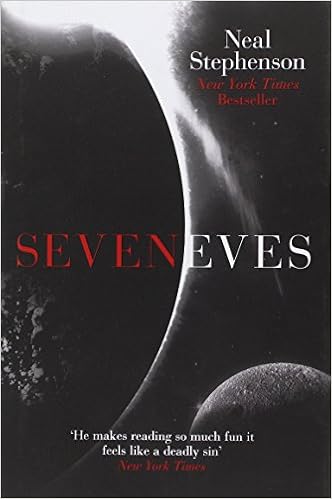
Just started reading Neal Stephenson's Seveneves. The novel starts with a bang: specifically, the Moon blows up. No one quite knows how the Moon blew up: some speculate about a primordial black hole (but we know from Greg Bear's The Forge of God that that wouldn't do it) but in the main, people refer to some unknown 'Agency' as the moving force behind the event.

The main thing is not so much that the Moon has exploded into fragments orbiting their common centre of mass, it's what will happen next. I could hardly believe it, so naturally searched the Internet for the 'Science behind Seveneves'. And came across this.
"There are many different ways in which a reader can imagine the moon blowing up—imagery of the death star annihilating Alderaan comes to mind as the most culturally ubiquitous. But Stephenson quickly establishes the hard-SciFi slant of the novel. There are no fireworks, no loud booms—the opening chapters read like historical fiction for what would actually happen if the moon was fractured into (mostly) gravitationally bound chunks by some unknown force. Chiefly, people would freak out a little bit.

An ensemble cast of characters and their reactions span the opening chapters. A character obviously modeled after Neil deGrasse Tyson, Jerome Xavier Harris (or Doob for short), is rapidly recruited to run popular science damage control—essentially, doing exactly what I would imagine Neil deGrasse Tyson doing if such an event were to happen: media appearances and public lectures explaining that the still-gravitationally-bound moon posed no danger.

In some sense, this is naively true. A common physics brain teaser is to ask what would happen if our sun were replaced by a black hole of equal mass. Barring the joke answer of “everything would probably freeze to death”, nothing much would happen. The black-sun would still be in the same place, with the same mass, thus the orbit of the earth would remain unchanged. As it’s established in the early pages of Seveneves, whatever unknown force which fractured the moon didn't send it on a direct crash-course with the earth—it just imparted enough energy to fracture it into a handful of pieces—pieces which remain in a wildly chaotic orbit around each other, but still somewhat confined to the general vicinity of the moon.

Orbital mechanics problems are notoriously tricky to solve. The so-called three-body-problem was one of the earliest problems tackled once the tools of calculus were developed by Isaac Newton in the late 1600s (a prominent character in Stephenson’s own Baroque Cycle). The problem is almost entirely explained by its title: how will three (or more) celestial bodies evolve in the night sky if you know their starting positions and velocities? Mathematicians eventually proved that there is no general analytic solution to the three-body-problem, barring a handful of special cases. The difficulty arises in the sensitivity of the problem to its initial conditions. If you don’t know exactly where the objects are and exactly how fast they’re going, your estimate can be wildly off.

Because numerical integration is really the only way to actually solve orbital mechanics problems, it’s clearly important that the chosen integration scheme be error free. Tools like Runge-Kutta and Euler integration are good, but they have technical shortfalls—they don’t manifestly conserve quantities that we know should be conserved. This sort of error is more than enough to yield completely nonsense results when trying to predict where things might be going in the night sky.

So, in one of my favorite scenes, when Doob realizes that the wildly chaotic orbits of the moonchunks might not be so harmless, and could even result in an exponentially increasing number of colliding and breaking fragments of moonstuff, I imagine that he sprinted to the nearest python terminal and coded up a symplectic integrator—an algorithm which is particularly good at orbital mechanics simulations. Whatever simulations canon-Doob did run, they soon indicated that the earth had about 2 years before the remaining moonchunks would rapidly break apart, and bombard the earth in moon-asteroids for approximately 10,000 years. This kills the planet. And everything on it.

I thought this would be nice to visualize, so I coded up a symplectic integrator and tried to see if I could reproduce what Doob calls the “White Sky” (the rapid dissolution of the moon) and the “Hard Rain” (the bombardment of the earth with asteroids). I tried to conserve mass and volume of moonchunks when they break apart and use a nearly elastic scattering model. With extremely generous assumptions, and the setting of arbitrary constants to 1 where convenient, I get something like this:


This simulation was very nearly contrived to produce an explosion of chunks in the beginning, and should be taken with a tremendous grain of salt, but hopefully it will allow you to at least suspend disbelief for the doomsday premise of the novel. The actual number of chunks and the rate at which they appear is, unsurprisingly, fairly sensitive to the initial conditions of the simulation. If nothing else, this simulation illustrates Kessler Syndrome fairly clearly—the rapid creation of dangerous debris from uncontrolled, chaotic orbits in space."
So there you have it: Stephenson was right (and/or was well advised).

A few pages in and before the disaster manifests, two feisty females on the International Space Station are discussing family matters. In a beautifully sardonic moment, we discover that one of them refers to the other's mother as 'the Maternal Organism'. Their conversation continues, punctuated with references to the morg.

My WhatsApp message to my sister this evening: "How did you find the morg today?"
"Sleepy."
What a child I can be.

---

Update (Sept 12th 2015): Seveneves is actually a terrible book: thin and excruciatingly torpid plot combined with way too much techno-dumping re: imaginary space-machines. Another misfire from Mr Stephenson. Skimmed and abandoned.

Tuesday, September 01, 2015

Women writing hard SF: Linda Nagata


Linda Nagata writes:
"... After a ten-year hiatus, I finally returned to writing. I was shocked to learn that, a decade into the 21st century, women were still using pseudonymous names to sell SF. One writer related how an editor had told her bluntly that hard SF would not sell under a woman's name. And social media is full of negative statements and stories--enough to convince any sensible woman to be wary of science fiction, and of hard SF in particular. This is my field, and I was wary of it!

The climate had gotten so bad that by the time I got around to writing a new hard SF novel--more precisely, a near-future, high-tech military novel written in first person from a male point of view, because why not max out the degree of difficulty?--I had no doubt I was making an illogical choice. I knew this was not what I should be writing if the goal was to further my career and grow my audience.

I wrote the novel anyway, because I needed to write it. And then I self-published it, because I didn't want to deal with what I perceived as the negative environment of traditional publishing. Two years ago I was here on Charlie's blog with a guest post about that decision. Since then, The Red: First Light was nominated for both the Nebula and John W. Campbell Memorial awards, and went on to sell to Simon & Schuster's new SFF imprint, Saga Press, with the sequel, The Trials, just out. It would be easy to say my fears were baseless and it all turned out okay--but how many of you have actually heard of these books, or read them?"
I bought The Red and enjoyed it; I have ordered the sequel, The Trials. I was particularly intrigued to see how well a woman could get inside the head of an elite male special forces trooper who fights in an exoskeleton.

Here's what The Red is all about (Tor review):
"The tone of the novel is set right from the very first paragraph:

“There needs to be a war going on somewhere, Sergeant Vasquez. It’s a fact of life. Without a conflict of decent size, too many international defense contractors will find themselves out of business. So if no natural war is looming, you can count on the DCs to get together to invent one.”

The speaker is Lt. James Shelley, a highly cynical but competent officer who leads a high-tech squad of exoskeleton-enhanced, cyber-linked soldiers in the latest manufactured international incident, deep in the Sahel. (The location illustrates another one of Shelley’s axioms: “Rule One: Don’t kill off your taxpayers. War is what you inflict on other people.”)

The start of The Red: First Light is simply flawless. Shelley introduces a new member to the squad, and in just a few scenes, you know everything you need to know: the tight bond between the soldiers, their faith in the highly cynical but reliable Shelley, the Linked Combat Squad technology, the general situation. The exposition is perfectly delivered, and before you know it you’re in the thick of it.

“The thick of it” in this case means a series of intense, well-written scenes describing life and combat in a remote military outpost somewhere in Sub-Saharan Africa: patrols, combat incidents, friendly interactions with the locals who are, in most cases, as war-weary as the soldiers. There’s an inexorable pull to this part of the novel: the soldiers live in a round-the-clock state of combat readiness, interrupted by brief chunks of drug-induced sleep. They’re monitored 24/7. There are no breaks. Once you’re into this book, it’s hard to put it down until you reach the shocking end of the first section.

It’s also full of examples of the plight of the common soldier, created by the faceless, immensely rich defense contractors who manipulate world politics to keep conflicts (and sales) going. High-tech combat equipment is recovered after a soldier’s death because it’s cheaper to train another grunt than build another robot. Lt. Shelley has his dad send medications for the squad’s dogs, and buys their food from the locals on his own dime. It reminded me of the saddening reality of teachers having to spend their own money on basic school supplies.

There are many more powerful illustrations of this “only a pawn in their game” theme (although a more appropriate Dylan tune to refer to here would probably be “Masters of War”). Drones relay the commands of faceless, codenamed Guidance officers down to the field. Most disturbingly, skullcaps worn by soldiers like Shelley allow their emotional and mental state to be monitored and altered as needed. Shelley is frequently aware that his true feelings are suppressed, and have been suppressed for such a long time that he’s become dependent. At one point, he notes drily:

The handbook says the brain stimulation [the skullcap] provides is non-addictive, but I think the handbook needs to be revised.

This emo-monitoring ends up highlighting the real issues: identity and awareness. Shelley occasionally has inexplicable, but always accurate premonitions. Where do they come from? Is it the voice of God, as one of his squadmates insist? Or is there something else going on? And regardless, how much of a person’s original identity remains if they are monitored and controlled 24/7?

Somewhere deep down in my mind I’m aware of a tremor of panic, but the skullnet bricks it up. I watch its glowing icon while imagining my real self down at the bottom of a black pit, trapped in a little, lightless room, and screaming like any other soul confined in Hell.

If my real self is locked away, what does that make me?

I know the answer. I’m a body-snatching emo-junkie so well-managed by my skullnet that the screams of my own damned soul are easy to ignore. But there is someone out there who can get inside my head. Am I haunted by a hacker? Or is it God?

Once the first “episode” of the novel is over, these become central questions. While that opening section is one long, intense, adrenaline-fueled rush, it focuses on what’s ultimately just a small part of the conflict. In section two, the novel takes a sharp turn when it starts exploring the broader issues. That also means things slow down considerably, for a while at least. Not that this is a bad thing—there’s a depiction of wounded soldiers’ rehabilitation that’s incredibly poignant, for one—but the change in pace is noticeably abrupt. Eventually, all of the pieces of the puzzle come together in a spectacular conflict that also sets up future installments."
The hero, Lt Shelley, is a middle-class antiwar activist who joined the US Army (as he appears to believe) to avoid a jail sentence for 'subversive' protests. In fact, he seems made for war: perhaps the covert AI which seems to be directing things behind the scenes made him that way?

Linda Nagata is a talented writer who can make the pages turn, summon up immersive scenes, write engrossing action sequences, all with an enviable turn of phrase. The Tor review I quote above goes on to highlight some weaknesses in plotting and pace: criticisms with which I agree.

I would add that I don't think she quite gets the male psychology right. Almost right, but our hero is just a tiny bit too empathic* - there's a casual psychological callousness which we expect to see in our SF (special forces!) action heroes, which we get in writers as diverse as Heinlein and Morgan, but not here.

My other criticism is her tediously Manichaean view of the world: evil defence contractors vs the ethically-righteous guardians of the common people. Post adolescence, the world is not quite like that and the best novels leverage Nagata-levels of moral indignation at more compelling and credible targets. I include both Heinlein and Morgan, by the way, as on the right side of their respective barricades on this particular issue.

Still, The Red is a more entertaining read than 90% of what's out there so give it a go.

---

* The dynamic of inter-personal relationships in this novel (especially with the insipid g/f Lissa) makes a lot more sense if we entertain the thought that Lt Shelley might in fact be the thinly-veiled depiction of a gay woman.