Showing posts with label base. Show all posts

Wednesday, June 03, 2026

Designing Out the Speed of Light Delay...


Designing Out the Speed of Light Delay

The conscious mind inhabits a permanent past. Neurological signals, flashing along axonal pathways, travel at a leisurely pace. By the time a photon striking the retina is translated into chemical flux, processed by the visual cortex, and integrated into conscious awareness, upwards of two hundred milliseconds have elapsed.

If the human brain relied on a simple feedback loop - perceive, decide, act - the body would be a clumsy, staggering thing, perpetually tripping over steps already taken and colliding with hazards already passed. To survive, the brain cannot live a fifth of a second behind actual reality; it must predict.

This deep biological truth provides the exact architectural blueprint for the contemporary frontier of space exploration. As countries race to establish a permanent presence on the Moon, engineers face a scaling up of the brain’s internal dilemma.

A radio signal traveling between Earth and a lunar rover at the speed of light takes roughly one and a quarter seconds to arrive, creating a minimum two-and-a-half-second round-trip latency. After factoring in communications and routing delays, this could amount to six to eight seconds overall lag. Attempting direct, unmediated teleoperation over this distance results in a catastrophic instability known as the move-and-wait problem. Control grinds at a glacial pace.

To navigate this speed-of-light barrier, aerospace architects are explicitly mimicking the neural mechanisms that allow biological organisms to move smoothly through a delayed reality by means of effectual predictive modelling.

The Biological Precedent

In computational neuroscience, the brain resolves its processing lag through a mechanism known as an internal forward model. When the motor cortex issues a command to a limb, it simultaneously transmits an exact duplicate of that signal—an efference copy—to the cerebellum.

The cerebellum then runs a predictive simulation of the body’s physics and the surrounding environment, instantly projecting what the real-time sensory feedback should look like. Consciousness perceives this internal prophecy rather than the delayed perceptions of raw reality, allowing for seamless, real-time movement.

The actual, delayed-by-processing sensory feedback arrives later, used quietly by lower neural circuits to adjust the model’s accuracy and suppress minor noise through precision weighting.

Only when a massive prediction error occurs such as stepping into an unseen hole does the mind's reality-simulation shatter, violently snapping consciousness back into raw, unmediated data processing. 

Anyone who's ever had a sudden, violent and unexpected accident will recall the jagged shards of fragmented perception, as their subjective cohesive predictive model collapses.

The Teleoperative Parallel

To bridge the gulf between Earth and the Moon, artificial intelligence systems are now being deployed to replicate this distributed, dual-loop architecture.

The human operator, wearing a virtual reality headset on Earth, does not interact with the physical Moon. Instead, they drive a local digital twin: a high-fidelity, predictive physics simulation running on terrestrial servers. 

When the driver turns a control wheel, the VR display renders the rover’s response instantly, superimposing a prophetic “ghost asset” over a three-dimensional map of the lunar terrain. This is the robotic cerebellum - the terrestrial simulation model in action.

Meanwhile, the actual command stream arrives on the Moon seconds later, where a secondary, autonomous edge AI handles the immediate physics of reality. This lunar-side system operates like the biological brainstem. If the Earth-side simulation fails to anticipate a patch of loose regolith or a crumbling rock shelf, the on-board AI detects the sudden torque spike or loss of traction. It does not wait for a human command from Earth; it executes an immediate, predictive reflex to stabilize the vehicle.

After a few seconds the predictive model running on terrestrial servers will quietly update (if the discrepancy is unimportant). Perhaps the human operator will not consciously notice the flicker.

The Terrestrial Training Loop

This architecture has transitioned from theoretical cybernetics to active procurement within the United States space programme. In preparation for the Artemis missions, NASA and its commercial partners are developing the Lunar Terrain Vehicle utilizing these exact supervised autonomy frameworks.

Recent testing has moved beyond hard-coded physics simulators toward adaptive systems that learn from experience in real time. Because the unique characteristics of the Moon, such as the behaviour of razor-sharp, electrostatically charged dust under one-sixth gravity, cannot be perfectly replicated in a terrestrial laboratory, the Earth-side digital twin relies on machine learning algorithms to ingest the stream of prediction errors sent back by the rover.

With every discrepancy between the simulated path and the actual lunar telemetry, the AI refines its geological and structural models, rendering the virtual reality on Earth increasingly indistinguishable from the physical truth on the Moon. Basically the operator gets to drive within an increasingly accurate prediction of what will actually be shortly happening on the moon.

Yet, this elegant solution conceals a profound paradox. The very infrastructure designed to make human teleoperation seamless is systematically engineered to render the human operator obsolete.

By inserting an adaptive, predictive AI between the human driver and the machine, we have created a highly sophisticated training loop. The AI is effectively observing the strategic choices of the human operator and mapping them against the messy, reactive physics of the lunar surface. It learns the subtle art of navigation, the nuances of risk assessment, and the translation of high-level intent into low-level mechanical execution.

As these predictive models master the edge cases through rapid, autonomous learning, the necessity of the human element evaporates. The human becomes a scaffolding structure, required only during the system’s infancy to provide the initial data and the intent - and will later transition to higher-level oversight.

Ultimately, the destiny of planetary exploration is not a control room in Houston filled with operators driving virtual rovers through a simulated digital twin. It is an autonomous machine workforce that has outgrown its biological supervisors, requiring nothing from the Earth but a destination. In the years to come this will be an increasingly familiar story across the board.


The Theoretical Limit of the Predictive Horizon

The absolute length of the delay that can be designed out is determined by a strict mathematical relationship: it is bounded by the prediction horizon of the environment.

In a perfectly deterministic, static universe, the delay could indeed be unboundedly large. If you are operating a probe in deep, empty interstellar space where the physics are limited to predictable gravitational fields, a predictive model on Earth can simulate the trajectory years in advance with millimetre precision.

However, in real-world environments, predictability degrades over time due to chaos theory and unmodelled dynamics. The time it takes for a simulation to diverge from reality is the true limit.

High-Chaos Environments (Short Horizon): On a dynamic surface like Mars, with seasonal windstorms, shifting dunes, and unpredictable dust devils, an Earth-side simulation might diverge from reality within just a few minutes.

Low-Chaos Environments (Long Horizon): On the airless, geologically dead lunar surface, the environment is exceptionally stable. The rocks do not move on their own; the craters do not shift. Here, the prediction horizon is much longer, allowing for the management of much larger latencies. All of this will change once human activity starts up.

Saturday, October 17, 2015

We invade the Moon .. but when?

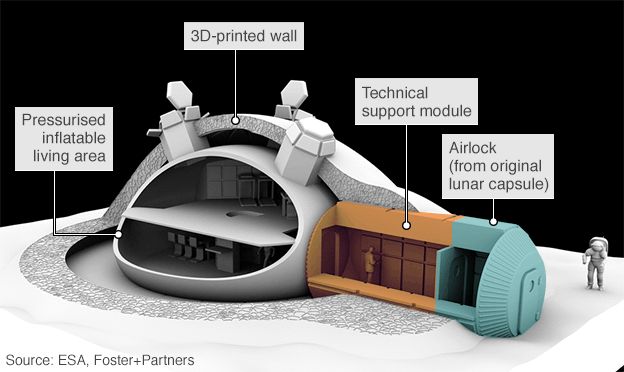
Proposed lunar habitat

According to the BBC,
"The European and Russian space agencies are to send a lander to an unexplored area at the Moon's south pole. It will be one of a series of missions that prepares for the return of humans to the surface and a possible permanent settlement. The spacecraft will assess whether there is water, and raw materials to make fuel and oxygen.

BBC News has obtained exclusive details of the mission, called Luna 27, which is set for launch in five years' time. The mission is one of a series led by the Russian federal space agency, Roscosmos, to go back to the Moon."
The only practicable way to construct a lunar habitat, like the one pictured, would be by using autonomous robots. They couldn't be teleoperated from Earth due to communication delay.

You may have noticed that nowhere on Earth right now are there autonomous robots capable of building a house - even under the benign conditions on our planet. People aided by dumb machinery build houses.

It's often said that the future is already here, just unevenly distributed. Absolutely cutting-edge stuff is very expensive and is solely used by elites (the rich, or priority government programmes). Later, technologies get better, prices come down via economies of scale .. and the future arrives for the masses.


Example: the first mobile phones, clunky things, date back to c. 1975. The mass take-up of mobile phones began in the mid-1990s, twenty years later. This period, twenty years from earliest adopters to mass deployment, seems about right for sophisticated, high-technology systems engineering.

As I noted above, there are no autonomous construction robots at all right now: we're probably ten years from systems which could autonomously build a habitat on Earth and perhaps thirty years from systems which are cost-effective for large scale use.

For a special-project moon base (large budget, customised equipment) I would guess twenty years out. For routine off-planet construction opening the way to significant lunar/martian cities it would have to be at least forty years.

So here's my summary timeline:
2025:  first proof-of-concept complete-house-building robots (autonomous)
2035:  first special-purpose lunar/martian habitat-building robots (autonomous)
2045:  houses routinely built by autonomous robots across the world
2055:  large scale town/city construction on the Moon and Mars by autonomous robots.
These are the earliest dates.

---

On a personal note, which of these events could I expect to see?

I checked an online life-expectancy calculator with this result:

My life expectancy at current age 64 (in 2015) = +25 years

This puts my expected date of death 25 years in the future, to 2040.

I might see the habitat pictured above before I go, with zen-like equanimity, to that good night.

Saturday, September 05, 2015

Be your own central heating engineer

Getting cooler isn't it. Nice to know that your Bosch Worcester Greenstar 30CDi gas-fired condensing boiler is working OK.

Last night the central heating failed. That is, the remote controller we have in our living room was registering 19.5 C and showing its little arrow to tell the central heating to turn on - but the pipes remained cold.

Suffering my usual aversion to physical reality and obtuse/opaque systems, I reluctantly went upstairs to the airing cupboard and examined the Siemens RCR10/433 wireless 'base station'. All the lights were out. I prodded the 'Set' button ('Do Not Touch This Button') and then, when nothing much happened, pressed the even scarier 'Reset' button. Then I turned all the power off at the socket and turned it back on again.

Yep, nothing.

This morning I changed the batteries on the Siemens RDJ10RF remote unit while Clare suggested we move blankets away from the boiler and hot water tank to 'prevent overheating'.

As magical thinking failed us, I recalled Adrian's advice of the previous evening and googled 'How can I reset Siemens RCR10/433'. And here was the advice.
If the Siemens thermostat remote unit (RDJ10RF) loses connection to the base station (RCR10/433) next to the boiler (possible symptom: the base station green light goes out).

---

1. Make sure the thermostat remote unit has its vertical switch set to 'run' and the horizontal switch set to 'auto'.

2. Loosen the screw holding the thermostat backing plate (situated underneath, just loosen the screw don't take it all the way out). Take the unit to the boiler.

3. On the wall unit/receiving unit next to your boiler there are two buttons 'Set' and 'Reset'. press and hold the reset button for 4 secs until orange light starts to flash.

4. Then press the 'Set' button on the same unit (the light should flash again).

5. Press the 'Learn button on the back of the thermostat unit - try to be a good meter away from the wall unit /boiler. The lights should flash and then turn green.

6. Press the 'test' button on the back of the thermostat. This sends a test signal to the boiler . The green light should come on again. When this has happened press the test button again to switch off the test signal.

This should now work.

And miraculously, it did. There was, however, more information on the Internet from those people for whom this procedure had not worked.
"I too have a malfunctioning RCR10/433 which responds to a sharp tap. I've done a bit of investigation but not fixed it yet, thought I'd share what I've found so far.

There's a click when the orange light comes on, but the relay contacts don't switch over until given a tap (checked with a multimeter).

There are two obvious possibilities here - duff relay or failing power supply capacitor. The click from the relay suggests the former, but I need to check the voltage applied across the coil to confirm ... ."
I went upstairs armed with a hammer, but was saved by Clare's ecstatic call of "You're a genius!"

The rewards of being in trade, even as a complete amateur.

---

Update September 14th 2015. The central heating has failed to come again today. I did 'all the above' but this time it failed to have any effect. I even tried (gently!) tapping the base station upstairs with the hammer. I can only assume that there is a fault in the room-remote or boiler-end control unit. We are in process of calling in an engineer to take a look ...

... and five minutes later, after calling an engineer, I go upstairs and tap the wretched base station with the hammer again (perhaps a little harder). And mirabile dictu, the heating turns on ...

Update September 23rd 2015. A qualified central heating engineer has now visited and checked everything. He informs me that the controllers are fine; the problem lies with the (rather old) three-way valve which routes hot water between the boiler and the hot water tank and/or the central heating system. Apparently it's sticking and not always responding - he will order a replacement.

 I am put in my place (along with the Internet).

Update October 14th 2015. The engineer has been busy and has not yet come. In his absence the system has continued working rather erratically. I checked the installation guide for the three-way valve (The Honeywell V4073A) - it states that the operating temperature must be less than 52 deg C. I wondered if it was overheating so I cleared clutter around it and left the airing cupboard doors open. Since then, cross your fingers, the central heating has been working OK.

Update October 22nd 2015. The system continues to behave erratically. The Honeywell V4073A three-way valve has hot water in all three of its attached pipes when the CH is set to 'on'. This indicates the valve itself is working; it's just that hot water is not being pumped around the house. The engineer is tied up with a house-construction contract and is not available until the beginning of November - but he has given me the number of his former boss to try in case we need action sooner. I'm on the case.

Update November 4th 2015. The central heating engineer, Ian Hosegood, came today. It turns out the problem was indeed with the Siemens wireless base station (wall-mounted next to the boiler). It was showing the radio link to the living room thermostat as active, but the relay to the boiler/pump had not tripped. This is the bug in the device highlighted above. Ian switched it out for the Honeywell CM927 wireless programmable room thermostat and upstairs relay box.

Finally, the central heating is working again.

---