This post is for J. and A. on their special day.
---
The word Tao means 'way' or 'path'. For a reductive materialist it could be identified with the spacetime
block-universe. But this fails to capture the relationship of the Tao to agency as well as physics.
Te means 'power', not in the sense of a
fifth-generation fighter aircraft, but in the old-fashioned sense of 'virtue'.
Ching means 'classic', or 'canon' or 'book': an authoritative statement.
People argue about the best translation of the
Tao Te Ching. Perhaps the most accessible is that due to
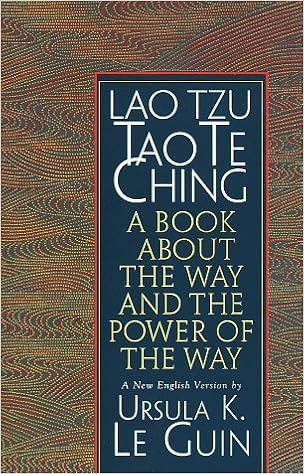
Ursula K. Le Guin, the most prominent contemporary Taoist in the philosophical tradition. I like many of her chapters (see below) which render Lao Tzu's thoughts into a contemporary idiom.
But there's always the danger of over-processing. My real favourite is
Arthur Waley's peerless text, which presents the Taoist work in its original cultural setting, allowing the reader space to engage and to seek the relevance in his or her own situation
To oxymoronically take a chapter almost at random. Here's Ursula Le Guin's Chapter 16.
Be completely empty.
Be perfectly serene.
The ten thousand things arise together;
in their arising is their return.
Now they flower,
and flowering sink homeward,
returning to the root.
The return to the root
is peace.
Peace: to accept what must be,
to know what endures.
In that knowledge is wisdom.
Without it, ruin, disorder.
To know what endures
is to be openhearted,
magnanimous,
regal,
blessed,
following the Tao,
the way that endures forever.
The body comes to its ending,
but there is nothing to fear.
In her note she comments, "To those who will not admit morality without a deity to validate it, or spirituality of which man is not the measure, the firmness of Lao Tzu's morality and the sweetness of his spiritual counsel must seem incomprehensible, or illegitimate, or very troubling indeed."
And here is how Arthur Waley translates the same chapter 16.
Push far enough towards the Void,
Hold fast enough to Quietness,
And of the ten thousand things none but can be worked on by you.
I have beheld them, whither they go back.
See, all things howsoever they flourish
Return to the root from which they grew.
This return to the root is called Quietness;
Quietness is called submission to Fate;
What has submitted to Fate has become part of the always-so.
To know the always-so is to be Illumined;
Not to know it, means to go blindly to disaster.
He who knows the always-so has room in him for everything;
He who has room in him for everything is without prejudice.
To be without prejudice is to be kingly;
To be kingly is to be of heaven;
To be of heaven is to be in Tao.
Tao is forever and he that possesses it,
Though his body ceases, is not destroyed.
So there you are: two interpretations of the same 2,400 year old text.
The Tao Te Ching, with its 81 chapters, is mystical and allusive. It's easy to let the eyes glaze over the stanzas which seem to require too much intellectual hard work.
A hard core materialist, who believes we - along with the other 'ten thousand things' - are 'just atoms' may simply walk away. I am basically just such a materialist, but learned long ago that the map is not the territory, and that an effective theory of agency and consciousness is not identical to being an agent and experiencing consciousness.
It's only when you examine your own self, abstracting a little from the busy personas of everyday role-playing, that the moral framework of the
Tao Te Ching comes into focus. It's not for everyone, and it's not for every day.
Sometimes, though, you should lift your head up if you can and try to engage with the biggest picture.
Cheng Man-Ch'ing used to say that Taoism was for the sage on his mountain, not for practical folk. But then, he was a Confucian.
---
Here's a short link to this post:
https://goo.gl/X2Rd7q using the
Google URL shortener.