Showing posts with label Serotonin. Show all posts

Tuesday, October 28, 2025

Serotonin - six years later

Is Houellebecq the new Camus?

Six years ago I first read Serotonin, and wrote my thoughts here. Now I've read it again. The thing with Houellebecq is that a single reading is never enough. His work constitutes a peculiarly male interiority, written without shame or inhibition; I can't imagine women readers enjoying it - they have perennial illusions - flattering ones - about the male psyche. Houellebecq is not the new Camus as I proposed before, however, though both are beholden to the same malaise.

Camus’s absurdism sought dignity in revolt - lucid endurance against a silent and pointless cosmos. His stance was tragic but moral: one must imagine Sisyphus happy.

Houellebecq’s world has no such rebellion. His protagonists surrender rather than resist. Their alienation is social, not really metaphysical: hopelessness born from late-capitalist atomisation, sexual failure, and bureaucratic sterility. Where Camus’s Meursault faced the sun and pondered, Houellebecq’s narrators close the curtains and despair.

Camus’s nihilism was stoic; Houellebecq’s is depressive. Yet both grasp the same intuition: meaning is no more than a human construct. The difference is that Camus urges the effort to keep producing it, while Houellebecq documents the fatigue and futility of trying.

In that sense, Houellebecq is not the prophet of nihilism but its deathbed attendant. He performs the autopsy, not the sermon. He doesn’t argue for nihilism; he records its arrival - the modern Western human-subject drained of transcendence, family, solidarity, or erotic mystery. His novels are clinical reports on what remains when consumer freedom has replaced every other value.

Commodification in action.

His tone is pathologist, not prophet. The souls he dissects are already dead to belief, desire, and purpose. He preserves them in irony, pornography, statistics and quiet despair. Camus still sought a cure: defiance, honour, the beauty of light. Houellebecq accepts there will be no recovery. His literature tidies the remains, labels the jars, and closes the morgue door.

He is popular among the French elite because he tells them the truth about their luxury-modernity in a form they can aestheticise. He articulates their own disillusion: secular, individualist, materially sated yet spiritually void. His novels turn their quiet despair into literature - making alienation itself an object of cultivated pleasure. He flatters the class he dissects by giving their emptiness philosophical depth.

He is both French and Western. His sensibility - rational, ironic, Cartesian in structure - is rooted in French literary tradition but his themes are entirely global: commodified sex, bureaucratic capitalism, digital loneliness, cultural and demographic collapse.

In France he writes as the national conscience; abroad he is read as the Western Everyman: exhausted, lucid, complicit. His readers are not surprised by the view, only curious as to the sordid trajectories of despair his heroes will inhabit as they fade to nothing at all.

Tuesday, October 15, 2019

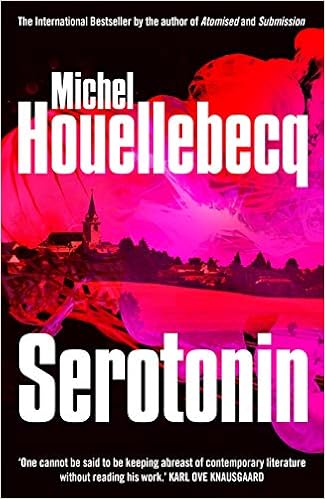
"Serotonin" - Michel Houellebecq

Amazon link

This is Wikipedia's summary.
"The narrator, Florent-Claude Labrouste, is a depressed agricultural scientist who lives in a Parisian apartment block, the Tour Totem. He commutes to Normandy to help promote French cheese.

Sympathetic to the plight of local farmers, he is powerless to help them retain their traditional methods:

    In short, what is taking place with French agriculture is a vast redundancy plan, but one that is secret and invisible, where people disappear one by one, on their plots of land, without ever being noticed.

After watching a television documentary about people who choose to disappear from their life without telling anyone, Labrouste abruptly leaves his girlfriend, a young Japanese woman who is sexually hyperactive but devoid of affection, quits his job under a false pretence and flees to a chain hotel in another part of Paris. A doctor prescribes him an antidepressant to remedy his low levels of serotonin, hence the title of the novel. Although the drug dulls his sex drive, Labrouste returns to Normandy in search of former lovers. While there, he visits an old college friend, Aymeric, a divorced and suicidal aristocratic landowner.

At the climax of the novel, farmers equipped with assault rifles blockade a motorway. Aymeric is among them and shoots himself, sparking a clash with riot police in which 10 more people die.

Later on, for a couple of weeks, Labrouste secretly observes the love of his life, Camille, who has a son from another man. Initially intent on killing the child with one of Aymeric's sniper rifles in order to win back her love, he finds himself unable to go through with it.

Finally, Labrouste moves back to Paris, contemplating suicide by jumping out of a window."
Reviews were mixed: bourgeois horror from Robert Harris in The Times; other reviews suggested it was a bit boring (as compared to "Submission").

Very superficial, these reviews.

Houellebecq gives voice to the modern petite-bourgeoisie. This vastly-expanded social stratum, left behind by the ascendant neoliberal elite (the 0.1%), is increasingly precarious, alienated and desperate. The Idealists amongst them, the Myers-Briggs NFs, increasingly assemble themselves around displacement activities: fads such as veganism, climate change, plastic waste. Meanwhile, the Rationals, the NTs, have become skeptical and nihilistic - seeing no way out.

Houellebecq speaks for the latter group.

In Houellebecq's previous novel, "Submission", his protagonist cynically converts to Islam and gets the material rewards of a remunerative position in the newly-Islamicised Parisian university sector .. and the sexual benefits of four provided nubile wives.

"Serotonin" is darker: the ministry bureaucrat has no way out except death itself. Houellebecq follows his spiritual guide, Albert Camus, to the end.

Just because the author does not see an end to the decay of neoliberalism, as here instantiated in the EU project, does not mean that there isn't one. While the Macron regime has no solutions to the excluded (most visibly the gilets jaunes), in the UK the Boris Johnson - Dominic Cummings axis is actively seeking a rebasing of post-neoliberal capitalism aimed at recapturing inclusivity.

It's not hard to see the outlines of such a solution: transfer payments for regional infrastructure, directed investments in areas which can mop up surplus (and over-educated) professionals, a non-faked sense of national purpose. It's the will to move in that direction which is so fiercely contested... under so many fake banners.