Showing posts with label Ross Douthat. Show all posts

Thursday, February 13, 2025

'Believe: Why Everyone Should Be Religious' - Ross Douthat

Amazon
---

I was quite excited to open this book. Influential New York Times columnist Ross Douthat was going to explain why Catholicism is literally correct in essentially all of its supernatural claims. He was going to defeat the atheists and secularists in the field of combat: compelling arguments were about to be unleashed.

I wondered where these new compelling arguments were going to come from. We've played the game of rational proofs of God's existence from the days of Aquinas, Anselm and Descartes: today they're a curiosity in introductory philosophy classes: find the fallacy.

The smart Catholic knows that it's impossible to prove the existence of God from science (or logic) because methodologically these fields of enquiry stem from skeptical empirical enquiry, or in the case of logic and mathematics, have no empirical content at all (in writing this review, today I'm a formalist, not a Platonist).

So Douthat throws himself into the quagmire of badly-understood science. He combines the unedifying traits of: ignorance and misunderstanding of the science; tendentiousness; gullibility. Here are a few examples.

John von Neumann might have believed consciousness was necessary to 'collapse the wave-function' and therefore fix reality - an idea influenced by his Mathematical Foundations of Quantum Mechanics (1932). But that hasn't been the scientific position for decades. Since the 1970s, work on decoherence, initiated by H. Dieter Zeh and later expanded by Wojciech Zurek in the 1980s–1990s, has shown that the universe can manage that feat all by itself. It doesn’t need an observing deity.

Evolution does not need a little helping hand on the tiller: its operation is completely consistent with the laws of physics and chemistry together with the physical boundary conditions on this planet.

Amazon

It is perfectly conceivable that the universe emerge spontaneously from the quantum vacuum, from 'nothing at all' - a parsimonious concept compared to a theistic entity imagined to be in some sense prior to spacetime but with the conceptual and instrumental powers to create spacetime and cosmology by its own willpower.

'Out of Body' instances and religious encounters are psychological experiences by definition. We are so far from understanding the pathologies of consciousness - it's hardly parsimonious or even helpful to rush to premature and speculative claims of verisimilitude.

Amazon

Contra Douthat, the New Testament is not to be taken as a body of text expressing historical truth by default (except when its own contradictions and inconsistencies prove otherwise). That's to reject decades of historically-informed scholarship in favour of wishful thinking.

On and on we stumble, through the swamp of unconvincing arguments. Douthat twists and turns to accommodate his desired conclusions. Yet the resulting flimsy structure doesn't survive scrutiny: perhaps that's what you'd expect from a journalist.

The universe is a strange entity; we are strange entities. Pushing our understanding forward is one thing - that's the mission of scientific research.

Meanwhile, creating our sense of ourselves, our values and our place in the scheme of things is ascientific, it is indeed the domain of faith and religion. Douthat would have written a more honest and compelling book if he'd taken that on board, although the Catholic Magisterium might not then have been quite so supportive. 

A missed opportunity.

Religion is everywhere. It provides important benefits and norms we sorely miss when absent. The Catholic Church says that reason and faith can't contradict each other and sometimes believes it. 

Douthat would have been better situating himself in that paradigm - he might then have crafted a narrative strong enough to confront secularism and actually win.

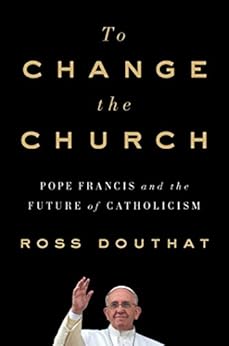
Thursday, May 17, 2018

"To Change the Church" - Ross Douthat

Amazon link

Ross Douthat is not very well known here but in the States he has a profile as a conservative commentator on the NYT. He is also a Catholic convert.

Here is what his fellow New York Times writer, Paul Elie, had to say about Douthat's work:
"To Douthat [Pope] Francis is an accommodationist, and decline has reached the apex of the church. “This is a hinge moment in the history of Catholicism,” he declares, “a period of theological crisis that’s larger than just the Francis pontificate but whose particular peak under this pope will be remembered, studied and argued about for as long as the Catholic Church endures.”

What immediately follows is an adroit, perceptive, gripping account of Catholic controversializing. Douthat sets out the liberal and conservative “master narratives” about the Second Vatican Council and then offers a third narrative that deftly blends the two.

He sketches the life and times of the future pope, Jorge Mario Bergoglio, the Argentine Jesuit archbishop of Buenos Aires. There’s commentary on past controversies and a brief history of Catholic teaching on marriage, from Matthew 19 (“What God has joined, let not man put asunder”) to Humanae Vitae, the 1968 encyclical in which Pope Paul VI upheld the ban on artificial birth control. ...

And then, as Douthat reaches what he sees as the heart of the matter — the Vatican synods on marriage and the family in 2014 and 2015 — his culture-warrior tendencies stir fully to life.

He casts the synods as a battle: warring factions, attacks and frontal assaults, purges and collaborators. Francis’ openness to the German cardinal Walter Kasper’s proposal to relax the ban on divorced-and-remarried people in Germany receiving Communion at Mass is framed as a liberal pope’s “crusade to change the church.”

Although Francis has invited free discussion more than any previous pope, his efforts to shape the synod’s outcome (he is the pope, after all) are seen as “stage-managing” and “deck-stacking.” The synod fathers’ disputes are rolled down the slippery slope and deemed a “full-scale theological crisis” in which the hope that Francis would foster unity and renewal is undone by the supposed liberals’ supposed desire to accommodate “the sexual revolution and all its works.”

Douthat’s own position is traditionalist-cum-literalist: Any relaxing of the Catholic teaching on marriage — one man, one woman, one time — means that core teachings can be changed; if core teachings can be changed, the Catholic Church is no longer the Catholic Church; and if the church is not the church, all hope is lost."
I started the book somewhat sympathetic to Douthat's position - Pope Francis has not endeared himself with his vague anti-capitalism, ecological posturing and seeming inability to sort out the Vatican.

Douthat is a smart guy but he has a problem - blind faith. Once he committed to switching his critical intelligence off to accommodate a strangely-invisible super-presence, the fount of moral authority and one which extruded a portion of itself into a low-key itinerant Jewish preacher some two thousand years ago .. well, he felt he had to commit himself to Jesus's reported words as divinely-inspired axioms for life.

No matter the grievous consequences to perfectly respectable people (remarried divorcees - the case in point - enjoined to live as 'sister and brother'), the letter of the law must be served or the heavens shall fall. In the face of such egregious nonsense one can only wish more power to Francis's elbow.

As Elie observes:
"Vatican II was at once the church’s response to a crisis and the perpetuation of it. In less than five years the council fathers made changes whose number and scale dwarf the modest proposals floated in Francis’ pontificate — made them over the objections of Bill Buckley and other pundits who styled themselves as more Catholic than the pope. The biggest change had to do with the church’s relationship to Judaism, other churches and other religions.

In a few strokes, Jesus’ hard saying “No one comes to the Father except through me” and its Catholic expression (“Outside the church there is no salvation”) were softened and qualified. The change was profound and tradition-defying. Ever since, the church has affirmed the integrity of other faiths; ever since, Catholics have had to ask themselves, “Why be Catholic, when other ways are O.K., too?” Ever since, there has been no one clear answer."

Monday, October 10, 2016

Etiolated liberalism, the hollow triumph of the superego

From Ross Douthat's op-ed piece in the NY Times (via Marginal Revolution).
"THE Western system — liberal, democratic, capitalist — has been essentially unchallenged from the inside for decades, its ideological rivals discredited or tamed. Marxists retreated to academic fastnesses, fascists to online message boards, and Western Christianity accepted pluralism and abandoned throne-and-altar dreams.

"The liberal system’s weak spots did not go away. It delivered peace and order and prosperity, but it attenuated pre-liberal forces – tribal, familial, religious — that speak more deeply than consumer capitalism to basic human needs: the craving for honor, the yearning for community, the desire for metaphysical hope.

"Those needs endured, muted but not eliminated by greater social equality and rising G.D.P. Nonetheless the liberal consensus seemed impressively resilient, even in the midst of elite misgovernment. 9/11 did not shake it meaningfully, nor did the Iraq war, and it seemed at first to weather the financial crisis as well.

"Now, though, there is suddenly resistance. Its political form is an angry nationalism, a revolt of the masses in both the United States and Europe. But the more important development may be happening in intellectual circles, where many younger writers regard the liberal consensus as something to be transcended or rejected, rather than reformed or redeemed.

...

"The first post-liberal school might be called the new radicals, a constellation of left-wing writers for whom the Marxist dream lives anew.

...

"The illiberalism of these new radicals is mirrored among the new reactionaries, a group defined by skepticism of democracy and egalitarianism, admiration for more hierarchical orders, and a willingness to overthrow the Western status quo.

...

"Then finally there is a third group of post-liberals, less prominent but still culturally significant: Religious dissenters. These are Western Christians, especially, who regard both liberal and neoconservative styles of Christian politics as failed experiments, doomed because they sought reconciliation with a liberal project whose professed tolerance stacks the deck in favor of materialism and unbelief.

...

"And all three post-liberal tendencies are in synch with aspects of the populisms roiling the West’s politics: the radicals with Bernie Sanders and Jeremy Corbyn and Podemos and Syriza, the neo-reactionaries with Trump and Brexit and Le Pen, the Catholic integralists with Eastern Europe’s rightward turn.

"So their ideas are, perhaps, genuinely dangerous to the order we take for granted in the West. Or — it all depends — they might be beneficial, because liberal civilization’s flourishing has often depended on forces that a merely procedural order can’t generate, on radical and religious correctives to a flattened view of human life.

"When those correctives are in short supply, the entire system becomes decadent. When they re-emerge, it’s best to learn from them — or else the next correction will be worse."

Douthat is writing in the ultraliberal New York Times which accounts for his dessicated take on all this. The ring of truth in his piece is that liberalism imposes a model of unfailingly prosocial, utterly good-natured citizenship which could consistently be carried through only by genetically-engineered or lobotomised humans.

It only works at all if normal human emotions can be atomised and damped down: a society without ego or id.

But these are not normal times, as Mr Douthat has observed.

Worth reading the whole thing.

Wednesday, July 06, 2016

Bubble-think and the ultraleft

Peter Turchin has a phrase, the 'overproduction of elites'.
"Elite overproduction generally leads to more intra-elite competition that gradually undermines the spirit of cooperation, which is followed by ideological polarization and fragmentation of the political class. This happens because the more contenders there are, the more of them end up on the losing side. A large class of disgruntled elite-wannabes, often well-educated and highly capable, has been denied access to elite positions."
He writes:
"The youth cohort in Europe, those in their 20s and 30s, are the highest educated in the history of humanity – and there are not enough jobs that would use their skills. History shows that the overproduction of youth with education credentials is a sure sign of political turbulence to come."
Ed West (The Spectator blog) describes what these elites believe:
"More widely, in political discourse and culture, warm, fluffy notions about human nature are favoured over depressive realism. From a very young age children are read books and shown films that teach the message that we are all basically good and just like us, and then the more intelligent ones are sent off to universities where conservatism has been frozen out."
It is sometimes thought that the chic-radicalism of the bien-pensant is politically represented by the likes of Jeremy Corbyn and the hard left. But this isn't really true: the Marxist left privately characterises bubble-think as petit-bourgeois, a utopian worldview in which everyone is 'nice' and there are no more victims. Petit-bourgeois utopians aren't known for letting the class structure of society trouble their righteous little heads.

Whatever Corbyn may himself believe (who knows?) the hard left supporting him are in no doubt that the way forward is not to manage or prettify capitalism but to destroy it, replacing it with a 'democratic, centrally-planned economy under the control of workers' councils'.

The Marxist position on the EU of the Capitalists is Brexit; the EU is to be replaced by a post-capitalist socialist Europe.

The Bubble  is firmly Remain, as they identify with their pan-European elite tribe (as Ross Douthat observed).

The Marxist left is a highly-ideological minority which for tactical reasons hides its differences with bubble-leftism. This has been the strategy for decades: the expectation is that as the crisis of capitalism develops, the faux-leftists will become amenable to Marxist ideas, swelling the ranks of the Revolutionary Party.

It seemed to work for Lenin, back in 1917.

---

The non-Corbynistas in the PLP, what we used to call 'The Labour Party', are no less bubble-thinkers. The Tristram Hunts and Chuka Umunnas are not unfamiliar with Hampstead and Islington. It's just that they have a sense that managing a capitalist economy does impose some constraints over generalised niceness, equality of outcome and punching-up: decisions necessarily make enemies.

And what about the real proletarians, those millions of workers - mostly outside London - who really are working class and who recognise neither their identity nor their interests in Corbyn politics, or leftist or neo-Blairite bubble-think?

I suggest those Labour policy-makers not in thrall to bubble identity-politics might think a bit about a manifesto for them (here's an idea).