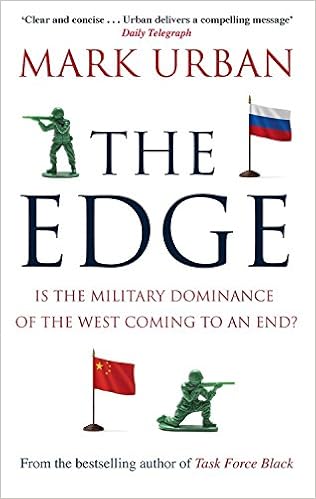
Mark Urban, diplomatic and defence editor on the BBC's
Newsnight, wrote "
The Edge: Is the Military Dominance of the West Coming to an End?" about six months ago.
Its arguments have been highlighted again by recent Brexit Referendum
discussions about the impact of the EU on war between states in Europe.
Here is an excerpt from
The Telegraph's
review.
"How many American tanks are permanently stationed in Europe? At a time when Vladimir Putin has invaded Ukraine and grabbed 10,000 square miles of his neighbour’s territory, you might be surprised to learn that the answer is none.
"With impeccable timing, the last American main battle tank left Europe shortly before the onset of Ukraine’s crisis in 2014. During the Cold War, the United States Army kept 5,000 tanks in Europe to defend its Nato allies; today, not a single one remains.
"Surely the world’s only superpower could rustle up some heavy armour pretty quickly in the event of an emergency? Don’t be so sure. General Sir Richard Shirreff, formerly Nato’s deputy supreme allied commander, thinks that America would need between six and 12 months to deploy one armoured division in Europe.
"Russia, meanwhile, has no fewer than 2,300 tanks, most of them already positioned in the European theatre.
"In The Edge, Mark Urban sounds the alarm over the scale and pace of the West’s disarmament since the collapse of the Soviet Union. Back in 1979, Urban, now the diplomatic and defence editor of Newsnight, was “for a short heady time” the “commander of one of the British Army’s 900 Chieftain tanks”.
"The era when Britain could field hundreds of the heaviest machines of war now seems impossibly distant. By way of comparison, the Army was down to 36 operational tanks for much of last summer.
"The picture at sea or in the air is little better. Year after year, every country in Nato – including America – has been paying off warships and decommissioning fighter squadrons.
"Even the forces that remain have been hollowed out by a shortage of spare parts and trained personnel. On paper, the Spanish Air Force has 39 Typhoon fighters, but only six are actually ready for combat. Of Germany’s 109 Typhoons, only 42 are in any condition to defend the country’s airspace.
"In clear and concise prose, Urban lays out the way in which an entire continent has chosen the path of wholesale disarmament. It is impossible to read this authoritative book without feeling a deep sense of alarm, indeed of wonder, that our leaders have chosen to take such breathtaking risks.
"The assumption behind the shredding of Nato’s defences is that warfare between European countries is no longer conceivable. In military jargon, “state-on-state” conflict is now irrelevant; the sole purpose of the tattered remnants of our armed forces is to fight “non-state actors” like terrorists and insurgents.
"Russia, however, was never so foolish as to make such an assumption. After the Cold War, the Kremlin was at first compelled to disarm for the simple reason that Russia’s economy had collapsed. For the last decade, however, Russia has been rearming on a huge scale – and its generals take the ruthless business of “state-on-state” conflict very seriously indeed. In Georgia in 2008 and now in Ukraine, those are precisely the kind of wars that Putin has chosen to fight."
Mark Urban paints a disturbing portrait of a "hollowed out" Western military. After the end of the Cold War, investment in classic state-on-state military systems was throttled right back. We have ageing ships and aircraft, and if they were destroyed in combat, the factories which could replace them have long since ceased production.
Urban contains his irritation at his colleagues in the media 'commentariat' - pacifist, consumed by imperialist guilt, united in a belief that interstate conflicts will never again transition to violence, at least as far as EU nations are concerned.
It's not true that pacifism has won a
bloodless victory amongst Western elites. Urban observes that there
is substantial funding for spooks and drones. And some UK investments, notably the carriers and the aircraft to fly off them, should come good after 2020 (we trust).
Absent an existential threat, the military was always going to fare badly in the tight budget wars after the Cold War. It's still possible to argue that Russia is simply sorting out historic anomalies as to where its borders should lie, and that the level of middle-eastern inspired conflicts outside of the middle-east are far removed from conventional warfare. Urban discusses these points.
Fundamentally, however, Western Europe is prosperous and disarmed. Historically states which have placed themselves in such a posture ended up as easy pickings for anyone with a military who felt sufficiently acquisitive.
It seems hard to believe that such a fundamental truth is now entirely behind us. Or that America will always save us (at potentially huge cost to itself).
---
It might be argued that we would have warning and could re-arm fairly quickly. But our weaponry is getting more and more complex and expensive with ever longer lead times.
It's been a cliche for a long time that an adversary with cheap and cheerful weapons (guns, fighter aircraft, bombers, ships, missiles) which can be produced
quickly and in bulk, and who has a
readiness to accept losses can beat a much higher-tech opponent who finds it difficult to develop, deploy and maintain its super-advanced systems .. and is loss-averse.