Showing posts with label Moral Foundations Theory. Show all posts

Sunday, December 23, 2018

Three virtual posts

Amazon link

I was going to review Richard Morgan's latest tech-thriller "Thin Air" which I enjoyed a lot. But Steven Poole of The Guardian expressed my thoughts so much more clearly. Really, it's easier just to point you to his review.

---

Like everyone else I had plenty of thoughts about the alleged Gatwick Airport drone incursion. The problem seems to be in two parts: first to identify the team launching/retrieving the drone; second to deal with the drone itself. The first part seems harder.

My idea was to run a real time video-acquisition platform (a satellite, police drones or arrays of ground-based CCTV) covering the operational radius of the hostile drone around the airport - I believe this is 2-3 miles. This would generate a great deal of video which would need to be searched very rapidly for hostile drone-team activity. Precisely what Project Maven was designed to address. Google may have gone pacifist but no reason for Qinetiq not to do the project.

But I read so many interesting ideas that it seemed pointless and redundant to add any more.

---

I was going to write about this paper with the unpromising title: "Mapping morality with a compass: Testing the theory of ‘morality-as cooperation’ with a new questionnaire" by Oliver Scott Curry, Matthew Jones Chesters and Caspar J. Van Lissa.

What they've done is rethink Jonathan Haidt's Moral Foundations Theory on the basis of evolutionary plausibility. Instead of Haidt's five dimensions, they have seven and in their field trials it all seems to make sense. Here are their seven moral dimensions. Click on image to make readable.


This is what they say in their abstract.
"Morality-as-Cooperation (MAC) is the theory that morality is a collection of biological and cultural solutions to the problems of cooperation recurrent in human social life. MAC uses game theory to identify distinct types of cooperation, and predicts that each will be considered morally relevant, and each will give rise to a distinct moral domain.

Here we test MAC’s predictions by developing a new self-report measure of morality, the Morality-as-Cooperation Questionnaire (MAC-Q), and comparing its psychometric properties to those of the Moral Foundations Questionnaire (MFQ). Over four studies, the results support the MAC-Q’s seven-factor model of morality, but not the MFQ’s five-factor model.

Thus MAC emerges as the best available compass with which to explore the moral landscape."
I have been quite enthused here by Moral Foundations Theory, while being aware that it, like the five-factor model of personality theory, floats unanchored, crying out for a deeper evolutionary embedding. So this latest work is potentially quite exciting.

Unfortunately, the paper itself is dry and technical and does not excite. I hope the research community builds on it to progress Jonathan Haidt's work - particularly on the psychological/moral differences between liberals, conservatives and libertarians. Then I will feel motivated to comment.

Saturday, May 20, 2017

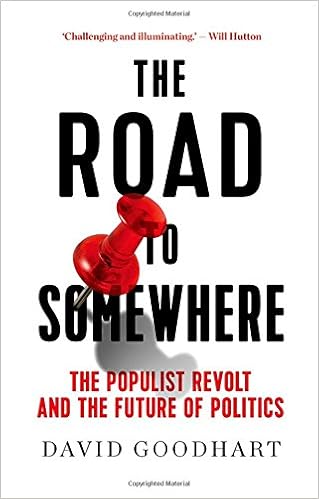
A field manual for Theresa May

Amazon link

Here's a summary:
"Several decades of greater economic and cultural openness in the West have not benefited all our citizens. Among those who have been left behind, a populist politics of culture and identity has successfully challenged the traditional politics of Left and Right, creating a new division: between the mobile ‘achieved’ identity of the people from Anywhere, and the marginalised, roots-based identity of the people from Somewhere. This schism accounts for the Brexit vote, the election of Donald Trump, the decline of the centre-left, and the rise of populism across Europe.

"David Goodhart’s compelling investigation of the new global politics reveals how the Somewhere backlash is a democratic response to the dominance of Anywhere interests, in everything from mass higher education to mass immigration."
and here's the author bio:
"David Goodhart is the founding editor of Prospect magazine and one of the most distinctive voices on British politics today. He is currently head of the Demography, Immigration and Integration Unit at the think tank Policy Exchange, and was previously director of the centre-left think tank Demos.

"His last book The British Dream: Successes and Failures of Post-War Immigration (2013) was runner-up for the Orwell Prize in 2014 and was a finalist for ‘Political Book of the Year’ in the Paddy Power Political Book Awards. David voted remain in the EU referendum and has been a mainly inactive member of the Labour Party since he was a student."
I was afraid I was going to get a typical liberal hatchet-job on Brexiteers and oiks. The familiar stuff about that section of the population notorious for being stupid, reactionary, nostalgic for times-long-gone, and so forth.

I'm pleased to say that David Goodhart's book is considerably better than that: it's well-written and quite a page-turner, despite a fair degree of repetition and the occasional splash of necessary but dry statistics.

Goodhart is open-minded, understands Jonathan Haidt's work on the differing moral foundations of liberals and conservatives, and sees how much light this sheds into his 'Anywheres' and 'Somewheres'. And although he never leaves the outer boundaries of the liberal paradigm, he does acknowledge innate differences in cognitive, personality and gender attributes (normally denied by liberals) and sees atomised individualism for the fanciful illusion it is.

Jonathan Haidt's Moral Foundations Theory: liberal vs. conservative values

Using an approach grounded in history, economics and sociology, his book details the damage that decades of neoliberalism has done to the fabric of non-elite life across the world. Goodhart's 'Anywheres' are deliberately myopic about this - they either do not care or think it's actually positive.

He makes a further very telling point: with the demise of the mass-unionised manufacturing sector, the elites are no longer afraid of the diminished and fragmented working class. They pursue their own agendas with impunity.

Those chickens finally came home to roost with Brexit, Trumpism and the generic rise of 'populism'.

Goodhart is keen to propose a political solution: essentially Blue Labour or Red Toryism .. which happens to be the position Theresa May has adopted in the current election campaign. He favours policies for strengthening technical education, controlling permanent immigration and improving integration, reinforcing the family and encouraging job/career opportunities for the 'non cognitive-elite'. You can already hear the condescending insults of the 'Anywheres' to such 'reactionary tosh'.

I don't want to get into his detailed policy prescriptions (which in any case seem to have mostly ended up in the Tory Manifesto). His general approach is what Tony Smith would probably call 'the social state', a recasting of 1950s social-democracy for the modern age.

It may well be the least bad option we currently have, even though I'm sure the British elite will put up the same contemptuous, disparaging resistance that the US elites are currently inflicting on the Trump Presidency. (It won't be so strident over here since things are not so polarised and May is a far less abrasive and aggressive politician).

Goodhart is detailed and descriptive, but with insufficient analysis as to why the extraordinarily silly ideas of the 'Anywheres' (expressed most clearly and absurdly in the 'political correctness' of 'social justice warriors') have become the entrenched ruling ideology of the age.

The answer is surely that they happen to express the entrenched interests and practices of the globalised elites themselves. With such powerful economic buttresses, coolly rational critical thinking from people like David Goodhart has hitherto found little purchase. Any influence he may yet develop will depend upon the 'populist' masses in motion - which do seem to be unsettling the elites, judging by their reactions. So although I read the book with much interest, I didn't feel in the end much of a wow-factor, as if I had suddenly understood the world in a new and more profound way.

It's more like David Goodhart, Ambassador to the 'Somewheres' from the 'Anywheres', returned to write down his considered thoughts, careful not to appear to have gone native.

Tuesday, January 17, 2017

The liberal colonisation of western elites: why?

The British Prime Minister, Theresa May, gave a defensive speech on Brexit today and was duly patronised on the talk shows by Remain liberals in their characteristic, languid upper-class drawl.

I wonder yet again why western capitalist elites seem dominated by liberals. The phenomenon is too widespread to be explained by purely national histories. From the Clintons to the Camerons to the Merkels the caste is pervasive.

I turn again to Jonathan Haidt and Moral Foundations Theory, quoting him from this previous post.
"Think of it like this: Evolution gave all human beings the same taste receptors — for sweet, sour, salt, bitter, and umami (or MSG) — but cultures then create unique cuisines, constrained by the fact that the cuisine must please those taste receptors. Moral foundations work much the same way. The six main moral taste receptors, according to MFT, are:

Care/harm: We feel compassion for those who are vulnerable or suffering.

Fairness/cheating: We constantly monitor whether people are getting what they deserve, whether things are balanced. We shun or punish cheaters.

Liberty/oppression: We resent restrictions on our choices and actions; we band together to resist bullies.

Loyalty/betrayal: We keep track of who is "us" and who is not; we enjoy tribal rituals, and we hate traitors.

Authority/subversion: We value order and hierarchy; we dislike those who undermine legitimate authority and sow chaos.

Sanctity/degradation: We have a sense that some things are elevated and pure and must be kept protected from the degradation and profanity of everyday life. (This foundation is best seen among religious conservatives, but you can find it on the left as well, particularly on issues related to environmentalism.)

"As with cuisines, societies vary a great deal in the moralities they construct out of these universal predispositions. Many traditional agricultural and herding societies rely heavily on the loyalty, authority, and sanctity  foundations to create rituals, myths, and religious institutions that bind groups together with a strong tribal consciousness.

"That can be highly effective for groups that are often attacked by neighboring rivals, but commercial societies (such as Amsterdam in the 17th century or New York City today) are far less in need of these foundations, and so make much less use of them.
Jonathan Haidt and his co-workers found that modern political tribes project differently onto these six dimensions.

Source: Wikipedia

Liberals are motivated almost entirely by the Caring dimension and Fairness, which they tend to interpret as equality of outcome. We might also observe that liberals tend to value self-control and eschew displays of physical aggression. Playing by the formal rules demands both.

Conservatives score less on Caring, stronger on Fairness which they tend to interpret as equality of opportunity, and are supportive of their own institutions via Groupishness.

Libertarians are like Mr Spock in Star Trek: cool and unemotional, detached and strongly autonomous as shown by their focus on Liberty - freedom from interference.

Modern capitalism in its full, globalist, multi-ethnic majesty is a kind of ecosystem-filter for these different moral types.

As I mentioned in the previous post about the current state of Russia, capitalism works best - as a network of anonymous economic relationships distributed over time and space - with a system of rules in place to enforce property rights and ensure transaction-integrity.

The point about rules is that they should be impersonal, not unduly biased by power and stable. In turn this requires an enforcing state which upholds associated values. These, however, can easily conflict with common psychological drives.

  • Universal abstract rights can undermine particularist family, kin and ethnic interests
  • Formal process requires the replacement of arbitrary force to resolve disputes
  • A safety net is needed to keep the masses from toppling the elites.

In MFT terms, this prioritises Fairness and Caring, and undermines the kinds of particularism expressed in the three Groupish dimensions. In theory Libertarian Freedom might suit an idealised capitalism but in reality its disengaged state-model is just ineffective and dangerously uncaring.

If these points carry a ring of truth then it's no surprise that liberals are so strongly selected for when populating elite positions, particularly within the state apparatus and organs of elite ideology like the media and social sciences.

When Groupish, 'populist' conservatives come to power, propelled by disgruntled in-groups, liberals react with fear and loathing seeing the threat to their carefully-crafted model of atomised society composed of formally-equal individuals.

They are right to do so: as discussed in the previous post, authoritarian leaders privilege their supporters while demonising others as out-groups. This can end in tears.

But .. the tenets of liberal ideology are so tendentious, so self-serving, and often so plainly delusional and damaging to the social fabric that sometimes, something just has to be done.

I think Theresa May clearly understands this, which makes her deference to the liberal establishment besieging her so depressing.

---

Is it possible to run a free, productive, dynamic, inclusive capitalist society without its natural ideology of social atomisation, blank-slate equality and hyper-individualism?

You might want to read this.

Sunday, July 17, 2016

Human Dodos

Before reading on, you should take a look at this introductory post first.

---

In the beginning, all human groups were necessarily clannish.
"We are social creatures surviving only in groups, but there is no celestial police force guarding each one of us. If we don't stick with our kin, some other group will make us toast (in the baleful meaning of that phrase)."
Trouble is, a society based on xenophobic clans doesn't scale. As Dr Fukuyama wrote:
"... state-building requires overcoming the strong bonds of kin. States were recurrently prone to being colonized by their officials’ nepotism (favouring their relations), dynasticism (seeking to have their offspring inherit their office), tribalism, and clannishness."
Typically it was a combination of war and religion which broke the power of the clans. Given gene-culture coevolution, the people who got to run countries and empires evolved different moral and psychological characteristics than those of a Genghis Khan style warlord - or of the smallfolk.

Jonathan Haidt's Moral Foundations Theory gives us the clue, as Wikipedia explains.

From the Wikipedia article

According to Haidt and his co-workers, there are six moral foundations which underlie human moral behaviour:
  1. Care: cherishing and protecting others; opposite of harm.
  2. Fairness or proportionality: rendering justice according to shared rules; opposite of cheating.
  3. Liberty: the loathing of tyranny; opposite of oppression.
  4. Loyalty or ingroup: standing with your group, family, nation; opposite of betrayal.
  5. Authority or respect: obeying tradition and legitimate authority; opposite of subversion.
  6. Sanctity or purity: abhorrence for disgusting things, foods, actions; opposite of degradation.
Not everyone exhibits moral feelings equally along all six axes. The differences are most stark in political terms: conservatives do indeed seem to feel all six moral emotions; liberals by contrast tend to feel primarily the moral senses of care and fairness, while libertarians tend to be motivated by fairness and liberty (and not to be much bothered by the other four dimensions).

Why is this? Wikipedia explains:
"Researchers postulate that the six moral foundations arose as solutions to problems common in the ancestral hunter-gatherer environment, in particular inter-tribal and intra-tribal conflict. The three foundations unique to conservatives (Loyalty, Authority, Sanctity) bind groups together for greater strength in inter-tribal competition; the other three foundations balance those tendencies with concern for individuals within the group.

"With reduced sensitivity to the groupish moral foundations, progressives tend to promote a more universalist morality. In attempting to show which moral matrix is "correct", progressives and libertarians may argue that the six moral foundations arose in a now non-existent tribal environment, and their evolution lags behind modern conditions, with larger-scale cities, countries, and supranational unions.

"Conservatives may counter that human beings remain cognitively designed for life in groups whose size does not exceed Dunbar's number, and that it is wishful thinking to expect group competition and conflict to disappear in the foreseeable future ... ."
As I observed in the introductory post,
"In the west we are so socialised into an atomised mode of life, mediated only by the nuclear family, that we see kin-groups (clans and gangs) as profoundly primitive and 'other'. But our way of life depends upon the integrity of a strong state exerting 'just power' through depersonalised laws. And a lot of conscious inhibition of retributive impulses.

"Erode that state, or let it collapse, and the only individualists left will be dead individualists."
Liberal thinking is the ideology of the privileged individualist, autonomous lifestyle choices guaranteed by the abstract power of the state. The Social Justice Warriors (the vanguard of liberalism) are the shock troops of the war for ever more benign laws, equalising people and outcomes alike.

Who could disagree? What could possibly go wrong?

In its own terms, liberalism is the progressive destination of all mankind - in this it has the same cultural dynamic as Marxism.

By definition, to be a less liberal polity is to be a more benighted one with a moral duty to be superseded.

But ...

The premise of liberalism is that, in all essentials, everyone is the same. There are no systemic human differences of personality, intelligence, motivation or even moral sense. In the liberal target-environment we never have any serious differences of opinion because everyone is so prosocial; all apparent conflicts can and will be settled by discussion in a spirit of goodwill.

Good luck with that!

A moment's cursory reflection upon the world and life experience will render you, the reader, open-mouthed in astonishment that anyone could ever believe such naive nonsense.

Because of this profoundly wrong theory of human nature, liberal thinking (so useful for running complex multi-ethnic empires when times are good) lets you down so badly when the problems start to multiply.

---

Things were really good for the dodos for a while: they grew fat in an environment of plenty with no natural predators.

The dodo is a variant of the dove. Game theory tells us that when a society composed purely of doves meets a predator, the doves are toast.

---

Human Dodos FAQs


Saturday, April 16, 2016

Matthew Parris, Brexit and MFT

For the background on Moral Foundations Theory (MFT) (Jonathan Haidt) start here.

The Conservative Right of the Tories

Matthew Parris writes a passionate opinion piece in The Times today, denouncing the Brexiteers in his own party as destroyers of the Tory Party and wreckers of Europe.
"My hunch is that there is a powerful correlation between those Tory MPs who want us to leave the EU, and those whom most people would describe as “right wing” more generally. There is no tick-box way of categorising a rightwinger: you have to look at a range of behaviours:

  • a strong and persistent interest in military matters; 

  • a marked admiration for Republican US presidents; 

  • social illiberalism (look at attitudes towards gay marriage, for example; or some of the church-fuelled reaction to what the rest of us might call progressive social policy); 

  • a certain lack of interest in the state’s role in protecting workers or the active promotion of healthy living; 

  • ... state intervention that such MPs would call “wishy-washy liberalism”. 

"All I can say is that in the Tory party you know a rightwinger when you meet one."

Compare that list of moral values with the standard conservative set I discussed yesterday.

Traditional conservatism - all boxes ticked, but moderately

---

The Liberal-Left of the Tories

I recall reading - I think in the Alan Clark Diaries - the consensus of the Thatcherite high command that for Matthew Parris, it was always going to be about Gay Rights.

And yesterday I also gave you the chart for the classic bien-pensant liberal, to which group Mr Parris is such an adornment.

This is broadly where Matthew Parris sits in the moral spectrum

---

I already wrote about Moral Foundations Theory (MFT) and Brexit here (scroll to the bottom).

Let me add that the Brexit camp combines three moral camps. As well as the traditional conservatives already mentioned - those well-represented in the conservative party - we also have:

The Libertarians

Matt Ridley, Mr Gove and the sole UKIP MP, Douglas Carswell. Here is their chart:

Libertarian Brexiteers dislike the dead hand of European oversight

The Authoritarians

The Nigel Farage wing of UKIP, and continental authoritarian nationalists like Marine Le Pen.

Brexit Authoritarians rally to a nationalist, communalist flag
---

Despite their preponderance in the media and the governing elite, there are only so many left-liberals. How to win over the others? Only fear of the unknown will do it. So Matthew Parris's column is full of fear and foreboding:
"It’s Project Fear that has turned us, and I don’t mind admitting it. Fear of the economic consequences of leaving. Distaste at many of the crew who want us out. Anxiety about the impact on our allies in Europe and worldwide if we kick this huge enterprise in European co-operation in the guts. Alarm at the rise of anger in the world. Shame that we British might come to be judged by history as vandals."
Fear has often been enough, when moral buttons are not being pushed too hard. But heaven help the 'Remain' camp if something bad (morally-speaking) happens EU-wise later this spring.

Friday, April 15, 2016

Jonathan Haidt in pictures (MFT)

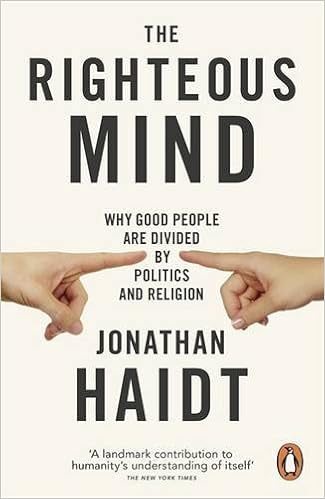
This is my third post on Jonathan Haidt's book, 'The Righteous Mind' and his Moral Foundations Theory (MFT).

If you just arrived here you should read my introductory post first.

The first five foundations of morality are described in this table on page 146 of Haidt's book.


You can click on any of the images in this post to make them larger.

The sixth foundation, Liberty/oppression, which generates emotions such as righteous anger when faced with illegitimate authority was introduced later in chapter 8.

The six moral foundations are best understood as evolved psychological adaptations which make scalable, stable societies possible - getting you past the limits of small kin-groups.

---

One of Haidt's major proposals is that different groups in the political spectrum inhabit very different moral universes, ones in which their own 'tribes' seem good and virtuous, while others seem strange and evil. In the book he discusses the liberal left (which includes social-justice warriors), the conservative right and libertarians; authoritarians are analysed in the context of Donald Trump in this article.

See this previous post for more details.

Here are some charts I put together to illustrate the different moral foundations of contemporary political positions.

The six foundations to get us started (refer to the table above)

Liberal-leftists: it's 'caring', 'oppression' and 'equality - not much else

Conservatives care about all the foundations - equality of opportunity not outcome

Libertarians: 'Don't tread on me!' with a side-order of tough-fairness

Authoritarians: Loyalty, Obedience to Authority, Sanctity: No Free Riders!

Authoritarians would include Donald Trump, the UK Independence Party's Nigel Farage and Marine Le Pen in France. Oh, and Vladimir Putin, Recep Tayyip Erdoğan, Abdel Fattah el-Sisi and Jacob Zuma amongst many, many more.

These charts are hand-wavy and suggestive, not at all definitive. For example, I've not said enough about Sanctity which is, of course, big in the States. Haidt links Sanctity with Contamination as polar opposites on an awe-disgust spectrum.

I'm not a big fan of how he treats Fairness, which seems to include in a muddled way:

  • strong elements of compassion on the political left (equality of outcome)
  • reciprocal-altruism on the right (duty) and amongst libertarians (transactional integrity)
  • a tendency towards strong retribution amongst authoritarians.

Incidentally, I observed in a post a while back that the attitude of most societies, traditional societies, towards male homosexuals is not fear ('homophobia' - a piece of politically-correct misdirection), but disgust. Educated liberals have carefully averted their minds from what male gay sexual practices actually involve, but acceptance is a lot easier if you deprecate the 'Contamination' moral foundation - as liberals and libertarians typically do.

If you want to see quantitative details on all the above, read the book and check Haidt's blog and the article I linked to in this previous post.

--

In case these charts are of any use to you - you might want to improve them - here's a link to the PowerPoint.

"Why do they hate us?"

Consider a tough gang. You, an outsider and by yourself, choose to walk up to the gang leader in front of fellow gang members and indulge yourself in a series of choice insults.

What happens to you?

Most countries have (or had) laws of lèse-majesté, which formalise penalties for disrespect to leaders. You may protest you have a right to free speech, but rights do not grow on trees. They're no more than agreements to permit certain kinds of behaviour, backed up by the powers of a State.

Absent such a State .. there are no rights.

And why would different communities agree on what should be morally permitted?

Whether it's Charlie Hebdo or that German comedian and President Erdogan, Jonathan Haidt's Moral Foundations Theory sheds some light.

Here's TheReformedMind post: "Applying Haidt’s Moral Foundations Theory to responses to “The Innocence of Muslims”:

"At a lawyers conference I attended recently, the conversation turned to “The Innocence of Muslims,” the offensive YouTube video that has sparked riots throughout the Muslim world. “Why do they react this way?” a partner at a major law firm asked, referring to Muslim societies.

"The idea that people would take such offense at an inept video, and blame American society in general rather than the individuals who produced the film, was incomprehensible to this American lawyer: “We would never react that way.” The other lawyers agreed.

This conversation came back to me this week as I read Jonathan Haidt’s very worthwhile new book, The Righteous Mind. Mostly, the book explores the different moral psychologies of American conservatives and liberals.  (Haidt argues that the differences are largely innate — “pre-wired,” he says — thus confirming Iolanthe’s famous observation that “every boy and every gal/ That’s born into the world alive/Is either a little Liberal /Or else a little Conservative!”).

"One chapter, though, compares American moral intuitions with those of other societies. America, Haidt says, has what psychologists call a WEIRD culture — Western, Educated, Industrialized, Rich, and Democratic. WEIRD cultures have a strong “ethic of autonomy”: they hold that “people are, first and foremost, autonomous individuals with wants, needs, and preferences” which, barring direct harm to others, should be fulfilled.

"In such cultures, as Jean Bethke Elshtain remarked at the annual Erasmus Lecture this week, “loyalty” principally means “being true to oneself.” The First Amendment reflects this ethic: it promotes the widest possible range of individual expression and advises offended listeners to avoid harm by turning away.

Largely through American influence, WEIRD values increasingly dominate international human rights discourse. This is ironic, because WEIRD cultures are global outliers — and America is the farthest outlier of all. Most of the world does not see autonomy as the most important value and does not privilege individual expression to the extent we do. Many cultures, Haidt says, have an “ethic of community” that sees people principally as members of collectives — families, tribes, and nations — with strong claims to loyalty. And many cultures have an “ethic of divinity,” which holds that people’s principal duty is to God, not themselves.

“In such societies,” Haidt writes, “the personal liberty of secular Western nations” — including the unrestrained freedom of expression — “looks like libertinism, hedonism, and a celebration of humanity’s baser instincts.”

Haidt’s account explains much of the incomprehension on display at that lawyers conference. To someone in a WEIRD cultural environment — and the educated upper-middle class in America, Haidt claims, is the WEIRDest environment of all — it is very hard to understand how people could feel morally outraged by an inept video that insults divinity. It seems so counter-intuitive.

"The incomprehension works the other way, too. To someone in a non-WEIRD environment, it is very hard to understand how people could feel morally justified defending sacrilegious expression. Haidt’s account suggests that the differences between these cultures are going to be extremely difficult to negotiate. Intuitions are stubborn things."

Moral parochialism is very tempting. Haidt says, "Morality binds and blinds." We're right and the other guys are wrong. He believes modern democratic states are a better solution to organising society than those that preceded them, and that their organising principle of rule-based utilitarianism is for the best ;-).

However, we should do better than blank incomprehension, let alone gratuitous provocation, when we encounter cultures which are not so WEIRD. And if people choose not to, there will be consequences - even if you personally believe on moral grounds that there shouldn't be. *

---

Further reading:

---

* Very relevant to all this is the incomprehension between honour cultures and dignity cultures. The EU is a dignity culture; the Middle-East and Turkey are honour cultures.

Thursday, April 14, 2016

Jonathan Haidt and Moral Foundations Theory

It's not often that you happen upon a book which reframes the entire way you think about humanity and large complex societies; a book with new paradigms for thinking about religion, politics and psychology.

When that book is beautifully-written and a real page turner you have this:


'The Righteous Mind' by Jonathan Haidt introduces Moral Foundations Theory - six dimensions on which our relationships with our fellow human beings and our environment can be classified. Emily Ekins and Jonathan Haidt explain the basics.
"We'd like to add another psychological tool to the toolbox: Moral Foundations Theory. One of us (Haidt) developed the theory in the early 2000s, with several other social psychologists, in order to study moral differences across cultures. Moral Foundations Theory (MFT) draws on anthropology and on evolutionary biology to identify the universal "taste buds" of the moral sense, while at the same time explaining how every society creates its own unique morality.

"Think of it like this: Evolution gave all human beings the same taste receptors — for sweet, sour, salt, bitter, and umami (or MSG) — but cultures then create unique cuisines, constrained by the fact that the cuisine must please those taste receptors. Moral foundations work much the same way. The six main moral taste receptors, according to MFT, are:
  1. Care/harm: We feel compassion for those who are vulnerable or suffering.

  2. Fairness/cheating: We constantly monitor whether people are getting what they deserve, whether things are balanced. We shun or punish cheaters.

  3. Liberty/oppression: We resent restrictions on our choices and actions; we band together to resist bullies.

  4. Loyalty/betrayal: We keep track of who is "us" and who is not; we enjoy tribal rituals, and we hate traitors.

  5. Authority/subversion: We value order and hierarchy; we dislike those who undermine legitimate authority and sow chaos.

  6. Sanctity/degradation: We have a sense that some things are elevated and pure and must be kept protected from the degradation and profanity of everyday life. (This foundation is best seen among religious conservatives, but you can find it on the left as well, particularly on issues related to environmentalism.)
"As with cuisines, societies vary a great deal in the moralities they construct out of these universal predispositions. Many traditional agricultural and herding societies rely heavily on the loyalty, authority, and sanctity  foundations to create rituals, myths, and religious institutions that bind groups together with a strong tribal consciousness.

"That can be highly effective for groups that are often attacked by neighboring rivals, but commercial societies (such as Amsterdam in the 17th century or New York City today) are far less in need of these foundations, and so make much less use of them.

"Their moral values, stories, and political institutions flow more directly from the liberty and fairness foundations — well suited to a culture based on exchange and production — and are therefore much more tolerant and open to ethnic diversity.

"In recent years, MFT has been used to study political differences between the American left and right. Republicans and Democrats in the United States are now in some ways like citizens of different countries, with different beliefs about American history, the Constitution, economics, and climate science.

"Using questionnaires, text analyses, and other methods, psychologists have found that progressives put more emphasis on the care foundation than do other groups, while social conservatives see more value in loyalty, authority, and sanctity than do other groups. Libertarians, meanwhile, put liberty far above all other moral concerns.

"Fairness, important to all groups, nonetheless has subtypes: The left values fairness more when it is presented as equality, particularly equality of outcomes between groups (which is at the heart of social justice). The right values fairness more than the left when it is presented as proportionality — a focus on merit, which includes a desire to let people fail when they are perceived to have been lazy or otherwise undeserving."

...

"Here's a graph showing how how each candidate's supporters prioritize each of the moral foundations compared with the average American.

"Bars above zero indicate that the candidate's supporters place more emphasis on that particular moral foundation compared with the average voter.

"Bars that dip down below zero do not mean those supporters do not care about the moral concern, only that they gave relatively lower ratings to it compared with the rest of our nationally representative survey sample."

Diagram edited to remove Mike Huckabee and Ben Carson

An explanation of this chart can be found at the article. Suffice it to say that it conforms to a much-replicated finding that:

  • Liberals (ie left-wingers) are motivated almost entirely by the Caring dimension (blue - concern for 'victims of oppression') and Liberty (yellow -  "everyone should be free to do as they choose, so long as they don't infringe on upon the freedom of others.")

  • Conservatives (ie right-wingers) are less 'caring', stronger on no freeloading (green - Proportionality is the desire for people to reap what they sow — for good deeds to be rewarded and bad deeds punished.") and supportive of institutions (red).

  • Libertarians, represented by no-hope candidate Rand Paul, are like Mr Spock in Star Trek: cool and unemotional, detached and strongly autonomous - as shown by the large response on yellow (Liberty - freedom from interference). 

Full disclosure: in tests, I score as Libertarian - even though I know that no such political movement can (or should) ever attain power.

---

In the UK, I think these political results would map smoothly across for the left.

Bernie Sanders presses just the same moral buttons as Jeremy Corbyn; Hillary Clinton could be any mainstream Labour Party machine politician.

Finding UK analogues for the right of the political spectrum is harder.

Trump's moral score makes him a traditional authoritarian, described in the article thus:
"Voters who still score high on authority/loyalty/sanctity and low on care — even after accounting for all the demographic variables — are significantly more likely to vote for Donald Trump. These are the true authoritarians — they value obedience while scoring low on compassion."
In the UK the only similar politician who comes to mind is Nigel Farage, who is not a serious contender for power. David Cameron is most like Jeb Bush, who scored pretty much where the average American was .. and got booted out of a highly-partisan contest for his pains.

---

Moral Foundations Theory also has something to say about Brexit.

Caring

The inflated 'Caring' universality of the left makes staying in the EU a liberal-elite reflex. The usual suspects include the BBC and The Guardian. The Bubble does indeed have a pan-European span. But the more parochial 'Caring' of the masses tends to stop at the Channel.

Fairness/Proportionality

If you're for Brexit it pays to emphasise that our natural loyalty is to the institutions of the British nation state which represents 'our tribe'. The EU violates Fairness/ Proportionality when using our resources in favour of free-riders.

There are plenty of examples, starting with Club Med.

Liberty

Here there are two narratives. The Brexit camp sees EU institutions as oppressive and pushes the Liberty button for freedom from them; the left sees the EU infrastructure (dominated by liberals) as a bastion of support in the battle against the truly oppressive elites (companies, English right-wing politicians).

Loyalty, Authority, Sanctity

Europe is not a demos for the masses: there is no sense of a 'moral us' between the English and the French, Germans, Italians and all the rest. This means that 'Remain' exerts little positive leverage on Loyalty, Authority or Sanctity although it can negatively leverage Authority, pointing out that leaving might lead to chaotically-worse institutional outcomes. Here lies Operation Fear.

---

I hope I've shown you the power of Moral Foundations Theory and I strongly recommend you read Jonathan Haidt's book. He has a blog, too.

---

Further posts on Jonathan Haidt's work: