 |
| Amazon link |
Grant Hutchison wrote this insightful review on Amazon.
"To some extent this is a companion volume to Egan's Orthogonal trilogy. In those books, he imagined what it would be like to live in a universe in which the time dimension behaved geometrically in exactly the same way as the three spatial dimensions, rather than with the hyperbolic coordinate relationship (described by special relativity) that we see in our own universe.In fact the best advice is to read Egan's website physics primer first.
In this book, Egan describes a universe in which one of the spatial dimensions has time-like properties - introducing the hyperbolic relationships of relativity into everyday spatial coordinates. (The title, Dichronauts, meaning "travellers in two times" is a reference to the fact that his story universe has two time-like dimensions (time and "axial") and two regular spatial dimensions.
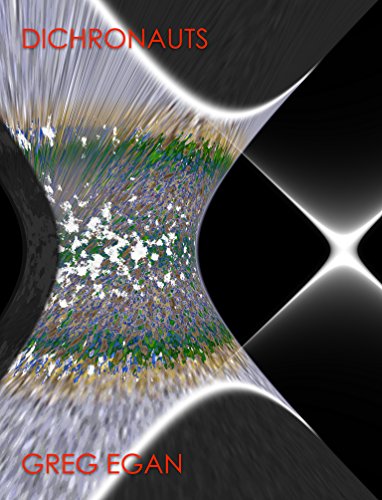
So we have a world in which simply trying to rotate an object can change its apparent shape; where it's impossible to rotate a north-facing object to face east, or an east-facing object to face north; where the stable shape for a planet is the hyperboloid depicted on the cover; where light can't travel to the north or south; and where falling over in those directions can have lethal consequences.
As with Orthogonal, Egan's aliens have one utterly alien property (in this case, we have two intelligent species that exist as commensals, one threaded through the skull of the other), but otherwise behave and speak like clever and amiable humans. And that's fine, because Egan's imagined world is strange enough without him expecting us to accommodate to an alien society, too. I'm therefore reminded of Hal Clement at his best, though Egan's characters have more humour.
The story is a quest, in which the reader finds out more about the world along with the story's characters. There are some surprises, and one toe-curling moment I certainly didn't see coming.
I knock off a star only because I think Egan's world may simply be too strange for many readers. In Orthogonal, one could amble along accepting that there was something a little odd about time without fretting about the details. In this story, almost every event is influenced by the strange spatial geometry, and if you don't find the geometry of special relativity engaging, you may be left floundering.
Egan provides some explanatory detail in the Afterword (which could productively be read first, since it contains no significant spoilers), and much more information on his website."
I read the first volume of the Orthogonal series and could't get into it. I felt that Egan was basically interested only in the setting - the physics - and was merely compelled by the fact that he was writing a novel to parachute some characters and plot in. Alternate spacetime topologies are plainly somewhat interesting, but one feels that 90% of the value is to be found on Egan's website in the relevant physics essays.
So I don't think I'll be reading Dichronauts any time soon. As another reviewer wrote:
"I really wish Grey Egan would stop writing these thought experiment alternate physics books. They're too much like hard work and are, frankly boring. He is a writer of enormous talent and needs in my opinion to concentrate on narrative and character rather than narrow concept world building."My thoughts exactly.
