Showing posts with label Atomised. Show all posts

Wednesday, April 08, 2026

The Surprising Success of Michel Houellebecq


The Surprising Success of Michel Houellebecq

Atomised (Les Particules élémentaires, 1998) remains Michel Houellebecq’s most accomplished and influential novel. A bleak anatomy of Western individualism, it brought him international recognition and fixed his reputation as the diagnostician of post-1968 malaise.

Its success was improbable: it's an austere, misanthropic book about loneliness, sex, and the bankruptcy of modern freedoms. Yet it sold in vast numbers and defined a literary generation. Yet strangely, I can never recall the arc of the labyrinthine plot.

The novel is strongly biographical. Its two half-brothers, Bruno and Michel, are transparent projections of the author himself. Bruno is the carnal self: needy, compulsive, humiliated by desire. Michel is the intellectual self: detached, analytical, pursuing transcendence through scientific abstraction. Between them, Houellebecq divides the human condition and his own into appetite and intellect, body and mind.

Their mother, Janine Ceccaldi, the self-absorbed hippie who abandons her children, mirrors Houellebecq’s real mother, Lucie Ceccaldi, who likewise left him in childhood and later retaliated in print against her portrayal. The father figures, distant and ineffectual, reproduce the author’s own experience of paternal absence.

Behind these transpositions lies a recognisable psychological pattern. Houellebecq is an introverted intuitive thinker, an INTP in typological terms, with depressive and schizoid traits. His emotional life is muted, turned right down; his imagination, hyper-rational. 

Early abandonment and social estrangement led him to retreat into intellect, turning observation into a defence against participation. Clinically, he displays the features of a depressive-schizoid personality: anhedonia, chronic withdrawal, oscillation between craving and disgust, and a sense that the world is unreal. His fiction transforms this alienation into his world-vision.

What makes this disturbance productive is that it coincides with the psychic landscape of the West itself. Houellebecq’s private detachment mirrors the collective mood of late-modernity: material comfort without purpose, sexual freedom without love, irony without belief.

Readers find in this bleak clarity not warmth but depressive recognition.


Thursday, October 24, 2019

Atomised - Marx, Houellebecq and Wilson


Perhaps every generation wakes up one day and realises that they live in a society of apparently-atomised individuals - and that the ideologies of the day celebrate that fact.

It certainly came as a revelation to me, as a child in primary school, that society wasn't actually for anything, that it seemed to have no overarching purpose. Where, then, was purpose to be found?

Religion?

The purposelessness of society and - with the decline of religion - the lack of any sense of life-meaning has conjured many things. The literature of Michel Houellebecq (cf. 'Atomised'), the activist-faddism of the new petite-bourgeoisie, the fetishism of feelings over rational analysis - these are all particularly salient today. But such epiphenomena have always been somewhere present in stabilised bourgeois societies.

This is what Marx wrote in "On The Jewish Question" (1843).
"Security is the highest social concept of civil society, the concept of police, expressing the fact that the whole of society exists only in order to guarantee to each of its members the preservation of his person, his rights, and his property. ...

The concept of security does not raise civil society above its egoism. On the contrary, security is the insurance of egoism.

None of the so-called rights of man, therefore, go beyond egoistic man, beyond man as a member of civil society – that is, an individual withdrawn into himself, into the confines of his private interests and private caprice, and separated from the community.

In the rights of man, he is far from being conceived as a species-being; on the contrary, species-life itself, society, appears as a framework external to the individuals, as a restriction of their original independence. ...

It is puzzling enough that a people which is just beginning to liberate itself, to tear down all the barriers between its various sections, and to establish a political community, that such a people solemnly proclaims (Declaration of 1791) the rights of egoistic man separated from his fellow men and from the community, and that indeed it repeats this proclamation at a moment when only the most heroic devotion can save the nation, and is therefore imperatively called for, at a moment when the sacrifice of all the interest of civil society must be the order of the day, and egoism must be punished as a crime. (Declaration of the Rights of Man, etc., of 1793)."
So here Marx is counterposing the social nature of humanity, its 'species-being', with the bourgeois concept of the autonomous individual, the social-atom coolly prepared for purely formal and transactional relationships with others.

It's a point made often. People instinctively yearn for community, remember fondly their 'war years'.

Yet Marx and the Marxists have never been clear about what a society founded upon the expression of 'species-being' would actually be like. Marx's utopian vision seemed to be that everyone would selflessly strive for the communal benefit of .. well, everyone else.

After all, it seems to works for ant colonies.

Yet our best, modern, biological understanding is that people work for and with family and friends in the everyday sense. There can be a commitment, a loyalty, to the imagined-communities of larger constellations - such as companies, countries or more abstract causes (only the latter being currently lauded).

And this seems psychologically-grounded in the belief that fellow (and presently unknown) members of or adherents to these above-Dunbar's-number 'communities' will have a propensity to enter into alliances of reciprocal altruism at need. That is to say they are already marked as 'potential friends and allies'.

But nothing gets done in practice without actual links with actual people, stable over time. And so we see that, contrary to the official story of a society of empowered individuals, all existing institutions - especially elite institutions - are composed of networks of people who typically have known each other a long time, who think similarly and who broadly trust each other. (The granularity of trust-groups is particularly fine in politics!).

Survey the media families (those familiar journalists, editors, presenters in the newspapers and television networks); the political dynasties; those families with durable military traditions; the elite universities which welcome the same names generation after generation.

Biology will out. Humanity's true species-being is a network of contending, alliance-making micro-tribes, surprisingly stable over the generations.

This is what made Robert Charles Wilson's wonderful The Affinities less a piece of social extrapolation and more a simple relabelling of what we already see around us.

The transcendence of bourgeois hypocrisy about the real nature of people and its lies about human nature are not to be found in the society of ants - unless future humans are going to be a singular clone-network (I would advise against this, citing bananas).

We are what we are and we need a mode of production which is aligned with that, absent unimagined qualitative 'changes/improvements' in human psychology. I'm still looking to total automation .. and a rocky transition to that state .. on a timescale of centuries, but not millennia.

- Adam Carlton (also published on Booksie).


Wednesday, June 21, 2017

"Atomised" by Michel Houellebecq (trs Frank Wynne)

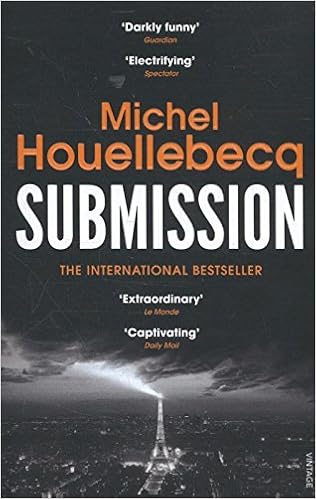
Michel Houellebecq came to prominence in the English-speaking world following "Submission", his recent novel about an Islamic politician being elected as President of France in the 2022 election.

Amazon link
"As the 2022 French Presidential election looms, two candidates emerge as favourites: Marine Le Pen of the Front National, and the charismatic Muhammed Ben Abbes of the growing Muslim Fraternity. Forming a controversial alliance with the political left to block the Front National’s alarming ascendency, Ben Abbes sweeps to power, and overnight the country is transformed. This proves to be the death knell of French secularism, as Islamic law comes into force: women are veiled, polygamy is encouraged and, for our narrator François – misanthropic, middle-aged and alienated – life is set on a new course."
I wrote about it here.

Deciding to read more Houellebecq, I settled on his 1998 novel, "Atomised", written when he was 42. I was, in truth, in two minds about ordering it: it is extremely explicit - some have used the p-word. For instance I can't reproduce the jailbait front cover here for brand-integrity reasons.

Here's part of Houellebecq's Wikipedia entry.
"Houellebecq was born in 1956 on the French island of Réunion, the son of Lucie Ceccaldi, a French doctor born in Algeria of Corsican descent, and René Thomas, a ski instructor and mountain guide. He lived in Algeria from the age of five months until 1961, with his maternal grandmother.

"His website states that his parents "lost interest in his existence pretty quickly" and at the age of six, he was sent to France to live with his paternal grandmother, a communist, while his mother left to live a hippie lifestyle in Brazil with her newly met boyfriend. His grandmother's maiden name was Houellebecq, which he took as his pen name.

"Later, he went to Lycée Henri Moissan, a high school at Meaux in the north-east of Paris, as a boarder. He then went to Lycée Chaptal in Paris to follow preparation courses in order to qualify for Grandes écoles (elite schools). He began attending the Institut National Agronomique Paris-Grignon in 1975. He started a literary review called Karamazov and wrote poetry.

"Houellebecq graduated as an agronomist in 1980, married and had a son; then he divorced, became depressed and took up writing poetry. His first poems appeared in 1985 in the magazine La Nouvelle Revue. Six years later, in 1991, he published a biographical essay of the horror writer H. P. Lovecraft, a teenage passion, with the prophetic subtitle Against the World, Against Life. 

"Rester vivant: méthode (To Stay Alive) appeared the same year, and was followed by his first collection of poetry. Meanwhile, he worked as a computer administrator in Paris, including at the French National Assembly, before he became the so-called "pop star of the single generation", gaining fame with his debut novel Extension du domaine de la lutte in 1994 (translated by Paul Hammond and published as Whatever).

"He won the 1998 Prix Novembre for his second novel Les Particules Élémentaires (translated by Frank Wynne), published in the English-speaking world as Atomised (Heinemann, UK) or The Elementary Particles (Knopf, US).

"The novel became an instant "nihilistic classic", though Michiko Kakutani described it in The New York Times as "a deeply repugnant read". The novel won Houellebecq (along with his translator, Frank Wynne) the International Dublin Literary Award in 2002."
Here is what The Guardian has to say:
"It tells the story of two half-brothers, Bruno and Michel, both children of a libertine hippy mother who had as little as possible to do with their upbringing. Houellebecq's childhood was very similar to this; the two main characters can be seen as divergent yet related elements of his own self.

"Michel Djerzinski is a diligent, brilliant scientist who gives up his job as a researcher working on decoding genomes or whatever in order "to think". As his superior puts it: "decoding DNA, pfff . . . you decode one gene, then another and another . . . it's like following a recipe. From time to time someone comes up with better equipment and they give him the Nobel Prize. It's a joke." From which you can decipher not only that Houellebecq's cynicism is sincere and well researched, but that he can be very funny indeed. (And, in passing, that the translation would appear to be first-rate.)"
Michel is a passive, anaemic character incapable of love (or any profound emotion) who lets down all who might depend upon him. But Bruno is far worse.
"Michel's half-brother, Bruno, is a more problematic individual; where Michel has virtually no sex drive at all, Bruno is obsessed, with the unfortunate twist that for long periods of his life, he doesn't get enough. He exposes himself to a girl in the class to which he teaches literature; he is sent to a mental institution (as was Houellebecq, if not for the same reason). He goes to a hippy holiday commune, the Lieu du Changement, and the vacuity of all New Age bullshit is brilliantly attacked. ("Tantric Zen, which combined vanity, mysticism, and frottage, flourished.") Bruno is the id to Michel's ego, if you want to use specious terms."
There is a lot of Bruno in the book. Many passages describe in minute detail orgies and swinger-parties. If pornographic means 'intended to arouse' this is not that. My reaction was more that given Houellebecq's searing honesty and obsessional quest for accuracy, such people and such clubs must actually exist and, moreover, Houellebecq must be very well acquainted with them.

I think I must have led a very sheltered life.

As The Guardian concludes,
"There is not too much doubt that Houellebecq is an unpleasant person. "
He is however, an astonishingly good writer. Yet still I ponder what this novel is really about. The Guardian again:
"This is a bold and unsettling portrait of a society falling apart: the rage that both left and right, the piously religious as well as the humanists, have expressed towards Houellebecq is pretty much the rage of Caliban seeing his face in the glass."
But outside the ranks of the marginalised, déclassé intellectuals which Houellebecq so brutally chronicles, has human nature really become as comprehensively atomised and dissociated as Atomised suggests? Would this even be possible? The novel sprawls and build to an unlikely conclusion but it seems most interested in the characters of the two grotesques - Bruno and Michel.

I'm with Houellebecq's mother: this is the author working off his resentment at his rubbish childhood.