Showing posts with label An Introduction to the Three Volumes of Karl Marx's Capital. Show all posts

Tuesday, November 14, 2017

Morbid phenomena of the most varied kind

There's a curious sense of a world marking time. Politics in America, the UK and Europe sounds more than usually confected. Bogus 'outrage' over "Russian intervention in elections", theatrical tub-thumping over North Korea, tedious shadow-boxing over Brexit.

It's all shallow - elite protagonists going through the motions.

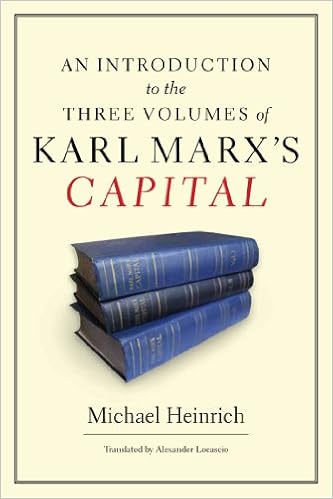
Here's an extract from that excellent essay which is Chapter 11 of Michael Heinrich's "An Introduction to the Three Volumes of Karl Marx's Capital":  State and Capital (p. 208).

PDF link

"A decisive shortcoming of the conception of the bourgeois state as an instrument in the hands of the capitalist class is that it presupposes a “ruling” class that is both unified and capable of acting, as well as a clearly defined class interest that simply needs an instrument for its implementation.

Neither assumption is self-evident. The “economic ruling class” in capitalism consists of capitalists with widely varying, even opposing interests. There is a common interest in the maintenance of the capitalist mode of production, but if the system is not threatened by a revolutionary movement, then this interest is far too general to serve as a guideline for “normal” state action. The interests that determine the state’s activity are not just sitting around waiting to be implemented, as is assumed by the instrumentalist conception. Rather, these interests must first be constituted.

All of the state’s measures are contested, whether the issue is the concrete organization of the legal system, the securing of the material conditions of accumulation, or the type and extent of welfare state benefits.

As a rule, every measure brings disadvantages for some capitalists (sometimes even for all capitalists) and advantages for others (or fewer disadvantages than for the rest). Advantages expected - but not certain - over the long term are pitted against immediate disadvantages.

The issue of what the general capitalist interest consists in, which challenges the state should react to and how - all that has to constantly be ascertained. State policies presuppose a constant ascertainment of the general interest and the measures for its implementation."
We're witnessing the terminal decay of the neoliberal ideological project amid the rising resentment of significant strata of society who are 'just not happy with the way things are going' - who yearn for vague, inchoate change.

I see genuine confusion within the elite as to optimal policy going forwards.

This seems very Gramsci:

Amazon link

“The crisis consists precisely in the fact that the old is dying and the new cannot be born; in this interregnum morbid phenomena of the most varied kind come to pass.”
It's hard to see a way out without some kind of multi-year social and economic crisis.

Thursday, May 11, 2017

This ritualisation of Marxism is getting tiresome

Another day and the Labour leadership will be asked once again whether they "agree with Marx". They will reply - again! - that there is a lot to learn from Marx, but that he was wrong about some things.

And they will be right.

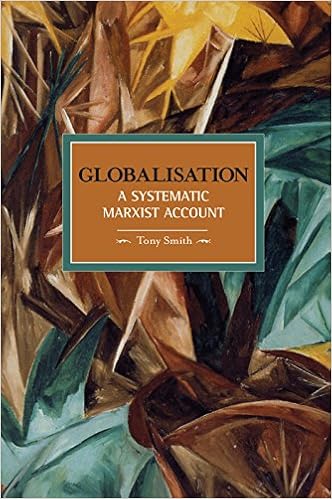
I have been reading: "Globalisation: A Systematic Marxian Account" by the excellent Tony Smith,

Amazon link

and I have read no other account of globalisation so sophisticated, profound or analytic (a detailed review here).

---

We all want some kind of roadmap, a clue as to where human civilisation is heading in the twenty first century. Smith reviews four contemporary theories:

  • Traditional social-democracy: capitalism plus a redistributive national state
  • Neoliberalism: emphasising the benign power of global markets
  • The "catalytic state": exemplified by the Chinese activist-state model
  • A putative 'democratic world-state' checking the power of global capital.


All these models assume global capitalism and seek to ameliorate its more perverse or dire effects, those currently creating the popular backlash against the dominant neoliberal ideology - so-called 'populism'.

Smith then cruelly eviscerates each of these models, giving a master-class elaboration of the Marxist approach to economics. It might help to have read Michael Heinrich's "An Introduction to the Three Volumes of Karl Marx's Capital" first.

Amazon link


Such criticism is fine: indeed, a breath of fresh air. Where Marxism fails is not so much in the analysis - who could deny that the 'structures' of society are, in any deep analysis, highly-sophisticated protocols of systematised (but malleable) human behaviour? - but in the remedy.

Describing capitalism for what it is should be ethically-neutral .. in the tradition of scientific analysis.No Marxist analysis has, for example, demonstrated that capitalism would collapse through its own inner nature through some terminal crisis.

But Marxists then add something new and extraneous: an ethical criticism.

They claim that capitalism is inherently unfair, oppressive and - dare I say it? - evil. In opposition, a communitarian solution is proposed (although the Marxist tradition was - and is - understandably sketchy on the details).

The model of future-communism is seldom subject to the level of rigorous criticism correctly bestowed on capitalism, but if it was, it would be understood to be an impossibility. It presupposes a biological human nature which does not exist.

---

There have been precisely zero attempts to integrate Marxism with current understanding of human (evolutionary) psychology, genetics or genomics. Attempts to do so are disavowed as if some category error is being proposed. Marxist blank-slatism reacts with horror to the idea that there could even be such a thing as human nature, detachable from specific and historic relations of production and exchange.

Such a lack of seriousness: the sure hallmarks of an ideology to be taken on faith.

If we learned one thing from Marx, let alone from the Stalinist experience, it's that lack of development of the productive forces is the root of all evil. Conversely, as capitalism increases those forces seemingly without limit, who can predict - yes, who? - as to how future-humanity may be able to organise itself?

In the meantime, let's just crack on and increase those productive forces, while ameliorating the consequences of their current inadequacy.*

---

* Yep, a lot of people think that. And then the arguments start 😟 ..


Thursday, September 01, 2016

Why Marxism refuses to die

Link to PDF

Michael Heinrich starts his book (above) with reasons we should still be interested in studying Marxism.
"“At the beginning of the 1990s, after the collapse of the Soviet Union, it seemed as though capitalism had ultimately and globally triumphed as an economic and social model to which there was no alternative.

“Although there had always been many on the left who did not see a desirable alternative to capitalism in Soviet “really existing socialism,” such distinctions no longer seemed important. To most people, a society beyond the capitalist market economy appeared only as an entirely unrealistic utopia. Instead of protest, accommodation and resignation reigned.

“But it was also - and in particular - the 1990s that showed that capitalism, even after its apparent “final victory,” continued to go hand in hand with processes of crisis and immiseration; and Kosovo, Afghanistan, and the first war in Iraq showed that wars in which the developed capitalist countries were not only indirectly, but indeed very directly involved, were by no means a thing of the past.

“All this was taken up in different forms by the new “counter-globalization” movement and other social movements and made the point of departure for critique. Initially, these critiques were focused on single issues and posed limited demands that remained within the framework of the system. Furthermore, the critiques often rested upon a simple black-and-white moralism.

“However, throughout the course of these conflicts, fundamental questions kept being asked: about contemporary capitalism’s mode of operation; about the connection between capitalism, the state, and war; and also about what kinds of changes are actually possible within capitalism. Leftist theory became important again.

“Every transformative practice assumes a particular understanding of that which exists. If, for example, we demand the introduction of a Tobin tax (that is, the taxation of currency transactions) as a crucial means for the “taming” of a capitalism “unleashed”, then this implies a certain theorization of the importance of financial markets, about tamed or untamed capitalism - whether or not these assumptions are made explicit.

“How contemporary capitalism functions is not an abstract, academic question.”
---

Let me continue the point with an analogy. The practitioners of feudalism conceptualised their society as three Great Estates: clergy (the First Estate), nobility (the Second Estate), and commoners (the Third Estate). A monarch, ruling by divine right, oversaw everything.

One might have observed in the interstices of society small-scale artisans employing a few people, usurers lending money, and merchants importing scarce luxuries. But these would not seem essential to the overarching 'structure' of society.

A feudal 'sociologist' might well assume the future to be like the past. The future king arbitrates between future groups of nobles; the church acts as power-broker and society's ideologist, while the commoners (peasants and artisans) work for a pittance and pay for it all. It's all sanctioned by God and how could it change - even in principle?

In actual history, the commoners lost their lands and became proletarians while the merchants, usurers and lower gentry transformed themselves into capitalists. Revolutions duly followed.

What was wrong with our feudal sociologist's theories? By being 'structuralist' they assumed the feudal order of things as axiomatic. But there are no structures, only people doing essential things in relation to each other in defined ways.

Marx talks about the forces and relations of production (and exchange).

---

Modern (bourgeois) sociologists similarly pre-suppose the forms of social organisation of capitalism. They're baked into the theories - economics being a case in point.

But if you're interested in whether capitalism is the last word on human social organisation, you can't do that. You have to step back and understand capitalism as just another form of human social behaviour. If people systematically behaved differently, capitalism would vanish like mist in the morning, as did 'communism' in the few short years following 1989.

That wouldn't happen, of course, unless there was a powerful, revolutionary fervour to do things differently: capitalism would have to fail the masses big time, and there would have to be a viable alternative to reorganise to.

For more than a century, Marxists have believed that capitalism contains in its mode of reproduction fatal and terminal contradictions, and that the socialist form of society - consciously planned by the masses - was a far superior, non-commodified mode of production.

But the empirical evidence for both these theses is hard to find. Marx may well have had the right kind of analysis (focus on human social relationships, not mythical 'structures') but was his specific analysis and vision correct?

Georg Lukács famously argued that a Marxist was someone who followed Marx's method, not someone who had to agree with all of Marx's historically-bounded results, hypotheses and suggestions.

I don't know if capitalism is 'the end of history', but I am sure it's a profound question for any human being thinking about how to make the future a better place.

Tuesday, August 30, 2016

Simple Reproduction in an Abstract Capitalist Society

Link to online PDF

Capitalism is characterised within the Marxist tradition as generalised commodity production; in Marx’s view, a correct understanding of the commodity encapsulates its fundamentals.

Key is the concept of labour power and surplus value. In the following extract from Michael Heinrich’s “An Introduction to the Three Volumes of Karl Marx’s Capital” (Chapter 5, The Capitalist Process of Production), the term ‘means of production’ relates to machinery and raw materials.
“With regard to the value of the newly produced commodities, the means of production and labour-power play completely different roles.

“The value of the means of production consumed in the creation of a commodity constitutes part of the value of the newly produced commodity. If means of production are completely used up in the process of production, then the value of these means of production is completely transferred to the newly produced mass of commodities.

“But if means of production such as tools or machines are not completely used up, then only a part of their value is transferred. If for example a particular machine has a life span of ten years, then one-tenth of its value is transferred to the mass of commodities produced within a year.  The portion of capital laid out in means of production will, under normal conditions, not change value during the production process, but a portion of its value will constitute a portion of the value of the commodities produced.

“Marx calls this portion of capital constant capital, or c for short.

“Things are different with labour-power. The value of labour-power is not all transferred to the commodities produced. The value newly generated by the “consumption” of labour-power, that is, by labour expenditure, is what is transferred to the value of the newly created commodities.
...
“How much value the worker adds to the product of labour does not depend upon the value of labour-power, but upon the extent to which the labour expended counts as value-creating, abstract labour. The difference between the newly added value and the value of labour-power is the surplus value, or s.

“Or to put it differently, the newly added value is equal to the sum of the value of labour-power and surplus value. Marx calls the portion of capital used to pay wages variable capital, or v for short. This portion of capital changes value during the production process; the workers are paid with v, but produce new value in the amount of v + s.

“The value of a mass of commodities produced within a specific period of time (a day or even a year) can therefore be expressed as:

c + v + s

Here c indicates the value of the constant capital consumed, that is, the value of the raw materials and the proportionate share of the value of tools and machines, insofar as they are used.

“The valorisation of capital results solely from its variable component. The level of valorisation can therefore be measured by relating the surplus value to the variable capital: Marx calls the quantity s/v the rate of surplus value. It is simultaneously also the measure of the exploitation of labour-power.

“The rate of surplus value is usually given as a percentage. For example, if s = 40 and v = 40, then one does not speak of a rate of surplus value of 1, but rather of a rate of surplus value of 100 percent. If s = 20 and v = 40, than the rate of surplus value amounts to 50 percent.”
---

An exercises in Marxist economics is to show how capitalism can reproduce itself. In the most basic case, we look at an idealised steady state situation, where capitalists appropriate surplus value and consume it without re-investment.

Expanded reproduction will be modelled in the next post.

The economy is divided into two departments: Department 1 is the sector which creates means of production (machines and/or raw materials); this department provides and reproduces the ‘c’ in commodity value.

Department 2 produces means of consumption:  food, shelter and all the other necessities for the survival and continuing existence of the workers and capitalists. It underpins the ‘v + s’ in commodity value.

For simple reproduction to occur, the following relation must hold*:

c2 = v1 + s1

This says that the value of the constant capital in Department 2 (means of consumption) must be equal to the variable + surplus value in Department 1.

All other levels of capital may be chosen freely to reflect the size of the economy, the amount of constant capital and labour-power employed and the degree of exploitation**. The economy will turn-over and reproduce itself provided the above relationship holds.

Here is an example spreadsheet, followed through 9 iterations. As you can see, it never changes and equivalent values (Exch) are exchanged between Department 1 and Department 2.


Link to spreadsheet

Department 1 has to buy means of consumption for its own workers and capitalists (v1 + s1) from Department 2 (it makes its own constant capital c1); Department 2 has to buy its constant capital c2 from Department 1, but can produce the necessaries of life for its own workers and capitalists (v2 + c2) itself.
Examine the first row of the spreadsheet above. Department 1 (creator of means of production) creates a value of 12 (in some units) in cycle one. This will purchase the next round of machines and raw materials in the second cycle: 3 units of value available for Department 1 and 9 for Department 2 (the creator of means of consumption).

Department 2 creates 22 units of value which supply workers and capitalists: 9 units required for Department 1 and 13 units for Department 2.

The column 'Exch' indicates the values exchanged between Departments 1 and 2. Department 1 'exports' a value of 9 to Department 2 to maintain/'depreciate' its machinery and raw materials; Department 2 'exports' a value of 9 also to keep the workers and capitalists in Department 1 in shape (5 + 4).

In a certain sense, Department 1 'exports' its surplus machine + raw material value while Department 2 'exports' its surplus necessaries of living value. The two have to match in the market place, where they share the common value of 9.

What counts is that the value created in Department 1 over and above what's needed to reproduce its own constant capital (c1 + v1 + s1 - c1 = v1 + s1) is exactly the same as the constant capital recurrently employed in Department 2 (c2). When that is the case, Department 1 finds a market for its output in Department 2 and can therefore afford to buy its necessaries of life from Department 2 (v1 + s1).

Department 2 will employ sufficient workers, at a cost of v2, to properly employ the means of production (of value c2).

The case for expanded reproduction exploits exactly the same procedure.
This proves that capitalist equilibrium (at least in this ever-so-simple model) is possible in principle; in reality capitalists make independent and non-centralised decisions so coordination cannot be as exact as in the spreadsheet. This will eventually lead us into a theory of crises.

Things get a little more complex and interesting when we consider expanded reproduction, the typical case of a capitalist economy in growth.

The subject of the next post: "Expanded Reproduction in an Abstract Capitalist Society".

---

* See 'Imperialism and the Accumulation of Capital, Bukharin 1925' for more details.

--

** 'Exploitation' is a pejorative word but should be here understood analytically. In any form of society which is economically growing, workers will receive less to spend than the value of their work-production. Otherwise, where is the infrastructure of civilisation to come from?

In the case of capitalism, that 'surplus value' is appropriated privately by the capitalist. In feudalism it was appropriated mainly by the aristocracy, and in slave societies it was directly, coercively owned by the slave's master.

In any society where humans work to society's benefit, there will be a social surplus product .. but it may not take the form of surplus value if labour is not commodified.

Who knows whether that will ever come about?

Wednesday, August 03, 2016

Communism would be like - what?

In my previous post, 'Revolution back on the agenda?', I wrote about difficulties in the Marxist concept of post-capitalist society in transition to communism.

We now know so much more about human nature, and specifically how much is genetically-determined; bureaucratisation and elite power-grabbing are endemic in human affairs.

So why doesn't this cause the collapse of 'bourgeois democracy' itself into the kind of 'big-man' kleptocracies we see in the Middle-East and Africa?

The conventional answer looks to the institutions of democracies. But institutions are not things (a reified view, in the jargon) but processes which are themselves composed through habitual and recurring human behaviour.

Bourgeois governments are quite weak and circumscribed in power. In the American case, this was explicitly by constitutional design. The bourgeois state, meanwhile, typically has few direct sources of revenue and has to tax or borrow - disproportionately from economic elites. Due to private ownership of the means of production, in a mature and advanced capitalist society the owners of capital constitute a diffuse and sprawling network of distributed economic power.

There is quite a literature, Marxist and otherwise, suggesting that except in periods of great crisis, the capitalists rather prefer a weakish government as a tool to resolve their differences of interest (plus occasional bouts of unrest from the proletariat), and a state which is not too expensive.

It has also been argued that the dominance of capitalist relations of production cannot be established in the first place without prior evolutionary selection for the kind of human who was "less prone to violence, had an affinity for work, had low time preference, and was individualistic (ie not too clannish) in several ways." Arguably this was the historic outcome of mediaeval feudalism.

In the immediate post-capitalist, post-revolutionary state, we have abolished - by definition - the capitalist class by violent expropriation, and reordered economic activity as conscious 'democratic planning'. Suddenly, those extended sources of countervailing power have all been removed.

Human nature promptly reasserts itself.

---

A personal aside. In my revolutionary youth, I read a lot of Trotsky and Lenin; I read Lukács and Korsch. I did not read much Marx except for his more philosophical works and in particular I could never get into Capital: I learned my Marxist economics from Ernest Mandel's textbook instead.


I was not the only one.

In 2012 Michael Heinrich published "An Introduction to the Three Volumes of Karl Marx's Capital" to great acclaim.


You can buy it from Amazon, but it's available free as a PDF here.

I was struck by the last chapter, (12), where the author summarises what Marx actually thought about communism - and tries to rebut some of the criticisms. It's interesting.

---

From: "An Introduction to the Three Volumes of Karl Marx's Capital" by Michael Heinrich.

Chapter 12. Communism—Society Beyond the Commodity, Money, and the State

Marx’s political aim was to overcome capitalism. A socialist or communist society (Marx and Engels used these terms interchangeably in the 1860s), in which private property in the means of production is abolished and production is therefore no longer carried out with the goal of profit maximization, was to take capitalism’s place.

Marx did not draft an extensive concept for such a society, so that even today many readers of Capital are surprised when they find out that it does not contain even a small chapter about communism. However, at various points (both in Capital as well as in earlier writings) Marx attempted to draw conclusions from his analysis of capitalism concerning general determinations of communism.

Since such conclusions depend upon the respective level of analysis, there are widely varying pronouncements that do not, however, add up to a unified conception.

There are two widespread complexes of conceptions regarding what constitutes communism in Marx’s sense. However, neither has much to do with the critique of political economy outlined in the preceding chapters.

Communism as an ideal.

Here it is assumed that communism means a society as it should be for ethical reasons: people should not exploit and oppress other people; they should not seek to gain material advantage, but rather show solidarity and helpfulness, etc. In Marx's early writings, one finds a few pronouncements that can be interpreted in this direction.

Against such a conception, it is often objected that 'humans are not as good as communism requires, that they always seek personal advantage and that communism therefore cannot function'.

On the other hand, people who are ethically or religiously motivated find a point of contact here, since Marx’s ostensible ethics seem to be strongly compatible with Christian ethics, for example.

Both sides do not consider the fact that in Capital, Marx does not criticize capitalism for moral reasons (see section 2.2). Rather, in the course of his analysis, he demonstrates that moral conceptions are socially produced (see section 4.3). It thus follows that morals only exist as the morals of a particular society, but not as a universal morality one can measure individual societies against.

Communism as the nationalisation of the means of production.

The abolition of private property in the means of production is here equated with nationalisation and state planning of the economy. Against this, the objection is raised that state planning is far too cumbersome and slow and includes a tendency toward authoritarian rule. Often, the "really existing socialism" of the Soviet Union is regarded as a more or less direct implementation of this conception of communism.

The collapse of the Soviet Union is then taken as an obvious proof for the inevitable failure of communism.

One finds demands for the nationalization of production both in the Communist Manifesto as well as Engels’s Anti-Duhring but only as a first measure and never as a characterization of communism. Rather, the means of production should pass into the hands of society and the state ultimately “dies out” (MECW, 25:268).

In the few fundamental observations concerning communism that Marx makes on the basis of the critique of political economy, two things are clear.

First, that communist society is no longer based upon exchange. Both the expenditure of labour-power in production as well as the distribution of products (first in their use as means of production and subsistence, then as the distribution of consumption goods among the individual members of society) occur in a manner consciously and methodically regulated by society - not by the market or the state. Not only capital (self-valorising value), but also the commodity and money no longer exist.

Second, Marx is not only concerned with a distribution that is quantitatively different from that under capitalism (this question of distribution was emphasized in traditional Marxism), but primarily with the emancipation from a social nexus that takes on a life of its own and imposes itself upon individuals as an anonymous compulsion.

Not only the capital relation as a specific relation of exploitation that generates bad and insecure working and living conditions for the majority of the population should be overcome; the fetishism that “attaches” to the products of labour as soon as they are produced as commodities should also be abolished.

Social emancipation, the liberation from self-produced and therefore gratuitous constraints, is only possible when the social relations that generate the various forms of fetishism have disappeared. Only then can the members of society truly regulate and organize their social affairs themselves as an “association of free men” (Capital, 1:171).

Marx is concerned with this comprehensive emancipation, and not merely with the question of distribution.

In contrast, it was a central tenet of traditional worldview Marxism and Marxism-Leninism that socialism or communism would lead to another mode of distribution that would offer individuals a foundation for other and better possibilities for development. According to this distribution-centric conception, an authoritarian welfare state that retains certain structures of the market economy can be regarded as socialism or communism.

The “really existing socialism” in Russia, Eastern Europe, and China moved exactly in this direction: the party elite occupied positions of state power and steered the economy in the direction of the greatest possible increase of material output, a somewhat egalitarian distribution of income as well as the greatest possible social security.

In the 'really existing socialist welfare state', the policies of the ruling party were not just imposed in an authoritarian manner against a political opposition striving for the reintroduction of capitalism. The majority of the population also had no actual influence; it was a more or less well taken care of but passive object of the party’s policies. Open discussion could occur only in a very limited way, if at all. The ruling “Communist” parties in the “socialist” countries also did not allow their monopoly of power to be questioned by other communist forces. Society here did not regulate the social process, the party did.

Clear-sightedly, Rosa Luxemburg criticized such tendencies early on. In her uncompleted text The Russian Revolution she writes:
"Without general elections, without unrestricted freedom of press and assembly, without a free struggle of opinion, life dies out in every public institution, becomes a mere semblance of life, in which only the bureaucracy remains as the active element. Public life gradually falls asleep, a few dozen party leaders of inexhaustible energy and boundless experience direct and rule. Among them, in reality only a dozen outstanding heads do the leading and an elite of the working class is invited from time to time to meetings where they are to applaud the speeches of the leaders, and to approve proposed resolutions unanimously—at bottom, then, a clique affair."

 (The Rosa Luxemburg Reader, Monthly Review Press, 2004, 307).
The state in 'really existing socialism', was primarily an instrument for securing the party’s rule over society. The “dying out of the state” was postponed to a distant future.

However, for Marx’s conception of communism, it is precisely this point that is of decisive importance: the state, whether bourgeois or “socialist,” constitutes an independent force standing above society that organizes (to a certain extent) and imposes (by force if necessary) a specific form of reproduction.

Against this, the “association of free men,” Marx’s characterization of communism, regulates its affairs without resort to such an external, independent force; as long as such a force exists, one cannot speak of an "association of free men".

That one can only speak of communism when not only the commodity, money, and capital have been abolished, but the state as well, does not mean that such a society would have no rules. The members of such a society would have to regulate their social life, organize production in individual workplaces, coordinate between workplaces, harmonize their different interests as producers and consumers, find ways of dealing with minority positions, and for a long time will still have to deal with different forms of gender and racial discrimination - such discrimination would not automatically disappear once capitalist exploitation ends.

The enormous effort of coordination that a communist society would have to perform, coordination that occurs today through the market, should not be underestimated in any case, nor should differences of interest and conflicts, as well as the danger of coordinating instances taking on a life of their own and becoming a state structure.

When Engels writes in Anti-Duhring that ‘‘the government of persons is replaced by the administration of things” (MECW, 25:268), this is correct, but one should also add that the administration of things also contains a potential for power that can always lead to the domination of people.

Despite all these difficulties, there is still no immediately apparent argument as to why a communist society should be impossible in principle. However, communism - if it is not to be a “crude” communism (MECW, 3:296) that merely manages scarcity - is tied to certain economic and social preconditions.

Marx emphasizes the massive development of productivity on the basis of science and technology, as well as the comprehensive development of the abilities of the workers as essential preconditions for the transition to a communist society (Capital, 1:616-21, 635, 637-38, 739; 3:958-59), even if both only occur in capitalism upon a narrow foundation, limited by the goal of profit maximization.

Two things are clear in connection with Marx’s considerations.

First, it is not sufficient for the transition to a communist society to conquer and defend state power during a weak phase of bourgeois rule, like in Russia in 1917. Without the corresponding social and economic preconditions, a socialist revolution might be successful as a project to maintain the power of a political party, but not as a project of social emancipation.

Second, a communist society requires a particular development to transform the preconditions created within capitalism. Not until “a higher phase of communist society,” where “the productive forces have also increased with the all-around development of the individual, and all the springs of co-operative wealth flow more abundantly” can “from each according to his abilities, to each according to his needs” apply (MECW, 24:87).

Even when a communist society can only be achieved with difficulty - in light of the social devastation wrought by global capitalism, by crises and unemployment in the developed countries as well as in the countries of the so-called Third World while there exists at the same time a historically unprecedented level of material wealth; in light of the destruction of the natural foundations of life caused by capitalist production, no longer occurring locally but affecting the planet as a whole (clearly visible in climate change); in light of constant wars that also emanate from or are promoted by “democratic” bourgeois states—in light of all that, there are enough good reasons to abolish capitalism and replace it with an “association of free men.”

---

Discussion

Marx's assertion that,
"moral conceptions are socially produced ... . It thus follows that morals only exist as the morals of a particular society, but not as a universal morality one can measure individual societies against."
is well-refuted blank-slatism. But it does seem needed to justify the utopian premises of super-egalitarian communism.

As far as the rest of Heinrich's piece is concerned - interesting as it is - it's more an expression of hope than logical analysis. My final thoughts linger with his observation:
"When Engels writes in Anti-Duhring that ‘‘the government of persons is replaced by the administration of things” (MECW, 25:268), this is correct, but one should also add that the administration of things also contains a potential for power that can always lead to the domination of people."
Sadly or otherwise, these are the people we've got - in all their physical and psychological diversity; ants they are not.

Let me just re-iterate my closing points from the previous post:
"Improving AI-driven automation will increase overall productivity and decrease costs for things like robotic personal assistants (just beyond the state of the art right now).

"This could eventually fund a 'basic income' which, with a mature virtual reality infrastructure, could keep the left-hand side of the bell curve quiescent for ever. They might even tell you they were already in paradise - before returning to 'Call of Duty VR'. No doubt there will be more highbrow versions extending - how far, I wonder? - up the right-hand side.

"In such a process of runaway automation, note that the former working class has in fact been expelled from the process of production. Literally, they are no longer proletarian, but a group wholly parasitic upon the automated economy.

"An analogy would be to imagine a people who inhabited such a benevolent natural environment that all their needs from the most basic (food, shelter) to the most refined were instantly and effortlessly available to hand.

"If such an AI-automation economy is the means by which 'communism' (full abundance) is to be achieved, we should be careful what we wish for.

"As well as the dysgenic dangers of relaxed selection (which we already experience in the West), I suspect that without any meaningful challenges, the population would rapidly disintegrate into chaos, anomie and violence .. unless this utopia provides for omnipresent VR capable of realising any fantasy-endeavour whatsoever.

"And it was for this that the great wheel of human history turned?"
---

Next: "On the Corbyn New Left".