Showing posts with label Alastair Reynolds. Show all posts

Friday, May 10, 2024

Notebook: Higgs, Gym, Beta-level Simulation

Amazon

Higgs field/boson popular science book

I recently read Matt Strassler's book, "Waves in an Impossible Sea" which aims to explain the Higgs field and Higgs boson to non-physicists. It's probably as good as you can expect for such a book. Strassler is a clear writer and doesn't shy away from difficult questions.

For example, he tackles the question of whether light, which travels through a vacuum, needs a (very strange, 'impossible') medium to carry the electromagnetic field. He makes a clear distinction between a medium and a field which is crucial here.

The explanation of the Higgs field "stiffening" quantum fields for particles with mass isn't perfect, but it's perhaps the best analogy available. It encouraged me to revisit the maths - I have some books which are gentler than this.

Exercise Routine

This morning at the gym I continued my aerobic workout: five minutes on the exercise bike, then the stepper, and finally, the treadmill. My goal is to improve my fitness, especially after a bad case of what was likely COVID last June. The breathlessness lingers, but I believe exercise can help. The idea is to use the gym for 15-20 minutes of high-intensity aerobic exercise, complementing my Tai Chi sword form, Tai Chi form and Heian kata (shotokan karate) practice.

With summer approaching I can move some of the latter exercises outdoors, freeing up gym time for equipment-based aerobic work.

Your very own beta-level simulation

An article in The Times recently discussed the use of large language models to create "Grief-Bots" or "Dead-bots" – terms that could use some marketing work! The concept involves feeding a large language model with information about a deceased person, including appearance, voice recordings, conversation samples, and even their style of communication. The system then essentially "reincarnates" the departed, allowing a simulated interaction with a spouse, parent, or other loved one.

One suggestion was to leave such a "beta-level simulation" (as Alastair Reynolds termed it) for your descendants. This could be an alternative to traditional ‘letters cast into the future’, which naturally lack context and specificity.

However, the question arises: what's the purpose of such a simulation? It wouldn't be an information source, as better systems exist and will continue to develop. It wouldn't be the first choice for advice either.

Perhaps it's for emotional support – someone who responds in a way that resembles a spouse, grandparent, or ancestor, acting more like a friend than a resource. Science fiction often explores this theme, sometimes with a Far-Eastern cultural context: ancestor-worship.

While I understand the concept, I suspect most people wouldn't be interested in frequent interaction with such an "archaic entity" when daily life offers so much.

Practically, leaving an operational large language model to your descendants is impossible. Technology advances rapidly, rendering the software outdated and unusable within a year.

A better solution might be to leave training data – biographies, transcripts, and other relevant information. This way, future generations could train a model using the latest software, essentially "reincarnating" you or anyone else.

Forward-thinking individuals might consider this approach for the future. Or perhaps they’ll wonder why on earth they should bother: one’s sprawling digital estate will have all the data any future AI system could ever require, whether you like it or not.

Saturday, April 20, 2024

What I'm Reading


From OpenArt

“Absolution Gap” by Alastair Reynolds: This science fiction epic throws us into a future where humanity has colonised countless planets. Reynolds crafts a vast and intricate space opera, delving into themes of technological advancement, engineered religions and an existential fight for survival against the Inhibitors. 

“Who Killed Jesus?” by John Dominic Crossan: Shifting gears completely, Crossan's book takes a historical and critical look at the life and death of Jesus of Nazareth. He dissects the various Gospel accounts, contrasting 'prophecy historicised' and 'history remembered' in the context of the political and social climate of first-century Galilee and Judea. This work would certainly be controversial amongst those with traditional religious convictions. In his conclusion, Crossan explains how reason and faith - correctly understood - cannot and should not be taken to contradict each other: historical and sacralised readings (parable expressed as history) each have their own validity.

“Fools, Frauds and Firebrands” by Roger Scruton: Renowned philosopher Roger Scruton takes aim at various intellectual movements and ideologues in this collection of essays. Scruton, a champion of conservatism, critiques figures like Jean-Paul Sartre, Michel Foucault and Slavoj Žižek,  arguing against their views on reason, morality, and society. This is a battle which will be fought forever.

“The Culture series of Iain M. Banks” by Simone Caroti: This analysis of Iain M. Banks' justly-famous science fiction series delves into the utopian society of "The Culture." Caroti explores the series' themes of post-scarcity economics, artificial intelligence, and how people spend their time within this highly advanced civilization. An interesting point of comparison might be with Reynolds' "Absolution Gap" mentioned above – how do these two fictional universes grapple with similar questions about humanity's future? Caroti's book is not so well-written, but better in content, than Paul Kincaid’s rather moralising take on the same subject (Iain M. Banks: Modern Masters of Science Fiction).

Despite their vast differences in subject matter, all these books grapple with big questions about humanity, society, and our place in the universe. Scruton and Crossan, though likely from somewhat opposing viewpoints, both engage in critical examinations of established (and orthodox) narratives. The science fiction books explore different facets of humanity's potential future, with Reynolds presenting a more dystopian outlook compared to the utopian Culture envisioned by Banks.

Wednesday, March 14, 2018

A beta-level simulation

Amazon link

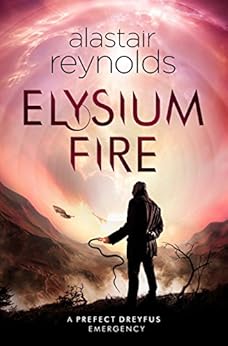
I'm just finishing "Elysium Fire" by Alastair Reynolds, his follow-up to "Aurora Rising: Previously published as The Prefect". It's a perfectly serviceable SF techno-thriller: the action moves along briskly enough.

I am most intrigued, though, by the concepts of alpha- and beta-level simulations.
"An alpha-level simulation was a digitised version of a scanned human mind, perfectly replicating its brain structure. It was fully capable of remembering past experiences, learning, adapting, and was fully self-aware.

Later technologies allowed individuals to survive the scanning process, leaving essentially two copies of the same person, one physical and one digital. ...

---

Beta-level simulations were sophisticated computer programs designed to mimic a person in appearance, mannerisms, and thought-patterns. While capable of successfully impersonating a human mind down to their most minute idiosyncrasies, they were not in fact self-aware -- they were just near-perfect imitations of life. As such, they enjoyed no legal rights or protections.

In Yellowstone society, and presumably other Demarchies, it was considered a most egregious social faux pas to allow someone to believe a beta-level simulation was in fact alpha-level."
A continuing theme is that after someone is murdered, they may well have had a shadowing beta-level simulation which the authorities then sequester for interrogation - a chance to interview the deceased victim, if you like. It's quite a shock when they're told they are dead.

The beta-levels generally don't know they're simulations and the hero, Inspector Dreyfus, is conflicted as to whether he should adopt the instrumental view ("I'm interviewing an expert system") or the intentional view ("I'm interviewing a digitalised person"). For the reader, this dilemma is never truly resolved.*

It does give me itchy fingers. I want to go back to my Lisp environment, to my 'Eliza' system and my automated theorem-prover. I'm sure I could knock up a fairly awesome beta-level myself, if we were talking, say, of a cat .. .

---

* I suppose a remote descendant of Replika will give us all beta-level simulations.

Monday, June 29, 2015

Machine intelligence will eat us - right?

Currently reading Absolution Gap (Alastair Reynolds) on the Kindle and Greg Bear's 'The Forge of God' to Clare as her book after dinner. In both cases we're dealing with implacable, malevolent machine intelligences which destroy intelligent biological life. Worry about the existential threat of future AI systems seems very trendy recently.

The Inhibitors - Alastair Reynolds' Revelation Space


Greg Bear's 'The Forge of God'

Here's the problem: to build a half-decent robot system currently needs a high-tech society of hundreds of millions of people; to build a person requires only untrained labour in a natural environment.

Everyone knows that living creatures are made up of cells (Carbon, Hydrogen, Oxygen, Nitrogen mostly). What is not commonly known is just how intricate a cell is - a tiny object capable of self-construction and self-replication. How does it do that, and how did this marvel of nano-engineering ever get started? I discussed Nick Lane's informed (and jaw-dropping) account a few weeks back.

The alleged dangers of future AIs comes about because of their faster learning, superior computational abilities and more powerful bodies. But does anyone know how to create an artificial analogue of cells with those desirable properties? I don't think so.

Absent that, our future machine overlords are going to look like a totally mechanised version of today's human societies: massive fully-automated fabs, battery factories, steel and aluminium smelters, and all the rest.

Sounds brittle and cumbersome to me - I feel sure we could take them down*.

---

* Bomb them back to the stone age and they're toast.

Wednesday, April 15, 2015

Maunsel Lock (TA7 0DH)

Nice day today so we took a picnic to Maunsel Lock, on the Bridgwater-Taunton canal. If the tsunami ever comes, the Somerset Levels will be scrubbed clear, so admire this charming Somerset construct while you can!

Maunsel Lock

The author at his favourite haunt: the Maunsel Tea Shop

Notice the pillbox machine-gun emplacement on the right; me neither ...

Jupiter
At Maunsel Lock you are in the centre of the famous Somerset Space Walk, (so famous I had not heard of it until today). The sun is located (scaled down a little) near the tea shop; the planets are marked canal-side at their appropriate distances and to scale. One pace equates to about 400,000 km (Pluto is 11 km away).

Ambling along at three miles an hour (8 paces in five seconds) I calculated we were walking at just over twice the speed of light. Light is real slow, you know, for getting around the solar system.

---

Trivia: I'm re-reading Alastair Reynolds' Chasm City. I'd forgotten how intricate and cleverly constructed this novel is. While slow to get started, it's gradually becoming somewhat addictive.

Friday, March 20, 2015

Upcoming science-fiction

1. "Slow Bullets" by Alastair Reynolds (9th June 2015).


Synopsis: "From the author of the Revelation Space series comes an interstellar adventure of war, identity, betrayal, and the preservation of civilization itself.

"A vast conflict, one that has encompassed hundreds of worlds and solar systems, appears to be finally at an end. A conscripted soldier is beginning to consider her life after the war and the family she has left behind. But for Scur—and for humanity—peace is not to be.

"On the brink of the ceasefire, Scur is captured by a renegade war criminal, and left for dead in the ruins of a bunker. She revives aboard a prisoner transport vessel. Something has gone terribly wrong with the ship.

"Passengers—combatants from both sides of the war—are waking up from hibernation far too soon. Their memories, embedded in bullets, are the only links to a world which is no longer recognizable. And Scur will be reacquainted with her old enemy, but with much higher stakes than just her own life."
2. "Poseidon's Wake" (Poseidons Children 3) by Alastair Reynolds (30 Apr 2015).


Synopsis: "Alastair Reynolds is known as an author with big ideas. From human modification, to techno-plagues, mega-crises to mega-structures, his writing has always contained big ideas. To get it out of the way, this book is no exception.

"The narrative explores the journey of several scions of the Akinya family, who figured heavily in the previous two books in the same universe. Reynolds has done something clever here – setting each novel with protagonists from a new generation of the same family allows the reader to track societal changes, see shifts in viewpoints at the macro level as well as the personal, whilst retaining reader investment in the individual.

"In this particular case, we’re given two initial strands to follow; one on Mars, the home of human ambassador’s to the human-created AI civilisation now present there, and another on Crucible – a human colony, home to the mysterious artefact ‘’The Mandala”, as well as the remnants of a tribe of uplifted, intelligent elephants. Not to give the game away, but these two locations may act as the springboard for the rest of the text, but things do quite quickly change.

"The Elephants, incidentally, are another key thread running through the series – their interactions with humanity showing the way in which we interact with other living beings unlike ourselves, even as the AI on Mars act as a mirror of how we might act when faced with a machine which is also, in some (or perhaps all) senses, alive.

"The characters are a key facet of this novel. I’ve criticised Reynolds before for having characters that seemed to act more like generators of interesting conversations than actual people; he’s done quite a lot to redress the balance here. The Akinya’s, their various friends, loves, and losses, have become quite believable over three books, and Reynolds has managed to avoid getting into the depths of technical exposition at the expense of character growth. Instead we get quite a lot of dialogue trying to build relationships around the characters, and more emotional reflection than might have been visible in earlier work. There’s still a few awkward flashes, emotional responses and intensities which didn't quite ring true, but the characters do feel a great deal like people.

"Worth noting that this is technically a standalone in a shared universe; honestly, I wouldn’t try and read it without having read the other two books first to provide some context. It looks like it would be possible, but a great deal of the text, especially the initial setup, draws on events from the other two books, and the universe of the narrative is much richer, and far less confusing, if you come to this as a conclusion to a multi-generational saga, rather than on its own.

"The text is full to bursting with answers to interesting questions, ranging from the philosophical - how do we act in a universe where we’re not alone? How might we interact with artefacts from a civilisation aeons older than our own? To the philosophical – how do we define humanity? If we were told the ultimate truth of the universe, how might we react? Who are we, really, as a species, as individuals? The narrative approaches all of these questions unflinchingly, and does its best to provide an answer to them.

"In that respect, it’s a typical Reynolds book, and if you want to explore these questions, and their answers, within a well realised sci-fi universe, with plausible characters and a decent narrative, then this book is worth picking up."
3. "Seveneves" by Neal Stephenson (21st May 2015)  [880 pages!]


Synopsis: "Stephenson’s remarkable novel is deceptively complex, a disaster story and transhumanism tale that serves as the delivery mechanism for a series of technical and sociological visions. When the moon explodes, it doesn’t take long for scientists (including Doc “Doob” Dubois, who bears no small resemblance to Neil DeGrasse Tyson) to realize that the debris will soon cause the destruction of Earth.

"The residents of the International Space Station, including roboticist Dinah MacQuarie and commander Ivy Xiao, immediately begin working with their colleagues on Earth to turn the ISS into a viable habitat for as many people as possible. The next two years are filled with heroic sacrifices, political upheavals, and disasters, most of which are only exacerbated when Earth finally succumbs to the “Hard Rain,” meteorite bombardment that last for millennia.

"The survivors—seven fertile women—are destined to repopulate the human race, and it’s only here, over halfway through the story, that Stephenson (the Baroque Cycle) really shows his hand, moving ahead 5,000 years to explore the moral and political implications of the earlier events. There’s a ton to digest, but Stephenson’s lucid prose makes it worth the while."
All three pre-ordered: two Kindle editions + "Slow Bullets" only available as paperback.


And now we turn to the 'to be read' stack. I loved "Fairyland" by Paul McAuley; some of his other stuff not so much. I'll be giving his latest a try.

4. "Something Coming Through" by Paul McAuley (19 Feb 2015)


Synopsis: "The aliens are here. And they want to help. The extraordinary new project from one of the country's most acclaimed and consistently brilliant SF novelists of the last 30 years.

"The Jackaroo have given humanity 15 worlds and the means to reach them. They're a chance to start over, but they're also littered with ruins and artifacts left by the Jackaroo's previous clients.

"Miracles that could reverse the damage caused by war, climate change, and rising sea levels. Nightmares that could for ever alter humanity - or even destroy it.

"Chloe Millar works in London, mapping changes caused by imported scraps of alien technology. When she stumbles across a pair of orphaned kids possessed by an ancient ghost, she must decide whether to help them or to hand them over to the authorities. Authorities who believe that their visions point towards a new kind of danger.

"And on one of the Jackaroo's gift-worlds, the murder of a man who has just arrived from Earth leads policeman Vic Gayle to a war between rival gangs over possession of a remote excavation site.

"Something is coming through. Something linked to the visions of Chloe's orphans, and Vic Gayle's murder investigation. Something that will challenge the limits of the Jackaroo's benevolence..."

5. The Revelation Space sequence by Alastair Reynolds

I read these over the years, but apart from the first volume (which is still pretty familiar) I've largely forgotten the sequels. Luckily they're pretty cheap on Kindle so books 2-5 are now stacked awaiting a revisit. Here are the titles in order.

  1. Revelation Space. London: Gollancz, 2000.
  2. Chasm City. London: Gollancz, 2001. 
  3. Redemption Ark. London: Gollancz, 2002..
  4. Absolution Gap. London: Gollancz, 2003.
  5. The Prefect. London: Gollancz, 2007.

Back to Conjoiners and their drive, Lighthuggers, Exordium, Hypometric weapons and the Inhibitors!

Wednesday, November 06, 2013

"On The Steel Breeze" - Alastair Reynolds

'On The Steel Breeze' is the second volume of Alastair Reynolds' planned trilogy Poseidon's Children (the first volume was the somewhat meandering and confusing 'Blue Remembered Earth' which I discussed here).

Here's part of the review from scifiempire.
‘On The Steel Breeze’ deals with three of the great-grandchildren of Eunice Akinya, the never seen but always present grand-mother of the two main protagonists Geoffrey and Sunday Akinya from Blue Remembered Earth. These three great-grandchildren are in fact clones of one called Chiku Akinya.

The clones are color coordinated, so you have Chiku Green, Chiku Yellow and Chiku Red. The latter got killed trying to save Eunice. Death must be interpreted relativistic as she still manages to influence the story. And so the two remaining clones set out to get the answers about life and everything that always seems to be a background theme of Alastair Reynolds.

Whereas ‘Blue Remembered Earth’ sometime has problems with characters performing actions that were illogical, or seemingly without purpose, this novel does it better. Each character is enriched with their own belief system and most importantly a personal politics that guide their every action and thought.
Reynolds has a talent for unobtrusively creating a densely imagined - one might even say anticipated - world. The central idea of OTSB is that the solar-system-wide computer system which runs civilization has been taken over by an AI which has itself been sequestered by signals from an alien machine intelligence. An epic battle for survival between organic and machine intelligences is about to play out, both at home and at the planet 18 light years out (called Crucible) where the alien machine systems hang out.

The novel is quite a page-turner, ending in multiple cliff-hangers. Many of the characters are less than endearing and the clone-heroines, the Chikus, are an irritating mix of smug moral superiority and inflexible pacifism. In real life this tends not to work too well, but the plot has been tweaked so that the expected bad things don't get to happen. Hmm.

Roll on volume 3.
___

Ten days ago a great storm lashed southern England and duly detached a single tile about a third the way up our steep roof, right at the front cement-edge. By some miracle the falling tile shattered on the driveway, missing the glass roof of the car port and the parked car. You'd think a quick climb up a long ladder and a bit of adhesive on a replacement tile would fix it, but what do I know?

Professional roofers have outlined a cascading sequence of problems.
  • The edge-tiles are light and experience wind-load, so the job should not be bodged. 
  • Insertion of a new tile will crack the one higher up unless that is also lifted: this domino effect extends for several metres.
  • Adjusting this set of tiles will require the removal and replacement of the edge-cement bedding, the cement verge. Actually due to age-deterioration it all needs replacement. (See here for more).
  • Scaffolding of some height is required for access. 
  • Our tree may need to be pruned back to get the scaffolding in.
Does any of this sound cheap?

The insurance assessor comes round tomorrow morning.

Friday, September 13, 2013

Same old ...

No posts for a while because little to write about. The weather has been indifferent, no-one fired any missiles and I got to read Alastair Reynolds' 'Blue Remembered Earth' (Nov 2012).

The 80 reviews on Amazon UK give it an average four stars, and this shows the opacity of averages because this is very much a novel of some highs and more lows.
  • The book is leaden to read, only just motivating a turn of the page
  • The characters, quite well done, are uniformly unattractive and irritating
  • The immersion into a well-imagined future society is brilliant
  • The plot is detailed and somewhat engaging but completely implausible
  • The ending leaves a multitude of loose-ends flapping.
But there are two follow-up volumes planned, and I did finish the 560 pages.

Dr Reynolds is a classic type of science-fiction writer: smart, well-educated scientifically, at home with advanced tech, improving in his characterisation, ponderous; Stephen Baxter is another.

"The plot," I hear you ask, "What's the plot?"

From the Amazon site (inside flap):
Earth, the 22nd century.

The Mechanism knows everything. It knows where you are. It knows what you are thinking, what you are feeling. There is no crime. You are safe.

But in a Utopia like this keeping a secret can be a deadly business.

Geoffrey and Sunday Akinya want no part of their family and its wealth. The Akinyas have ridden Africa 's economic boom into orbit and beyond. Wherever mankind has gone in the Solar system the Akinyas have profited.

But Geoffrey and Sunday have rejected it all. Geoffrey conducts research into elephant cognition in the shadow of Kilimanjaro, Sunday makes her way as an artist beyond the reach of The Mechanism on the far side of the moon.

But when their Grandmother dies she leaves behind a secret that throws Geoffrey and Sunday into a desperate race against their family. A race run beneath the unblinking eye of The Mechanism.