Showing posts with label Ebola. Show all posts

Wednesday, October 15, 2014

Any chance of stopping this Ebola thing?

An aside: you might think that an airliner must be an ideal Petri dish - recirculating air and a captive audience. It is claimed that cabin air filters have a virus removal efficiency of greater than 99.999% but that manufacturer's guarantee shouldn't be relevant as the Ebola virus currently doesn't transmit via the air, only by personal contact; so we hope for the best. (See here for an informed contrary view).

---

Ebola is not going to be stopped in Central Africa: too many cases, too-porous borders, high population densities, poor infrastructure and incompetent authorities, rubbish disease-incidence reporting. Ghana won't be safe for too much longer.

From GhanaWeb

Projection data for the likely spread of Ebola is modelled here - click on charts.

The media (the BBC is a typical offender) talks about 'irrational fears' and the shocking humiliation caused to those on the wrong-end of screening. Very comforting - God help that we should over-react or anything.

What is scary with exponentially-increasing and highly-lethal epidemics is the way things can turn from a background somebody else's problem to something directly, immediately threatening on a time frame of less than a month. (Although here in Europe we'll probably get the Ebola experience quarter one of next year via North Africa).

We're in a situation far too reminiscent of the mediaeval Black Death. The thing which we know works is draconian quarantine. People will be shot (or quarantine will fail). I expect there are contingency plans to set up quarantine zones in the UK right now - if not, someone isn't doing their job right.

The other thing which might work is a treatment or vaccine.  The development schedule is not encouraging.

---

The Wikipedia article notes:
"Ebolavirus is classified as a biosafety level 4 agent, as well as a Category A bioterrorism agent by the Centers for Disease Control and Prevention. It has the potential to be weaponized for use in biological warfare, and was investigated by the Biopreparat for such use, but might be difficult to prepare as a weapon of mass destruction because the virus becomes ineffective quickly in open air."
I have this vision of sections of the Nigerian military collecting the corpses of Ebola victims, dressing them in soldiers' uniforms and dropping them by parachute into areas know to be occupied by Boko Haram - they'd be sure to investigate. The equivalent to the mediaeval practice of catapulting the bodies of plague victims into besieged castles. Could anyone, do you think, be so stupid?

Sunday, October 12, 2014

Ebola nuclear strike: a really poor idea

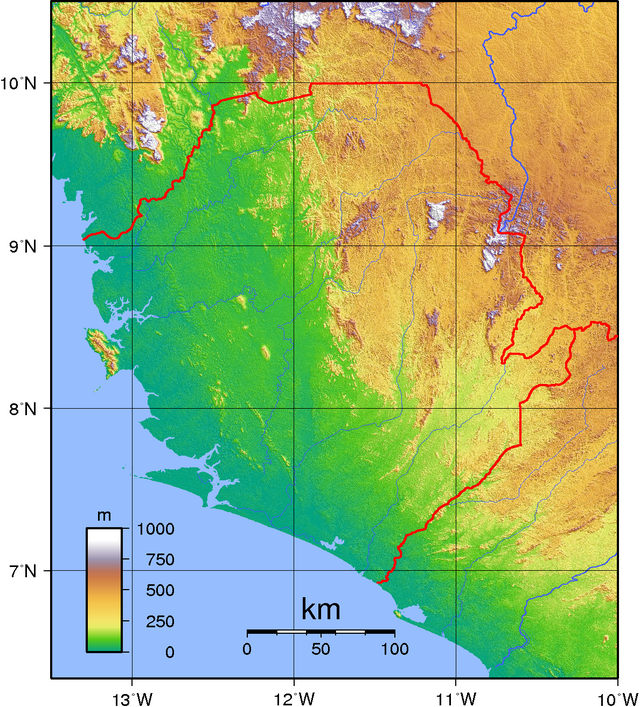
Sierra Leone topography (Wikipedia)
It might have occurred to you that rapid sterilization of the current Ebola outbreak could paradoxically be the most humane course of action in the long run. So we read statements like this *:
"Under the circumstances, we must assume the worst-case scenario,” Weurfuqd’naowe concluded at the close of his press conference.  “The evidence we have indicates that this is a new and extremely contagious strain of filoviridae Ebola, posing a health threat worse than any previously-known epidemic.  If the virus succeeds in migrating out of Guinea, it could very well sweep the planet more rapidly than any medical intervention would be possible.”

“We will monitor conditions in Guinea’s urban centers closely over the next twenty-four to thirty-six hours.  If the disease spreads as rapidly as we fear, it will be imperative that the outbreak be contained and exterminated at any cost.  Regretfully, it is the recommendation of the World Health Organization that members of the United Nations must consider the use of a nuclear weapon, if necessary, in hopes of stopping the lethal virus before it spreads across the world.”
Here are some reasons why this is a poor idea.
  1. The last thing anyone wants is kilotons of wind-borne radioactive fall-out dusting Central Africa. This might suggest using high-altitude radiation-enhanced weapons (aka neutron bombs). Unfortunately, while gamma rays are good at killing people, viruses are remarkably tough. So in practice we would need to ensure detonation of the thermonuclear fireball pretty close to ground level. Unfortunate.

  2. Sierra Leone is big - see the map above. So are Guinea and Liberia. There are big cities where the epidemic concentrates, but also networks of far-flung villages where infection ebbs and flows. Nuclear bombs are not good area-denial weapons: the fireball radius goes only as the cube root of the weapon yield. To sterilize a country the size of any of the three affected would require hundreds of high-mega-tonnage systems, with no guarantee of complete success.

  3. Not all Ebola-carriers would be vapourised in any conceivable strike. Inevitably refugees would flee into neighbouring countries: Senegal, Mali, Ivory Coast, there to become the seeds of a subsequent round of infection. There is a limit to the number of African countries which can be nuked. And in the aftermath of the sterilization event, do-gooders from a hundred countries would flock in for 'disaster relief'. Can you imagine a more effective method of then spreading Ebola around the globe?
And radiation-induced viral mutation; we so don't want to go there. No, nuking the epidemic is a poor response and I would advise policy makers not to go down that route.

---

* Check the date, by the way, on that report.

Saturday, October 11, 2014

Ebola: should you be worried?

Just to the end of October 2014
That's the trouble with exponentials: they burble around beneath the noise floor - 1, 2, 4, 8, 16 - and then sixteen iterations later it's one million, two million, four million .. and you're overwhelmed.

Scientific American writes:
"In a worst-case scenario the CDC projected that by mid-January, Sierra Leone and Liberia alone could have up to 1.4 million cases."
Yes, mid-January .. and 1.4 million.

Dr James Thompson at UCL has been posting about this, the latest being his satirical "Ebola IQ test"
"Given a viral disease which is transmitted by contact with the contaminated bodily fluids of infected dying and dead people such that each case can lead to 2 new cases, and for which there is no known cure, though rehydration and basic nursing improve outcomes somewhat, which of the following is the best strategy to save the most lives?

"In each case, chose either A or B."

(continue reading)
The NHS could presumably handle what eluded the Spanish, the prompt isolation of a carrier followed by quarantine of all contacts. But this is highly labour-intensive (dozens of at-risk contacts); it's hard to see it working if we had a hundred belatedly-identified carriers. The UK, along with the rest of Western Europe, is densely populated and highly-interconnected by busy transport links. City-wide or regional quarantine would be difficult in the extreme, even if the political will could be found for the necessary military enforcement

If the Ebola exponential wildfire sweeps across Sub-Saharan African early next year, then the UK isn't just subject to the  threat of incoming air flights. Most likely the virus will burst out to the more adjacent Middle-Eastern or North African regions, and thence into Europe by a thousand routes.

At the moment, due to West African poverty and lack of development, the virus is moving slowly. Incursions into Europe have mostly been self-inflicted through the repatriation of infected health workers. However, if incursions become more organic and massive then all those complacent "We're protected," bets are off.

Time for that trip to town, to stock up on soups, bottled water and Campingaz cartridges. A shotgun would be handy too as you hunker down.